
A school district in the Midwest specified AC4 laminate flooring for a new elementary wing, passed the abrasion test paperwork, and still ended up tearing out warped boards near the water fountain hallway eighteen months later. The AC rating measures surface wear, but it says nothing about moisture exposure, indoor air quality, or slip resistance near high-traffic entry points. That AC4 rating is only an opening line item, yet procurement teams often treat it as a complete checklist. If you are evaluating commercial grade laminate flooring for a school renovation, seven factors rank right alongside wear resistance: formaldehyde limits, slip coefficients, installation timelines against your school-year deadline, and supplier documentation that holds up during bulk procurement negotiations.
AC4 Rating Verification: Confirm the Abrasion Test, Usage Class, and Commercial Warranty Match First
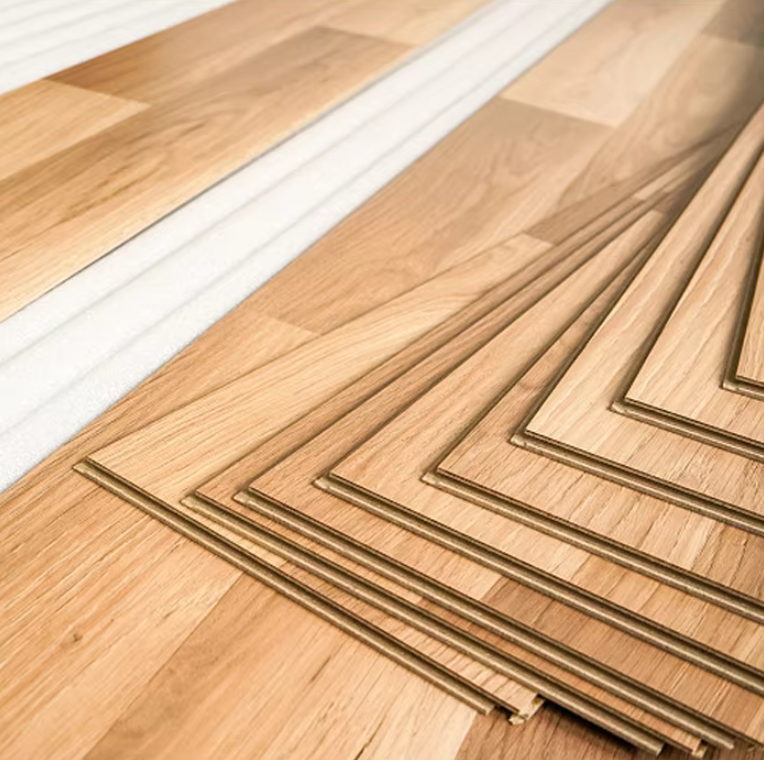
Vendors often treat an AC4 rating like a blanket guarantee, but it has strict limits. Under EN 13329, AC4 covers general to moderate commercial traffic such as small offices, boutique retail, and cafes. High-traffic zones like airports, hotel lobbies, main school corridors, or entrances without walk-off mats require AC5.
Demand the actual test numbers. Never accept a spec sheet that lists only “AC4” without supporting data. Ask for the Taber abrasion test report showing the cycle count. Quick-Step and Pergo both rate their AC4 lines at ≥4,000 cycles, which serves as the industry benchmark. The test report must list the sample model, batch number, test date, and the accredited lab that ran it. Without that paperwork, treat the rating as unverified.
Match the usage class to the AC rating. EN 13329 categorizes commercial foot traffic into distinct classes, placing AC4 into Class 32 for general commercial traffic. That rating holds up in meeting rooms and low-traffic workspaces, but it will fail prematurely in a school’s main hallway during class changes.
Check the commercial warranty wording. Commercial coverage is always separate from residential terms. Quick-Step’s AC4 line, for instance, carries a 25-year residential warranty but drops to 5 years for commercial installations, and Pergo follows the same split. Read the specific definition of wear-through. Some manufacturers pay claims only after the core material is exposed across at least 3% of the installed floor. Surface scratches and dulled finish never qualify.
For moderate-traffic school areas, verify four points: AC4 under EN 13329, a Taber rating of ≥4,000 cycles, Class 32 classification, and a 5-year commercial warranty with clear wear-through terms. If a supplier falls short on any of these, request the complete lab documentation before signing off.
Moisture Protection and Dimensional Stability
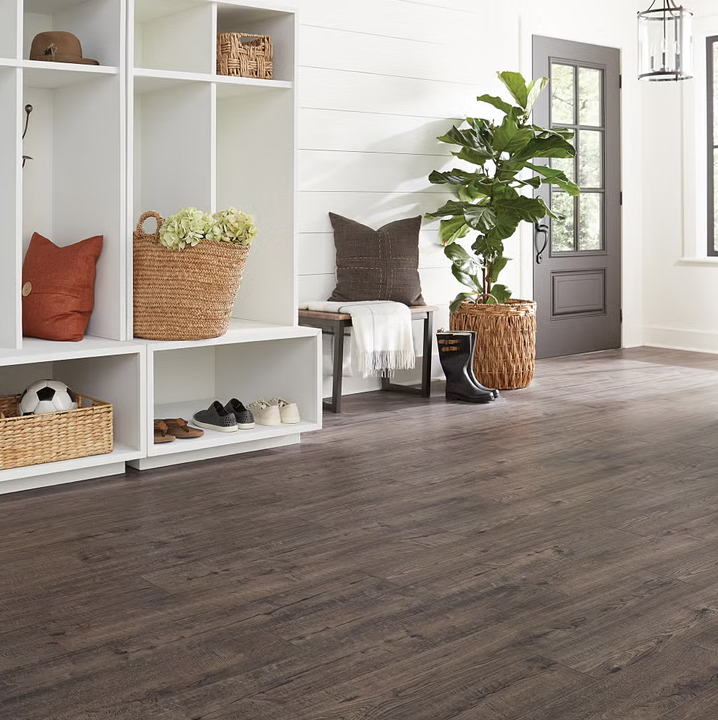
Moisture rarely ruins a floor overnight. It creeps behind baseboards and door frames until a board lifts. When reviewing school renovation flooring materials, check four zones closely: the entrance, the ground floor slab, water fountain alcoves, and restroom perimeters.
Entrance and ground-floor checks. Walk the threshold after rain. Water pooling at the door, or an entryway that fails to clear runoff, points to a grading problem before installation even starts. Test the concrete subfloor moisture level. It needs to stay under 4%; anything above 6% requires a moisture barrier or a switch to water-resistant material like tile, stone, or SPC at that entry point. Check exterior walls and crawl space perimeters for salt staining or mold, both clear signs of rising damp.
Water fountain zones. Inspect supply lines, valves, and drip pans under every fountain and water dispenser. Run a 24-hour static leak test with the unit turned off, checking for water rings, swelling, or discolored seams. Request the 24-hour water absorption thickness swell report: European benchmarks sit near ≤18%, solid commercial laminate flooring high traffic areas products land closer to ≤8%, and premium waterproof lines reach ≤3%.
Restroom perimeters. Check flood test results: a minimum of 2-3cm standing water, preferably 3-5cm, held for 48 hours. A passing result shows no visible leaks and a water level drop under 2mm; anything beyond that fails. Inspect adjoining walls and nearby flooring for swelling or dark staining, since moisture problems often show up outside the restroom first.
Dimensional stability for classroom flooring durability. For SPC subfloors near wet zones, verify these specs: length change ≤0.15%, width change ≤0.10%, thickness change ≤0.10%, and warping ≤0.5mm/m. Keep photo records of all subfloor moisture readings and flood test water levels. You will need that documentation if a warranty dispute arises later.
Formaldehyde and VOC Emissions
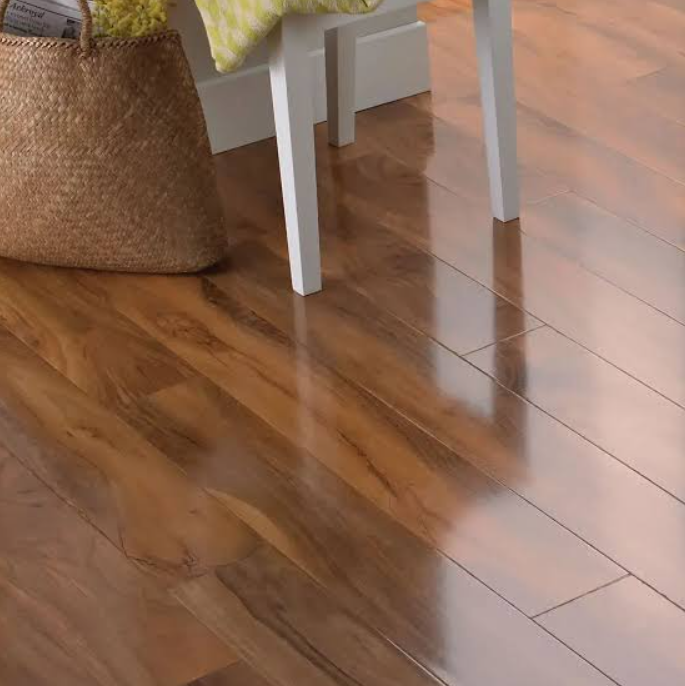
When a supplier hands you an “E0 substrate” certificate, you learn almost nothing about the finished product sitting in a classroom. That certificate covers raw core material alone. It leaves out the decorative paper, bonding adhesives, edge-sealing glue, surface coatings, backing material, hardware, and any raw edges exposed during cutting and installation. Any of these layers can push emissions well beyond the substrate report. Demand documentation naming the test subject as a “finished product,” “assembled component,” or “furniture piece.”
China’s Formaldehyde Classification Limits
Under GB/T 39600-2021, man-made board emission tiers break down as:
– E1: ≤0.124 mg/m³
– E0: ≤0.050 mg/m³
– ENF: ≤0.025 mg/m³
ENF caps emissions at half the E0 ceiling. For educational facility flooring standards, push suppliers toward ENF on the panel itself, then request a separate furniture-level VOC report.
Test Method Details Matter
Climate chamber testing under GB/T 39600-2021 must state sample dimensions, temperature, humidity, air exchange rate, equilibrium time, and result units. Watch for specifications that mix desiccator method figures (E0 ≤0.7 mg/L) alongside chamber results; these methods run under different conditions, use different units, and cannot be compared.
Finished furniture gets tested separately under GB/T 38794-2020. Check that the report header, sample name, model number, batch, and specifications match the shipment arriving on site.
VOC Is Not Formaldehyde
E0 and ENF ratings address formaldehyde alone. Benzene, toluene, xylene, and TVOC require independent testing. Standard office furniture VOC benchmarks often cite TVOC ≤694 µg/m²·h and formaldehyde ≤85.1 µg/m²·h. These are release-rate units, separate from chamber mg/m³ figures.
Contract Language Worth Adding
-
Require test reports on complete assembled furniture samples
-
Mandate combined test results for formaldehyde, benzene, toluene, xylene, and TVOC
-
Specify the standard, method, units, chamber conditions, edge-sealing status, and test date
-
Require batch testing whenever suppliers or adhesives change
-
Evaluate raw panels, site-cut edges, and finished furniture separately
Slip Resistance and Fire Safety: AC4 Abrasion Rating Cannot Replace Campus Safety Standards
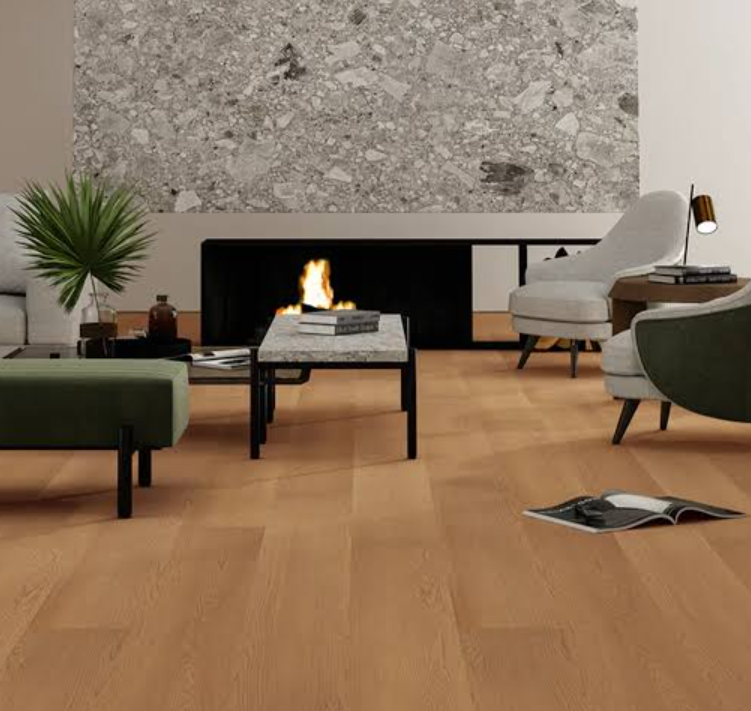
An AC4 abrasion rating tells you nothing about how slick a floor gets during a wet recess or how it behaves in a fire. The EN 13329 Taber test only measures surface wear under dry, rolling-wheel conditions. It does not evaluate wet friction, slip coefficients, flame spread, smoke density, or dripping particles. Treating AC4 as a blanket safety certification causes serious problems for procurement teams down the road.
Slip resistance needs its own sign-off. JGJ/T 331-2014 divides floor slip safety into four tiers: low, medium, medium-high, and high. Outdoor surfaces, wet indoor floors, ramps, and stairs all require separate slip-value testing. Children’s facilities and wet-prone areas sit one safety grade above baseline. An AC4 laminate rated for EN 13329 Class 32 works for general classroom traffic, but that rating says nothing about how the floor performs near entrances or cafeterias when wet.
Sports surfaces carry hard numbers. GB 36246-2018 sets mandatory baselines for school athletic areas. Track and field surfaces require a wet BPN (at 20°C) of at least 47, while courts and activity areas need a dry slip value between 80 and 110. Flame-retardant performance must reach Grade I, with an exception only for acrylic coatings on professional competition courts.
Fire performance follows a separate standard. GB 50222 and GB 50016 govern combustion behavior for interior finish materials in schools. Procurement specifications must state the exact combustion class, smoke generation limits, and dripping-particle criteria alongside any wear rating.
Four Evidence Categories to Demand at Procurement
-
Wear: AC4 test report citing EN 13329 (or an equivalent national standard), cycle count, and the matching product model
-
Slip: dry and wet friction test results for corridors, stairs, entrances, restrooms, and cafeterias, rather than an unverified AC4 label
-
Fire: GB 8624 combustion performance report covering the substrate, surface layer, adhesive, and full construction assembly
-
Campus-specific: GB 36246-2018 verification for sports surfaces, including wet BPN, dry slip values, and flame-retardant grade
A bid clause reading “flooring wear rating no lower than AC4” only locks in durability. Include separate clauses specifying the required slip grade or friction coefficient by zone, wet BPN values, combustion class, and on-site re-testing rights. Cross-check the product name, thickness, layer structure, and batch number on every report against the materials delivered to the site.
AC4 ratings evaluate surface wear, slip ratings assess fall hazards, and fire ratings measure combustion and smoke development during an emergency. Each standard addresses a distinct safety requirement, and none substitutes for the others.
Impact, Indentation, and Noise
A desk leg sitting still for a semester does more damage than a thousand footsteps. Permanent indentation, caster wheel fatigue, and impact noise rarely show up on a standard AC4 abrasion class laminate spec sheet, yet they decide whether classroom flooring survives five years of daily furniture movement.
Indentation and caster testing. Under ISO 24343-1, high-durability products should maintain an average residual indentation of ≤0.10 mm. For caster wheels, ISO 4918 and ISO 10582 apply roughly 196 lb (89 kg) of load and require 25,000 cycles without delamination—meaning no visible damage, open seams, or cracking. Test samples must include at least one short-edge seam, since that joint area fails first in real classrooms.
Run realistic combined loads. Request static load tests using actual desk and chair glides, recording indentation recovery at 24 hours and 7 days. Add chair-drag simulations near seams and wall edges, then follow impact tests (using a steel ball or standard impactor to simulate dropped backpacks or chairs) with a caster cycle test. Testing only a fresh floor misses how damage compounds over time.
Glide specs matter. Choose large-contact, flat-bottom, rounded glides over high-crown hard casters, which concentrate weight and accelerate indentation.
Noise Performance
For laminate flooring in high-traffic spaces above classrooms, ANSI/ASA S12.60-2010 sets minimum baselines at IIC 45 and AIIC 40, thresholds that many standard floors fail to meet. Gyms and dance rooms require IIC 70 and AIIC 65, which call for sprung or floating systems instead. Always demand impact sound reports for the combined floor and underlayment assembly rather than standalone pad data, since a 1–2 mm acoustic layer changes results significantly.
Installation Timelines and Maintenance Costs
Flooring budgets usually blow up because project teams fail to calculate the full bill before warranty claims start arriving. A realistic budget accounts for six distinct stages: initial installation, pre-opening rush labor, routine upkeep, a local repair reserve, periodic renewal, and teardown. Over the life of a school building, expenses typically split into 46% construction, 39% operations, and 15% maintenance and replacement. In one 25-year case study, total lifecycle costs reached 114.02 billion Indonesian rupiah. That cost split alone shows why bulk procurement decisions for laminate flooring must look beyond the initial purchase price.
Maintenance Budgets by Asset Value
University facility managers generally budget 2–3% of replacement value each year for routine maintenance. For a $50 million, 100,000-square-foot building, that equates to $1–1.5 million every year, or $10–15 per square foot. Local repair reserves for activity surfaces and athletic fields take another 1–3% of the installed price annually, alongside a separate 10–15% contingency fund drawn from the yearly maintenance budget. For example, a $40,000 installed surface demands $400–1,200 annually for routine upkeep, tracking toward the top of that bracket if the site handles heavy foot traffic or complex drainage.
Counting Backward From Day One
Standard commercial flooring installations take 4–6 weeks on-site, matching the timeline needed for full-size artificial turf fields. Working backward from opening day, contracts, material specifications, and factory production runs need to be settled 8–12 weeks ahead of time. Materials should land on-site 6 weeks out, allowing crews to finish the main installation with 2 weeks to spare. The final week covers testing, cleanup, defect corrections, and handover. Any installation tied into the subgrade, site drainage, fire systems, or custom fabrication also requires built-in weather and inspection buffers to keep small fixes from delaying the opening.
Field-Type Cost Benchmarks
Installing a full-size artificial turf field runs $500,000–1,200,000, with $10,000–25,000 in annual upkeep for fiber brushing, infill leveling, and patch repairs. One school district managed to hold annual field maintenance to $2,000–2,500. For natural grass, maintaining two acres costs $12,400–13,000 per year. An 85,000-square-foot natural field costs $50,000–600,000 to build compared to under $400,000 to roughly $1 million for turf, though natural grass frequently proves cheaper across its full operating lifespan.
Repair Cycles and Bid Line Items
Waterproofing and flooring surfaces require professional inspection and spot repairs on a 6–10 year cycle. Playground equipment requires small-part replacements every 3–5 years, followed by complete redesigns every 15–20 years. Building-wide repairs hit their first major peak around year 20, with a second wave arriving near year 30.
Require contractors to price these items directly into their bids: hard dates for project start, delivery, completion, acceptance, and pre-opening buffer days; component-by-component warranty boundaries; inspection frequencies and labor hours; unit repair pricing with minimum callout rates; spare-part lead times; and 10-, 15-, and 25-year cumulative cost projections alongside the base bid price.
Bulk Procurement and Supplier Qualification
Low prices win bids, but mismatched paperwork sinks projects after contracts are signed. Before comparing final bids on bulk laminate flooring, put suppliers through a pass/fail screen on legal identity, certification scope, and document consistency. A low quote never offsets a compliance failure.
Check entity consistency first. The quoting company, contract signatory, payment account, and actual manufacturer name must all match. If a trading company submitted the bid, demand manufacturer authorization and a clear statement of liability between both parties.
Verify certification scope. ISO 9001, ISO 14001, and product-specific certificates need valid dates, a confirmed holder, and a scope covering the product you are buying. A certificate for an unrelated product line is a red flag.
Cross-check batch documents. Specification sheets, TDS, SDS, COA, test reports, and packing lists must match on product name, model, grade, batch number, and quantity. A COA without a listed test method, batch number, or issuing signature shows weak traceability.
Project Experience Scoring
Request at least three comparable projects from the past three years, each covering 50–100% of your expected order volume. Weight the evaluation:
-
Similar product experience: 25%
-
Comparable batch delivery experience: 25%
-
Similar destination/regulatory experience: 15%
-
On-time delivery record: 15%
-
Repeat orders or long-term contracts: 10%
-
Quality complaints and corrective actions: 10%
Brochures citing “well-known clients” count for nothing without verifiable project records.
School AC4 Laminate Flooring Procurement Checklist: Shortlist Suppliers in 30 Minutes
Thirty minutes sounds tight for a school renovation decision worth six figures, but a scored checklist makes it workable. Procurement teams that bring a pre-built scorecard into supplier meetings cut their review time while keeping evaluation standards strict.
Sample Panel Test (On-Site, 10 Minutes)
Request at least one full-size sample board with matching locking mechanisms from every bidder, then run five checks on the spot:
-
Visual scan: Check for bulging, cracking, delamination, chipped edges, or visible color mismatch.
-
Dimension check: Measure length and width with a tape measure and thickness with calipers, then verify them against the lab report tolerance.
-
Click-lock assembly: Snap 3–5 panels together to check for smooth engagement, tight seams, and flush edges without lift.
-
Water-drop screening: Place water on the core edge and backside. Rapid swelling or layer separation is an instant failure, though this spot check does not replace a standard lab swell test.
-
Stain and impact check: Mark the surface with a water-based pen, coffee, or iodine, then wipe clean. Inspect edges and corners for damage resistance.
Quote Breakdown Requirement
Reject any quote that bundles everything into one lump sum. Require line-item pricing for flooring, waste allowance, trim and accessories, transport, labor, baseboards, edge strips, tax, and warranty, plus a stated loss rate (budget 3–5% before adjusting for irregular rooms).
Scoring Table
|
Category |
Weight |
|---|---|
|
Report-to-product consistency |
30 |
|
Formaldehyde/environmental documentation |
20 |
|
AC4 wear rating, substrate, and locking performance |
20 |
|
School project history and delivery capacity |
15 |
|
Sample appearance and assembly result |
10 |
|
Quote completeness and after-sales response |
5 |
Shortlist threshold: 80 points. Eliminate any bidder automatically if their quoted model does not match the test report, if they cannot provide a physical sample, or if they refuse random batch inspection.
Conclusion
AC4 abrasion class laminate gets you in the door, but it will not carry a project through final inspection on its own. Schools avoid costly rework when they treat AC4 as a baseline and pair it with verified moisture resistance near entryways and bathrooms, confirmed E0/E1 formaldehyde compliance instead of “eco substrate” marketing claims, and slip resistance ratings that meet classroom safety codes.
AC4 abrasion class laminate flooring for school projects is a procurement decision. Approaching it that way prevents the 8-15% budget overrun that comes from discovering gaps during handover week. Suppliers with integrated OEM and ODM production, such as a professional laminate and vinyl flooring manufacturer, show how factory-level quality control supports this kind of consistency.
Before you issue a single PO, run shortlisted suppliers against the seven-point acceptance checklist above. Thirty minutes now beats a semester of squeaking floors and warranty disputes later. For background on the manufacturer behind these specifications, see our company overview.