
If you’re staring at a quote from your HDF supplier right now, wondering whether to sign or sit tight, you’re not alone. Wood fiber costs swung hard over the past year, resin prices keep creeping up, and ocean freight has thrown another wrench into landed costs. One wrong move and your laminate flooring manufacturing cost could blow past budget before Q3 even starts.
We break down the real high density fiberboard price drivers—energy costs in Europe, capacity shifts in Southeast Asia, and tariff noise—to help you decide whether to lock pricing now or wait. You will get a practical decision framework ready for your next purchasing call.
HDF Board Price Trend: Where the Market Stands After the Last 6–12 Months
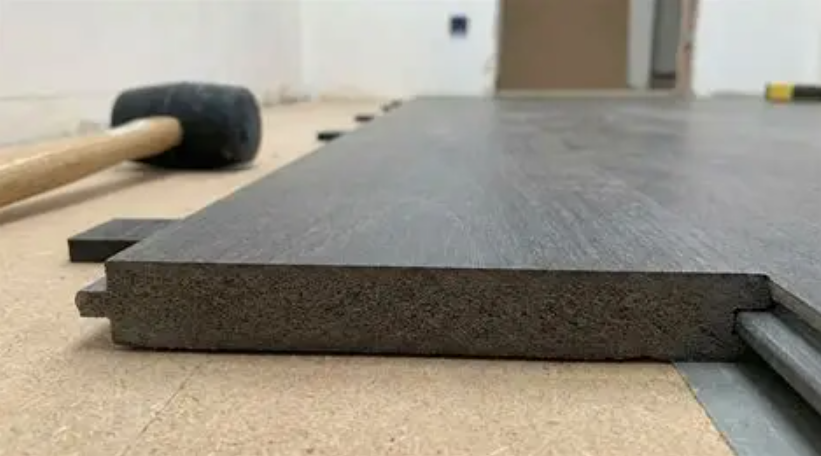
European 3 mm HDF currently sits near US$470/m³, while Asia FOB rates trade around US$388/m³. Both are up 13.3–13.5% year over year. This sustained climb indicates that the HDF price forecast remains firm.
If you are budgeting for import or export procurement, plan around US$390–523/m³ FOB across Asia and Europe for MDF and HDF panels. Melamine-faced boards add another US$90–130/m³ on top. Treat that as your working range for the next quarter.
India’s numbers break it down by thickness:
-
3 mm plain HDF: ₹18–30/sq ft (≈₹575–960 per 8×4 sheet)
-
6 mm: ₹35–45/sq ft
-
8 mm: ₹40–55/sq ft
-
12 mm: ₹55–75/sq ft
Metro markets run 10–15% higher than tier-2 and tier-3 cities, and regional spreads can hit 25%. Moisture-resistant 12 mm HDF climbs to around ₹75/sq ft, while branded fire-retardant panels like Action TESA Boilo’s 18 mm line command ₹165–195/sq ft.
On the finished-goods side, laminate flooring prices reflect that same strength. AC3 runs ₹65–90/sq ft, AC4 hits ₹85–110/sq ft, and AC5 climbs to ₹100–140/sq ft. Embossed and EIR flooring tops out near ₹150/sq ft.
There is no evidence of a broad correction in the HDF core price over the next 6–12 months. With the flooring outlook staying stable to firm, factor these baselines directly into your next purchase order.
HDF Raw Material Price Drivers: Wood Fiber, Resin, Energy, and Certification
Four line items decide whether your next HDF quote goes up or stays put. Each moves independently and deserves its own line in your cost model instead of a vague “raw materials” bucket.
Wood fiber carries the biggest share, typically 35–42% of total HDF production cost. Pulpwood and sawmill-residue prices, species mix, fiber moisture, and refining losses all shift this number. A 10% jump in delivered fiber cost raises total manufacturing cost by 3.5–4.2% before supplier margin or freight. Always ask for pricing per oven-dry tonne rather than wet tonne, since nominal wet pricing hides real cost changes.
Resin and adhesive run 18–24% of production cost. UF resin benchmarks at €0.80–€1.20/kg in Europe, while polyurethane sits near €2.50/kg. German UF resin hit $361/tonne in June 2025, and France spiked to $580/tonne in March 2025. A 10% move in resin price shifts total cost by 1.8–2.4%.
Energy accounts for 12–18% of cost, covering fiber drying, hot pressing, and electricity for refining. Elevated European gas prices pushed up UF-resin costs in Austria and Germany through 2025. A 10% energy swing adds 1.2–1.8% to total cost.
Certification (FSC/PEFC) adds 5–15% at the mill gate, narrowing to 3–8% at distribution. Always require suppliers to disclose whether quotes reflect certified, controlled-wood, or mixed-credit material, which affects your flooring raw material shortage exposure and procurement risk, one of several variables buyers must check before ordering.
Regional HDF Supply Outlook: China, Europe, and Southeast Asia
Three regions control your sourcing options, and each plays a different game.
China runs the table on volume. Fiberboard capacity reached 40.0–40.4 million m³/year in 2025 across 220–244 production lines. Ten provinces hold 89% of that total, led by Shandong at 17.1% and Jiangsu at 13.3%. That concentration, paired with integrated furniture and flooring supply chains, makes China the standard choice for bulk commodity HDF. Verify CARB/EPA TSCA Title VI, E1/E0 formaldehyde ratings, and FSC certifications before committing.
Europe competes on tight specifications. The region accounts for roughly 20% of global HDF demand. Germany leads supply at $255.18 million LTM value (an 18.88% share), followed by France at $141.64 million. Lithuania grew by $10.67 million to reach $28.53 million. You will pay more for wood fiber and energy here, but you take on far less compliance risk if you need FSC-certified, low-emission panels.
Southeast Asia is your diversification play. Vietnam’s VRG Dongwha Binh Phuoc project expanded from 600,000 m³/year to 1.3 million m³/year, showing how quickly regional capacity is building out with Chinese-supplied production lines.
|
Region |
Best Use Case |
Main Risk |
|---|---|---|
|
China |
Volume, commodity pricing |
Freight, documentation gaps |
|
Europe |
Certified, premium grades |
Energy-driven cost |
|
Southeast Asia |
Regional diversification |
Thin supplier verification |
Use China to benchmark pricing, Europe for regulated grades, and Southeast Asia to hedge freight exposure.
Freight, Tariffs, and Landed Cost: Why FOB Prices May Mislead Buyers
The FOB quote in your inbox is only a starting number.
Landed cost = FOB Value + International Freight + Insurance + Duties/Tariffs + Government Fees + Brokerage + Port Charges + Drayage + Domestic Delivery.
Take a 5,000-unit shipment from Ningbo to Los Angeles. A $6.18 FOB unit price climbs to $7.18 landed, a 16% jump, once you add ocean freight, marine insurance, ISF filing, customs brokerage, and an 8% import duty. Raise that duty to 25%, and the landed cost reaches $7.60, about 23% above FOB.
On 10,000 units at $2.00 FOB, freight, a 10% duty, processing fees, drayage, and domestic delivery push the final cost to $2.70 per unit, a 35% increase.
Current freight rates widen that spread. Recent reports put Asia to U.S. spot rates at $7,960/FEU to the West Coast and $11,259/FEU to the East Coast, a swing of over $3,300 based on routing alone.
Tariffs apply to the customs value rather than your quoted price. On a $20,000 shipment, moving from an 8% to 25% duty adds $3,400.
Before comparing two HDF suppliers, get these details in writing: the HS code, country of origin, duty rate and exclusions, freight quote by route and container type, drayage and inland delivery assumptions, and landed cost per sellable unit rather than FOB alone.
A $0.20 cheaper FOB price means nothing if it hides a costlier port, poor container utilization, or higher defect rates.
HDF Price Forecast for the Next 3, 6, and 12 Months
Three scenarios matter more than any single quote in your inbox today. Here is how the next year shapes up across bear, base, and bull cases tied to current market drivers.
3 months: expect flat to +2%. The base case holds European 3 mm HDF near $470–480/m³ and Asia FOB near $388–400/m³. For the bear case ($460–470/m³ in Europe), resin prices must ease and freight rates need to drop below the current $7,960/FEU West Coast mark. The bull case (+5%) triggers if Chinese mills cut export allocations during peak shipping season.
6 months: base case points to +3% to +6%. Pricing hinges on whether Southeast Asian capacity, such as Vietnam’s 1.3 million m³/year expansion, comes fully online, and whether European energy costs stay high through winter demand. A flat bear case requires both factors to swing in buyers’ favor at the same time, which is improbable.
12 months: bull case runs +8% to +15% above current baselines, pushed up by compounding resin, energy, and certification costs. The base case lands around +5% to +8%. A bear case (flat to +3%) needs a genuine supply glut, with new Asian capacity clearly outpacing demand.
Key catalysts to track:
– China export policy shifts affecting Asia FOB pricing
– European gas price movement into Q4
– New capacity commissioning timelines in Vietnam and Indonesia
– Tariff rate changes on finished laminate imports
– FSC/PEFC certified fiber availability tightening further
None of these point toward a meaningful correction. Budget accordingly.
Laminate Flooring Cost Increase Scenarios by Product and Origin
Wholesale budget AC3 (6–8 mm) sells for $0.75–$1.50/sq. ft., mid-range AC4 (10–12 mm) runs $1.50–$2.75, and premium AC5 waterproof reaches $2.50–$4.00. Across the broader U.S. market, trade pricing spans $0.64–$5.12/sq. ft. with a $2.23 median, while retail stretches from $0.99 to $6.82, centering on a $3.19 median.
Factory quotes out of China sit at $2.60–$6.00/sq. m for orders around a 300 sq. m MOQ. When orders scale to a 2,800 sq. m MOQ, 12.3 mm AC4 drops to $3.60–$4.05. Meanwhile, FOB export-grade benchmarks run $18–$30/sq. m before adding another $10–$20/sq. m to cover freight, fees, and margin.
Origin matters. European median retail sits near $2.37/sq. ft., roughly 17% higher than blended multi-origin pricing at $2.02/sq. ft. Sourcing from China and the Asia-Pacific region looks cheapest on paper, but it leaves buyers exposed to freight swings, currency shifts, and tariffs.
Run these three scenarios against your SKUs:
-
10% factory inflation: Mid-range $1.50 → $1.65; Premium $4.00 → $4.40
-
20% tariff case: Mid-range $1.50 → $1.80; Premium $4.00 → $4.80
-
Combined (10% + 20%): Effective increase hits 32%, not 30%—tariffs apply to the inflated base. Mid-range $1.50 → $1.98; Premium $4.00 → $5.28
Budget AC3 absorbs these increases worst. A bump of $0.10–$0.20/sq. ft. kills retail competitiveness fast.
Lock Price or Wait: A Practical HDF Purchasing Decision Matrix
Global HDF import value fell 22.36% in 2025, even as benchmark prices climbed 13.3–13.5% year over year. When trade volume drops while prices firm up, split your volume into tranches.
Lock 70–80% of your volume now if your quote sits within the $388/m³ Asia FOB or $470/m³ Europe FOB range. Secure that share early when delivery dates are fixed, inventory covers less than 12 weeks, or the board is custom or certified and hard to replace. Quote validity under 15 days and active resin surcharges also point to locking in.
Leave 20–30% open when demand visibility runs under three months, stock covers 12–16 weeks, or suppliers are actively competing with ex-stock offers.
Regional signals matter. Belgium and Germany grew HDF import value by $10.64M and $8.47M, so lock orders earlier there. Demand fell in the UK (-45.07%) and Hungary (-51.68%), which gives you room to negotiate harder.
Worked example for 60 m³ over six months: Lock 42–48 m³ upfront at benchmark pricing with compliance approved. Reserve 12–18 m³ for quarterly replenishment. Budget 25–30 days for Asia-to-Rotterdam transit, and reopen pricing if the second tranche drops 5% below your locked rate.
Supplier Quotation Data Required for HDF Flooring Procurement
A vague quote costs you more than a vague price. Before you lock anything in, pull these data points from every supplier.
Technical specs to confirm:
– HDF density ≥800 kg/m³ (EN 13329 benchmark)
– Abrasion rating: AC3, AC4, or AC5 (Class 33 commercial needs AC5, IP ≥6,000 revolutions)
– Thickness swelling ≤15%, impact resistance ≥15 N
– E1 formaldehyde classification with lab report
Commercial terms to request in writing:
– MOQ by décor and total m² (2,800 m² is a common Chinese supplier benchmark)
– Price basis (EXW, FOB, CIF, or DDP), validity period, and currency-adjustment clauses
– Payment terms: 30% deposit / 70% before shipment is standard
– Packing data (for example: 10 pieces = 2.058 m²/15 kg per carton; 55 cartons = 113.19 m²/825 kg per pallet)
Skip any of these details, and calculating your landed laminate flooring manufacturing cost turns into pure guesswork.
Procurement Actions for the Next 90 Days
Run your next quarter as a sprint across four windows.
Days 1–15: Build a spend baseline by supplier and category, then rank your HDF suppliers on capacity, lead time, and single-source exposure. Lead times over 12 weeks require forecast-based orders right away. Electronics currently face 12–40 weeks, capacitors sit near 34 weeks, and flooring raw material shortages follow the same pattern.
Days 10–45: Launch RFQs with at least three qualified bidders per category. Negotiating before seasonal demand surges cuts prices by 18–22% on average. Best-in-class procurement teams capture 8.0% savings this way instead of paying list price.
Days 30–60: Convert quotes into signed contracts. Lock pricing for 90–180 days where volatility runs high; otherwise, rely on index-based clauses with caps. Push for a 12-month capacity forecast from every critical supplier.
Days 60–90: Target 90% PO coverage on addressable spend and 80% contract compliance (best-in-class hits 79.5%). Report weekly on realized savings, late deliveries, and critical-item inventory so finance can see what your locked HDF pricing protects.
Conclusion
The data points to a tightening supply window. Wood fiber costs remain elevated, European energy surcharges are staying put for now, and Southeast Asian capacity will need another two to three quarters to offset the gap. This pressure is why our HDF price forecast points moderately upward over the next 6–12 months, even if temporary dips create brief buying opportunities.
If you buy at volume—whether container loads or long-term contracts—locking in pricing now protects your margin before laminate flooring production costs reach supplier quotes. Smaller buyers have more room to wait, but staggering orders is safer than staying fully exposed.
Avoid guessing your way through Q3 and Q4 sourcing. Pull your last three supplier quotes, run them through the decision matrix, and commit to what the numbers show. To understand the manufacturing background behind these numbers, learn more about us.