
You priced out laminate flooring for your living room, braced yourself for the number… and then gasped anyway. If that’s you, you’re not imagining things — and you’re definitely not alone. Laminate used to be the budget-friendly answer to hardwood dreams, but somewhere between 2020 and now, “affordable” quietly stopped applying.
It’s a tangled mix of tariffs on imported flooring, rising wood resin prices, and supply chain shifts that most retailers won’t explain at checkout. We’ll break down exactly where your money goes, from the HDF core to the price tag, and where you still have room to save.
The U.S. Laminate Flooring Price Baseline: Retail, Trade, and Installation Costs
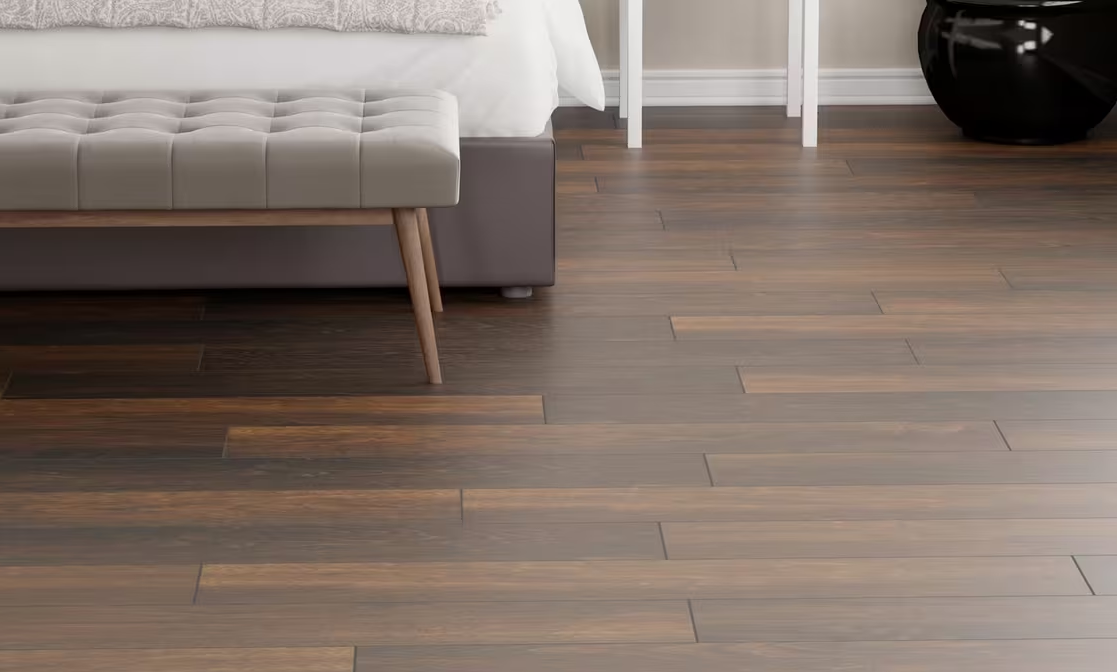
Numbers tell the story better than anyone’s excuses. So let’s actually look at them.
At big-box retail, laminate flooring material costs land between $0.79 and $3.00 per square foot. Current benchmarks show a wider range of $1.00 to $5.49 per square foot, with a median around $3.11. Most industry guides use a simpler baseline of $1–$4 per square foot for material alone, before you’ve paid a single cent for labor.
Trade pricing tells a different story. Wholesale buyers see roughly $0.75–$1.50/sq ft for budget-grade laminate, $1.50–$2.75/sq ft for mid-range, and $2.50–$4.00/sq ft for premium waterproof or 12mm+ product. One wholesale seller lists three clear tiers: $1.89, $2.29, and $2.89/sq ft. Another shows 8mm planks around $1.40/sq ft and 12mm around $1.75/sq ft. By the case (usually 20–25 sq ft), 12mm laminate runs $28–$70.
What Installation Adds
Nationally, the cost of installed laminate flooring clusters around $3–$13/sq ft. Home Depot’s own guide narrows that to $3.80–$4.80/sq ft total, split between $2.00–$3.00/sq ft for installation and $0.29–$0.79/sq ft for underlayment.
Budget installed floors run $4–$7/sq ft, with labor alone taking $2–$4/sq ft. Premium installed floors climb to $7–$14+/sq ft, sometimes reaching $10–$24/sq ft for high-end materials.
For a 1,000-square-foot living space, that means anywhere from $3,000 to $13,000.
The 2020–2025 Laminate Flooring Price Timeline
Laminate prices spiked, then settled somewhere still uncomfortable.
Manufacturer selling prices tell the clearest story. In 2020, laminate averaged $0.99/sq. ft. By 2023, that number jumped to $1.27, a 28% increase in just three years. Since then, prices have eased slightly to $1.21 in 2024 and $1.20 in 2025, a modest 5.5% pullback from the peak.
But “pullback” doesn’t mean cheap. Wholesale laminate hit $1.28/sq. ft. in 2024, the highest level since 2008, rising over 2% that year alone. Sales reflected the surge too: the category brought in $1.382 billion in 2022, up 6% from 2021.
Then demand cooled. In 2024, laminate sales dropped 16.8% in dollars and nearly 16% in volume, a real slowdown, even with prices staying elevated. Today, retail material costs typically sit between $1 and $6.50/sq. ft., with Lowe’s most common listings clustering around $2.00–$2.99.
The Laminate Flooring Cost Stack From HDF Core to U.S. Retail

The price jump from factory to your cart rarely comes from the wood itself. It comes from spec upgrades. See how laminate flooring is made for the full breakdown.
Every laminate plank starts as either MDF or HDF at its core. HDF is denser, sturdier, and pricier, which is why two planks that look identical can sit $1/sq. ft. apart. For a deeper look at these differences, see our HDF vs MDF board comparison. Thickness matters too. Basic laminate runs 6–7mm, midrange 8–10mm, and high-end 12mm+, with acoustic performance and locking quality climbing right alongside price.
Then come the add-ons. Waterproof cores, attached pads, and higher AC rating laminate flooring classes push products into premium territory fast. One real listing: a 10mm waterproof hybrid core with an 8mm core plus 2mm pad, sold at 17.95 sq. ft. per carton. That spec combo lands in mid-to-premium pricing.
That’s why entry laminate stays $0.79–$1.50/sq. ft., midrange climbs to $1.50–$3.00, and premium hits $3.00–$5.00+. Underlayment adds roughly $0.30/sq. ft. on national average. Add installation complexity, and full installed projects span $4–$14/sq. ft., a gap built almost entirely from spec choices, not raw materials.
HDF, Wood Fiber, Resin, and Decorative Paper Costs
Peel back the plank, and the real math starts. Standard HDF costs manufacturers around $280–$380 per cubic meter, while fire-rated or moisture-resistant HDF climbs to $420–$580. That gap alone explains why “waterproof” laminate never sits in the bargain bin.
Wood fiber feedstock makes up 35%–42% of production cost, according to one industry model. Another model pegs raw materials even higher, at 60%–70% of total manufacturing cost for HDF plants. Either way, the wood itself is the biggest line item.
Resin comes next, and it’s not cheap either. Adhesive resins like urea-formaldehyde and melamine-formaldehyde eat up 18%–24% of production cost, with some reports citing 20%–30%. Energy adds another 12%–18%, labor 15%–20%.
By the sheet, HDF runs $30–$80 for a standard 4×8 board, averaging $50–$60. Thinner 1/4-inch sheets stay near $30–$50; thicker 3/4-inch versions hit $55–$90.
Decorative paper adds its own cost layer, ranging $4.00–$150.00 per sheet depending on grade and design complexity. It’s the finishing touch that turns fiberboard into something that looks like oak.
AC Rating, Waterproof Construction, and Premium Specifications
AC rating measures abrasion resistance, not water resistance. It tells you how well the surface holds up to scratches and foot traffic — nothing about joint sealing, core swelling, or spill protection.
AC4 is the everyday workhorse, rated for heavy residential and light commercial spaces like kitchens, hallways, busy family homes. AC5 steps up for heavy commercial traffic — rentals, retail, offices. Lab tests put AC4 at roughly 4,000 Taber rotations and AC5 at 6,500, which means AC5 delivers 60%+ more abrasion resistance.
That upgrade isn’t free. Moving from AC4 to AC5 typically adds $1–2/ft². Waterproof laminate carrying AC4 runs $3.50–5.50/ft²; AC5 waterproof climbs to $5.00–7.00/ft², comparable to UK pricing of £22–36/m² for full waterproof-sealed products.
Premium waterproof laminate comes with 10–12mm thickness, EIR texture, sealed locking joints, and wax-treated edges. AC rating alone won’t tell you any of this — check spill-resistance duration, edge treatment, and core density separately.
For wet rooms, skip laminate entirely. Even AC5-rated boards aren’t built for standing water; that’s SPC/WPC territory.
Tariffs on Imported Flooring and China Sourcing Changes
Tariffs on imported flooring are baked into almost every laminate price tag, whether the label admits it or not.
China-made vinyl and rigid-core products, the ones closest to laminate in the aisle, still carry a 25% Section 301 duty under HTS 3918.10. Add the 5.3% MFN base duty, a broad 10% Section 122 baseline surcharge, and a small 0.3464% Merchandise Processing Fee, and you’re looking at roughly 40.3% combined exposure plus fees heading into 2026.
It’s calmer than it was. Peak China exposure on some goods hit 145% before those IEEPA-based duties were struck down on Feb. 20, 2026, with the 10% baseline surcharge replacing them four days later.
The timeline explains the pattern: 10% in 2018, 25% by mid-2019, reaffirmed again in 2020. Each jump pushed manufacturers to shift sourcing — to Vietnam, India, Indonesia, Turkey, and more U.S. domestic production. That migration is real, and it’s the biggest reason China-sourced LVP/SPC is now the riskiest, priciest category on the shelf.
A container sitting at anchor for a week doesn’t feel like your problem, until it shows up on your receipt. Shipping delays are quietly one of the strongest forces behind the flooring industry inflation you’re seeing at checkout.
The math is blunt. A 100-hour shipping delay raises consumer goods inflation by 1.194 percentage points, and at its peak, that delay pushes consumer inflation up roughly 0.5 percentage points. Global shipping-cost shocks matter too: a 21.8-point spike in shipping costs lifts headline inflation by 0.15 percentage point over the following year. Even a 1% jump in global freight raises US import prices by more than 0.01%, and that effect lingers for three months.
Port congestion adds its own tax. Dry bulk vessels held direct holding costs near $14,000 per day in 2023. Run the math on a real container: freight jumping from $1,500 to $4,500 on a 1,000-item shipment adds about $3 per item, a 6% hit on a $50 product.
Why Delays Still Bite in 2026
By mid-2026, the bottleneck shifted inland — uneven container arrivals and trucking constraints, not terminal congestion, drove variability. Freight reports recommended budgeting 4–5 extra free days on European imports and 2–3 on US East Coast shipments just to dodge detention fees. Then September’s typhoon-driven backlog left 90 ships waiting over a week for a Shanghai slot, proof that capacity crunches haven’t disappeared but have just moved.
Brand Premiums, Distribution Margins, and the Import-to-Retail Gap
The name on the box often costs more than the box itself. Across import-heavy categories, procurement can translate to roughly 2x retail sales value by the time it reaches the shelf. Laminate flooring isn’t exempt from that math. For current trade costs and country-by-country comparisons, check our North America flooring price guide.
A distributor takes 25%–35% gross margin. Retailers add 40%–50% on top of wholesale, though that shrinks to an effective 20%–30% after chargebacks and freight. In branded consumer goods, the brand itself keeps only 25%–40% of the final retail price once everyone else has taken their cut.
In apparel, wholesale markup runs 2.0x–2.5x landed cost. Retail then adds another 2.2x–2.5x. Stack those together and a $10 landed product becomes a $50+ shelf price without a single material upgrade.
What This Means for Your Flooring Price Tag
That same layering happens with laminate. Master importers earn 15%–25%, regional distributors 4%–12%, and local retailers 10%–40%, depending on volume and negotiating leverage. Private-label flooring avoids several of these layers, which is why the identical HDF core, resin blend, and AC rating can sell for 30%–50% more under a national brand. That premium is brand value. Performance is identical.
Imported Versus U.S.-Made Laminate Flooring Prices
American-made doesn’t always cost more.
A 2026 price index puts USA-made laminate at $0.65–$3.75/sq ft, with a median of $2.16. European-origin laminate lands slightly higher, at $0.65–$4.12/sq ft, median $2.37. That’s a small gap, but it’s real.
Brand shifts the picture fast. Mohawk’s U.S.-made RevWood line runs $2.79/sq ft for the base tier, $3.19–$3.49 for RevWood Select, $4.19–$4.69 for RevWood Plus, and $4.99 for RevWood Premier. One U.S. seller lists domestic options as low as $1.29–$2.99/sf.
Meanwhile, general imported-style listings cluster at $1.29–$4.69/sq ft, hitting points like $1.79, $2.99, and $3.99.
Imported laminate skews toward the $1–$3 band, while recognizable U.S. brands often push $2.79–$4.99. Country of origin matters less than the name on the box.
How to Tell Whether a Laminate Flooring Price Is Reasonable
A quote either matches the specs on paper, or it doesn’t — that’s the whole test. Material alone should sit at $0.79–$3.00 per square foot for solid mid-range boards, with the broader retail range topping out at $5.49 and a median of $3.11. Installed prices run $3–$13 per square foot for most legitimate quotes, with $3–$11 as the tighter average. For step-by-step installation guidance, see our laminate flooring installation guide.
Labor typically runs 20%–50% of the total bill, or roughly $2–$8 per square foot on its own. If underlayment isn’t already baked in, expect another $0.29–$0.79 per square foot.
Quick sanity check:
– Low-end: material under $2, installed $3–$6 per square foot
– Mid-market: material $2–$4, installed $6–$11 per square foot
– Premium: installed $11–$14 per square foot
For 1,000 square feet, that’s $1,000–$5,000 in materials or $3,000–$13,000 installed. The best quotes always show their math — thickness, demolition, trim work, all itemized. If they don’t, ask why.
Here is the rewritten version, keeping every number, tip, and the original structure while smoothing out the wordy or awkward phrasing.
Five Practical Ways to Reduce Laminate Flooring Costs
None of these costs are fixed. You have more room to negotiate than the price tag suggests.
Skip the premium-look planks. Smooth, plain styles run $1.70–$2.60/sq. ft., while brushed or oiled finishes climb to $5.60. Same core, different texture, different bill.
Get three bids, minimum. Labor eats 20%–50% of your total, or $2–$8/sq. ft. National labor averages run closer to $2–$3/sq. ft., so shopping around is where the real savings live.
Prep the room yourself. Move furniture, pull old flooring, clear trim and staples. Furniture removal alone can add $35 for up to six large pieces — small, but it adds up.
Choose pre-attached underlayment. Standalone pads add $0.29–$0.79/sq. ft. Skip that line item.
Stick with 6–8mm boards. 6mm materials run $0.69–$0.99/sq. ft., while 12mm climbs to $2.29–$5.99. Going DIY drops the total to $1.50–$6/sq. ft., versus $3–$13 professionally installed. On 1,000 sq. ft., that’s $1,500–$6,000 versus $3,000–$13,000.
Laminate Alternatives When the Price Premium Isn’t Justified
Sometimes the smartest move is walking away from laminate altogether. Installed laminate runs $15–$40/sq ft in tighter budgets, up to $20–$60/sq ft in broader market guides. At that ceiling, alternatives start looking competitive.
Ceramic or porcelain tile is the closest value substitute: $5–$30/sq ft installed and a 20+ year lifespan. That’s double what laminate typically offers (10–20 years).
You can get the wood look without laminate’s brand markup. Skip real butcher block ($40–$100/sq ft) and try imitation versions using high-pressure laminate, LVP, or peel-and-stick vinyl. These run $15–$45/sq ft installed and give you a similar visual payoff.
If durability matters more than upfront cost, solid surface (think Corian) runs $35–$85/sq ft, lasting 15–25 years with repairable, seamless surfaces. Entry quartz brands like Silestone or Caesarstone start at $50–$80/sq ft, lasting 25+ years. The jump from laminate to quartz typically adds $30–$60/sq ft.
When U.S. Laminate Flooring Prices May Actually Fall
Prices already peaked and are sliding down. Manufacturer selling prices dropped from $1.27/sq ft in 2023 to $1.20 in 2025. Don’t expect a crash, though. 2026 looks like slow, uneven improvement, not a rebound.
Demand is the real brake. 2025 laminate sales hit $878 million on 734 million square feet, down 1.5% in value and 0.7% in volume from 2024. Weak, but not collapsing.
Tariffs on imported flooring keep list prices sticky. Duty exposure runs 10%–20% under Section 232 and 122, which keeps a floor under prices for imported SKUs.
Your best shot at savings is domestically produced laminate, which largely dodged 2025–2026 tariff hikes. There’s also closeout inventory already appearing at $1.29–$1.88/sq ft.
Conclusion
Laminate flooring prices remain high in the United States because of four factors: HDF and resin costs that jumped 20–30% since 2021, tariffs adding 10–25% to imported lines, freight bottlenecks that never fully unwound, and brand markups padding the final tag well beyond what materials justify. The last factor is where you have power. Once you can separate real cost from margin, you stop guessing and start negotiating.
Before your next quote, run the math: check the AC rating, ask where the core was milled, and compare at least one lesser-known brand against the name you already trust. Sometimes the identical product sits behind two very different price tags.