
You’re standing in front of two supplier quotes right now, aren’t you? One says MDF, the other says particle board, and the numbers don’t quite match up to what you budgeted for that kitchen cabinet run or wardrobe project. Furniture board prices in the UAE vary a lot with thickness, and the cheaper option on paper can actually cost more once you factor in Dubai’s humidity and hardware weight requirements. This guide covers real 2024 price ranges per square meter, how particle board compares to MDF under daily use, and which board makes sense for your specific room. By the end, you’ll walk into your next supplier call knowing precisely what to ask for.
UAE MDF and Particle Board Prices by Thickness: 9mm, 12mm and 18mm

Numbers tell the story faster than any sales pitch. A standard 1220 × 2440 mm (4ft × 8ft) sheet runs across UAE suppliers in 2024 at the ranges below, retail and bulk, so you can spot a fair quote from an inflated one.
MDF sheet price per square meter, broken down by thickness:
-
9mm MDF: AED 40–45/sheet retail, AED 30–38/sheet bulk
-
12mm MDF: AED 50–56/sheet retail, AED 38–48/sheet bulk
-
18mm MDF board price: AED 70–81/sheet retail, AED 48–65/sheet bulk
Dubai retailers like Thermal.ae quote almost identical figures — AED 40 for 9mm, AED 50 for 12mm, AED 70 for 18mm — which tells you these ranges aren’t outliers. FEPY’s online listing runs a bit wider, AED 39.38 to AED 81.20 depending on thickness and delivery timing.
Particle board pricing sits noticeably lower. Across UAE market listings, chipboard furniture material runs AED 25–60 per sheet, with the bottom end tied to standard-grade or imported bulk stock. That’s a real gap — sometimes 30-40% cheaper than equivalent MDF thickness, which explains why particle board still dominates flat-pack and budget furniture lines here.
One sourcing detail worth flagging: bulk MOQs for plain MDF sheets (China-manufactured, covering 6mm through 18mm) often start around 100 sheets at roughly AED 65 reference price. If you need furniture-grade MDF for a single wardrobe or cabinet run, that bulk pricing won’t apply — you’ll be quoted retail, so factor that into your budget before comparing supplier quotes side by side.
MDF vs Particle Board UAE: The Real Price Difference Per Usable Panel
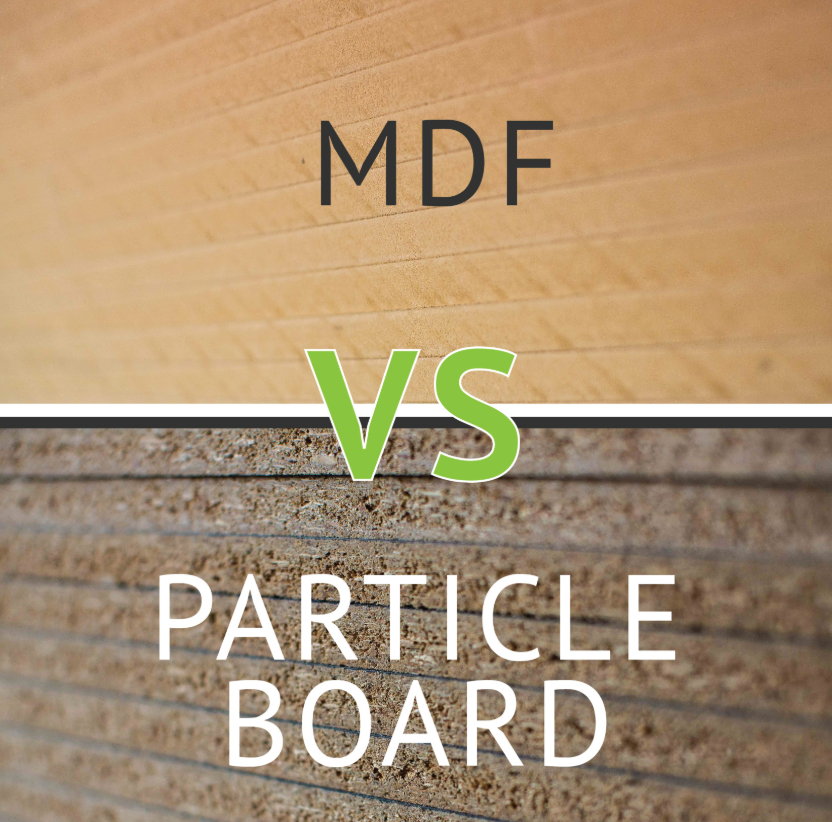
Sheet prices lie if you only look at the tag; cost per usable square foot after trimming waste is the real figure.
Retail listings across Dubai swing wide. ACE UAE prices MDF 12mm at AED 309/sheet, while Speedex Tools lists MDF 18mm commercial at just AED 150/sheet, and their melamine-white 18mm version sits at AED 160. DBM Store’s 18mm melamine Magnolia Cream runs AED 180/sheet. Same material, wildly different numbers — supplier, finish, and MOQ all move the needle.
A standard 4×8 sheet gives you roughly 32 sq ft gross. Shave off 10% for trimming and offcuts, and you’re working with about 28.8 sq ft usable. Run that against the AED 150 sheet and you’re paying AED 5.21 per usable sq ft. The AED 309 sheet works out to AED 10.73 per usable sq ft — more than double, for the same nominal thickness.
Particle board doesn’t play by sheet-price rules in UAE listings. BBMC’s category tiers show pricing from AED 10–49 up through AED 200+, depending on grade and finish, which makes side-by-side comparison messier than it should be.
For bulk buyers, skip retail sheets entirely and compare by volume. Particle board typically runs $180–300/m³, while MDF sits at $180–400/m³ internationally. That’s your cleanest apples-to-apples number when quoting large orders.
Particle Board vs MDF Strength, Density and Hardware Holding
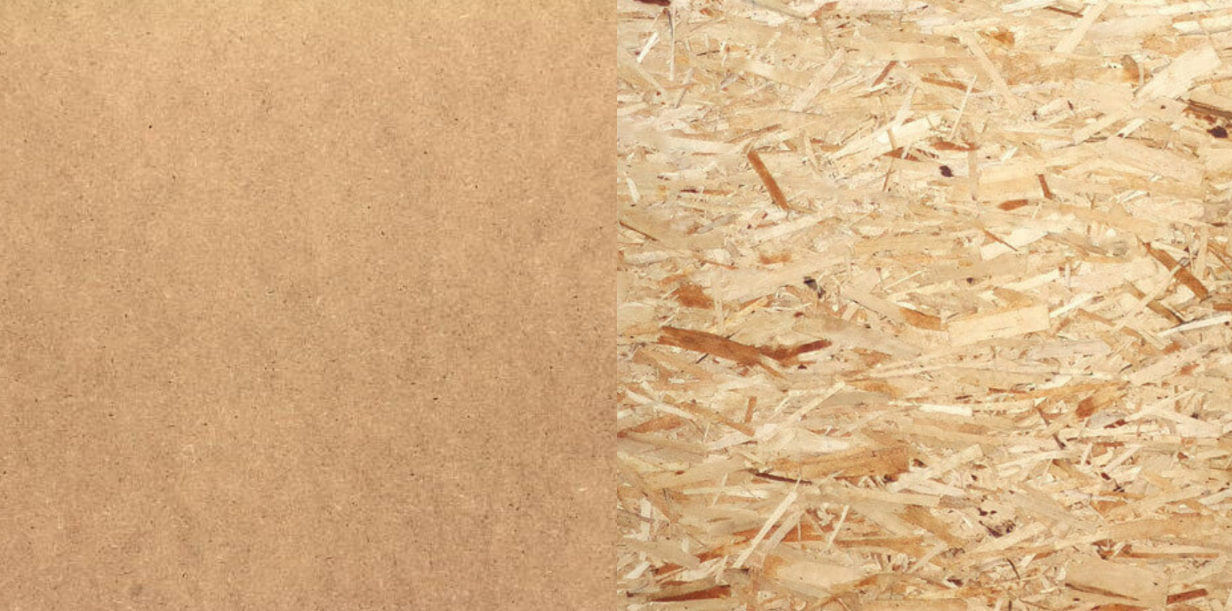
When a hinge starts squeaking loose six months after installation, a density problem is at work. Particle board density sits at 550–750 kg/m³, while MDF runs denser at 650–850 kg/m³. That gap shows up anywhere a screw goes in.
MDF’s face screw-holding measures 1,346 N versus particle board’s 1,134 N in one comparative furniture study, and in a laminated comparison that gap widens to 1,638 N vs 1,346 N. Edge holding tells a sharper story: 693 N for MDF against 595 N for particle board, sometimes stretching to 1,204 N vs 693 N under different test conditions. One practical benchmark for 18mm boards gives roughly 1,100 N face / 600 N edge for MDF and 650 N face / 400 N edge for particle board.
Density and withdrawal strength move together. Test data shows particle board at 0.64 g/cm³ holding around 590–687 N, while MDF at 0.72 g/cm³ climbs to 880–1,067 N. MDF edges out particle board strength by about 22% on face screws and 74% on edge screws.
If your design involves hinges, adjustable shelving, or furniture that gets assembled and disassembled repeatedly, MDF earns its higher price tag. Particle board still works fine for static, budget-conscious cabinet carcasses, but plan your fastener spacing and edge banding more conservatively.
MDF Water Resistance Comparison for UAE Humidity and Wet Areas
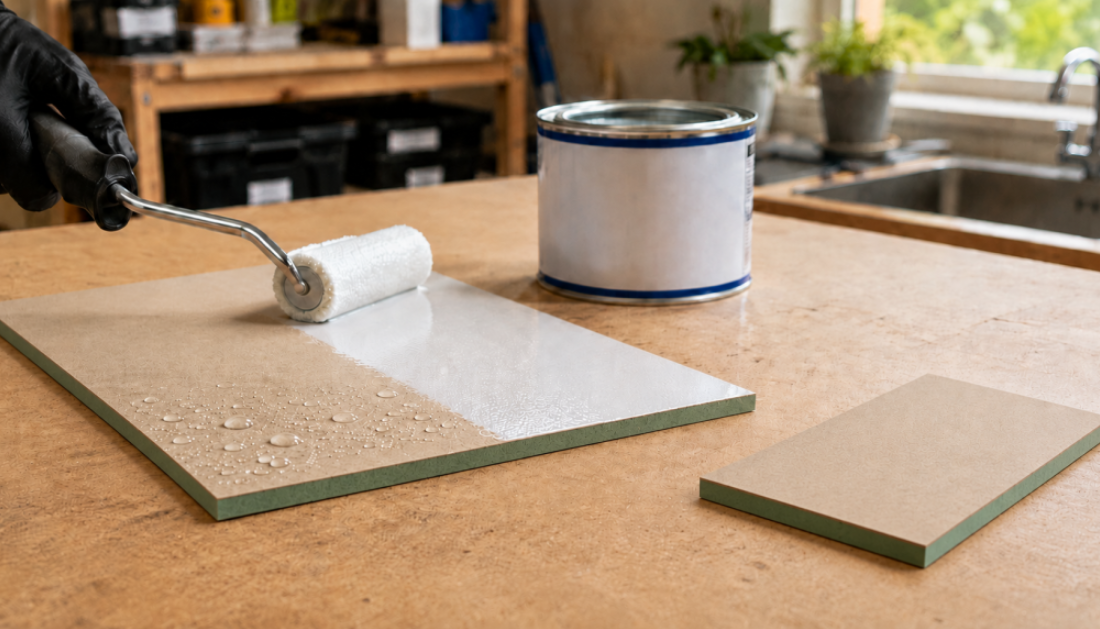
Water complicates MDF’s reputation fast. Standard MDF swells and delaminates when moisture sits on it too long. That’s the exact risk in a Dubai kitchen or bathroom cabinet exposed to ambient humidity year-round. At this point, the specific MDF grade matters more than whether to use MDF at all.
Two grades, two very different outcomes:
-
Standard MDF: dry interiors only. Thickness swelling runs 10%–25% wet, and it uses moisture-sensitive urea-formaldehyde (UF) resin.
-
MR MDF / HMR MDF (MDF.H2): built for humid interiors like kitchens, bathrooms, and laundry rooms, using melamine-urea-formaldehyde (MUF) resin. Swelling drops to roughly 5%–10%, and higher-quality moisture-proof boards can hit as low as ~2% on 24-hour immersion tests, versus ≤18% for ordinary MDF.
Neither grade is waterproof. The classification that separates “humid” from “high humidity” is 20°C with 65%–85% RH. That covers most UAE interior air, but not standing water. Skip MDF for shower enclosures, wet-room floors, pool-house interiors, or saunas. PVC board, WPC, cement board, or marine-grade plywood handle those zones.
When you’re on the phone with a supplier, ask for MDF.H2 or MR/HMR MDF, confirm edge sealing on every cut panel, and request the 24-hour swelling percentage, targeting ≤8% and ideally closer to 2%. Reference EN 622-5, EN 317, or ANSI MR10 if they can’t quote a number outright.
Kitchen Cabinets: Where MDF or Particle Board Saves More
Kitchen budgets live and die by the cabinet box, not the fancy trim. Factory-level numbers show that 18mm particle board averages USD 240–290/m³ FOB, while standard MDF runs USD 380–420/m³ FOB. Particle board is 30-40% cheaper before you even attach a hinge.
That gap holds at sheet level too. A ¾-inch, 4×8 sheet lands around $25–$50 for particle board versus $50–$130 for MDF. Scale that to a full kitchen:
-
Per cabinet unit: particle board runs $20–$50, MDF runs $40–$80
-
Per linear foot installed: particle board sits at $70–$150, MDF climbs to $100–$250
-
A standard 10×10 kitchen: particle board stays around $1,800–$4,000; MDF ranges $1,500–$7,000+ depending on finish
Pick the right cabinet material for each job. Build carcasses in particle board where humidity stays low and nobody’s touching the structure daily. Save MDF for painted doors and shaker fronts. Its smoother, denser surface (31–52 lb/ft³ versus particle board’s 25–69 lb/ft³) takes paint and machining far better. That particle-board-carcass, MDF-door combo is the standard budget-to-midrange move UAE cabinet shops rely on.
Wardrobes and Office Furniture: Best Board by Application and Budget
Flat-pack wardrobes across the UAE run almost exclusively on melamine-faced particleboard (MFC). The 18mm thickness with edge-banding is the default spec every low-cost supplier quotes first. It’s the cheapest mainstream option on the market — sheets land around $20–$40 — and for modular storage that isn’t carrying much weight, it holds up fine.
Office furniture splits differently depending on what part you’re buying. Desks and light storage units still lean on MFC particleboard or MDF, 15–18mm with a laminate face for wear resistance. But reception furniture, premium wardrobe fronts, or anything getting painted moves to MDF, because the smoother surface takes finish work that particleboard can’t match.
Here’s how the numbers stack up:
-
Screw holding: particleboard 65–90 lb/in vs. MDF 95–125 lb/in
-
Shelf span: particleboard maxes at 24 in; MDF stretches to 30 in
-
Moisture swell: particleboard swells 20–28% after a 24h soak; MDF sits at 16–22%
For heavy shelving or long-span storage, plywood outperforms both. Screw withdrawal climbs to 130–175 lb/in depending on grade. Ask suppliers for E1-certified board and formaldehyde compliance paperwork before signing off on any large office fitout.
MDF and Particle Board Fail Outdoors. Use Fiber Cement or MgO for Shade Structures.
Sun, sand, and salt air will find every weakness in a panel within one Dubai summer. MDF and particle board, the engineered wood boards most UAE buyers stock, don’t survive the UV exposure, moisture swings, and thermal cycling outdoors. Skip both for shade structures.
Exterior boards need water absorption ≤15%, compressive strength at least 25 MPa, flexural strength at least 10 MPa, a Class A or A1 fire rating, and 1000 hours of UV aging with no cracking across -40°C to +70°C thermal shock.
Fiber cement board, MgO board, or UV-stabilized PVC foam handle rooftop pergolas and exposed carports far better. For windy, sun-blasted sites, HDPE mesh or guided aluminum systems with side tracks outperform any flat panel. Ask suppliers for outdoor service-life years and UV test results before ordering — not just a thickness and price.
UAE Furniture Board Suppliers and a Practical Quotation Checklist
A good supplier list saves you three phone calls and a wasted afternoon. Emilam Industries LLC in Jebel Ali has been around since 2001. They claim the region’s first melamine-laminated MDF line and the UAE’s largest production capacity for melamine MDF. PG Bison UAE, distributed through Salvocorp, sells MelaWood and BisonBord for cabinetry work. Kingdom Dekor calls itself the top MDF importer in the UAE and Oman. For mixed-material orders, Noaf General Trading stocks plywood, MDF, chipboard, and hardware fittings side by side. Madar UAE covers Dubai, Abu Dhabi, Ajman, and RAK with both melamine-faced and plain MDF boards. Danube/DBM Store handles melamine-faced chipboard if you’re sourcing online. Directory names like Woodstock Trading, Ominco Trading, and Suma Building Materials fill gaps across Sharjah and Dubai.
Before you request a quote on any engineered wood board UAE suppliers offer, specify: board type (MDF/MFC/plywood), MR or FR grade, exact thickness and sheet size in mm, edge treatment, formaldehyde certification (E1/CARB), MOQ, lead time, price basis per sheet or m³, delivery terms, and stock location. Vague requests get vague and inflated numbers back.
Conclusion
The “best” board comes down to matching material to moisture, load, and budget. If your project touches water or humidity (hello, Dubai kitchens), spend the extra dirhams on moisture-resistant MDF; your cabinets will thank you in year three, not just week one. For budget wardrobes or office units that stay dry, particle board’s lower price per square meter makes real financial sense, especially once you factor in the particle board vs MDF strength trade-off for your specific hardware needs.
Don’t just take the first quote you get. Walk into two or three furniture board suppliers UAE has to offer, bring this price guide with you, and ask pointed questions about thickness tolerance and moisture rating before you commit. That five-minute comparison could save you thousands in rework and a lot of frustration down the line.