
Villas in the New Administrative Capital, retail chains in Alexandria, and social housing blocks across the Delta are landing on the same flooring choice. That’s the picture from Cairo’s construction sites—one spreadsheets can’t quite capture. Egypt’s SPC flooring demand is growing across residential and commercial projects, driven by climate conditions, faster construction timelines, and demand for durable waterproof flooring. Brutal summer heat, humidity swings near the coast, and a construction sector tired of ceramic cracking and hardwood warping within a year of installation are driving it.
If you’re a contractor sourcing materials, a developer weighing cost against timeline, or a distributor trying to tell which SPC flooring manufacturer delivers on quality claims, the real question is which suppliers, specs, and installation practices separate projects that last a decade from those that don’t. This article covers that—market data and the purchase criteria that matter on-site.
Egypt SPC Flooring Market Size And Growth Trajectory
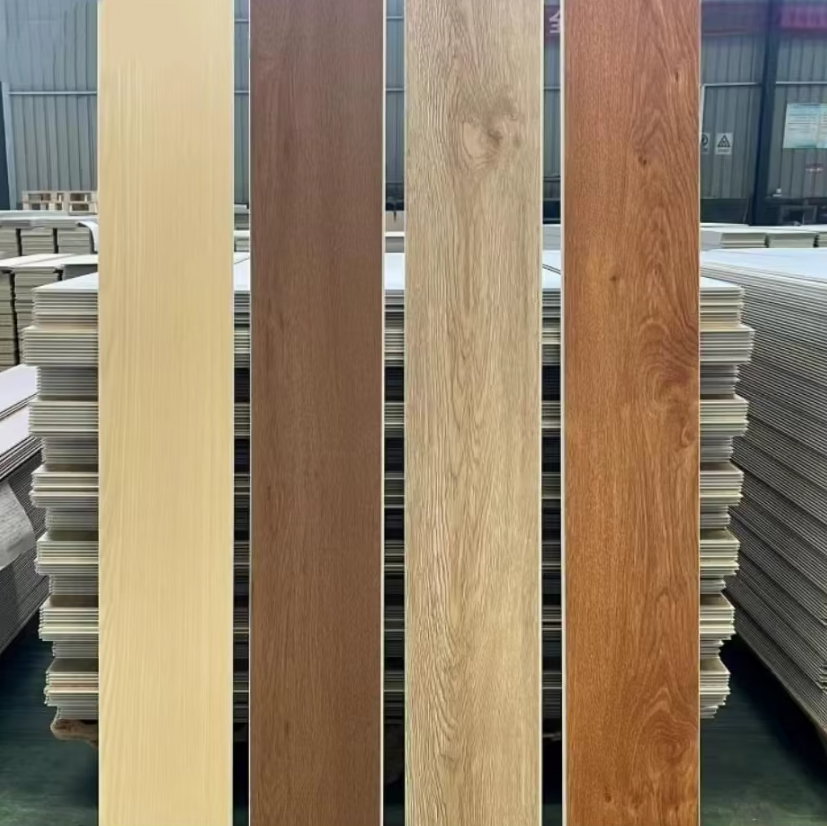
Forty-one million dollars. That’s what Egypt’s SPC flooring market was worth in 2024. By 2033, projections put it at USD 145.08 million with a 14.78% CAGR that outpaces almost every other flooring category in the country. SPC is growing and has become the largest segment within Egypt’s stone plastic composite flooring space, which tells you this isn’t a niche product anymore.
Egypt’s overall floor covering market is worth USD 2.39 billion in 2025 and is projected to climb to USD 3.24 billion by 2031 at a 5.20% CAGR. The broader flooring solutions market was USD 1.514 billion in 2024 and is heading to USD 2.1123 billion by 2031 at a 4.9% CAGR. SPC accounts for roughly 2.8% to 4.6% of that broader market depending on the benchmark. It’s a small slice, but it’s growing roughly three times faster than the category it sits inside.
Resilient flooring (SPC and LVT combined) is forecast at 8.09% CAGR through 2031. SPC alone grows at nearly double that rate. Carpet and rugs still hold 41.12% market share in 2025, proof that traditional categories aren’t disappearing overnight. But every point of share SPC gains comes from somewhere, and right now it’s coming fast.
Urbanization is the engine. New city development, population growth, and projects like the New Administrative Capital create sustained volume demand across residential towers, retail spaces, and hospitality builds. This is the demographic backbone behind Waterproof SPC Flooring adoption in Egypt, particularly in projects where durability, moisture resistance, and fast installation are important. Egypt’s construction and urban development activity can be tracked through Egypt construction statistics published by CAPMAS.
Why SPC Flooring Fits Egypt’s Climate And Construction Reality
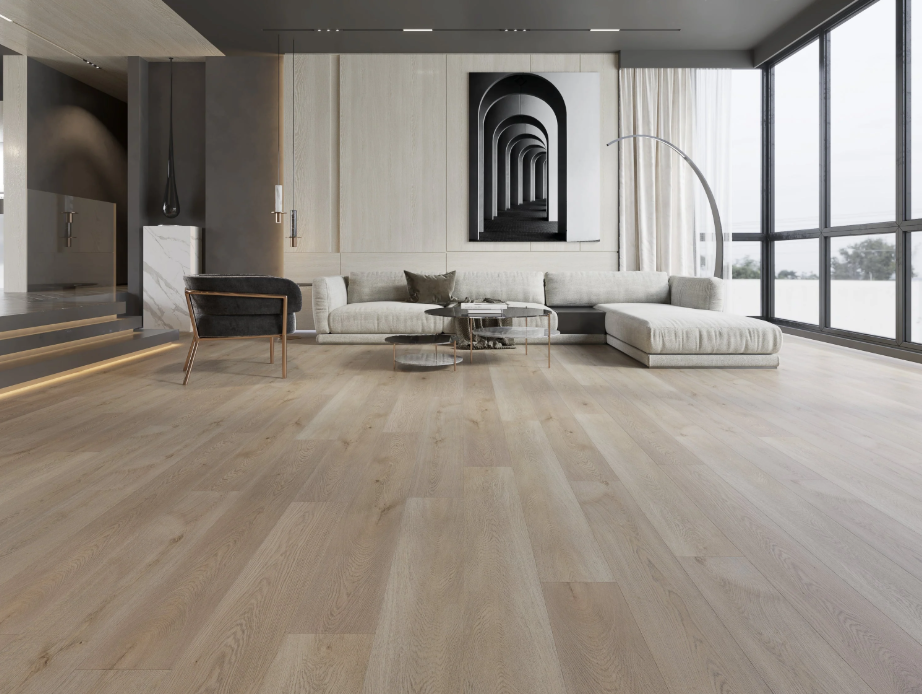
Cairo barely sees rain—just over 10 mm annually. Alexandria sees roughly 200 mm and summer humidity that climbs to 77%. Two flooring problems, one country. Inland sites fight heat. Coastal sites fight moisture. rigid core flooring solves both because the stone-plastic composite doesn’t care which direction the stress comes from.
Heat Stability Where It Matters Most
SPC technical sheets show dimensional stability holding at ≤0.1% to ≤0.25% under heat exposure. ASTM F2199 testing backs that up, with some products measuring <0.51 mm / 0.17% and premium lines tightening to ≤0.1%. Thermal expansion sits around 5 × 10⁻⁵ per °C, though high-density cores push into the 8.5–11.5 µm/m·°C range. SPC technical sheets commonly report dimensional stability under heat exposure, with ASTM F2199 used as a reference test method for resilient flooring dimensional stability.
Run the math on a real installation: a 10-meter floor exposed to a 20°C swing expands about 10 mm total. That means floating installation and perimeter gaps aren’t optional in Egyptian apartments and office fit-outs. Skip that detail and you get buckling within a season. Some product lines rate for continuous use up to 60°C, with dimensional stability holding at ≤0.1% at 80°C for six hours.
Moisture Resistance For Coastal Builds
SPC cores are marketed as 100% waterproof, with thickness swell under 0.5% after 24-hour immersion. Some spec sheets claim under 0.2%. Wood-based flooring starts reacting once relative humidity holds above 70% long-term. Alexandria hits that number every summer. Ceramic tile handles moisture fine but loses on comfort and installation speed, especially in retrofit projects with uneven slabs.
Built For Fast, Low-Disruption Renovation
SPC ships in 4–8 mm profiles, which keeps floor buildup low. That matters for rental retrofits and quick-turnaround apartment renovations across Egypt’s residential flooring trends.
SPC Flooring Demand in Egypt’s Residential Projects(Apartments, Villas, Social Housing)
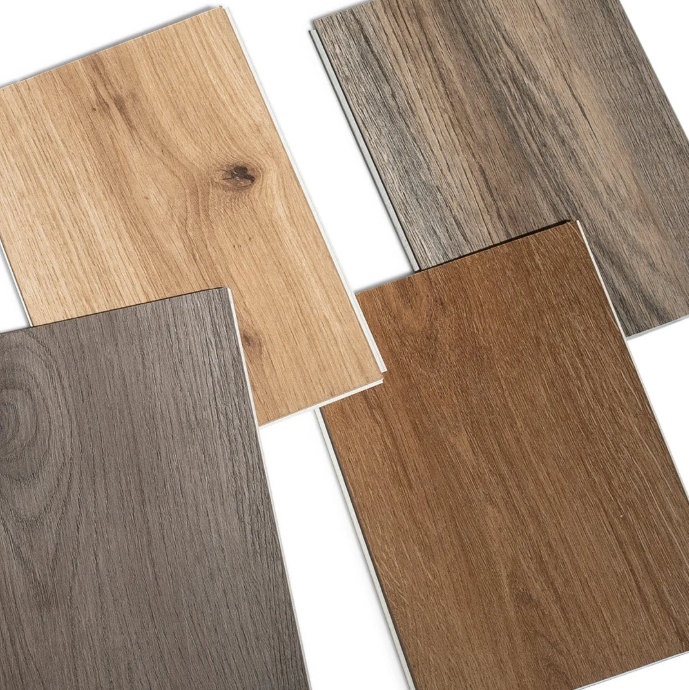
Residential buyers drive this market. Households, not commercial developers or government contracts. One global report puts residential use at 56.21% of SPC demand in 2025, and another lands close at ~55% of global SPC value in 2024. Either way, homes are where SPC flooring wins first.
Renovation is the real engine inside that number. Roughly 40% of global SPC demand comes from replacement projects rather than new builds, and mature markets saw retrofit orders climb ~38% in 2024 alone. That pattern holds in Egypt: owners pulling up cracked tile or warped laminate reach for SPC because it installs fast and doesn’t need the slab to be perfect first.
Apartments And Multifamily Units
Multifamily projects account for ~34% of residential SPC installs globally. Average job size runs 20–120 m² per unit, which is standard apartment territory. Buyers here want click-lock systems, 0.2–0.35 mm wear layers, and 3.0–4.0 mm profiles that keep costs down without sacrificing a wood-look finish.
Villas And Owner-Occupied Homes
Villa owners spec differently. They buy thicker product, 4–7 mm planks with 0.3–0.5 mm wear layers, because they’re covering more square footage and expect the floor to outlast a decade of foot traffic. Plank formats like 1220 × 180 mm and 1500 × 220 mm show up most in these orders.
Social Housing And Affordable Builds
Social housing runs on a different formula: lowest installed cost plus waterproofing plus minimal upkeep. SPC installed cost sits around $25–35/m², against $30–45/m² for engineered hardwood in standard residential grades. That gap is why housing authorities keep specifying SPC flooring over laminate and lower-grade vinyl.
Wet Areas Push Demand Everywhere
Kitchens, bathrooms, basements, laundry rooms, these rooms decide the purchase. SPC’s <0.1% water absorption and 0% swelling specs make it the default answer for wet-zone retrofits across apartments, villas, and social housing alike.
SPC Flooring Demand in Egypt’s Commercial Projects (Offices, Retail, Hospitality)
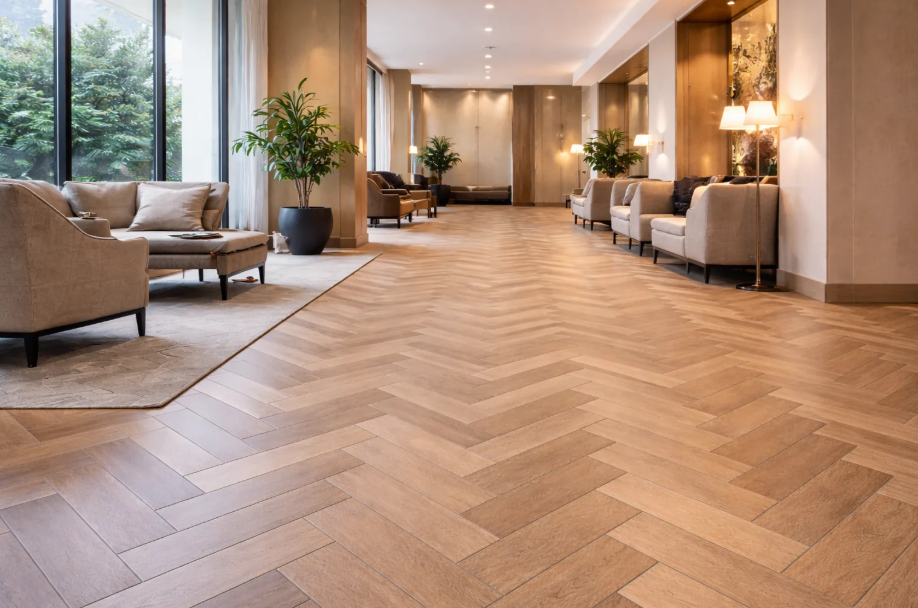
A hotel lobby doesn’t forgive a cheap floor. Neither does a supermarket aisle running carts through it eight hours a day. Commercial buyers know this, and it shows in the specs they demand from any SPC flooring supplier in Egypt.
Wear Layer Thickness Sets The Floor
Commercial buyers should compare SPC wear layer thickness alongside total thickness, core density, and usage class when specifying flooring for high-traffic projects.
The commercial minimum is 0.5 mm / 20 mil. That’s the entry point for offices, co-working spaces, clinics, and small retail. Step up to 0.55 mm and you’re in mainstream heavy-duty territory—restaurants, cafés, and stores dealing with scuffing and rolling loads. Hotel corridors and lobbies push further: 0.7 mm / 28 mil is the standard for continuous foot traffic and luggage carts. Guest rooms can drop to 20–22 mil since traffic there is lighter.
AC Ratings Do The Sorting
AC4 covers general commercial use across offices and retail. AC5 handles heavy commercial zones—hotel corridors, busy retail floors, open-plan corporate spaces. AC6 exists for extreme cases like healthcare facilities and transport hubs where aggressive cleaning and equipment loads are constant.
Core Density And Build Specs
Premium commercial-grade SPC flooring runs core density ≥1.95–2.0 g/cm³, with total thickness in the 5.0–6.0 mm range. Locking systems get tested too, with a common benchmark sitting at ≥550 N/m for click strength. Egypt and MENA procurement teams typically ask for 0.5 mm minimum wear layer, AC4 certification, and 5 mm+ total thickness as the baseline filter, moving up to 0.55–0.7 mm for hospitality and heavy-traffic retail bids.
Why Owners Switch From Stone And Tile
Buyers comparing resilient flooring options can also evaluate SPC vs LVT based on rigidity, installation method, waterproof performance, and application requirements. That means less downtime on active commercial sites. No grout lines means less maintenance. And when a plank gets damaged, replacing it locally beats redoing an entire wet-adhesive tile field—a detail that matters most in leasehold retail and renovation-heavy hospitality projects.
Key Purchase Criteria For B2B Buyers (Contractors, Developers, Distributors)
Price alone tells you almost nothing until you attach it to a spec sheet. Egypt’s SPC flooring price runs EGP 450–950/m², and the gap isn’t random. It maps directly to thickness, wear layer, and underlayment.
Price Tiers Explained
- EGP 450 to 550/m²: Standard 4–5mm SPC with basic texture, for general apartments.
- EGP 550 to 700/m²: Mid-to-high tier, 5–6mm with IXPE acoustic underlay and better wood-grain finish. Common in developer show units.
- EGP 700 to 950/m²: Imported or branded SPC,6–8mm and up, with thicker wear layers and stronger click systems. Hotels and premium residential lobbies use this.
By thickness, the numbers confirm the same pattern: 4mm runs 200–280 EGP/m²,5–6mm goes 280–380,6–8mm is 380–520, and imported 6–12mm hits 600–1,000+.
What Each Buyer Prioritizes
- Contractors want unit price, install speed, and low rework. They stick to click-lock systems,4–6mm profiles,0.3–0.5mm wear layers.
- Developers balance total project cost against delivery consistency and warranty.5–6mm with IXPE underlay hits that sweet spot for showroom-ready units.
- Interior designers care less about per-square-meter cost,more about plank width, grain realism, and matte or embossed finishes that match furniture styling.
- Distributors stock a spread: cheap 4mm for volume,5–6mm as the core seller,0.5mm commercial-grade, plus one imported line for premium bids.
The Acceptance Checklist That Matters On-Site
Before signing off, confirm wear layer (0.3mm minimum residential,0.5mm+ commercial), verify total thickness against traffic zone, and pressure-test seam sealing after installation — not just the “100% waterproof” claim on the box. If a quote comes in under EGP 450/m², check the wear layer and underlay first.
How to Choose an SPC Flooring Supplier in Egypt
Four names keep surfacing when contractors talk sourcing: Rowad El Shareq, Admiral, Unispec, and Kemet Flooring. Each represents a different angle on the same decision: local stock versus imported consistency.
What Separates A Reliable SPC Flooring Supplier In Egypt
Start with ISO 9001 and CE certification as non-negotiables. Commercial and public projects also require checking for EN 13501-1 Bfl-s1 fire rating, low-VOC documentation, and system certification where applicable. The minimum order quantity from local suppliers is typically around 200 m², which fits project trial orders and mid-size builds without forcing bulk commitments.
Local Production Versus Imported Brands
Rowad El Shareq, founded in 2010, ships rigid core click SPC at US$7–12/m² FOB with that 200 m² MOQ, plank sizes running 152–228 × 914–1524 mm, 2–3 m² per box. Admiral launched in 2023 out of 10th of Ramadan City, betting on fresh manufacturing capacity. Unispec runs wholesale out of El Sokhna, Suez. Kemet markets itself on European-quality positioning at competitive pricing.
Local supply wins on turnaround, critical for urgent orders and site restocks. Imported lines bring deeper certification, including ISO 14001, floorscore, Bfl-s1, E1 Formaldehyde ratings, and R9 slip resistance. That’s the paperwork hospitals and institutional bids demand. Sea freight and customs mean longer lead times, so lock orders early if importing.
Where “Bayer” Fits The Egyptian SPC Conversation
Bayer Limited Egypt operates out of New Cairo, but that entity is pharmaceutical, not flooring. For SPC flooring, the sharper reference point is KAMSTON’s partnership with i4F drop-lock technology, targeting local Egyptian production by Q3 2025 for domestic and export markets.
The Screening Order That Works
First, filter by local address, MOQ around 200 m², ISO 9001/CE, and Bfl-s1. Then compare FOB/EXW pricing, lead time, sample speed, and batch consistency. Finally, confirm local project references, Installation Support, and low-VOC documentation.
Installation And Maintenance For Egyptian Projects
Two Installation Methods dominate Egyptian job sites, and picking wrong costs more than the material itself. Click-lock floating installation wins on speed and subfloor tolerance, good for renovations where the base isn’t perfect. Glue-down wins on stability in high-traffic commercial zones where board shift isn’t an option. Correct SPC flooring installation is equally important, particularly for large commercial areas where subfloor flatness, expansion gaps, and temperature control affect long-term performance.
Floating Installation: The Numbers That Matter
Subfloor flatness needs to hit ≤2 mm/2 m, sometimes stated as 3/16 in. (5 mm) over 10 ft. Perimeter expansion gaps run 10–12 mm standard, at walls, columns, door frames, pipe penetrations. Rooms exceeding roughly 15-meter spans need transition strips or expansion breaks, especially at doorways. Installation temperature should sit at ≥15°C, and planks need 48 hours to acclimate before laying.
Glue-Down For Commercial And High-Traffic Zones
Adhesive installation suits public buildings, hotels, and continuous heavy-footfall areas. It demands stricter subfloor moisture control and cleanliness but delivers better resistance to displacement under load.
Egypt’s Sun Problem
Direct sun exposure near glass facades and large windows pushes expansion gaps from 10 mm to 15 mm. SPC’s thermal expansion is small—engineering data cites ≤0.05%—but gaps and transition strips still do the real work. Avoid installing during peak heat hours; control plank, adhesive, and subfloor temperature instead.
Common Fixes On-Site
Uneven subfloors get leveled before laying, not after. Insufficient gaps cause buckling; cut back to restore the 6–12 mm clearance. Long corridors need T-transitions to break stress buildup.
Maintenance Economics
SPC flooring in commercial settings budgets for 10–20 years of service life. Daily upkeep is dry mopping and pH-neutral cleaner, with no waxing or acid-based products. Compared to stone or hardwood, labor and material upkeep costs run consistently lower.
Conclusion
Egypt’s construction market is shifting, and SPC flooring sits at the center of it. Developers need better humidity resistance, faster project timelines, and tighter budgets. That combination is pushing Egypt SPC flooring demand from a niche product to a mainstream specification. You see it in new-build villas in New Cairo, retail fit-outs in Alexandria, and hospitality projects along the Red Sea coast.
For buyers, climate performance, wear-layer thickness, and supplier reliability matter more than price alone. Cutting corners on sourcing often costs more in callbacks and replacements than it saves upfront.
If you’re planning a residential or commercial project in Egypt, don’t wait until material delays derail your timeline. Reach out to a proven SPC flooring manufacturer with local project experience. Request product Samples and technical documentation, and lock in supply before the next construction wave hits.