
MDF quality problems are not always visible during a routine pre-shipment inspection. A panel may look smooth and uniform while hiding excessive moisture, inconsistent density, weak internal bonding, or dimensional instability. If these defects go unnoticed before loading, buyers may face processing difficulties, product failures, costly rework, or disputes after delivery.
For importers, furniture manufacturers, and building material distributors, checking surface appearance alone is not enough to verify MDF quality. A reliable inspection should also cover moisture content, density distribution, thickness tolerance and flatness, internal bond strength, and thickness swelling. This guide explains five MDF quality issues buyers often overlook before shipment, along with practical inspection methods and specific questions to ask suppliers before approving a batch.
Moisture Content Too High or Uneven: The Hidden Risk Behind “Dry-Looking” MDF
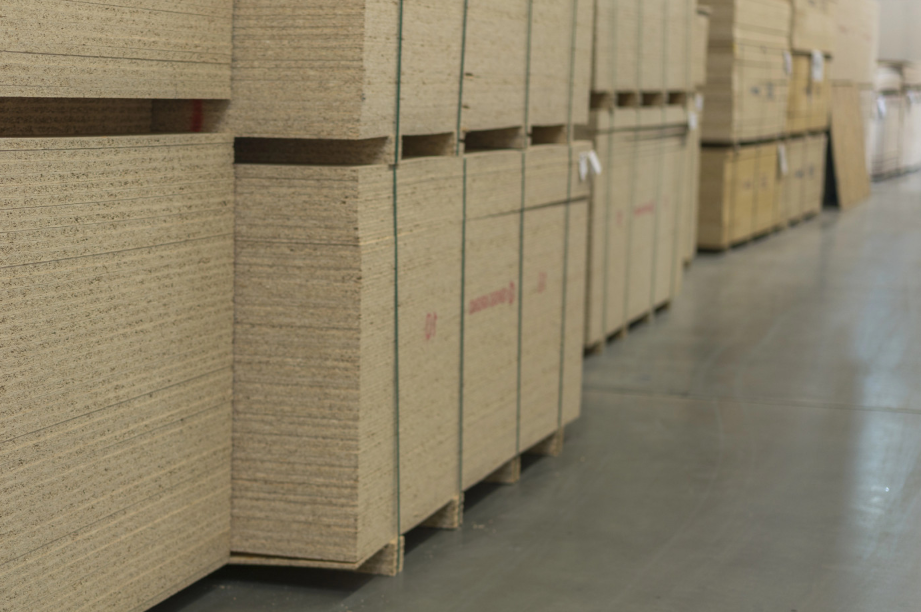
A single percentage-point swing in moisture content can cause a 0.35% thickness change and 0.05% in-plane movement in MDF. That sounds small until you scale it up. A 600mm-wide, 15mm-thick door panel exposed to a 5% MC increase can swell 1.5mm in width and 0.3mm in thickness. That is enough to bind doors, misalign hardware, and stress fasteners before the product leaves the warehouse.
MDF leaves the factory at 7–10% moisture content, within the 4–11% dispatch range allowed by EN 622-1. For Northern European interior applications, the practical target sits closer to 9% ±2%. Yet a board can look bone-dry on the surface while its core, edges, or one face holds far more water. Surface dryness tells you almost nothing about what is happening inside the panel.
Why “Looks Dry” Is the Wrong Test
Humidity does the damage you cannot see. At 20°C, equilibrium MC shifts directly with relative humidity:
-
30% RH → about 5% MC
-
65% RH → about 8% MC
-
85% RH → about 12% MC
Move a panel from a damp warehouse into a heated room, or stack it flat on a wet floor, and you invite trouble. One-sided laminating or painting blocks even moisture exchange. Exposed edges absorb moisture faster than the center. Mixed batches with different MC histories create inconsistencies you will miss without testing.
Swelling from over-absorption is often permanent. MDF rarely returns to its original dimensions after re-drying, and thickness swelling leaves visible surface defects alongside reduced strength.
The Incoming Inspection Protocol I Actually Use
Skip the “one representative sheet” shortcut and measure multiple boards per lot. Check the center, corners, edges, top face, bottom face, and both sides. Record the highest, lowest, and average readings. A large face-to-face or edge-to-core gradient causes far more damage than a high overall average.
Use a calibrated meter suitable for MDF moisture testing, and verify any questionable reading against an oven-dry reference or the supplier’s lab report. Quarantine any panel showing abnormal gradients until it equalizes.
Email template to send your supplier:
“Please provide moisture content readings from at least five boards per lot, measured at center, edges, and both faces, along with your lab’s calibration certificate for the meter used.”
If the supplier cannot produce that, treat 7–10% MC as your fallback benchmark. For humid-use applications, insist on MDF.H or MDF.HLS grades per EN 622-5 instead of standard board.
Density Inconsistency and Weak Core Hidden by a Good Surface
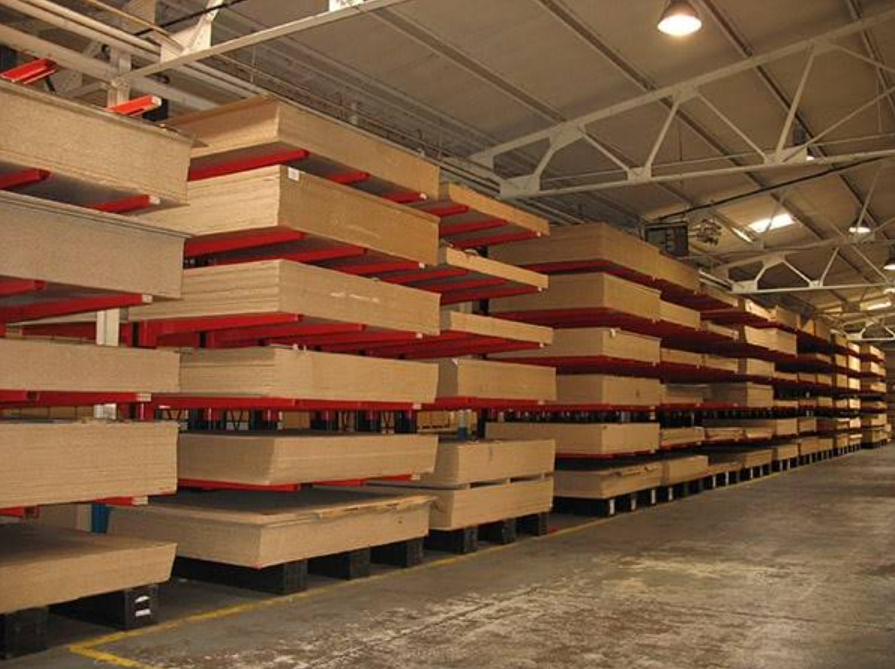
A Baier MDF panel can look flawless and still fail inside the core. Buyers get burned here because a clean face easily masks an unstable structure underneath.
MDF carries a natural density gradient. Surface layers run 1,000–1,100 kg/m³, while the core sits lower, around 600–700 kg/m³. That gap is expected. Problems start when the core drops below that range or shifts across the sheet. Once that happens, screw-holding power, edge-banding stability, and machining quality all take a hit, even if the face looks perfect.
What “Good Surface, Weak Core” Actually Looks Like
A visual scan will not catch this. The tells show up during processing:
Cut edges that crumble, dust, or chip right after trimming, despite a smooth face
Edge-banding that looks fine on day one but lifts, cracks along the glue line, or separates after handling
Screws that grip near the surface but loosen or pull out once they reach the core
Inconsistent cutting resistance across the same board, with corners and centers feeling different under the saw
A thick, well-pressed laminate can mask internal voids and low-density pockets temporarily. The failure appears later, during routing, edge-banding, or repeated assembly.
Numbers That Separate Good MDF From Risky MDF
Standard MDF density: 600–800 kg/m³
Furniture-grade MDF: 700–800 kg/m³, with quality targets around 700–750 kg/m³
Recommended procurement floor: ≥730 kg/m³, held across the entire batch rather than accepted as a single pooled average
Below 620 kg/m³: high risk of weak edges and unstable edge-banding
Strength data backs this up. Core density under 700 kg/m³ often results in rougher machined edges and screw pull-out resistance below 90 psi (0.62 N/mm²). Dense 700–770 kg/m³ panels, by comparison, hold surface screws at around 200 lbf (890 N) and edges at 175 lbf (778 N). If your Baier batch tests below those numbers, investigate the core first.
Internal bond strength provides another benchmark: sound MDF runs 0.5–1.0 N/mm², compared to an overall bending strength of 20–40 N/mm². A panel can pass a standard bend test and still carry a weak internal bond.
How to Inspect Before You Accept the Shipment
Avoid relying on a single density reading. Measure at least 5 points per panel (four corners plus the center) and evaluate edge, center, and corner values independently.
Email template to send your supplier:
“Please provide a density distribution map or multi-point test record for this batch, showing edge, center, and corner readings rather than a single averaged value.”
On the inspection floor, examine cut edges. Continuous dusting, honeycomb porosity, crushed edges, or edge-banding glue that fails to bond properly indicate an underbuilt core.
Set your procurement floor at ≥730 kg/m³ for furniture or cabinet-grade MDF, with no core zones below 600–650 kg/m³. Require batch-level density and internal bond data, as formaldehyde and surface abrasion reports alone will not catch internal structural voids. Verify core strength directly before accepting the shipment.
Thickness Variation, Edge Tolerance, and Panel Warping That Appear After Packing
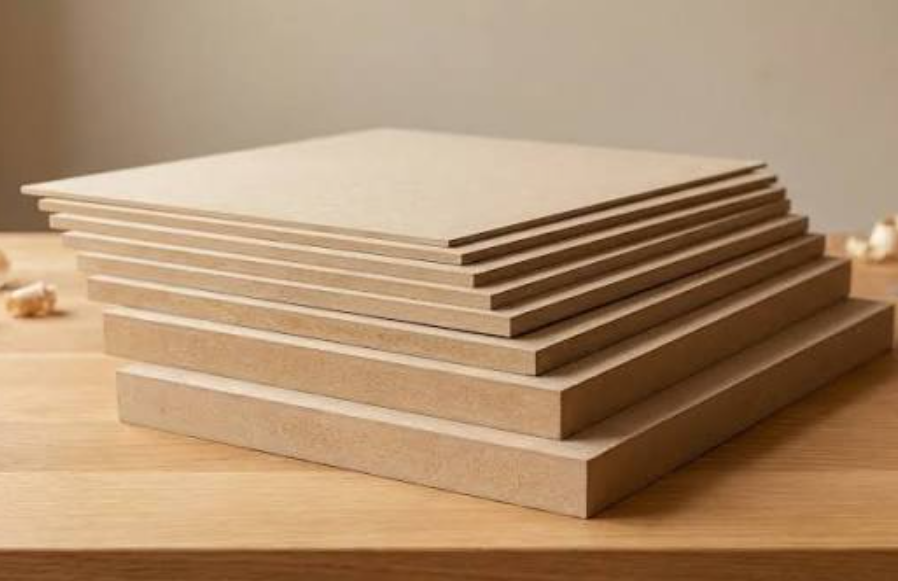
Panels measured before packing rarely match what arrives at the port. Strapping, stacking, humidity, and storage orientation alter the board after your inspector signs off. Checking thickness and flatness only at the factory misses these shifts.
Thickness Tolerance: Tighter Than Most Buyers Assume
Most buyers check thickness with a single caliper reading at the center. That misses edge variations. CPA TFL panel standards require the panel average to stay within ±0.125 mm (±0.005 in) of the specified thickness, and no single point on a sanded panel can deviate more than ±0.125 mm from that average.
By comparison, plywood under ISO 1954 allows more room depending on thickness: up to 0.5 mm for thin unsanded panels, 1.0 mm for 7–12 mm panels, and 1.5 mm for panels between 12–25 mm. Laminated panels under ISO 13894 permit ±0.4 mm on one-sided laminate and ±0.5 mm on two-sided.
Take eight measurements across the board: 25.4 mm (1 inch) from each corner, plus the midpoint of each edge. Compare both the average and the worst single deviation.
Supplier email line: “Please share your eight-point thickness measurement record for this batch, showing both average and maximum deviation.”
Edge Tolerance: Check After Unpacking, Not Before
Edges that look straight at the factory often bow in transit. ISO 1954 sets maximum edge straightness deviation at 1 mm per metre. Composite panels run ±0.2 to ±0.3 mm for thin boards and widen to ±0.5–0.75 mm for multilayer construction.
Check three points: the leading edge, middle edge, and trailing edge. Record chipping, crushing, and swelling separately from straightness, since each stems from a different root cause.
Panel Warping: Bow, Cup, and Twist Hiding in the Stack
Warp shows up in three forms: bow (along the length), cup (across the width), and twist (diagonal distortion). A practical commercial benchmark caps warp at 2 mm per linear metre, though some specs allow ±4 mm/m under expected stress conditions.
Because temperature and humidity shifts during transit trigger bowing and twisting, ISO 13894 requires assessing flatness at delivery.
Where Packing Actually Breaks the Panel
Uneven pallet support creating permanent bow
Over-tightened straps compressing edges below nominal thickness
Mixed thicknesses stacked together, crushing corners
Trapped moisture inside stretch film causing asymmetric cup
Missing caul plates, letting stack curvature transfer into panels
Vertical storage after packing, amplifying twist
Inspection line to use on-site: “Place a calibrated flat table check and feeler gauge reading on three random panels from different pallet positions before I sign off.”
Reject anything exceeding 2 mm/m warp unless your contract allows the wider range.
Weak Internal Bond, Delamination, and Poor Fibre Bonding Inside the Panel
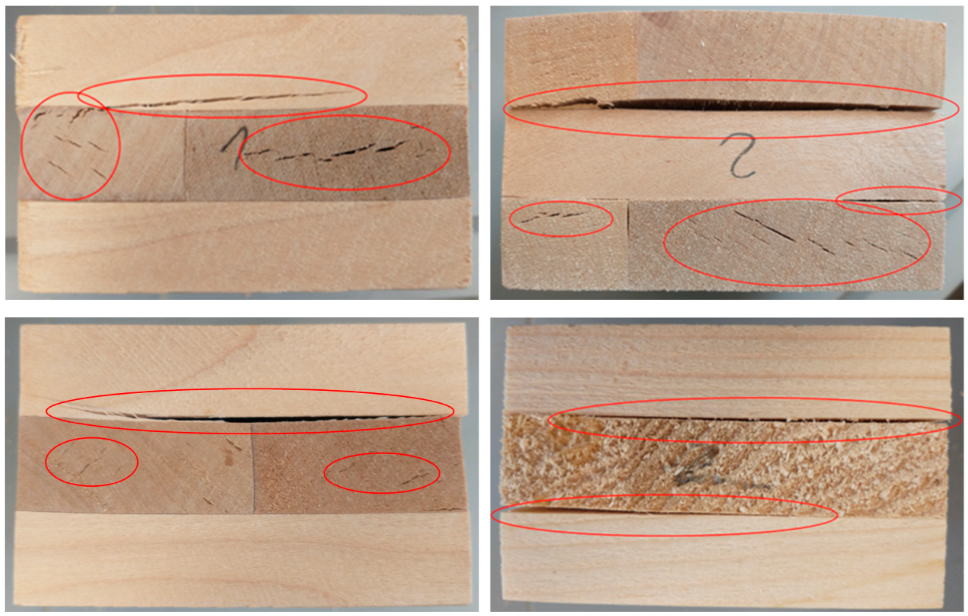
Delamination is hard to spot on the inspection floor. It surfaces weeks later, once humidity swings cause the wood fibres to pull apart. By that stage, you are dealing with a full claim.
Why Panels Split From the Inside Out
Moisture triggers the separation, but poor resin curing and temperature control cause it. Wood fibres swell at different rates than the cured resin around them. When a panel cycles through wet and dry conditions, this mismatch builds internal stress until the bond tears apart. Several process shortcuts create this issue:
Resin content under 5% by weight (the OSB benchmark), which weakens the initial fibre contact
Press temperatures below 200°C or press times under 180 seconds, leaving the resin undercured
High furnish moisture, which wastes press energy generating steam instead of curing the binder
Uneven resin distribution or dry pockets from miscalibrated blenders or poor strand orientation
Wood species high in natural extractives or surface contaminants that block resin adhesion
Missing or thin edge sealant, which lets moisture enter the core in the warehouse
The Test That Actually Catches This: EN 319
Surface inspections miss internal bond failures. Catching them requires EN 319 (BS EN 319) testing. In this test, a lab glues a specimen between loading blocks and pulls it apart perpendicular to the panel face. The calculation divides the maximum tensile load by the surface area of the test block.
The break line pinpoints the manufacturing flaw:
Breakage through the core fibres indicates inadequate resin application or an incomplete cure.
A clean split along a single line points to surface contamination or uneven platen pressure during pressing.
Separation starting at the edges indicates moisture entered past missing edge sealant.
Resin adhered to one surface suggests spray starvation during blending.
Benchmarks Worth Holding Your Supplier To
Standard OSB internal bond minimums sit at 0.34 N/mm² for 6–10mm panels, dropping to 0.30 N/mm² for 18–25mm boards. EGGER lists 0.40 N/mm² on technical datasheets for comparable panels, giving you a clear baseline if your supplier offers lower ratings.
Do not settle for a single average value across a production run. EOTA guidelines specify a 5% characteristic internal-bond value calculated under EN 326-1, which accounts for the weakest panels in the pack.
Ask your supplier for this verification before dispatch:
“Please provide EN 319 internal-bond results showing both the mean value and the 5% characteristic value for this batch, along with furnish moisture and press-cycle records.”
If the supplier cannot supply both figures, the material was not tested to standard. Hold the order before it leaves the mill.
Water Swelling and Moisture Resistance Below the Claimed Grade
“Moisture-resistant” is one of the most misused terms in MDF sourcing. Suppliers put it on spec sheets expecting buyers to read it as waterproof. Yet EN 312 P3 particleboard, the standard reference for humid-condition panels, allows 10–14% thickness swelling after 24 hours in water. If your supplier quotes P3 or an equivalent grade and claims the boards will hold up in bathrooms, kitchens, or coastal shipping routes, that tolerance should worry you.
The Benchmark You Should Actually Be Checking Against
For WPC and NFC cladding or tile products, prEN 15534-5 gives you hard numbers to hold suppliers to:
Mean thickness swelling: ≤10%
Individual thickness swelling: ≤12%
Mean width swelling: ≤1.5% / individual: ≤2%
Mean length swelling: ≤0.6% / individual: ≤1.2%
Mean water absorption: ≤8% by weight / individual: ≤9%
Anything testing above those figures is outright underperformance.
Why “Average” Numbers Lie to You
Untreated OSB swells 10–15% after a 24-hour soak, which means an MDF panel in that range is standard board sold under a marketing label. In contrast, well-formulated WPC should stay below 5% swelling. A recycled-HDPE composite I tested hit 3% swelling and 12% absorption after a 10-day soak test. At the other extreme, a PHBV-based composite recorded 54% water absorption, which shows that polymer content on a spec sheet means nothing without test data behind it.
Repeated wetting causes more damage than a single soak. Solid pine expanded around 5% and exterior plywood reached 10% after 40 weeks of continuous moisture exposure, and wet-dry cycling often drives worse movement than constant wetting. Sustained high humidity alone, even without immersion, has pushed some wood composites to 20–30% expansion.
How I Verify a Disputed Moisture Claim
Condition five specimens at 20°C and 65% RH until stable. Record mass and thickness to 0.01mm. Immerse them in 20°C water for 24 hours, surface-dry each piece, then remeasure. Calculate the swelling and absorption percentages from those measurements rather than relying on a supplier’s summary.
Use this request when writing to a supplier: “Please provide an accredited lab report from SGS, TÜV, or an equivalent ISO/IEC 17025 facility, showing mean and maximum individual swelling separately, along with wet MOR results above 5 N/mm².”
A compliant average can still hide one bad specimen pulling the whole batch down. Don’t accept a single blended number as proof.
Conclusion
All five of these problems stay hidden until you are stuck with a container full of warped, delaminating, moisture-swollen panels in your warehouse.
That is the cost of skipping MDF moisture content testing or letting “looks fine” replace a third-party inspection MDF report.
Stop relying on how the panel looks on the surface. Pull out the moisture meter, request the density gradient data, check the edges under raking light, and get swelling test results in writing before the container seals.
Print the checklist and take it to the factory floor. Make your supplier answer to numbers instead of adjectives.
One skipped step now can mean a full customer refund later.