
Argentina’s construction sector is rebuilding, and the plywood supply chain feeding it is under real strain. Argentina Plywood Imports have swung sharply over the past few years, driven by currency volatility, freight costs, and a supplier base concentrated in just a couple of countries. For traders and importers, that volatility means pricing risk. For construction procurement teams, it means material availability can make or break project timelines. For analysts tracking Argentina timber trade flows, the numbers show where South American construction growth is headed.
Where the plywood is coming from, why supplier concentration is a bigger risk than most buyers realize, and what grades are moving fastest as Argentina’s building boom accelerates. If you’re making sourcing decisions in this market, the details matter.
Argentina’s Construction Market Momentum: Setting the Stage for Plywood Demand
Numbers tell the story better than sentiment ever could. Argentina’s construction industry is projected to grow somewhere between 4.1% and 8.8% in 2025. The spread isn’t a rounding error—it reflects two different ways of measuring the same recovery. GlobalData’s real-growth figure sits at 4.1%, tied to private-sector energy and transport investment that carries momentum through 2029. ResearchAndMarkets puts market value growth at 8.8%, reaching ARS 7.75 trillion, following a blistering 12.7% CAGR from 2020 to 2024. A third estimate lands at 6.8%, framed as a rebound off a low base after 2024 austerity measures sliced roughly a quarter of output.
The monthly data backs the recovery narrative. June 2025 construction activity climbed 13.9% year-over-year. Q2 2025 came in even stronger at +16.1% y/y. Sequential improvement showed up too—June’s +0.9% month-over-month seasonally adjusted followed May’s -1.8% dip, signaling the sector found its footing.
Import volumes confirm this isn’t a saturated market. Wood and wood-product imports totaled just US$82 million across 62,728 tonnes in 2024—a cyclical low. That leaves substantial room for plywood demand to climb as housing recovery, commercial remodeling, and infrastructure works accelerate.
Argentina Plywood Import Trends: Decline, Recovery Signals, and Price Movement
Two consecutive years of falling plywood imports tell a story that construction output alone can’t explain. IndexBox data shows Argentina’s Plywood Purchases from abroad dropped again in 2024, extending a decline that followed two prior years of growth. The wider wood-based panels category fared even worse, posting what analysts describe as a “deep setback” spanning 2018 through 2024. This wasn’t an isolated plywood problem—it was symptomatic of something bigger.
The macro numbers explain the drag. INDEC reported that Argentina’s total merchandise imports fell 24.2% year-over-year through the first nine months of 2024, landing at US$44.049 billion. When an economy pulls back on imports at that scale, construction inputs like plywood get caught in the compression. Domestic demand had weakened through much of 2024. Importers likely destocked existing inventory rather than placing new orders. Add currency pressure and tighter FX access, and non-essential imports naturally got delayed.
Construction output turns before import volumes do. Plywood buying typically lags real activity—importers work through existing stock first, then re-order only after demand proves durable. With construction up 13.9% YoY in June 2025, the sector shows classic signs of what’s better described as a late-lag recovery phase rather than a full plywood import rebound.
Price movement adds another layer. Argentina’s average plywood import price hit US$557/m³ in March 2025, up 6.6% month-over-month. That’s a meaningful jump against weak volumes, and it typically signals one of three things: importers chasing higher-spec or higher-freight cargoes, financing constraints limiting bargain-hunting, or exporters pushing through price increases on a thin market.
For hardwood plywood pricing to stabilize into a cleaner demand signal, volumes need to rise while prices hold steady. Until then, this remains a market defined by lag, not liftoff.
Supplier Landscape: Brazil’s Dominance and the Paraguay-China Dynamic
One country controls this supply chain more than buyers might assume. Brazil sits at the center of South American wood trade, and its reach extends far beyond Argentina’s borders. In 2020, Brazil’s forest-products exports to China and the United States combined accounted for 52.1% of total exports—China alone took 27.9%. That’s concentration risk hiding in plain sight for anyone sourcing plywood export countries in this region.
The Brazil-China wood flow dwarfs regional alternatives. Brazil shipped US$36.5 million in rough wood to China in 2024. Paraguay, by comparison, exported just US$66.9k in the same category to the same market. That’s roughly a 500x gap on one product line alone. Paraguay does show promise—its export-potential analysis flags China as its highest-opportunity market, with an estimated gap of US$1.91 million still unrealized. But construction procurement teams need scale now.
Uruguay plays a supporting role. It’s Paraguay’s largest rough-wood export destination at US$2.38 million, functioning more as a regional absorption point than a primary supply source. Germany and Spain show up in Brazil’s import-partner data too, but they’re relevant for certified or processed wood inputs, not as replacements for Southern Cone raw fiber volume.
For anyone building an Argentina building materials supply chain strategy, Brazil remains the benchmark for logistics, minimum order quantities, and supplier depth. Diversification exists on paper. In practice, it’s still thin.
Construction Demand Drivers Reshaping the Plywood Market
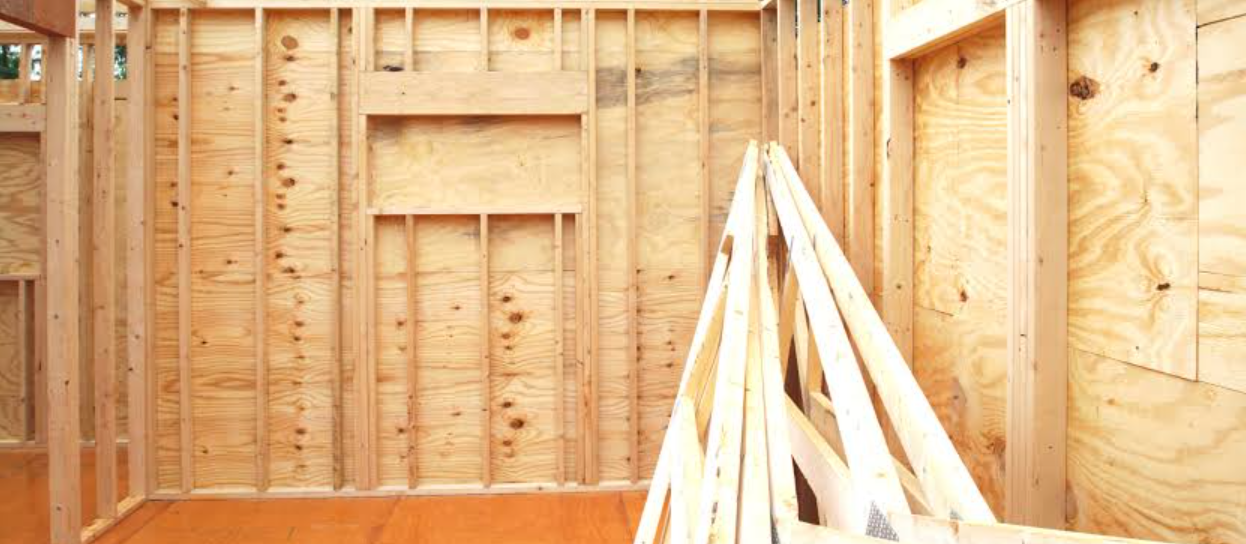
Not all construction spending pulls plywood the same way. Residential projects dominate, accounting for anywhere from 58% to 87.9% of plywood consumption depending on the market studied, covering new builds, renovations, interior wall panels, flooring, and roofing. But the sharper signal sits in structural applications, which claim roughly 67.3% of plywood revenue worldwide. Load-bearing floors, roofing, walls, and formwork move the volume.
For Argentina’s recovery, the segment breakdown is clear. Residential is the largest single driver, covering new housing, remodeling, and interior surfaces. Commercial expansion pulls lighter structural boards, while infrastructure projects like roads, bridges, and rail drive formwork plywood demand. Industrial and institutional uses like schools, hospitals, and warehousing need structural and partition-grade panels.
New construction starts are the core growth engine here. Globally, residential and commercial groundbreakings rose over 8% year-over-year in 2024. The pipeline effect from urbanization, housing expansion, and commercial real estate tends to show up in formwork orders first, then structural panel reorders, and finally interior-grade demand.
Peso stability changes the order sequence. When exchange rates hold steady, imported veneer and adhesive costs stop swinging, letting contractors lock project budgets with confidence. That reduces financing risk for developers, who then greenlight more housing and commercial starts. In the predictable procurement pattern, formwork and structural plywood tenders rise first, followed by furniture-grade and packaging-grade demand.
For buyers tracking plywood quality standards, that means prioritizing moisture-resistant, structurally rated, and eco-certified panels, the specs that infrastructure and green-building projects demand.
Import Dependence Risks: Currency, Freight, and Supply Concentration
Twenty-one and a half percent. That’s Argentina’s share of Brazil’s exports — roughly one in every four dollars Brazil sends abroad lands in Argentina. Since MERCOSUR’s formation in 1991, Brazil has stayed Argentina’s largest trading partner, and that relationship has hardened into structural dependence.
The import composition shows where the exposure concentrates. In the first half of 2023, intermediate goods made up 51.1% of Argentina’s imports from Brazil. Capital-goods parts added another 20%. Passenger vehicles took 8.7%. Combined, intermediate inputs and components exceeded 70% of the flow — the threshold where currency and freight shocks stop being line-item concerns and start disrupting inventory cycles and delivery schedules.
Procurement teams use simple thresholds to flag this risk. Single-source dependence above 30% triggers concentration monitoring. When the top two suppliers combine for more than 60% of volume, any logistics disruption or sharp peso devaluation pushes substitution costs higher. Argentina plywood imports follow that pattern, with Brazil anchoring the supply base.
The landed-cost math shows how shocks transmit. Landed Cost equals factory price times exchange rate plus freight, insurance, duties, and inland transport. For dollar-denominated cargo, peso depreciation hits landed cost directly. High-value, component-dense shipments feel currency swings hardest; low-value, freight-heavy commodities feel shipping-rate spikes hardest. Either way, Argentina timber trade economics stay exposed on two fronts at once.
High-Demand Plywood Grades for Argentina’s Construction Boom
Argentina’s plywood segment is small—US$0.18 million in 2025, projected to reach US$0.21 million by 2030, a 2.88% CAGR. But the grade mix inside that number shows where construction dollars are actually going.
Formwork is the main driver. Argentina’s formwork market is forecast to grow at 4.2% CAGR through 2026, riding bridge, building, and road infrastructure work. For this application, WBP/Class 3 bonding is the non-negotiable spec—outdoor exposure and repeated concrete-pour cycles demand it. Film-faced panels typically run B/C or C/D cores since the overlay masks face defects; core density and bond class matter more than surface cosmetics here.
Three grades, three job sites: – Formwork plywood — shuttering, slab/column/wall forms, built for reuse and moisture punishment – Structural plywood — sheathing, roof and wall diaphragms, load-bearing subfloors, prioritizing strength class and thickness consistency – Interior/decorative panels — cabinetry, wall lining, fit-out work where appearance grade outranks bond durability
Pricing confirms the split. Import prices averaged US$557/m³ in March 2025, up 6.6% month-on-month. Locally, 18mm phenolic plywood runs around ARS 49,515, while film-faced phenolic nearly doubles to ARS 97,123—a clean line between economy bulk sheets and premium industrial grades. Wood carpentry construction costs hit 157,838.7 (1993=100) by early 2026, putting sustained pressure on wood inputs.
Supplier Selection Framework for Argentina-Bound Plywood Buyers
Price alone tells you nothing. A supplier quoting 5% below market means little if delivery windows slip or moisture content fails inspection at the port. Buyers sourcing plywood from export countries need a scoring system.
A 100-point framework works best for evaluating suppliers.
-
Quality and compliance (35 points): Check moisture content: target 8–12%, tightened to ≤12% for tropical port transit. Bonding class: WBP for high-humidity or structural use, MR as the floor for lower-risk applications. Thickness tolerance: ±0.5mm. Density: 650–700 kg/m³. Bond strength: >1.0 N/mm², pushed to >1.2 N/mm² on premium builds. Test reports referencing ISO 16987, 16998, or 16999 are more reliable than verbal assurances.
-
Delivery stability (25 points): Look for on-time delivery rate above 95%, lead-time variance under 10%, container-window hit rate above 90%. Pull six to twelve months of shipment history and check the 95th-percentile lead time, not just the average. Averages hide systemic delays.
-
Landed cost (25 points): It includes factory price plus inland freight, export fees, ocean freight, insurance, duties, VAT, and port handling. Calculate it per cubic meter, not per sheet. Suppliers should quote FOB price, load volume, and documentation fees together.
-
Traceability and risk control (15 points): Look for batch-level tracking from mill to container, FSC chain-of-custody documentation, and CARB/EPA compliance if you are reselling into North America.
Any supplier unwilling to provide these figures on request is a red flag before pricing even enters the conversation.
Market Outlook: Argentina’s Import-Led Plywood Sector Through 2029
Five years from now, Brazil will still be shipping most of the plywood Argentina uses. That’s the baseline. The drivers behind the volume changes are already visible in project pipelines.
The import-value trendline is cyclical. Argentina’s plywood imports by value hit US$6.3 million in 2020, climbed to US$17.8 million in 2022, then eased to US$13.6 million in 2023. Brazil supplied US$9.8 million of that 2023 total. China contributed US$1.7 million. Paraguay added US$1.0 million. Supplier concentration is a fact already in the trade data.
Construction’s medium-term growth supports fresh import demand. Industry forecasts project 5.1% average annual growth from 2026 through 2029, backed by renewable energy and transport infrastructure spending. A 500 MW battery storage tender launched in February 2025 has a 12–18 month execution window, so procurement demand runs through roughly 2026. Argentina’s renewable-energy target (57% by 2030, up from 37% in 2023) plus a national transmission plan covering more than 5,610 km of new 132 kV and 500 kV lines and over US$6 billion in investment points to a second demand wave for formwork and packaging-grade plywood running 2026–2029.
A sizing framework quantifies this. Construction growth typically passes through to imported plywood demand at 1.0x to 1.3x. Applied to an 8.8% construction expansion scenario, that implies roughly 9% to 11% import-demand upside, concentrated in project-grade and certified sheets.
The best commercial targets through 2029:
– Infrastructure contractors working roads, bridges, and rail
– Renewable-energy EPCs building wind, solar, BESS, and substations
– Industrial packagers needing pallet and export-pack plywood
– Wholesale lumber importers in Buenos Aires running repeat container programs
For suppliers positioning against Brazil’s dominance, the strategy splits two ways: compete on landed cost for commodity panels, or win on documented compliance (FSC/PEFC certification, fire ratings, low-emission adhesives) for the certified-spec work that renewable and transport projects increasingly demand.
Conclusion
Argentina’s plywood import story is a story about trust under pressure. Brazil’s grip on supply, Paraguay’s quiet rise, and a peso that refuses to sit still — these forces are rewriting how buyers approach Argentina Plywood Imports in real time. Demand is climbing faster than domestic capacity can match. Pricing volatility isn’t going away. And supplier concentration is the single biggest risk hiding in plain sight for anyone tracking plywood market trends through 2029.
For procurement teams and traders, the move now is to build stability by diversifying supplier relationships before the next currency shock hits. Bayer’s positioning across quality grades and logistics resilience offers that kind of buffer.
Argentina’s construction boom won’t slow down to accommodate a fragile supply chain.