
Two particle boards can look almost identical at delivery — same thickness, same surface finish, even the same price range — yet perform completely differently six months later.
One stays stable in a kitchen cabinet for years. The other starts swelling around the edges, loses screw holding strength, and eventually collapses under everyday load. Most buyers don’t discover the difference until the failures begin.
The problem is that particle board quality is determined long before the panel reaches a warehouse or showroom. Surface appearance tells you very little about what’s happening inside the board.
The real variables sit deeper in the manufacturing process:
Raw material consistency
Resin binder ratio
Pressing pressure and curing time
Density distribution across the panel core
Small shortcuts in any of these areas can create major differences in long-term performance. A board may still pass visual inspection while already carrying weak internal bonding, unstable density profiles, or poor moisture resistance.
This is why particle board failures rarely happen at random. Most follow predictable manufacturing weaknesses that buyers never see on a standard specification sheet.
For furniture manufacturers, importers, and fit-out contractors, understanding these hidden quality variables matters far more than comparing price alone. The wrong board can lead to swelling, delamination, screw pull-out, surface defects, and warranty claims long after installation.
This guide explains why particle board quality varies so much across suppliers, how those differences affect real-world performance, and what buyers should verify before placing large-volume orders.
For buyers comparing different particle board manufacturers, understanding how production variables affect long-term board performance matters far more than comparing price alone.
Quick Decision Guide: How to Identify High-Quality Particle Board
Buyers can usually identify particle board quality through four core indicators:
| Factor | High-Quality Board | Low-Quality Board |
|---|---|---|
| Density | ≥700 kg/m³ | <600 kg/m³ |
| Moisture Resistance | ≤13% swell | >16.5% swell |
| Internal Bond | Stable screw holding | Edge collapse |
| Certification | EN312 + E1/E0 traceable | Generic or missing |
If a supplier cannot clearly provide these four data points, the board quality risk increases significantly. Density consistency becomes easier to evaluate once buyers understand how engineered panel specifications influence machining strength and long-term structural stability.
What Goes Into Particle Board (And Why It’s Never the Same Twice)
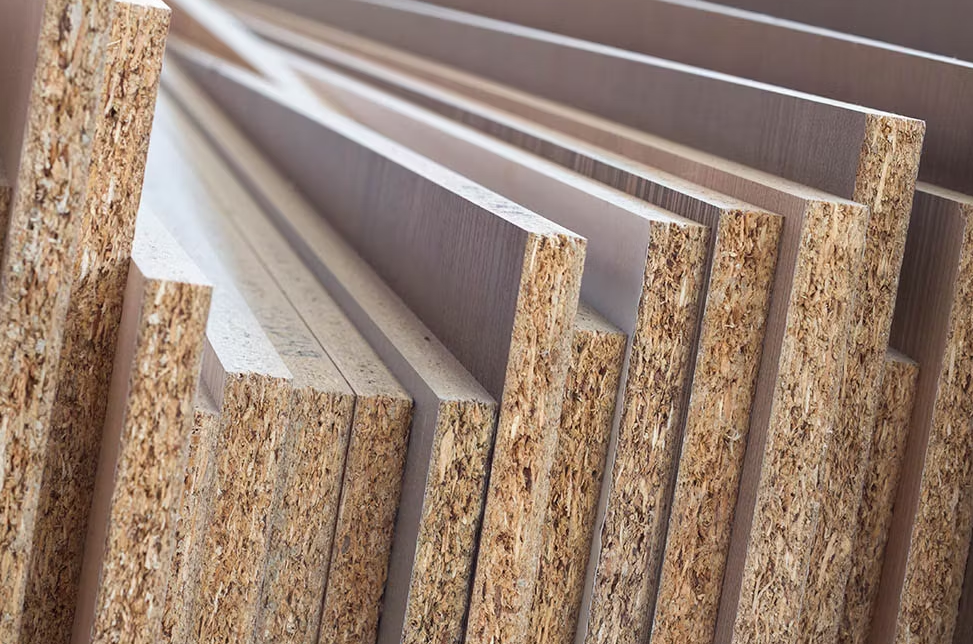
Strip a panel down to its raw inputs. The variation makes sense right away.
Particle board comes from three material streams: fine sawdust packed into outer layers for surface smoothness, wood shavings, and larger core chips that add structural bulk and screw-holding strength. Most mills buy these materials from outside suppliers. That’s where batch consistency starts to fall apart. Chip geometry, moisture content, particle size distribution — none of it matches from one delivery to the next.
The three inputs that determine what you get:
Wood particles — Standard production runs at 90–92% dry weight. Budget manufacturers push that toward 70%+ recycled waste: pallet scraps, sawmill shavings, mixed-grade offcuts. The per-cubic-meter cost drops from $250+ to $150–200. Density uniformity falls with it, by around 5–10%.
Resin binder — Urea-formaldehyde gets sprayed as a fine mist at 8–10% dry weight. It coats every particle and builds the bond network. Drop that to 6–7% — a common cost-cutting move — and internal bond strength falls 10–15% per percentage point removed. Add humidity swings above 50% RH, and delamination follows.
Additives — Paraffin wax and curing agents run at 1–2% in standard production. Cheaper runs cut that to 0.5–1%. Moisture resistance drops 20% as a result.
|
Component |
Standard Mix |
Low-Cost Variant |
Performance Impact |
|---|---|---|---|
|
Wood particles |
90–92% |
92–95% (waste-heavy) |
−5–10% density uniformity |
|
Resin (UF/MDI) |
8–10% |
6–7% |
−15% internal bond strength |
|
Additives |
1–2% |
0.5–1% |
−20% moisture resistance |
The structural logic matters too. Graded-density boards use air jets to sort particles during mat formation. Fines go to the outer layers. Coarser chips go to the core. That layering pushes face density above 800 kg/m³, while the core runs at 600–750 kg/m³. Mix up that gradient with inconsistent particle sizing, and bending strength drops 15–20% before pressing even starts.
This is why particle board quality never stays consistent across suppliers. Outside sourcing brings in moisture variance, chip geometry shifts, and contamination risks. Internal production lines catch some of it — not all. No two mats are identical. The spec sheet won’t tell you that. The panel performance will, given time. Reliable particle board manufacturers usually maintain tighter control over raw material sorting, resin application, and density consistency across production batches.
The Pressing Process Gap: Why Two Boards Can Look Identical but Perform Worlds Apart
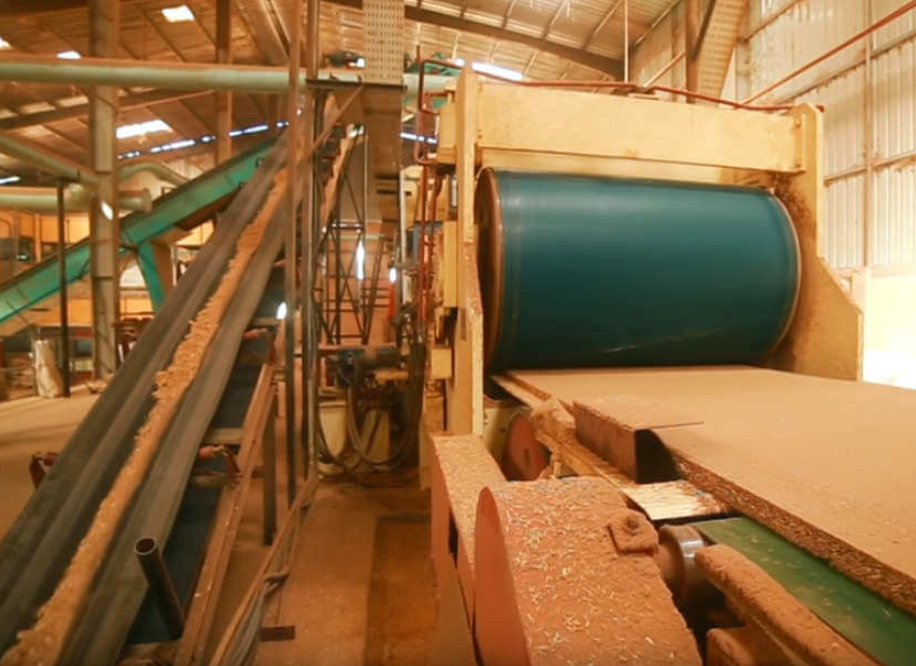
Here’s a number worth sitting with: a 30–40% reduction in core density — hidden from the outside, with zero visible signs.
That’s the pressing process gap. It’s where particle board quality breaks down in ways no spec sheet will ever warn you about.
The physics are simple. Hot pressing runs at 160–200°C and 25–35 MPa for 8–12 minutes. That combination drives resin deep into the core, cures the binder network, and builds a density gradient that holds structure under real load. Cut the dwell time to 4–6 minutes — a move that saves €0.06–0.08 per board and 30–35% on pressing cost — and the surface looks the same. The density meter reads 680–720 kg/m³. It passes visual inspection. It ships.
The core tells a different story. X-ray profiling on under-pressed boards shows 40–60% void content in the interior layer. Actual core density sits at 300–380 kg/m³ — close to half what the surface reading suggests.
The failure timeline runs like clockwork:
-
Months 0–3: No visible issues. Static load performance looks normal.
-
Months 4–8: Micro-fractures form around fastener holes. Screw pull-out force starts dropping.
-
Months 6–12: Edge swelling speeds up. Delamination becomes visible. Load-bearing capacity drops by 50% or more.
A 2024 European supplier audit tracked this pattern directly. A furniture manufacturer received 500 pallets, surface-verified at 710 kg/m³ against a P2 spec. Seven months later, 12–15% of assembled shelving units showed screw failure and edge collapse. The root cause: core density of 320 kg/m³, the result of a 3-minute press cycle instead of the standard 10.
Standard testing won’t catch this. EN 310 bending tests average the dense surface against the hollow core — the result looks fine. EN 320 screw retention passes at 6 months. The failure hits at 9–12. By then, the order is long closed.
|
Board Type |
Surface Density |
Core Density |
Screw Holding Force |
Failure Timeline |
|---|---|---|---|---|
|
Full-Pressed (P2) |
650–750 kg/m³ |
400–500 kg/m³ |
800–1,200 N |
Stable 5+ years |
|
Under-Pressed “Standard” |
620–680 kg/m³ |
280–350 kg/m³ |
400–700 N |
4–8 months |
The margin incentive for suppliers is real. So is the exposure for buyers — up to €112,500 in returns on a single 500-pallet order. Catching the problem means layer-density profiling via X-ray (€500–800 per sample) or acoustic resonance testing (€200–400). Neither is standard practice in most procurement workflows.
The board that fails your client’s kitchen cabinet in month eight looked no different from the one that won’t.
How Moisture Exposure Reveals Hidden Quality Problems
Water doesn’t care what the spec sheet says.
A low-quality particleboard panel — built with UF resin below 6% and poor density uniformity — absorbs 25–40% of its own weight in water after 24 hours of immersion. A high-quality MUF or PF-resin board at the same exposure absorbs 8–15%. That gap isn’t a footnote. It’s the difference between a kitchen cabinet that lasts three years and one that lasts twelve.
Here’s how it breaks down. Low-quality boards use loose flake particles averaging 0.5–1mm thick. Wax content sits below 5%. That structure pulls water in through tiny capillary channels. Once free water activity crosses 0.75–0.85, it starts breaking down the urea-formaldehyde bond network — the same bonds holding the panel together. Swelling speeds up 2–3x faster than in a well-made board. A 10% moisture gain produces a 25% volume increase. Edge banding fails first. Then the core follows. Humidity exposure during transportation is one of the main reasons engineered wood panels develop swelling, mold, and dimensional instability after export shipment.
The Veneer Problem Nobody Talks About
Here’s what makes moisture failures so damaging to your business: they stay hidden until it’s too late.
A 0.3–0.6mm melamine overlay passes visual inspection and matches lab moisture readings — while the core’s water activity climbs beneath it without any visible sign. Industry case studies show 70% of delamination failures had a “perfect” surface right up until separation began.
The failure path in humid environments runs in four stages:
-
Moisture migration — water activity rises 0.1–0.2 with no measurable change in total moisture content
-
Hydrolysis — UF resin breaks down as core water activity crosses 0.7; swelling pressure builds above 2 MPa
-
Adhesive shear failure — veneer detaches at 80–90% RH; this takes 6–12 months in kitchen or bathroom environments
-
Structural collapse — full delamination, 50% strength loss, cabinet failure
US Consumer Reports tracked 500+ installations. 28% showed edge swell exceeding 20mm after 18 months at 85% RH. By year three, 35% of low-quality particleboard cabinets in high-humidity environments had failed outright.
High-quality MUF-resin boards tell a different story. Euro Class E0 particleboard holds its structure at 80% RH for 10+ years. Failure rates stay below 5% at the decade mark.
|
Factor |
Low-Quality Threshold |
High-Quality Spec |
|---|---|---|
|
Water Activity Max |
>0.75 |
<0.60 |
|
24h Thickness Swell |
35–50% |
<12% |
|
Kitchen Cabinet Lifespan |
~3 years |
12+ years |
|
RH Tolerance |
<65% |
Up to 85% |
The board that passed incoming inspection will fail your client’s bathroom vanity in month fourteen. Moisture exposes every shortcut made during manufacturing — the resin cut by two percentage points, the wax left out of the mix, the press cycle that ended four minutes short. None of those decisions show up at delivery. They show up later, as a warranty claim you never saw coming.
How to Verify Particle Board Standards and Certifications
Standards exist to protect buyers. The problem is that most buyers don’t know how to read them — and suppliers know it. European particle board manufacturing standards are primarily defined under EN 312 classification requirements for mechanical performance and moisture resistance.
EN 312 is the European benchmark for particleboard manufacturing standards. It covers seven structural grades, P1 through P7. Each grade sets minimum mechanical performance: bending strength, modulus of elasticity, and moisture tolerance. These aren’t guidelines. They’re hard threshold values. But they only protect you if you know which grade your application needs.
The P-Class System: Seven Grades, One Critical Decision
The grade you specify shapes everything that follows.
P1 / P2 — Non-load-bearing, general interior use. P1 works in dry conditions only. P2 covers humid environments and must pass EN 321 cyclic testing. Minimum bending strength: 10 N/mm². Fine for furniture cores. Not for shelving that carries weight.
P3 / P4 — Load-bearing boards. P3 handles dry conditions at ≥16 N/mm² MOR. P4 adds moisture resistance for flooring supports at ≥20 N/mm². These carry a particle board load bearing capacity spec that P1/P2 will never meet.
P5–P7 — Heavy-duty grades for high-traffic and structural use. P7 is rated for load-bearing in wet-area construction.
Particle board thickness tolerance gets tighter as grades go up: ±0.3mm for sanded panels between 6–20mm. Any drift beyond that range is a red flag in your incoming quality check.
Formaldehyde Emission Classes: What E0, E1, and E2 Cost You
Particle board formaldehyde emission is where health risk enters the picture.
Three classes. Three very different indoor air outcomes:
|
Class |
Chamber Limit (mg/m³) |
Perforator (mg/100g) |
Indoor Air Impact |
|---|---|---|---|
|
E0 |
≤0.025 |
≤3.0 |
<0.03 ppm — negligible risk |
|
E1 |
≤0.124 |
≤8.0 |
0.05–0.1 ppm — within WHO limits |
|
E2 |
≤0.500 |
≤30.0 |
>0.3 ppm — irritation risk, EU indoor use restricted |
E1 is the minimum standard for indoor furniture across the EU. E0 puts out about 80% less VOC than E2. That’s why it’s the go-to for children’s furniture and premium residential projects. E2 boards are banned from general indoor use under current EU regulation. A supplier quoting E2 pricing for an interior job isn’t offering you a deal. That’s a liability waiting to happen.
How to Verify Compliance Without Taking Anyone’s Word for It
Certificates get copied. Dates get changed. E0 claims show up on boards that test closer to E1.5 once an independent lab checks them.
Five checks that protect your procurement:
CE mark + Declaration of Performance (DoP) — It must reference EN 13986 and list the P-class, E-level, and batch number. Any certificate with no batch traceability is worthless. Don’t accept it.
Accredited issuer verification — Cross-check the ILAC logo against the EU NANDO database. Bodies like Intertek and BSI leave a verifiable notifier number. No number found means the certificate is suspect.
Raw test data, not summaries — Ask for the full EN 717-1 chamber report. That means GC results, the chamber graph, and equilibrium readings at 40°C / 45% RH. A summary sheet alone proves nothing.
Independent sample testing — Test three to five panels using the perforator method, at roughly €200 per panel. Genuine E1 reads below 8 mg/100g. Genuine E0 reads below 3.0 mg/100g. The number either checks out or it doesn’t.
Check for CARB Phase 2 compliance — Real E0 claims from export-market suppliers need CARB Phase 2 documentation at ≤0.05 ppm. E0 without CARB proof is an unverified claim, not a confirmed chipboard quality grade.
Fake certificates follow a clear pattern: recycled dates, no QR codes or watermarks, and E0 claims that fall apart under perforator testing. Genuine E1 boards emit below 0.08 mg/m³ after 24 hours. That number is testable, traceable, and non-negotiable.
Knowing the standard isn’t enough. Knowing how to verify it is what separates a protected purchase from an expensive mistake.
5 Physical Tests That Expose Low-Quality Particle Board Before You Buy
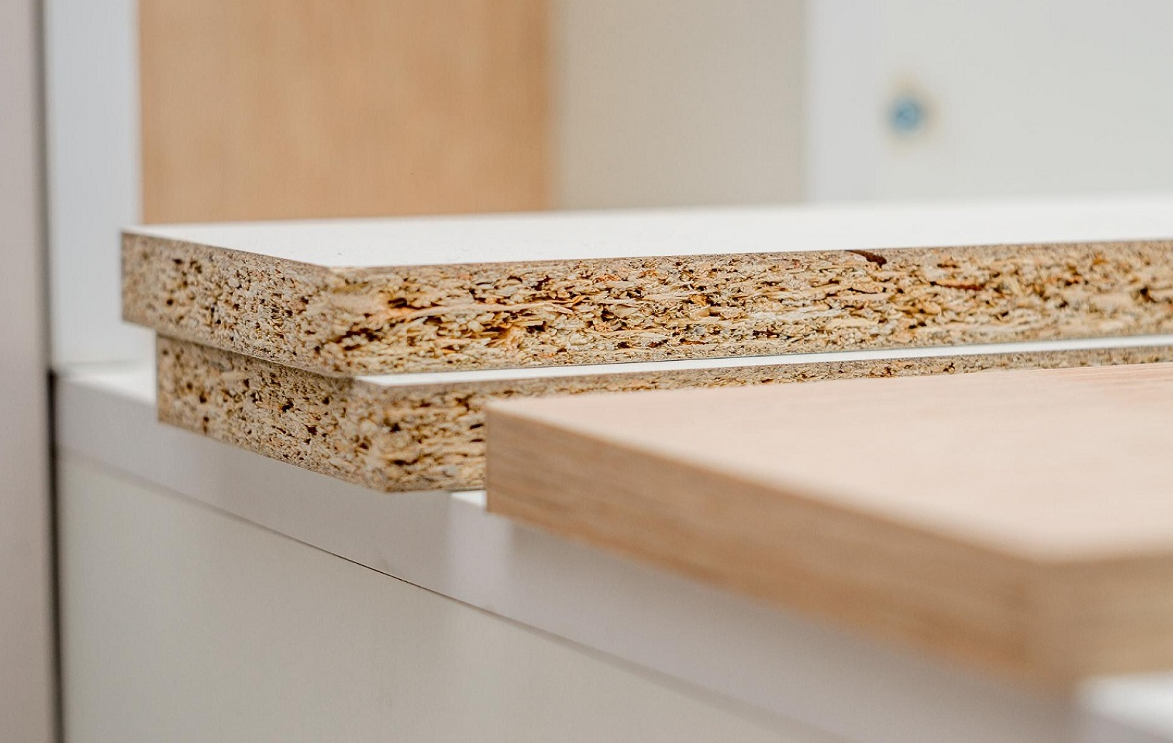
Certificates lie. Spec sheets omit. But a 50×50mm sample soaked in a bucket of water for 24 hours will tell you everything a supplier won’t.
These five tests require no laboratory. No expensive equipment. Just basic tools, a sharp eye, and the willingness to do what most procurement teams skip.
Test 1: The 24-Hour Water Immersion Test
Cut a 50×50mm sample. Submerge the edge in water. Wait 24 hours. Then measure.
Low-quality particle board swells beyond 16.5% — often far more. A Chilean lab study found interior-grade boards swelling from 19.5mm to 23.14mm. That’s an 18.6% increase in one day. The P3 moisture-resistant standard requires thickness swell to stay at or below 13–14%. Anything above 14% on your sample is a rejection.
Water absorption above 96% of the board’s own weight is another clear failure signal. High-quality particle board moisture resistance keeps that number well below 50%.
Test 2: The Weight and Density Check
Take a consistent sample — 500×500×15mm works well — and put it on a scale. Calculate density using mass divided by volume.
The numbers are clear. Below 600 kg/m³ means loose particle structure and poor internal bonding. Standard interior-grade particle board density rating runs 650–750 kg/m³. P3 humid-condition boards should clear 700 kg/m³. Lab testing on softwood P6/P7 boards shows modulus of elasticity values of 2,721–3,403 N/mm². These figures tie to densities above 700 kg/m³. A kitchen cabinet shelf below that threshold is already failing — it just hasn’t shown it yet.
Test 3: The Screw Pull-Out Test
Drive a #8 wood screw 25mm into the panel edge. Pull it out at a right angle — use a force gauge if you have one, or a lever and your own judgment if you don’t. Do this at five separate points across the edge and average the results.
Good P5/P6 particle board load bearing capacity holds above 1,000N. Below 800N on average, reject the batch. Below 500N, the board is breaking apart under the screw head. That’s the same failure pattern seen in month-seven cabinet collapses: fastener pull-out before the structure carries any load at all.
Test 4: Edge Fiber Density Inspection
Run your fingertip along a sanded edge. Then press a 3mm drill into it by hand.
Premium board pushes back. The fiber density feels uniform and tight. No crumbling. Low-quality board gives way — loose, powdery, uneven beneath the surface laminate. A drop in drill resistance of more than 20% within the first 5mm of penetration means fiber density at the edge has fallen below 70% uniform. That’s a clear sign of particle board resin binder failure in the core. P3-compliant edges don’t crumble. If yours does, the density profile you were sold doesn’t exist.
Test 5: The Surface Scratch Test
Drag a fingernail — about 10N of force — along a 100mm line on the panel surface.
Premium board with proper particle board surface finish leaves a faint mark or nothing at all. The overlay stays intact. The resin bond holds. Low-quality board exposes crumbly core particles on contact. Dust lifts. The surface separates from the substrate it was never bonded to. More than 5% of the scratched area flaking means the internal bond has dropped below 0.5 N/mm² — the failure threshold for P5 classification under EN 312.
Quick-Reference Rejection Benchmarks
|
Property |
Pass (Premium) |
Reject (Low-Quality) |
|---|---|---|
|
Thickness Swell (24h) |
≤13% |
>16.5% |
|
Density |
≥700 kg/m³ |
<600 kg/m³ |
|
Internal Bond (Screw Proxy) |
>1.0 N/mm² |
<0.5 N/mm² |
|
MOE (Deflection Proxy) |
≥2,400 N/mm² |
<2,000 N/mm² |
None of these tests take more than 30 minutes of preparation and 24 hours of patience. That’s a small investment against the cost of a failed batch — or a warranty claim you spot too late, after the cabinets are already installed.
Procurement Checklist: How to Avoid Low-Quality Particle Board
Cheap particle board rarely looks cheap at delivery. Experienced particle board manufacturers should be able to provide batch-level density data, moisture-resistance verification, and traceable certification records before production begins.
The problems appear later — swelling around sink cabinets, shelf deflection under normal load, screw pull-out during assembly, or surface separation after humidity exposure. By the time these failures show up, the savings from buying lower-grade board are already gone.
The core mistake is simple: buyers often purchase particle board by price category instead of matching specifications to the actual application.
Different applications require completely different performance thresholds.
| Application | Recommended Specification |
|---|---|
| Bookcases & shelving | ≥650 kg/m³, 16–25mm |
| Cabinets & case goods | ≥700 kg/m³, EN 312 P2 |
| Tables & desks | ≥750 kg/m³, 25mm+ |
| Flooring base | ≥750 kg/m³, moisture ≤8% |
| Decorative wall panels | 600–650 kg/m³, E0/E1 |
A board suitable for decorative wall panels may completely fail in a kitchen cabinet or shelving system. Load conditions, humidity exposure, and span length all change the required specification.
One of the biggest procurement mistakes is choosing thinner or lower-density boards to reduce upfront costs. The savings look attractive during quotation — but disappear quickly once failures begin.
Cheap particle board often lasts only 3–5 years in real applications, especially in humid environments or load-bearing furniture. Higher-quality MR-grade boards can remain stable for more than 10 years under the same conditions.
The hidden costs usually appear in four areas:
Swelling and moisture-related warranty claims
Screw pull-out and cabinet failure
Rework and replacement labor
Client complaints and repeat-business loss
For furniture manufacturers and fit-out contractors, those secondary costs often exceed the original material savings within the first project cycle.
Before approving any supplier, buyers should verify the following checkpoints.
| Checkpoint | Pass Threshold | Reject Signal |
|---|---|---|
| Density | Within 5% of spec | >5% variance |
| Thickness tolerance | ±0.3mm | Outside tolerance |
| Formaldehyde emission | E1 / E0 traceable | No batch report |
| Screw pull-out | >800N average | <500N |
| Thickness swell (24h) | ≤13% | >16.5% |
| Lot traceability | Batch-level records | Missing documentation |
| Surface bond | <5% flaking | Visible separation |
| Certification validity | Issuer-verified | Expired or summary-only |
For new suppliers, moisture resistance and screw-holding tests should be verified on the first three deliveries — not just the initial sample order.
Buyers should also avoid relying on generic terms like “standard grade” or “high-density board.” Procurement requirements must connect directly to the real application:
Humid environment → moisture-resistant grade
Heavy shelving → higher density and thickness
Painted furniture → smoother surface finish
CNC machining → stable density consistency
The cheapest board in the quotation is rarely the cheapest board after installation, replacement, labor costs, and warranty claims are included.
A reliable procurement process starts by matching the specification to the real load condition — then verifying whether the supplier can consistently produce it.
Conclusion
Particle board quality isn’t a mystery. It’s a manufacturing decision made long before the board reaches your warehouse floor. The resin ratio, wood fiber source, applied pressure, and emissions standard all matter. Each variable stacks on the next. Pick the wrong board for the wrong environment, and the failure shows up fast.
For importers sourcing MDF, plywood, and particle board together, working with a wood-based panel factory can simplify quality verification and long-term supply consistency. The difference between a costly mistake and a smart procurement decision comes down to one thing: asking the right questions before signing the purchase order — not after the kitchen starts swelling.
You now have the framework. You know what particle board density rating signals, why formaldehyde emission grades can’t be swapped out, and how a board that passes visual inspection can still break down within eighteen months.
So use it:
Run the checklist
Request the certifications
Push for test data
The cheapest board in the quote won’t stay cheap by the time the project wraps up.