
If you landed on a pile of sanding and priming tutorials, you were sent to the wrong aisle. This guide covers factory-finished MDF, looking at where UV-coated and pre-finished panels belong in your product line and where they will cost you more than they save. Cabinet doors, wardrobes, wall panels and commercial fit-outs each demand something different from a surface, and the wrong choice shows up later as returns, color complaints and thinner margins. Here you’ll match each interior application to the right surface, core and price tier, weigh UV MDF against melamine, HPL and PET, and work through edge banding, export packaging, compliance checks and what to have ready before sending an inquiry to Baier.
Define the Product Position: Factory-Finished Decorative Panel, Not Raw MDF for On-Site Painting

A factory-finished panel sells as a finished decorative product rather than raw material awaiting paint. Your catalog needs to establish that distinction immediately, before buyers start comparing each decorative MDF supplier on grade and density.
Working definition: a rigid MDF panel that leaves the plant with its final decorative face in place. That surface might be UV paint, lacquer, melamine, PET, PVC laminate, or real-wood veneer. The core promise to the buyer is an “install-ready, finished surface” with dependable color, gloss, texture, and edge quality from one batch to the next.
How It Differs from Raw MDF
|
Attribute |
Factory-finished panel |
Raw MDF for on-site painting |
|---|---|---|
|
Surface |
Final coating applied under controlled factory conditions |
Unfinished fiberboard |
|
Site work |
Install, cut or fabricate with limited finishing |
Sanding, sealing, priming, painting, drying |
|
Appearance |
Repeatable color, sheen and texture |
Risk of brush marks, dust and uneven coverage |
|
Edges |
Factory edge-banded or matched |
Raw edges absorb finish and can turn fuzzy |
|
Repair |
Needs a compatible touch-up or replacement panel |
Local repainting is simple |
|
Best fit |
Retail, offices, hospitality, wall panel substrate, cabinetry |
Custom millwork where color changes on site |
Be clear about the trade-offs. Color is locked before delivery, and surface damage takes more effort to repair than wet-painted substrate.
Specify It Like a Product
Typical benchmarks:
– Sheet size: 1220 × 2440 mm
– Thickness: about 2.5–25 mm, with 6, 9, 12, 15, 18 and 25 mm common in architectural work
– Density: 680–800 kg/m³
– Tolerance: about ±0.2 mm on thickness
List available finishes clearly, covering UV-cured matte, satin, gloss, or textured surfaces, melamine paper, PET or PVC film, and real-wood veneer sealed under a clear protective coat.
Cite concrete standards for every compliance claim. Good references include ANSI A208.2, CARB Phase 2, EPA TSCA Title VI, and E0 or E1 low-formaldehyde tiers (commonly cited at ≤0.05 and ≤0.124 mg/L). Include FSC or PEFC chain-of-custody, ISO 9001, and ISO 14001 where certified. For fire performance, quote an actual ASTM E84 or EN 13501-1 test classification instead of writing a loose claim like “fire-rated.”
Every SKU sheet needs sheet size, thickness, core grade, density, finish type, sheen, color code, texture, face and back treatment, edge detail, emission class, fire rating, certifications, MOQ, lead time, and the approved touch-up method.
Critical boundary: pre-primed board still requires a site topcoat, so keep it distinct. Sell this inventory as final-finish, ready-to-install, or fully decorated.
Match Each Interior Application With the Right Surface, Core, Thickness, and Price Tier

Core choice comes first, then surface, then price. Get that order wrong and you end up paying for a gloss finish on a board that swells in a bathroom.
The benchmarks below come from HPL and laminate market listings rather than UV MDF quotes. Use them as price-tier anchors when you position UV-coated or pre-finished MDF against the alternatives.
Application Matrix
|
Application |
Surface |
Core |
Thickness |
Tier and benchmark |
|---|---|---|---|---|
|
Budget cabinet interiors, drawer sides |
Melamine paper or 0.6–0.8 mm liner HPL |
E1/E0 particleboard or MDF |
12–18 mm |
Economy: liner laminate about ₹12–25/sq ft |
|
Standard kitchen and wardrobe shutters |
0.8–1.0 mm decorative HPL (matte, suede, woodgrain, gloss) |
MDF preferred for routed profiles |
16–19 mm |
Mid-market: HPL about ₹42–56/sq ft; finished shutters ₹350–650/sq ft |
|
High-use doors and fronts |
1.2–1.5 mm premium HPL or acrylic/PET |
High-density MDF or plywood |
16–19 mm |
Mid-to-premium: premium HPL sheets about $10–40+ each |
|
Desks, reception counters, retail and café furniture |
1.0–1.5 mm textured or scratch resistant HPL |
Moisture-resistant MDF or plywood |
18–25 mm |
Premium durability: priced above standard residential laminate |
|
Vanity tops, toilet cubicles, lockers |
Compact HPL |
Solid phenolic core |
12–13 mm (8–10 mm light duty) |
Premium: about ₹200–400/sq ft at 12–13 mm |
|
Laboratory worktops |
Chemical-resistant compact or postforming HPL |
Solid phenolic core |
12–20 mm |
Premium: check ISO 4586-2 and moisture absorption below 1.5% |
|
Wall cladding and feature walls |
0.5–1.0 mm HPL on panel, or 3–6 mm compact |
MDF, plywood, cement board or honeycomb as wall panel substrate |
12–18 mm composite |
Economy-to-mid: standard HPL sheets about $5–15 |
|
Interior doors |
0.5–0.8 mm HPL (1.0 mm high traffic) |
MDF, plywood or engineered core |
35–45 mm complete door |
Economy-to-mid |
|
Shelving and carcasses |
Melamine faced MDF or particleboard |
E1/E0 particleboard |
16–25 mm |
Economy |
|
Fluted, routed and premium fronts |
Veneer, acrylic, PET or premium HPL |
MDF |
16–25 mm |
Mid-to-high: price rises with coating, thickness, brand and E1/E0 class |
Rules of Thumb
Vertical, low-wear faces: 0.5–0.8 mm is enough.
Visible furniture: 0.8–1.0 mm on 16–19 mm board.
Horizontal or high-traffic surfaces: step up to 1.2–1.5 mm or compact laminate.
Wet zones: use compact phenolic instead of ordinary laminate on untreated MDF.
Compact load-bearing panels: look for a density of at least 1,350 kg/m³ with ±0.1 mm tolerance.
MDF suits routed and painted fronts, which is where high gloss MDF panels and matte UV MDF compete. Plywood holds screws and handles moisture better, while particleboard keeps flat panels cheap.
Use an Application Selection Matrix Before Adding UV MDF to the Product Portfolio
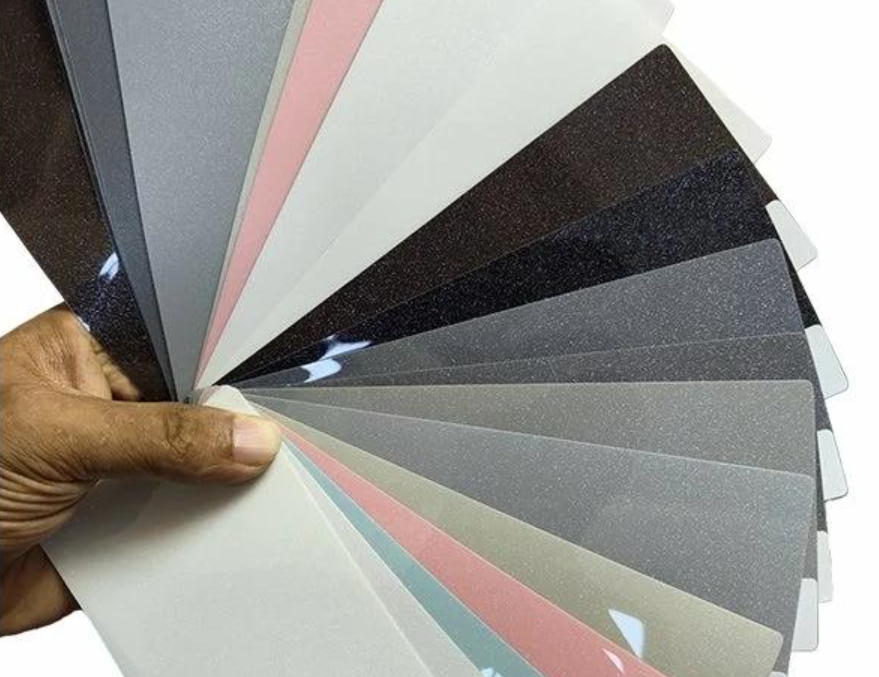
A good-looking sample board is no reason to list a SKU. Score it first. Rate each criterion from 1 to 5, multiply by its weight, and require 70/100 or higher alongside the compliance gates below.
The Weighted Scorecard
The evidence column draws on datasheets from comparable UV-coated MDF products. Use these figures as benchmarks to verify against your supplier’s test reports rather than taking them as guarantees.
|
Criterion |
Weight |
Pass benchmark |
Evidence from comparable datasheets |
|---|---|---|---|
|
Application fit |
20% |
Defined indoor use |
Furniture, cabinetry, shop fittings, displays, wall units, dry-area linings |
|
Moisture exposure |
15% |
Dry or controlled humidity |
24-hour thickness swelling of about 10–15%, depending on thickness |
|
Surface durability |
15% |
Meets project scratch and abrasion needs |
Grade 5 dry-heat and damp-heat resistance; scratch resistance around 0.9 N |
|
Emissions and compliance |
15% |
Market certificate verified |
E1, E05, CARB Phase 2 or TSCA Title VI; EN 622 Type 5 core |
|
Mechanical performance |
10% |
Suits doors and routed parts |
Bending strength 18–22 N/mm²; MOE 2,100–2,500 N/mm²; internal bond at least 1.00–1.05 N/mm² |
|
Dimensional control |
10% |
Works with CNC and edging |
Length, width and squareness ±2 mm/m; thickness ±0.2 mm |
|
Fire performance |
5% |
Meets contract class |
D-s2,d0 under EN 13501-1; higher classes need separate certified construction |
|
Size and thickness |
5% |
Fits customer cutting plans |
1220 × 2440 mm and 1830 × 2440 mm; 2–30 mm |
|
Supply quality and yield |
3% |
Acceptable defect policy |
One supplier spec shows 70% flawless panels; negotiate tighter A-grade yield for visible fronts |
|
Processing compatibility |
2% |
Validated on your line |
Sample-test chip-out, edge adhesion, coating cracks, saw marks, film removal |
Where UV MDF Fits and Where It Doesn’t
|
Application |
Suitability |
Control required |
Portfolio action |
|---|---|---|---|
|
Kitchen doors and drawer fronts |
High |
Scratch, dry-heat, edge and cleaning tests; E1/CARB2/TSCA papers |
Core SKU if surface tests pass |
|
Bedroom, living-room, office furniture |
High |
Indoor-use declaration, colour consistency, machining samples |
Standard white plus high-demand colours |
|
Shop fittings and displays |
High |
Abrasion, impact, repeat cleaning, replacement supply |
Commercial-grade finish |
|
Wall units and decorative panels |
High |
Flatness, panel size, fire class where required |
Large-format options |
|
Bathroom interiors |
Conditional |
Validate edges, joints, condensation resistance |
Never market as waterproof untested |
|
Laundry cabinetry |
Conditional |
Moisture-cycle and edge-seal validation |
Sealed edges and installation limits only |
|
Signage and exhibition panels |
Conditional |
Print adhesion, handling durability, thickness |
Thin or lightweight option after trials |
|
Marine, caravan, transport, exterior |
Low |
Separate humidity, vibration, UV-weathering, fire tests |
Keep out of the standard range unless certified |
Documents to Collect Before Listing
A technical datasheet covering density, thickness tolerance, moisture content, bending strength, internal bond, swelling and fire class.
An emissions certificate for E1, E05, CARB2 or TSCA Title VI.
Finish test reports for scratch, dry heat, damp heat, colourfastness and cleaning resistance.
Full-size samples in every proposed finish and thickness.
Written manufacturer limits for humidity, temperature, storage, machining and edge treatment.
A batch colour-tolerance procedure and replacement policy.
Confirmed dimensions, MOQ, lead time, packaging details and defect allowance.
The Approval Gate
Approve the SKU only when it:
Scores 70/100 or higher.
Passes emissions and application-compliance checks.
Shows acceptable CNC cutting, edge banding, drilling and cleaning results on your equipment.
Carries documented restrictions against wet, exterior, marine and high-humidity use.
Offers at least one viable format, such as 1220 × 2440 mm, in thicknesses that match cabinet and furniture demand.
Compare UV-Coated MDF and Pre-Finished MDF With Alternative Surface Systems
Sheet price tells you little about which surface actually works best. Repair difficulty, edge risks, and finish consistency matter far more once panels hit the production line.
|
Surface system |
Strength |
Main limitation |
Sourcing data (supplier listings) |
|---|---|---|---|
|
UV-coated MDF |
Smooth gloss, satin, matte, or embossed face; high scratch, chemical, and abrasion resistance (verifiable by DIN 68861 testing) |
Deep scratches are difficult to fix. Gloss highlights fingerprints and edge imperfections, and finish quality depends on coating-line controls. |
18 mm high-gloss example: MOQ 50 sheets, about US$18–25 per sheet |
|
Melamine-faced MDF (LPL) |
Consistent finish, cleans easily, runs fast through machining, and costs less than post-painted panels |
Lacks visual depth and cannot be spot-repaired. Raw edges require PVC, ABS, or melamine edge banding. Lower impact and heat resistance than HPL. |
Core density runs 720–780 kg/m³ |
|
HPL-faced MDF |
Best impact, abrasion, and heat performance of the group |
Higher material and press costs. Seams and heavy impact marks cannot be hidden after repair. |
18 mm example: about US$10–13 per sheet |
|
PET-faced MDF |
Low-glare matte or soft-touch surface with solid fingerprint resistance |
Corners and edges require precise gluing. Panel performance depends on film thickness and glue selection. |
Same 6–30 mm range and 1,220 × 2,440 mm format |
|
PVC-faced MDF |
Foil stretches over routed profiles, contours, and curved edges |
Low heat tolerance. Foil can lift near ovens, dishwashers, or steam. |
Offered beside melamine, PET, UV, and HPL lines |
|
Veneered MDF |
Authentic wood appearance that accepts sanding and refinishing |
Natural color and grain shifts require tighter receiving inspection. |
Custom thickness and emission grade available |
|
Painted (post-finished) |
Any custom color with seamless profiles and no edge seams |
High labor and cure times. Carries risks of dust contamination, orange peel, and batch mismatch. |
Suits custom, small-to-medium runs |
These prices reflect individual supplier listings rather than direct head-to-head quotes. Core board, coat count, color, and order volume will shift the final numbers.
Which System Fits Which Job
Lowest-cost standard casework: melamine-faced MDF.
Premium gloss: UV-coated MDF. Specify gloss level, single or double-sided coating, scratch and chemical test targets, and batch color tolerances.
Heavy wear: HPL-faced MDF. Specify laminate grade, pressing adhesive, and edge system.
Matte, fingerprint-resistant fronts: PET. Put the exact film thickness, adhesive type, and edge-delamination test requirements directly into the purchase order.
Curved or profiled doors: PVC film, which wraps profiles where rigid HPL breaks.
Natural wood: veneer. Specify wood species, flitch matching method, and topcoat sheen.
Damp rooms: MR/HMR MDF produced with waterproof resin cores and fully sealed edges.
Most supplier catalogs stock 6–30 mm thicknesses paired with matching PVC, melamine, or pre-laminated edge banding. Before you lock the spec, compare durability and cost with an HPL and melamine MDF supplier.
Build Product Combinations for Brands, Distributors, Projects, and E-Commerce Channels
Nobody buys a finished panel in isolation. It ships with edge banding, a compatible touch-up method, and a spec file, and your catalog should sell it that way.
Match the Bundle to the Channel
|
Channel |
Example combination |
Pricing structure |
What it demands |
|---|---|---|---|
|
Brand / private label |
One hero panel (matte UV MDF or high gloss MDF panels) plus matching edge banding for MDF and a touch-up kit, or a budget line from a melamine MDF board supplier |
8–12% bundle advantage |
Consistent BOM, private-label packaging |
|
Distributor |
SKU-compatible kits with fixed component lists and substitute rules |
Standard price below 500 units, then tiers at 500, 1,000 and 2,500 |
Carton quantities, compatibility |
|
Project |
Ready-to-install MDF kits by room, area or installation phase |
Per-project kit or pallet tier |
Accurate BOM, coverage calculation, delivery scheduling |
|
E-commerce |
Starter, professional and replenishment sets |
8–12% value pricing, or a no-discount convenience bundle |
Inventory sync, bundle SKU management |
Use Three Levels
Essential: 2–3 core SKUs.
Professional: core SKUs plus accessories or consumables.
Project/enterprise: full quantity, spares, packaging, documentation and service support.
Price Kits Carefully
These figures are general B2B bundling benchmarks, not MDF quotes. If you need a discount, set the kit about 8–12% below the combined à-la-carte price. That protects your margin far better than taking a deep cut on a single item. Well-built bundles regularly lift average order value by 20–30%. In one Shopify case, average order value rose from $66.84 to $85.33 (27.6%) without changing individual prices.
Write Every Kit Down
Give each bundle a name based on its application and outcome. Document the exact SKUs and quantities, approved substitutes, MOQ, case pack, tier prices, lead time, and sample policy. Include the full technical packet with the datasheet, emission certificate, finish test reports, and warranty terms. Add a replenishment rule as well, such as refill packs of edge banding on a 30-, 90- or 365-day cycle.
Launch Lean
Start with stock panels and custom outer packaging. Save custom colors, textures, and printed components for combinations that have proven annual volume.
Specify Cutting, Edge Banding, CNC, and Custom-Finish Requirements Before Quotation
Vague requests get vague quotes. If you send a supplier “UV MDF, 18 mm, some doors,” that price will change the moment drawings arrive. Lock these four areas down first.
Cutting
Board and size: name the exact type and grade, such as 18 mm MDF at ±0.2 mm on 2,440 × 1,220 mm sheets. “Wood” is not a spec.
Cut list: include part number, length × width, quantity, grain direction, face orientation, edge treatment, and drawing revision.
Tolerance: ±0.5 mm is a practical standard for general panel sizing. Quote anything tighter as a separate line item and get it confirmed in writing.
Yield: state whether you need nesting, grain matching, a minimum offcut size, or a material-yield report.
Special cuts: list mitres, angles, cut-outs, slots, radii, and pockets.
Edge Banding for MDF
Material and thickness: ABS, PVC, PP, veneer, solid wood, acrylic, aluminum, or matching tape, usually in 0.4, 0.8, 1.0, 1.5, or 2.0 mm.
Color match: provide a manufacturer code, RAL reference, or physical sample to your melamine MDF manufacturer.
Process: hot-melt EVA, PUR, or laser. PUR or laser banding is the standard benchmark for moisture exposure or seamless premium work.
Corners and glue line: define flush trim, corner radius, and acceptable glue-line visibility.
Dimension basis: state clearly whether panel sizes apply before or after banding.
CNC Work
Send a STEP or IGES model alongside a dimensioned 2D PDF showing revision, units, and datums. Detail all drilling, grooves, hinge boring, dowel holes, and profiling. For holes, give diameter, depth, pitch, edge distance, and the hardware system.
Reserve tight tolerances for mating or functional features. Standard machined features usually hold ±0.13 mm; anything down to ±0.025 mm requires special fixturing. Set tear-out limits, mark cosmetic zones, and state whether you require first-article inspection.
Custom Finish
Color and gloss: use RAL, Pantone, or an approved physical sample. Define gloss numbers where possible, such as 10–20 GU at 60° for matte.
Coverage: identify visible faces, concealed faces, edges, and masked areas.
Tolerance basis: specify whether tolerances apply before or after coating, since finish build alters fit. For example, black anodizing adds roughly 5–8 μm.
Acceptance: set limits for color variation, orange peel, pinholes, dust, and touch-up repairs.
Approval: require a signed-off sample before running custom colors.
Quote Package Checklist
Cut list and nesting file
3D CAD plus 2D drawings
Edge-band map
CNC and hardware schedule
Finish schedule with sample reference
Inspection requirements
Quantities with price breaks at 1, 10, 50, 100, and 500 pieces
Packaging, delivery date, and destination
Certificates needed
Have the supplier price every secondary operation on its own line: cutting, CNC, banding, finishing, inspection, packing, and freight.
Design Packaging and Export Protection Around the Finished Surface
Most surface damage happens inside the carton after parts leave the line. This guidance draws from standard packaging practice for finished surfaces, so adapt it to your UV-coated or pre-finished MDF and confirm it on real samples.
Isolate the Face
Put a soft, non-abrasive layer against the finish, such as nonwoven fabric, tissue, or low-lint film.
Keep corrugated board, wood grain, staples, cable ties, and foam edges off the cosmetic face.
Place anti-scuff interleaf sheets between stacked panels.
Spread restraint loads across broad foam pads instead of narrow straps.
Add Moisture Protection for Sea Freight
Combine a sealed moisture-barrier bag, desiccant, and a humidity indicator.
Seal the bag after the product cools down to avoid trapping condensation.
Mark the packing date and add “open only in dry conditions.”
For long storage, use a crate with a raised internal platform.
Use VCI film or paper only for metal fittings in the kit, and test compatibility on the actual finish first.
Validate the Whole Pack
Run ISTA 3B for less-than-truckload shipping. For Asia-to-U.S. lanes, use ISTA Project 3M, which includes 72 hours at 100°F and 85% relative humidity.
Accept the pack only if there are zero visible scratches, scuffs, dents, coating transfer, water spots, or gloss changes. Panels must show no foam imprinting or adhesive residue.
Verify Performance, Emissions, and Compliance With a Purchase-Specification Checklist
A compliance claim means nothing on its own. Under ISO 9001, buyers carry the responsibility to define product requirements through specifications, drawings, standards, and purchasing data. Put your specific checklist into the purchase order before your MDF panel supplier sets terms for you.
Performance and Emissions
Performance: Require a guaranteed value, test method, and tolerance for each property, such as scratch resistance, gloss, and thickness. Get supporting test evidence alongside the values.
Emissions: Require exact measured test results against each limit. Record the certificate number, the covered model or product family, and the applicable standard.
Test basis: Make sure test results come directly from the regulatory method mandated in your target market.
Jurisdiction: State the target country, state, and specific edition of each required standard on the order.
Supplier Qualification
Check the scope, issuing body, certificate number, expiry date, and manufacturing site on every ISO 9001 or ISO 14001 certificate.
Review how the plant manages inspections, tool calibration, nonconforming parts, and corrective actions.
Request references from buyers placing comparable orders.
Documents and Acceptance
Require these before shipment:
Approved datasheet and revision-controlled specification
Certificates of conformity and test reports
Calibration records for the instruments used during testing
Handling instructions, storage requirements, and warranty terms
When the shipment arrives, check the model number, batch code, labels, and packaging condition first. Run technical testing after that visual inspection clears. Keep all photos, raw data, and ambient test conditions on file. Release final payment after you approve the documents and the goods pass your acceptance tests.
Contract Clauses
No deviation: The supplier must get written approval before switching materials, coatings, or manufacturing sites. Also require any MDF supplier with shipping protection standards to document packaging and moisture barriers.
Traceability: Batch numbers must trace directly back to the production line.
Audit rights: Reserve the right to inspect facilities, quality logs, and raw test data.
Nonconformance: Set firm deadlines for defect notices, root-cause reports, and part replacements.
Remedies: Define who covers retesting costs, and spell out rejection rights or warranty extensions.
Supplier Response Table
|
Requirement |
Supplier response required |
|---|---|
|
Performance rating |
Guaranteed value, test method, tolerance, evidence |
|
Emissions |
Measured results, certificate numbers |
|
Compliance |
Applicable standards, certificates, expiry dates |
|
Quality system |
Certification scope, site, audit evidence |
|
Acceptance |
Procedure, instruments, pass/fail criteria |
|
Deviations |
Full list with approval status |
|
Warranty |
Duration, exclusions, response time |
Set a Repeatable Incoming-Inspection and Sampling Procedure
Even a good supplier ships a bad lot now and then. A written procedure catches those parts at your receiving dock instead of at your customer’s site.
Define the Lot First
A single lot must share identical production conditions: one supplier, one purchase order, one part number and revision, one production batch, and one Certificate of Conformance. Never combine items with different dates, revisions, or certificates. Record the lot quantity, carton and pallet counts, supplier batch number, and receiving date.
Write a One-Page Inspection Plan per SKU
For each UV-coated or pre-finished MDF part number, include:
Specification revision, critical dimensions and tolerances
Finish, color, gloss and edge requirements
Inspection equipment and its required accuracy
Sampling standard: ANSI/ASQ Z1.4 or ISO 2859-1
Inspection level: General Level II by default
AQL by defect class: critical 0 accepted, major 1.0–2.5, minor 2.5–4.0
Accept/reject numbers (Ac/Re) and required documents
AQL represents the worst tolerable process average, and it never permits accepting a known critical defect. Pull Ac/Re limits directly from the current controlled standard rather than copying them into local documents.
Draw the Sample Correctly
Determine lot size.
Select the inspection level.
Convert both into a sample-size code letter.
Read sample size and Ac/Re from the table.
Pull sample units across different cartons, pallets, layers, and positions. When you can identify sub-lots, use proportional sampling. Neither the supplier nor the receiver should ever hand-pick “representative” panels. Mark every carton sampled and log the sample IDs. Inspect suspected transport damage on its own and preserve the evidence.
Inspect in a Fixed Order
Documents: PO, certificate of conformance, test certificates, declarations such as E0/E1 emission reports
Packaging and labels: part number, revision, batch traceability
Visual workmanship: scratches, contamination, deformation, discoloration
Dimensions: calibrated tools suited to the tolerance
Functional tests: fit, operation or any defined test
Defect classification: critical, major or minor
Decide and Escalate
Accept the lot only when defect counts stay within the Ac/Re limits, and reject it as soon as a count reaches the rejection number. Any critical or safety-related defect holds the lot immediately, regardless of what the sampling statistics show. Never average measurements together to offset an out-of-spec unit. Use ANSI/ASQ Z1.9 for variable measurements.
Set clear switching rules for normal, tightened and reduced inspection. State how many consecutive accepted lots earn reduced inspection, along with what triggers tightened inspection. Return to normal or tightened inspection after finding a critical defect, changing a process, or releasing a spec revision.
Handle Rejected Lots
Hold material physically and in the system.
Issue a nonconformance report with defect counts, photos and measurements.
Choose a disposition: return, 100% sort, rework, concession or scrap.
Demand corrective action for recurring defects.
Reinspect reworked material under a documented rule.
Keep rejected samples until disposition is approved.
Keep a Traceable Record
Log the supplier lot, part revision, PO, receiving date, sample size, inspection plan parameters, inspector, and all equipment along with its calibration status. Record individual measurements, defect classes, the pass/fail decision, corrective-action numbers, photos, and the final disposition.
Prepare a Complete UV MDF Supplier Inquiry for Baier
A short inquiry gets a short, vague quote. Send all your specifications in one message to skip two or three rounds of back-and-forth emails.
Specify the Product
Core and size: furniture-grade MDF, 1,220 × 2,440 mm, 18 mm preferred. Include 6, 9, 12, 15, 16 and 25 mm if needed.
Density and surface: target 680–800 kg/m³ and request their exact figure. Specify the finish as UV coating over raw MDF or melamine-faced MDF, in high gloss or matte.
Colors and back side: white, black, grey, wood grain or custom. Ask for separate pricing on each back-side option (matching UV, white melamine or balancing layer).
Edges: calibrated and square, with low chipping.
Demand Numbers and Original Documents
Ask for gloss levels in GU at 60° for each finish. Request abrasion results under ASTM D4060 (aiming above 1,000 cycles for high-traffic furniture), plus official test reports covering scratch, impact, adhesion, chemical resistance, board flatness, and E0/E1 formaldehyde emissions.
Require copies of current certificates, including CARB Phase 2, ISO 9001, CE and FSC, along with the technical datasheet, SDS, country of origin and HS code. Catalog claims are not proof.
Quote Structure
Request pricing per sheet, per m² and per m³, under both FOB and CIF terms, along with price validity dates. Have the supplier itemize packaging, sample and color-development fees, payment terms, container loading capacity and production lead times.
Published market benchmarks run about US$8.95–14.87 per sheet for solid-color UV MDF and US$18–25 for certain 18 mm high-gloss panels. Comparable MOQs range from 50 sheets to 500 pieces, 10–35 m³ or a full container, with delivery windows usually around 10–15 days. Ask the supplier to break out their MOQ by color, sheet size, thickness and private-label packaging.
Close With Proof Requests
Also ask for:
Factory capacity
Coating line details
Batch traceability
A defect credit policy
Pallet and moisture protection
Production photos
Confirmation that the quote comes from the MDF board manufacturer or an authorized exporter
Conclusion
Positioning UV-coated and pre-finished MDF comes down to three decisions. First, treat it as factory-finished MDF, sold and evaluated on its decorative surface. Second, use the selection matrix to match each application to the right surface, core, thickness, and price tier, then compare total cost against raw-board spraying, melamine, HPL, and PET rather than sheet price alone. Third, protect the finish from the first cut to the final shipping container. Settle cutting, edge banding, and packaging details before quoting, then verify emissions and performance against a written checklist and repeatable incoming inspections.
You now have the framework. Gather your application details, quantities, target market, and finish requirements, and send a complete inquiry to Baier at baierfloor.com. A clear spec turns a long quoting back-and-forth into a single conversation.