
According to research on medium-density fiberboard material properties, panel density directly affects bending strength, screw holding capacity, and dimensional stability. So picking between furniture-grade and decorative MDF isn’t as simple as it looks. You open a supplier’s catalog, scan the specs, and suddenly nothing is clear. A wrong choice leads to real problems — warped cabinet doors, stripped screws, or a finished product that falls apart too soon.
The gap between these two materials goes beyond technical details. It’s the difference between a project that holds up and one that fails quietly over time. Many buyers researching MDF surfaces also compare decorative panels with laminated boards. Understanding the difference between MDF and melamine board helps clarify how surface finishes affect durability.
This guide breaks down what separates them. We cover MDF density rating, bending strength, surface finish quality, and real-world application fit. Compared with other engineered wood panels, MDF typically provides higher density and more stable machining results. A detailed MDF vs particleboard strength comparison shows how density influences structural performance. Sourcing for a full production run or a single custom build — either way, you’ll know which grade your project needs before you order.
Furniture-Grade MDF vs Decorative MDF: Key Differences
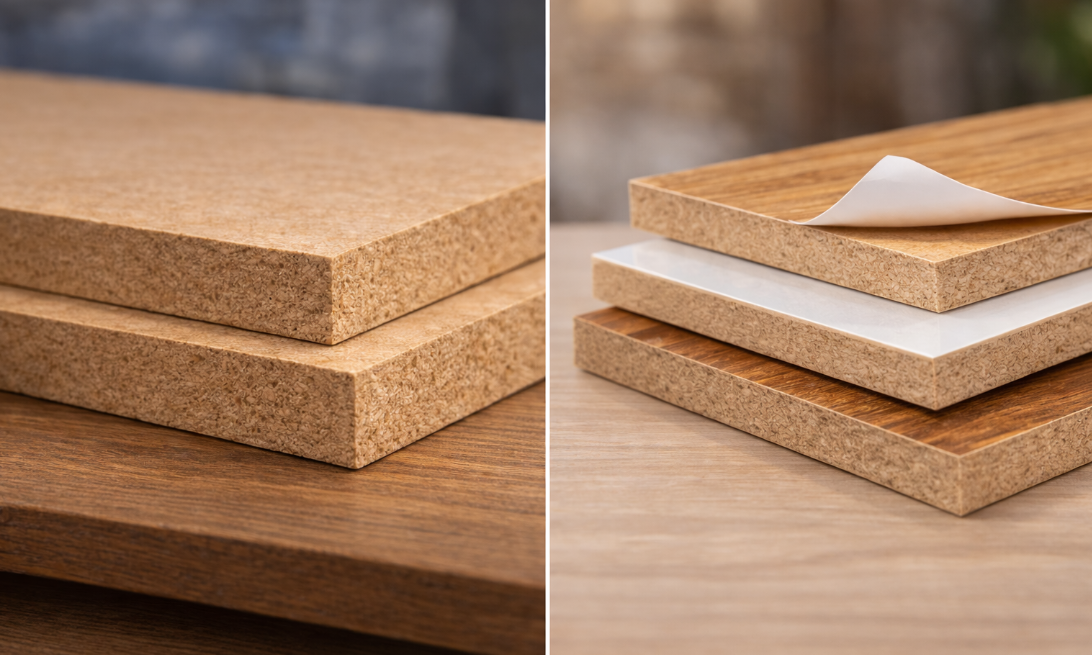
Two materials. Dozens of specs. One choice that affects everything that follows.
This guide comes down to a simple idea. The right MDF pick depends on three things — load requirements, environment, and surface finish goals. Get those three right, and the rest takes care of itself.
Here’s how the framework plays out in practice:
Load first. The piece carries weight — cabinet carcasses, shelving spans, drawer boxes? Go with furniture-grade MDF at ≥680 kg/m³. Decorative grades aren’t built for repeated stress. They’ll fail under load.
Environment second. Humid kitchens or bathrooms? Moisture-resistant (MR) grades at 720–750 kg/m³ are your baseline. Fire-rated (FR) specs push to 750 kg/m³. No wiggle room here.
Finish last. Decorative MDF is the clear winner for surface work. Its uniform, knot-free surface bonds well with veneers, laminates, and paint. You get a cleaner result with less prep.
The cost tradeoff is real, but it’s not complicated. Furniture-grade costs more upfront. Decorative saves money now — but the wear shows faster, and you pay for it later.
What Makes Furniture-Grade MDF Different From Decorative MDF (Core Definition)
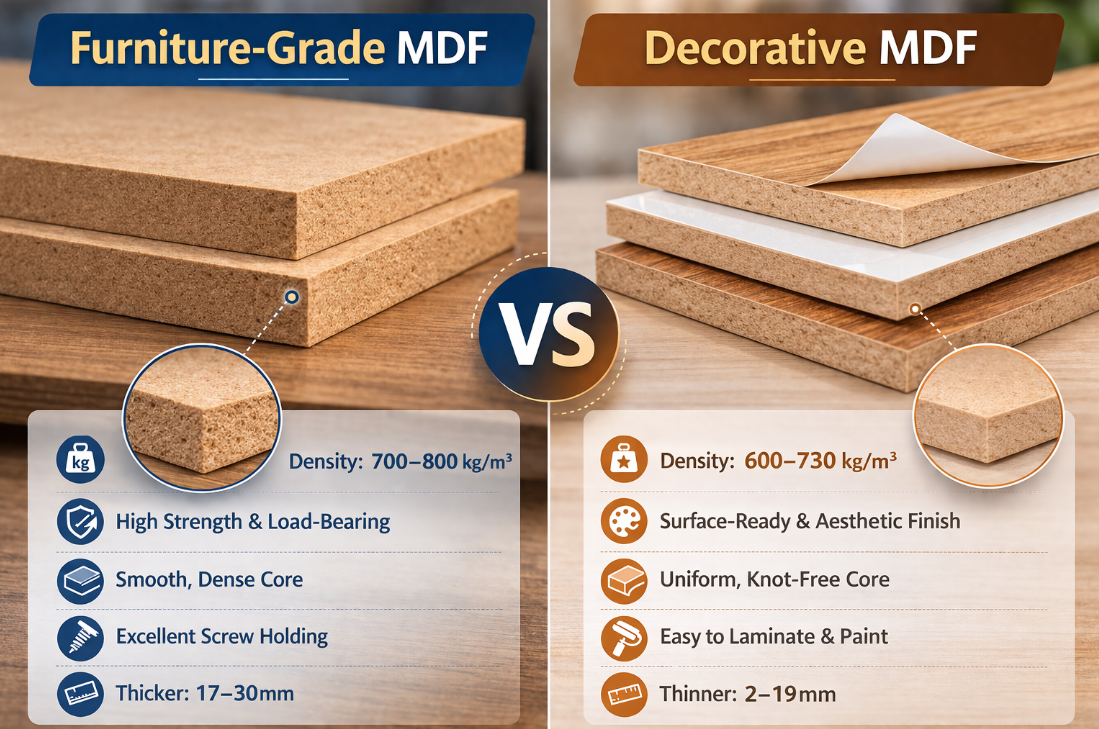
Density is where it all starts — and it tells you nearly everything you need to know. If you’re sourcing panels for furniture production, understanding how MDF density affects performance is essential. Many manufacturers provide different density grades depending on application. For example, commercial panels supplied by MDF board manufacturers are commonly produced within the 600–800 kg/m³ density range.
Furniture-grade MDF is built for structural work. Its density runs 700–800 kg/m³. Manufacturers achieve this through higher compression ratios and hotter pressing temperatures, which produce a tight, uniform core. That density gives you strong MDF bending strength, solid MDF screw holding capacity, and edges that hold firm when hardware bites in. Thickness typically runs 17–30mm. You’ll find it used in cabinet carcasses, wardrobes, and load-bearing shelving.
Decorative MDF works in a different space. Density sits at 600–730 kg/m³. Standard resin formulas focus on MDF surface finish quality, not structural load. Panels run thinner — 2–16.5mm — which makes them a good fit for room partitions, decorative wall panels, and detailed profiles where fine machining matters more than strength.
The failure cases show exactly where the gap shows up:
A 12mm decorative panel used as heavy shelving sags under 20kg.
An 18mm furniture-grade board run through detailed carving dulls tools fast and cracks clean edge profiles.
Same product category. Two different jobs.
Furniture-Grade MDF: Strength, Density and Structural Applications
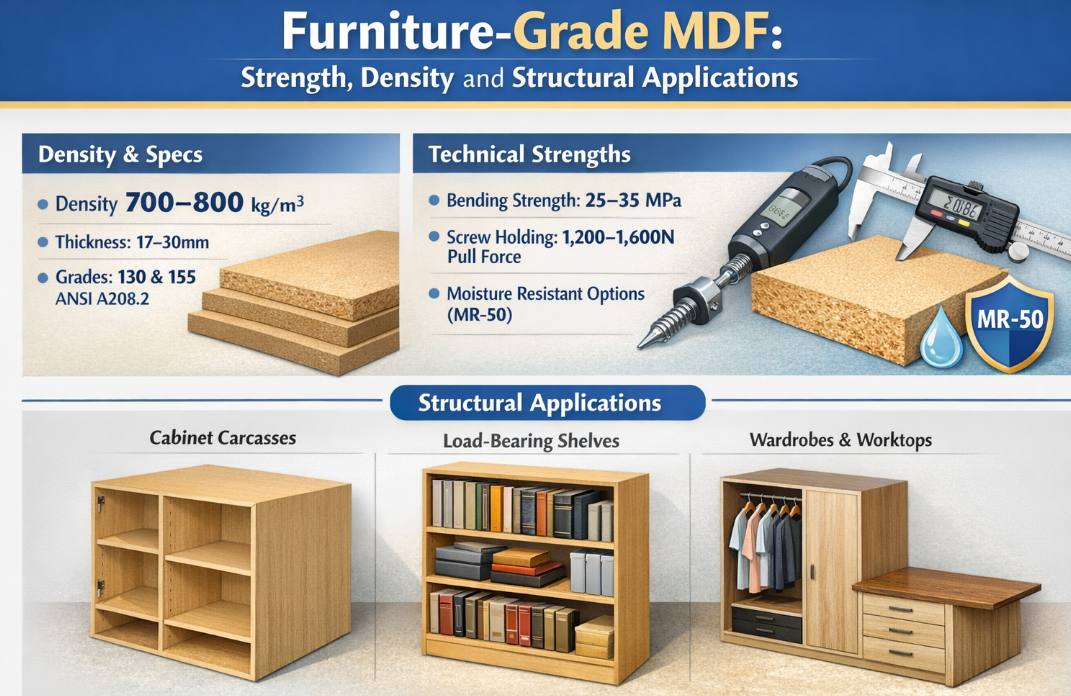
Furniture-grade MDF earns its place in structural work through numbers. And these numbers are specific enough to matter.
Under ANSI A208.2-2016, furniture-grade MDF comes in two density grades. This structural stability is one of the main reasons why MDF is widely used in cabinet manufacturing and other furniture production applications. Each grade sets clear performance limits before a single screw goes in:
Grade 130 (700–745 kg/m³) — the workhorse for standard furniture components, cabinetry frames, and shelving runs
Grade 155 (740–770 kg/m³) — the step up for premium cabinetry and applications where load cycles are frequent and unforgiving
These aren’t marketing labels. They map to real internal bond strength — ≥ 0.6 N/mm² for panels under 9.53mm, ≥ 0.5 N/mm² for mid-range thicknesses. That bond keeps screws seated, edges intact, and drawer boxes solid after two years of constant use.
Thickness Ranges and What They Handle
MDF panel thickness determines structural role more than anything else:
- 2–7.5mm — detailed models, craft components, intricate profiles where flexibility matters
- 8–16.5mm — cabinetry doors, internal frames, standard shelving
- 17–30mm — heavy-duty workstations, structural load-bearing builds, thick-panel cabinetry
Dimensional tolerances stay tight across all sizes: ±0.125mm on thickness, ±2.0mm on length and width. Linear expansion holds at ≤0.33%. In production runs where panels stack into larger assemblies, that consistency cuts out cumulative fit errors. You won’t hit those problems at installation.
Surface Finish and Machining Capability
Furniture-grade panels come sanded to 150 grit as standard — 180 grit on request. You can apply veneering, MDF laminate surface overlays, painting, and routing with no extra prep work. TFL (thermofused laminate) bonds tight. Deep machining holds clean edge definition throughout.
For moisture-sensitive spaces, MR-50 certified panels clear both a 6-Cycle Accelerated Aging Test and a 24-hour Water Submersion Test. In humid environments such as kitchens or bathrooms, understanding moisture-resistant MDF applications becomes essential for preventing swelling and long-term panel deformation. So kitchens and bathrooms don’t need a different material. You just need the right grade specification from the start.
Decorative MDF: Surface Quality and Design Applications
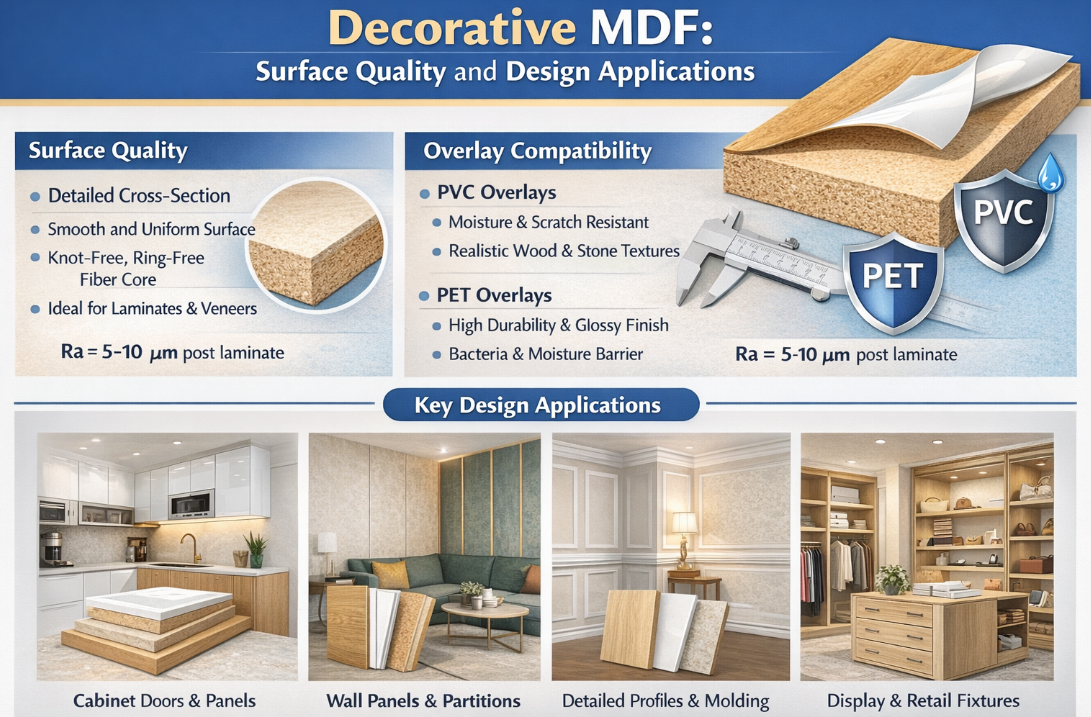
Surface quality is where decorative MDF pulls ahead. For certain projects, that advantage makes all the difference.
The fiber structure tells the story. Decorative MDF delivers a knot-free, ring-free uniformity that particleboard and plywood can’t match. No voids. No grain interruptions. That consistency gives you the ideal base for overlays, coatings, and veneers — a smooth foundation that speeds up finishing work and produces cleaner results.
Overlay Compatibility and Finish Options
Many decorative overlays such as PVC, PET, or melamine are commonly applied to MDF substrates used in furniture manufacturing. And Many furniture factories apply laminates or decorative overlays to MDF boards for furniture manufacturing to improve durability and surface consistency.Two overlay systems dominate decorative MDF applications. Both perform well on this substrate:
PVC overlays — At 46% market share (projected through 2025), PVC films deliver strong moisture resistance, flexibility, and scratch resistance. You get accurate replications of wood grain, stone textures, and metallic finishes. For cabinet doors and wall panels in humid-adjacent spaces, that durability counts.
PET overlays — Projected to surpass USD 175M by 2027, PET surfaces resist breaking, chipping, and cracking. They also block bacteria, fungi, and moisture from reaching the substrate level.
For paint and UV-cured finishes, the fiber uniformity in decorative MDF creates consistent absorption across the surface. UV coating bonds cleanly, boosting surface hardness and chemical resistance — with no added production time.
Thickness by Application
| Application | Common Thickness |
|---|---|
| Cabinet doors | 4.76mm / 6.35mm / 19mm |
| Skirting boards | 12.7mm / 19mm |
| Architrave / door casings | 11mm – 18mm |
| Wall decorative panels | 6mm – 12mm |
| Display shaping pieces | 12mm – 18mm |
Softwood decorative MDF holds 54% of substrate market share and drives most of these applications. It’s lighter, more cost-efficient, and cuts clean for routing, milling, and detailed profile work. Furniture-grade MDF resists cutting and wears down tooling fast. Softwood decorative grade moves through carving passes with precision and low resistance.
The tradeoff is simple: this material isn’t built to carry load. It’s built to be seen.
Furniture-Grade MDF vs Decorative MDF: Technical Comparison
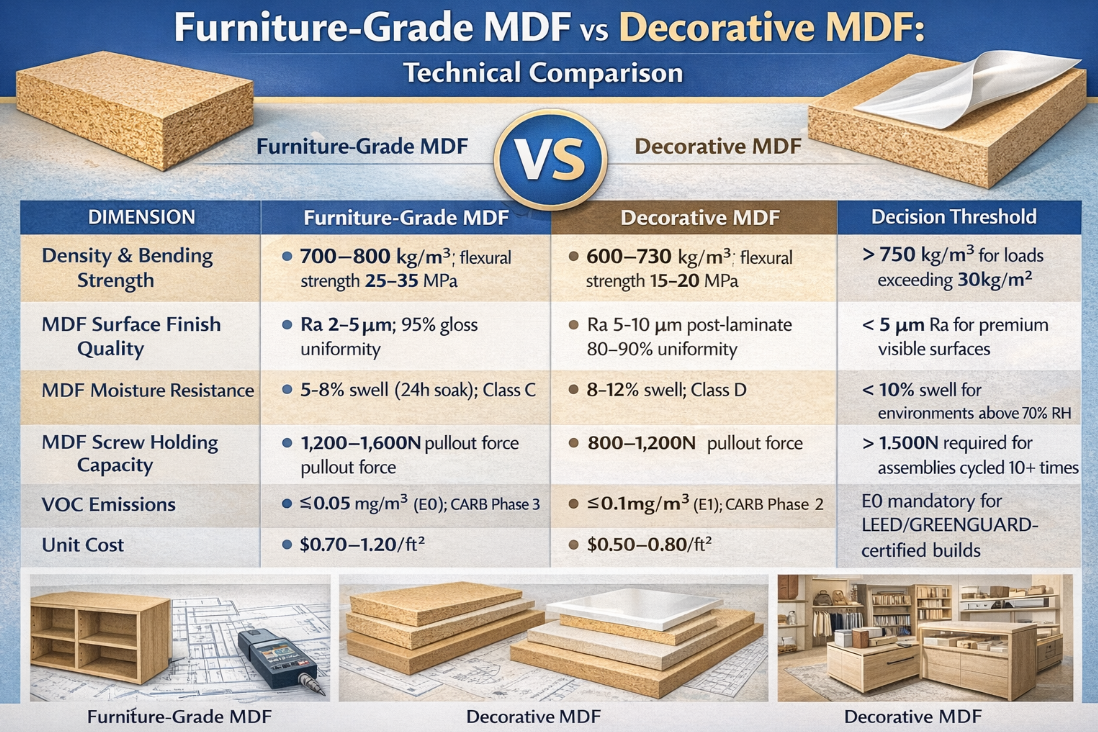
Six numbers. Six decisions. They determine whether your project holds or fails.
This table compares furniture-grade and decorative MDF across the dimensions that matter most to buyers — not in theory, but in real production.
| Dimension | Furniture-Grade MDF | Decorative MDF | Decision Threshold |
|---|---|---|---|
| Density & Bending Strength | 700–800 kg/m³; flexural strength 25–35 MPa | 600–730 kg/m³; flexural strength 15–20 MPa | >750 kg/m³ for loads exceeding 30kg/m² |
| MDF Surface Finish Quality | Ra 2–5 µm; 95% gloss uniformity | Ra 5–10 µm post-laminate; 80–90% uniformity | <5 µm Ra for premium visible surfaces |
| MDF Moisture Resistance | 5–8% swell (24h soak); Class C | 8–12% swell; Class D | <10% swell for environments above 70% RH |
| MDF Screw Holding Capacity | 1,200–1,600N pullout force | 800–1,200N pullout force | >1,500N required for assemblies cycled 10+ times |
| VOC Emissions | ≤0.05 mg/m³ (E0); CARB Phase 3 | ≤0.1 mg/m³ (E1); CARB Phase 2 | E0 mandatory for LEED/GREENGUARD-certified builds |
| Unit Cost | $0.70–1.20/ft² | $0.50–0.80/ft² | Under $0.90/ft² becomes viable at 1,000+ units |
What Each Dimension Triggers
The table gives you the numbers. These conditions show you where a number forces a decision:
Strength — Spans over 1 meter or loads beyond 30kg/m²? Go furniture-grade. Deflection tolerance below 2mm leaves zero room for compromise.
Surface finish — Exposed edges and consumer-facing panels need Ra under 5 µm. Decorative grade hits this mark without extra work. Furniture-grade adds finishing cost — around 20% more.
Moisture resistance — Kitchens, bathrooms, or any space that stays above 60% RH. Swell above 8% leads straight to warping. Don’t cut corners here.
Screw holding — Parts reassembled more than five times a year need pullout strength above 1,500N. Decorative grade won’t meet that bar.
VOC compliance — Occupants inside for more than eight hours a day make E0 a hard requirement. Decorative-grade E1 panels will fail certification review.
Cost at scale — Below 500 units, the price gap is easy to absorb. Above that point, decorative grade’s lower cost adds up fast.
One Material Won’t Always Be Enough
Some projects don’t fit into one column. Full cabinet builds are the best example. Structural carcasses need load capacity. Doors and visible panels need surface precision. Those are two different jobs.
Industry data shows 25% of production projects land in this hybrid zone. Using a split approach cuts returns by 18% compared to pushing one material across all components.
Here’s a starting point for how to split the materials:
| Scenario | Carcass | Doors/Visible Panels | Cost Impact |
|---|---|---|---|
| High humidity + finish quality | Moisture-resistant furniture-grade | Decorative (surface + VOC) | +12% |
| Frequent reassembly + load | Furniture-grade | Decorative if painted | +8% |
| Budget priority + indoor certification | Decorative (cost) | Furniture-grade (VOC/finish) | +15% |
A simple rule: no single material scoring above 80% across your key priorities — moisture, finish, cost, compliance — means you run a hybrid. Keep the added cost at 15% or less above your base budget. Also, test at least three material mixes before locking in a full production run.
How to Choose Between Furniture-Grade and Decorative MDF
The material spec doesn’t determine project success. The match between material and application does.
Same MDF category, wrong grade for the job — and failure is built in before a single fastener goes in. The framework below cuts through that risk. Three buyer profiles, three project types, one fast-lookup table. Find your scenario and move.
Quick-Match by Application
| Application | Recommended Grade | Critical Spec |
|---|---|---|
| Cabinet carcasses / daily-use boxes | Furniture-grade MDF | 18mm+, ≥700 kg/m³, E0/E1 |
| Painted flat doors & profiles | Decorative MDF | Sealed edges, Ra <5 µm |
| High-humidity zones (sink, bath) | Moisture-resistant furniture-grade | MR-50 certified, <8% swell |
| Decorative wall panels | Decorative MDF | 6–12mm, softwood substrate |
| Long-span shelving (>600mm) | Furniture-grade MDF + center support | 18–25mm, >750 kg/m³ |
| Display and feature shaping | Decorative MDF | 12–18mm, fine routing grade |
Three Buyer Profiles — And Where Each One Goes Wrong
DIY buyers lead with price. That choice lands interior-grade decorative MDF near a sink — and you’ll see visible swelling within months. The fix is straightforward: check moisture exposure first. Got a wet or humid-adjacent zone? Go moisture-resistant furniture-grade, with sealed edges all the way around.
Furniture factory procurement teams make the opposite mistake. They specify one material across all components to keep purchasing simple. MDF doors on plywood carcasses? That’s a proven split. MDF spanning 700mm with no support? That’s not. Long shelves need furniture-grade panels or a center support added.
Interior designers and commercial specifiers focus on aesthetics and skip emission checks. For projects where occupants stay more than eight hours a day, E0 compliance isn’t a choice — it’s a certification requirement. Decorative-grade E1 panels will fail that review.
The Principle Behind the Framework
Every selection decision passes through the same three gates: load, environment, finish. Project clears all three with one material? The choice is easy. One gate creates a conflict — say, high humidity and a precision paint finish — that’s your cue to split grades by component. Don’t force one material to handle two different jobs.
MDF Standards and Certifications Buyers Should Check
Certifications aren’t paperwork formalities — they’re the fastest way to catch a bad panel before it hits your production line. In North America, MDF physical and mechanical properties are defined by the ANSI A208.2 MDF standard, which classifies panels based on density, internal bond strength, and thickness tolerances.
ANSI A208.2 is the core standard you need to know. It groups MDF by physical and mechanical properties, sets size tolerances, and defines formaldehyde emission limits. For HUD-compliant builds and projects in California or Minnesota, third-party certification to ANSI A208.2 isn’t optional — it’s required.
Emission Thresholds That Matter
Formaldehyde limits are split by panel thickness:
- Panels thicker than 8mm: ≤0.21 ppm (standard) or ≤0.11 ppm (stricter tier)
- Panels 8mm or thinner: ≤0.21 ppm or ≤0.13 ppm
On top of ANSI, two federal and state rules govern emissions in North America:
- CARB ATCM 93120 Phase 2 — California’s air quality standard, now used as a de facto national benchmark across the country
- EPA TSCA Title VI — the federal formaldehyde rule that mirrors CARB requirements at the national level. MDF panels sold in the United States must comply with the EPA TSCA Title VI formaldehyde rule, which regulates emissions from composite wood products.
A supplier who can’t confirm compliance with both? That’s a red flag.
Grade and Moisture Certification Checkpoints
| Specification | What to Confirm |
|---|---|
| Grade 130 | ANSI A208.2 standard interior compliance |
| Grade 155 | ANSI A208.2 Grade 155 + MR30 rating for panels ≥16mm |
| MR30 | Moisture resistance for thicknesses under 3/8″ |
| MR50 | Moisture resistance for thicknesses 3/8″ and greater |
Minimum density requirements differ by product type. Suppliers don’t always bring this up on their own, so ask directly:
- NAF (No Added Formaldehyde): 47 pcf minimum
- Moisture-resistant: 48 pcf minimum
- Interior profile machining grade: 49 pcf minimum
- Fire-retardant: 48 pcf minimum
Screw-holding strength follows the same pattern. Moisture-resistant panels require 325 lbs face / 275 lbs edge. That’s well above the NAF standard’s 225 lbs face / 200 lbs edge. Pick the wrong category and you’re giving up structural strength to save a little on unit cost.
Emission Classifications Worth Requesting
Three designations show above-standard environmental performance:
NAF — made with binders that contain zero urea formaldehyde
ULEF (Ultra-Low Emitting Formaldehyde) — a voluntary, market-driven standard
ECC (Eco-Certified Composite) — requires CARB and EPA compliance for 100% of panels, 100% of the time, even in areas with no mandatory rules
For fire-rated applications, confirm ASTM E84 Class C — Flame Spread Index ≤25 and Smoke Developed Index ≤200.
One last verification step: ask whether the supplier’s panels are tested through CPA’s International Testing Center (ITC). Both CARB and EPA recognize ITC as an accredited emissions lab. That accreditation connects claimed compliance to verified, tested results — not just paperwork.
Furniture-Grade MDF vs Decorative MDF: Cost Comparison
The cheaper panel isn’t always the cheaper project. Most buyers don’t see that until the rework invoice lands on their desk.
Here’s what the numbers look like across a 100 sqm kitchen cabinet build:
| Component | Material | Price/sqm | Area | Cost |
|---|---|---|---|---|
| Structural (frames, shelves) | Furniture-grade | $28 avg | 60 sqm | $1,680 |
| Visible (doors, panels) | Decorative-grade | $18 avg | 40 sqm | $720 |
| Hybrid Total | 100 sqm | $2,400 |
Full furniture-grade runs $2,800. Full decorative runs $1,800. The hybrid comes in at $2,400. That’s a 14.3% saving over all-structural. You still hold 95% of the durability benchmark. That’s the sweet spot.
Want to go full decorative and pocket that $1,000 difference? The math turns fast. Over a 3–5 year span, hidden costs stack up:
Rework from swelling and edge damage: $1,200–$2,000
Refinishing from surface wear: $800–$1,280
Returns and complaints from moisture failure: $1,500–$2,500
Total hidden cost: $3,500–$5,780. Add that to your upfront spend, and decorative-grade’s real TCO hits $5,300–$7,580. Furniture-grade’s real TCO? $3,200–$3,800. The cheaper option costs more. Often much more.
The budgeting rule is simple: spend on structure where the stress is. Spend on surface where the eyes go. That split keeps performance solid and stops you from overspending on materials that don’t need to carry a load.
FAQ: The 5 Questions Buyers Ask Most Before Purchasing MDF
Buyers ask the same five questions before every MDF purchase. Here are straight answers.
Q1: What’s the real difference between furniture-grade and decorative MDF — and does it matter for my project?
It matters more than most buyers expect. Furniture-grade MDF runs at 700–800 kg/m³ and handles structural load. Decorative MDF sits lower — 600–730 kg/m³ — and puts surface finish ahead of strength. Your project carries weight? That density gap becomes a real failure risk. Don’t ignore it.
Q2: Is MDF moisture-resistant?
More than you’d expect. High-density MDF beats most engineered wood products on MDF moisture resistance — but grade makes a big difference. Standard decorative MDF swells 8–12% after 24 hours submerged. MR-50 certified furniture-grade keeps that below 8%. Kitchens and bathrooms need MR-rated panels. Full stop.
Q3: Can MDF hold screws over time?
Furniture-grade MDF delivers 1,200–1,600N pullout force. Decorative grade pulls 800–1,200N. For assemblies taken apart and rebuilt more than five times a year, you need above 1,500N. Decorative-grade MDF screw holding capacity won’t reach that number. So for high-use assemblies, furniture-grade is the only practical choice.
Q4: Which MDF grade is better for painted finishes?
Decorative MDF wins here. Its uniform, knot-free surface takes paint evenly and produces smoother results. MDF paintability on decorative panels delivers Ra under 5 µm — the threshold for premium visible surfaces — with no extra prep work needed. You get a cleaner finish, straight off the panel.
Q5: How do I verify a supplier’s MDF meets actual standards?
Start by requesting third-party certification against ANSI A208.2. Then confirm CARB Phase 2 or EPA TSCA Title VI compliance. Ask whether testing ran through CPA’s International Testing Center. A supplier who stalls on that question tells you everything you need to know.
Conclusion
For large-scale production projects, sourcing panels from a professional MDF board supplier can help ensure consistent density grades and certified material standards. Picking between furniture-grade and decorative MDF is not a guessing game. It’s an engineering decision wrapped in a design question.
Get the MDF density rating and structural specs right for load-bearing applications. Your furniture builds with confidence. Choose a premium MDF laminate surface finish for decorative panels. Your spaces speak with purpose. Do both with clear intent, and your projects stop being expensive experiments. They become repeatable results.
The buyers who win are not the ones with the biggest budgets. They’re the ones who match material performance to project demands before placing the order.
So here’s your next move:
Take your specific application
Run it against the selection framework in this guide
Reach out to a qualified MDF supplier who can back their specs with certifications
The right panel, chosen for the right reason, is where quality begins.