
Picking the wrong surface material for a furniture or cabinetry project isn’t just a cosmetic mistake — it’s an expensive one. You’ll see the damage months later: chipped edges, warped panels, and a build you wish you’d done differently.
The HPL vs melamine on MDF debate goes beyond price tags. It’s about matching the right material to the right environment, load, and lifecycle. Both laminate options bond to MDF cores. But they hold up in very different ways under real-world stress.
So before your next build or renovation, here’s a straight breakdown of what each material offers — durability, moisture resistance, cost, and the specific situations where each one makes sense.
This comparison is built around the decisions that matter most on a project.
What this article covers:
Durability breakdown — hardness ratings, scratch resistance, heat tolerance, and moisture behavior. Real numbers included: HPL at 3,618 psi vs. melamine at 2,144 psi
Construction differences — HPL uses 6–8 kraft paper layers at 0.8mm thick. Melamine uses a 0.3mm thermal-fused surface. These two behave in very different ways under stress
Cost logic — not just sticker price. You’ll see where each material pays for itself over time
Application mapping — which surfaces need HPL, which work fine with melamine, and where using both cuts costs without hurting performance
Edge treatment — most guides skip this detail. It’s the one that determines how long either material holds up
By the end, you’ll know which surface belongs on your countertops and which belongs inside your cabinet boxes. That distinction matters more than any other choice in the build.
What Is HPL on MDF? (Material Composition & Construction)
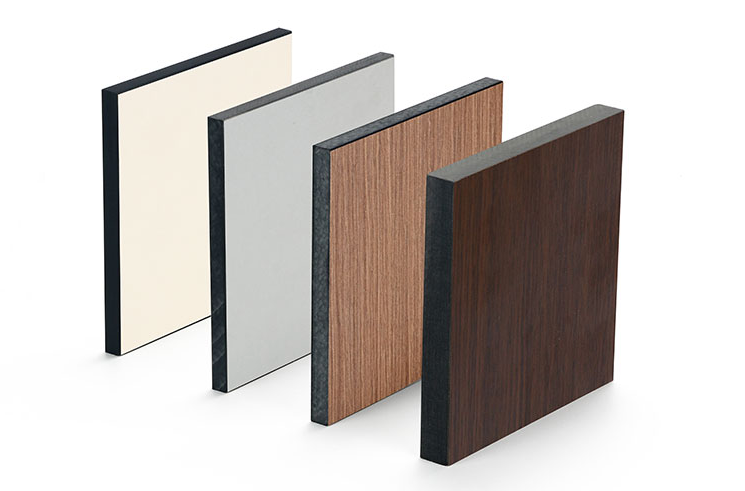
HPL is a manufactured sheet product built from layers — and the layering is the point.
High-pressure laminate starts with decor paper (the printed surface you see) and a stack of kraft paper core sheets. Both get saturated with phenolic or melamine resins. That stack then goes under intense heat — up to 400°F — and pressure over 600 psi, held for 30 to 90 minutes. The resins cure into a rigid, permanent bond. You get a dense, stable sheet that ranges from 0.7mm to 1.5mm thick.
That finished HPL sheet bonds directly to an MDF substrate — one with a density of 45–50 lb/ft³. MDF gives HPL the flat, defect-free base it needs to bond well. Before bonding, both materials need to sit together and acclimate: 75°F, 45–55% relative humidity, for at least 72 hours. Skip that step and delamination becomes a real risk down the line.
HPL Grades: Not All Sheets Are Built the Same
Three grades matter for Mdf Applications:
Horizontal (HGS) — 0.7–1.0mm thick, standard core layers. Used on flat surfaces like tabletops and cabinet faces. Cost-effective and easy to source.
Vertical (VGS) — around 1.2mm, with more core layers. Built for edges and vertical panels where impact resistance matters more than compression strength.
Compact — 1.5mm and beyond, up to 24+ core layers. Self-supporting. It can work without MDF backing at all — useful for thin panels that need serious bending strength.
The grade you pick determines how much punishment the surface can take. Most furniture builds run on Horizontal. High-traffic countertops and commercial jobs often step up to Vertical or Compact.
What Is Melamine on MDF? (Material Composition & Construction)
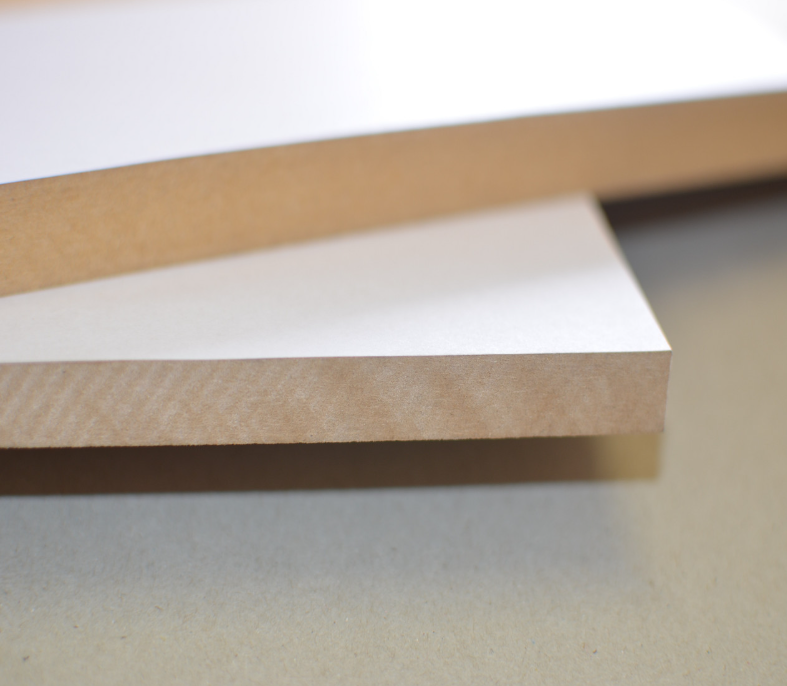
Melamine on MDF isn’t a laminate you glue on afterward — it’s baked in from the start.
The process is called low-pressure melamine (LPM). You’ll also see it sold as TFL (thermally fused laminate) or LPL. Here’s how it works: decorative paper soaks in melamine-urea-Formaldehyde (MUF) resin. Heat then presses it onto the MDF core in one manufacturing step. The result is a surface layer 0.1–0.3mm thick. It’s built into the board — no separate overlay sitting on top.
That’s the key difference from HPL. There’s no distinct face sheet. The surface and the board are one thing.
What’s Inside the Core
The MDF core uses a consistent formula: 82% wood fiber, 9% urea-formaldehyde resin, 8% water, 1% paraffin wax. Density runs 600–800 kg/m³, with 730 kg/m³ as the standard benchmark. Structural specs land at a modulus of rupture (MOR) of 40 MPa and internal bond strength of 900 kPa. Twenty-four-hour thickness swell sits at 6% — worth paying attention to in humid environments.
Surface Finish Affects More Than Looks
Not all melamine surfaces perform the same. The finish type has a real impact on durability:
Glossy — lowest abrasion resistance. Prone to micro-cracks. Steam resistance tops out at ≤2 cycles. Not suited for wear-heavy applications.
Textured (silk or wire-drawn) — moderate durability. Holds up better in daily-use environments.
Wood grain (premium) — highest scratch resistance in the melamine category. Test it in your actual end-use environment before specifying.
Standard sheet sizes come in 2440×1220mm or 3050×1220mm. Thicknesses start at 3mm and 6mm for furniture and cabinet carcass work. Dimensional tolerances follow AS/NZS 4266.1: thickness ±0.6mm, length/width ±5.0mm, flatness ±2mm/m.
For moisture-sensitive projects, go with MR-grade variants. These use MUF resin and carry a green dye marker — a fast visual check that the board has enhanced moisture resistance.
Durability Face-Off: HPL vs Melamine on MDF (Core Comparison)
0.5mm doesn’t sound like much. But that gap between HPL’s 0.8mm surface and melamine’s 0.3mm layer is where the entire durability story plays out.
Start with construction. HPL bonds 6–8 layers of kraft paper under high heat and pressure. This produces a rigid, dense face sheet. Melamine fuses a single treated paper layer onto the MDF core at low pressure — no separate sheet, no added thickness. You end up with a surface that’s three times thinner than HPL. That thinness makes it dependent on what happens at the edges.
Scratch and Wear Resistance
HPL handles abrasion well. Daily friction from dishes, tools, bags, and repeated cleaning cycles won’t break it down fast. That’s why you’ll find it on commercial countertops and worksurfaces that take punishment for years.
Melamine is moderate at best. Under repeated contact:
The surface chips
Edges peel
Scratches build up
That’s not a failure of the material — it’s a failure of application. Melamine works fine in low-friction spots. Put it on a surface that takes a beating every day, and it won’t hold up.
Impact and Heat Resistance
HPL absorbs impact better than melamine. High-traffic doors, exposed work surfaces, and curved panels stay solid under HPL. The layered core spreads force across the surface. Melamine dents and wears faster under the same conditions.
Heat resistance follows the same pattern. HPL handles moderate heat without issue. Melamine near a stove or oven is a risk — the surface breaks down faster under sustained heat. In a bedroom wardrobe, that’s not a problem. On a kitchen countertop, it’s a deal-breaker.
Moisture Resistance
HPL is dense and non-porous. Humidity, steam, and spills don’t get through it. Melamine’s weak point is the edge. Once moisture finds an unsealed edge, it gets into the MDF core and causes swelling and blistering.
Edge sealing isn’t optional with melamine in wet environments. It’s the deciding factor.
The Breakdown
| Property | HPL | Melamine |
|---|---|---|
| Scratch/Wear | Very high | Moderate |
| Impact | Superior | Lower |
| Heat | Strong moderate tolerance | Susceptible |
| Moisture | Non-porous, reliable | Edge-dependent |
| Thickness | 0.8mm | 0.3mm |
| Best use | Worktops, doors, exposed surfaces | Interior panels, low-contact verticals |
The rule is simple: match usage intensity to material strength. Heavy use, moisture, high traffic — HPL earns its cost. Low contact, interior panels, dry environments — melamine does the job without the premium.
Moisture & Edge Vulnerability: The Critical Weakness of Melamine on MDF
Melamine’s face surface is solid. It repels water, wipes clean, and holds up against everyday humidity. That’s not the problem.
The problem is the edge.
Every cut edge on a melamine MDF panel exposes raw MDF core — unsealed and hygroscopic. Moisture doesn’t need much of an invitation. Once it finds that edge, the substrate starts absorbing. And MDF absorbs fast.
What Happens Inside the Panel
The numbers tell the story. For every 1% increase in moisture content, MDF swells 0.3–0.5% in thickness. Push humidity from 30% to 90% relative humidity, and you’re looking at 6% thickness expansion across the board. Standard 18mm MDF panels hit 9–11.1% thickness swell in a 24-hour soak test. Even moisture-resistant MDF — the better-spec’d option — still swells 4.7–5.6% under the same test.
That swelling doesn’t reverse. It deforms the edge, lifts the melamine surface, and breaks down the glue bond underneath. Add time and you get fungal growth on top of the structural failure.
High-Risk Environments
Some spaces punish unsealed edges faster than others:
Bathrooms and kitchens — sustained steam and splash exposure
Tropical and coastal regions — humidity above 80%, compounded by heat
Laundry rooms — chronic elevated moisture with limited ventilation
In these environments, it’s not a question of if an unprotected edge fails. It’s when.
Edge Sealing Isn’t a Nice-to-Have
In HPL vs melamine on MDF decisions for wet-adjacent spaces, edge treatment is what determines service life. Sealed melamine MDF holds up for 10–15 years under normal conditions. Skip the edge sealing, and that timeline collapses fast.
The right approach depends on the environment:
PVC or ABS edgebanding — reliable for standard interior cabinetry
Hot-melt adhesive systems — strong bonding with good moisture resistance when applied with care
Water-resistant edge sealants or full capping systems — required for kitchens, bathrooms, or any high-humidity installation
Seal cut edges right after machining. Don’t wait. The acclimation window before installation — 48 hours minimum — matters too. Panels that skip acclimation shift after installation. Even tight edge sealing can gap under that dimensional movement.
The bottom line: melamine surface performance and melamine panel performance are two different things. The face holds up. The edge decides whether the whole build does.
Cost Breakdown: HPL vs Melamine on MDF (Material + Installation + Lifecycle)
The price difference between HPL and melamine isn’t just a number on a quote. It tells you where the real cost lands over time.
Material costs tell the first part of the story. HPL runs $3.50–$30 per square meter on an MDF substrate, depending on thickness, brand, and design complexity. Premium or custom runs push that ceiling higher. Melamine comes in at 50–100% less for comparable coverage. That gap comes down to manufacturing. With melamine, decorative paper bonds onto MDF in one step — no kraft paper stack, no high-pressure press cycle. A simpler process means a lower price.
What You’ll Pay at Installation
The price gap gets bigger once you add labor.
Melamine panels cut well and machine fast. Standard panel work moves at a good pace. HPL is a different story. It needs tighter CNC tolerances, more time per profile, and careful handling on curved or detailed surfaces. That extra fabrication time adds up on a large job.
The honest math:
– Melamine: lower material cost + faster machining = lower initial spend
– HPL: higher material cost + more precise labor = higher upfront total
Neither number tells you what you’ll end up paying by year seven.
The Lifecycle Flip
This is where the comparison turns.
Melamine’s lower upfront cost hides extra charges in high-traffic or moisture-prone areas. Edge failures, surface wear, and panel swelling trigger repair cycles that eat into the savings fast. In a kitchen or laundry room, that “cheaper” build can end up costing more by year five than an HPL installation would have on day one.
HPL flips that equation. You pay more upfront, then very little after. A damp cloth handles maintenance. The surface holds up under friction from regular use. In commercial spaces or wet zones, HPL’s 2–3x longer service life produces a lower total cost of ownership over a 5–10 year period.
| Cost Category | HPL | Melamine |
|---|---|---|
| Material (per sqm) | $3.50–$30 | 50–100% less |
| Installation labor | Higher CNC demand | Faster, lower cost |
| 5–10 Year TCO | Lower (durability offsets) | Higher in wear/moisture zones |
| Bulk discount potential | Strong at commercial scale | High for mass production |
Where Each Material Pays for Itself
Strip out the noise and the decision becomes clear:
Use HPL on countertops, exposed doors, and any surface that sees regular contact, heat, or humidity. The extra cost pays for itself.
Use melamine on interior cabinet boxes, shelving, and low-contact vertical panels in dry spaces. You don’t need HPL’s strength there — paying for it is waste.
Bulk procurement shifts the math further. Both materials offer volume discounts, but they work differently. Melamine has high price flexibility — mass furniture production systems use that to their advantage. HPL suits large commercial projects where durability is already a given. At that scale, the per-unit premium shrinks with volume.
The bottom line: HPL vs melamine on MDF isn’t about which one is cheaper. It’s about which one is cheaper for your specific application. Pick the wrong match and the lower-priced material becomes the more expensive decision.
HPL vs Melamine: Best Use Cases & Application Matching Guide
The material itself isn’t the decision. The surface it’s going on is.
That shift changes everything. HPL and melamine on MDF aren’t competing for the same job — they’re built for different zones of the same project. Match them right and you get durability where you need it, savings where you don’t.
Where HPL Earns Its Place
Four environments justify HPL’s higher price point:
Kitchen cabinet doors — daily exposure to heat, steam, and impact. HPL’s layered construction takes that punishment without chipping or peeling.
Countertops and tabletops — strong thermal stability, plus 40% better abrasion resistance than standard laminate. The surface holds up under constant contact.
Commercial office furniture — the structural strength supports thinner panel applications. Fire-resistant grades are also available where building codes require it.
High-traffic public spaces — UV resistance, chemical resistance, and no warping under humidity swings. HPL holds its ground in tough environments.
Where Melamine Holds Its Own
Melamine isn’t a compromise. In the right zones, it’s the smart call:
Wardrobe interiors and drawer side panels — low wear, dry conditions, minimal heat. Melamine gives you 15+ year service life here without the HPL price tag.
Display shelf backs and cabinet carcass interiors — solid quality in low-abrasion spots. At 30–40% lower cost per square meter, the savings are real and the performance is more than enough.
Budget residential builds in dry zones — no edge vulnerability, no heat exposure, no problem.
The Hybrid Approach: Zone Both Materials
The best projects don’t pick one material. They split the work.
Exterior and exposed surfaces get HPL. Doors, fronts, tops — anywhere friction, moisture, or heat lands. Interior and hidden surfaces get melamine. Cabinet boxes, backs, shelving — low contact, dry, out of sight.
That split cuts material costs 30–40% on the interior build. It also protects project longevity where it counts. Seal the junctions at the edges with care — HPL outer panels bond well there and stop delamination at the transition point.
The ROI case is simple. Melamine’s lower replacement and maintenance costs pay back within 3–5 years on interior zones. HPL on exposed surfaces extends overall project life by 20–30%. Together, they produce a better number than either material alone.
How to Choose Between HPL and Melamine on MDF: Decision Framework
Five factors determine the right call. Rank them in this order: usage frequency (30%), moisture exposure (25%), budget (20%), aesthetics (15%), and project timeline (10%).
Usage and moisture drive most decisions. Heavy contact surfaces — worktops, cabinet doors, exposed panels — point to HPL every time. It beats melamine in scratch and impact resistance by a wide margin. Wet zones follow the same logic. HPL is non-porous. Melamine’s edge is not.
Budget sets the boundary. HPL runs 2–3x the material cost. But it delivers 2–5x the service life in demanding applications. Melamine belongs on interior carcasses and low-contact panels. Not because it’s cheaper — but because HPL’s strength simply isn’t needed there.
How to Identify What You’re Holding
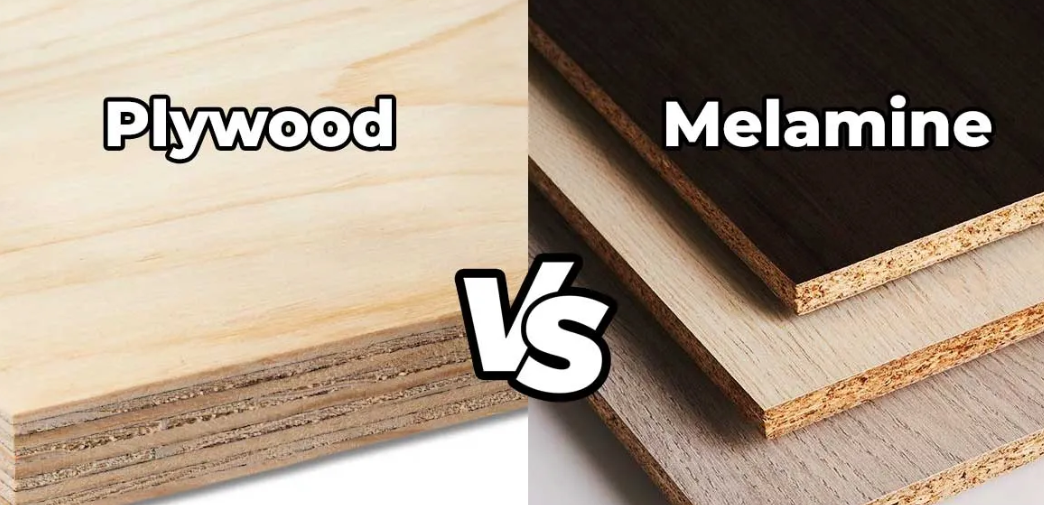
Run your finger across the edge cross-section. HPL shows a visible kraft paper stack — dense, rigid, 0.8mm. Melamine shows a single decorative paper layer fused to the substrate — thin, softer at 0.3mm. Press a fingernail into the face. HPL won’t dent. Melamine will.
Procurement Checklist
Check certifications and key metrics before ordering:
| Indicator | HPL Target | Melamine Target |
|---|---|---|
| Thickness | 0.6–1.2mm | 0.2–0.4mm |
| Wear Resistance | >400 Taber cycles | <200 cycles |
| Moisture Absorption | <1% | 2–5% (seal edges) |
Confirm EN 438 compliance for HPL. Melamine boards should carry EN 14322. For hybrid builds — melamine interiors with HPL on exposed faces — add 10–15% to your budget for matched edge tape. You still net 20–30% overall savings from the melamine internals.
Conclusion
HPL vs melamine on MDF — the decision isn’t about which one is “better.” It’s about matching the right surface to the right situation.
The numbers and real-world performance make this clear. Melamine wins on upfront cost and everyday aesthetics. HPL wins on longevity, moisture resistance, and total lifecycle value. Use melamine in a high-traffic kitchen or a humid bathroom, and you’ll replace it far sooner than you planned.
So before signing off on a spec sheet or finalizing a supplier quote, ask one honest question: What will this surface face in five years?
Think about what the answer looks like in practice:
Water, abrasion, or heavy use every day? HPL is the smarter investment. It holds up where melamine breaks down.
Low-traffic interior space with a tight budget? Melamine gets the job done. It’s cost-effective and looks good in the right conditions.
Pick the surface that fits the life of the project — not just the budget line on a quote sheet.