
Every year, procurement teams approve bulk particle board orders based on one label — “moisture-resistant” — and consider the job done. Then the cabinets swell. The surface layers separate. Warranty claims start piling up.
The real problem was never the product itself. It was the gap between what that label implies and what the material does under real humidity conditions.
Particle board moisture resistance is one of the most misunderstood specs in the engineered wood industry. The bad information doesn’t appear out of thin air — it gets built into marketing language, passed along by distributors, and left unchallenged until something breaks down.
This guide cuts through that noise and covers three things:
The myths that are costing sourcing teams money
The grade classifications that matter
A procurement framework built to stop expensive mistakes before products leave the factory floor
Myth #1: “Moisture-Resistant” Particle Board Is Waterproof
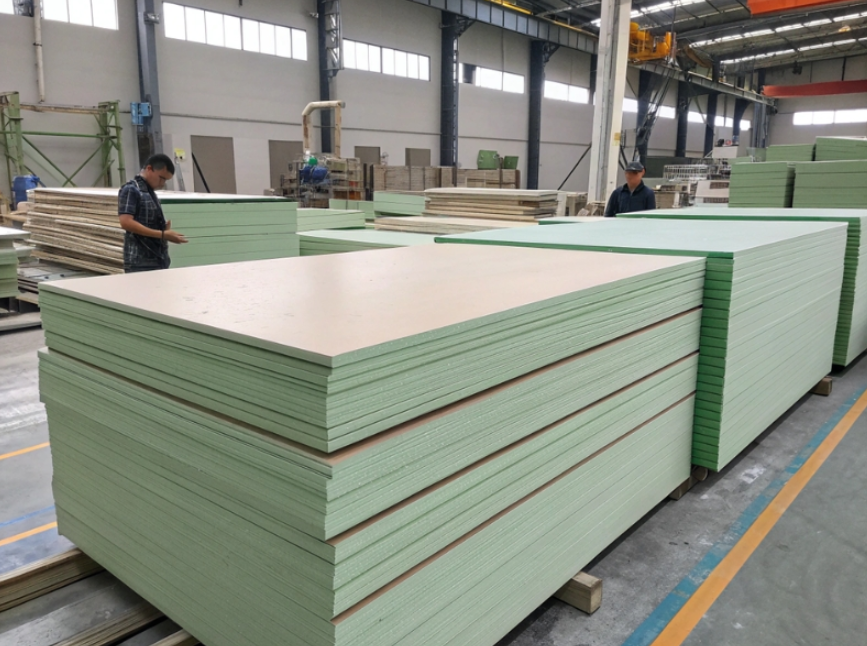
Fact: MR-grade particle board resists humidity. It does not survive water.
That gap sounds small. In a kitchen cabinet job, it decides between a five-year product and a five-month problem.
The confusion starts with language. “Moisture-resistant” gets squeezed into marketing copy, repeated by distributors, and treated as shorthand for waterproof. It isn’t. Under EN 312, P3-grade particle board — the standard MR classification — is defined for use in humid conditions, not wet ones. After 24 hours of water immersion at 20°C, EN 312 allows up to 14% mean thickness swelling. That number alone rules out any waterproof claim. True waterproof materials — marine-grade plywood, for reference — stay below 2–5%.
The adhesive chemistry tells the real story. Standard particle board uses urea-formaldehyde resin. That resin breaks down its bond structure when it meets sustained moisture. MR grades move up to phenol-formaldehyde or melamine-formaldehyde resins. These handle short-term humidity. Neither handles immersion. After 24 hours of direct water contact, even P3-grade boards swell 10–14%. Adhesive failure comes next.
Density is another variable most procurement teams skip. High-density MR boards (above 650 kg/m³) absorb water slower than low-density boards in the 500–650 kg/m³ range. The lower-density boards swell about 20–30% faster. Same “MR” label. Very different performance in the field.
What to demand from suppliers before signing off:
EN 312 P3 certificate from an accredited lab (SGS, TÜV) confirming ≤14% thickness swell after 24-hour immersion
Post-immersion MOR data: ≥11 N/mm² dry, ≥5 N/mm² wet
Resin type confirmation — PF or MF only, not UF
Edge sealing specs: melamine or laminate coating at 0.6–1.2mm minimum
Any supplier listing “moisture-proof” and “waterproof” as interchangeable on their spec sheet is sending one of two signals: they don’t understand the standard, or they’re counting on you not to.
For buyers comparing particle board with other engineered panels, Baier’s wood-based panel factory page gives a broader view of MDF, plywood, OSB, and particle board options for furniture and interior projects.
Myth #2: Particle Board With Standard Adhesives Handles Humidity Like Solid Wood
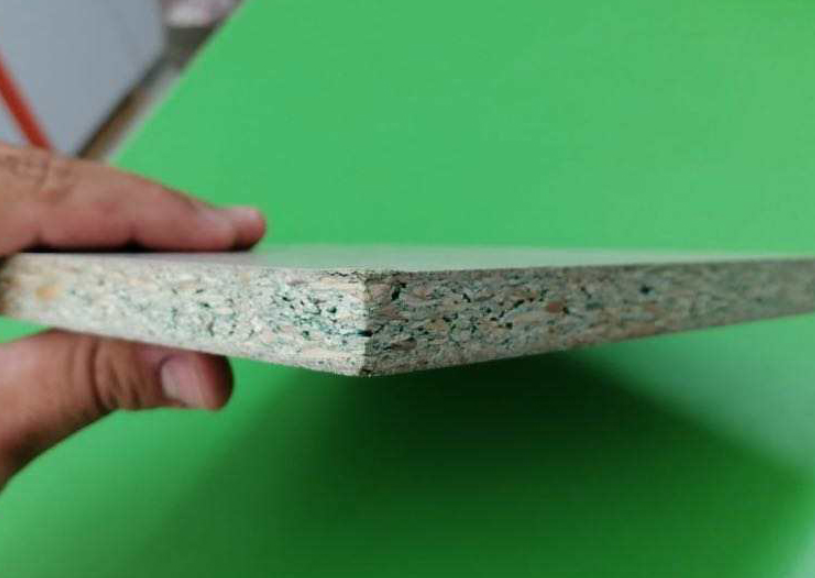
Fact: Standard UF adhesives break down under humidity. Solid wood doesn’t.
Here’s what most spec sheets skip over. Solid wood has natural resins and lignins. These limit moisture uptake to 10–15% equilibrium moisture content, even at high relative humidity. Standard particle board uses compressed wood fragments bonded with urea-formaldehyde resin. Those fragments leave gaps. Those gaps pull in moisture fast. The result: thickness swelling above 25% after 24 hours of water immersion under EN 317 — close to double what solid wood shows under the same conditions.
The real failure point is the adhesive. UF resin breaks down through hydrolysis once humidity stays high for long enough. That chemical reaction chips away at the bond structure step by step, cutting internal bond strength by more than 50% through cyclic humidity testing. Post-humidity IB values fall below 0.3 N/mm² — well short of the P3 threshold of 0.5 N/mm². Solid wood’s lignin bonds don’t behave that way. They hold steady. UF bonds lose strength.
MDI-based adhesives close part of that gap. Internal bond retention stays above 0.5 N/mm² after cyclic testing. MDI-bonded boards stay usable up to 80% RH. At standard conditioning — 20°C, 65% RH — even compliant particle board reaches 5–9% moisture content. That causes dimensional shifts above 2%. Solid wood under the same conditions stays below 1%.
What to require from suppliers:
Adhesive type declaration: MDI or PF — not UF-only
Post-cyclic IB result: ≥0.5 N/mm² per EN 319
Water absorption ceiling: <30% per test certification
Thickness swelling confirmation: <20% under EN 317 protocol
Any supplier quoting standard UF-bonded board for applications above 65% RH is giving you the wrong product.
For screw-holding, density, and furniture load risks, buyers can also review particle board strength in furniture projects before approving large cabinet or shelving orders.
Myth #3: Standard Particle Board Is Acceptable for Kitchens and Bathrooms
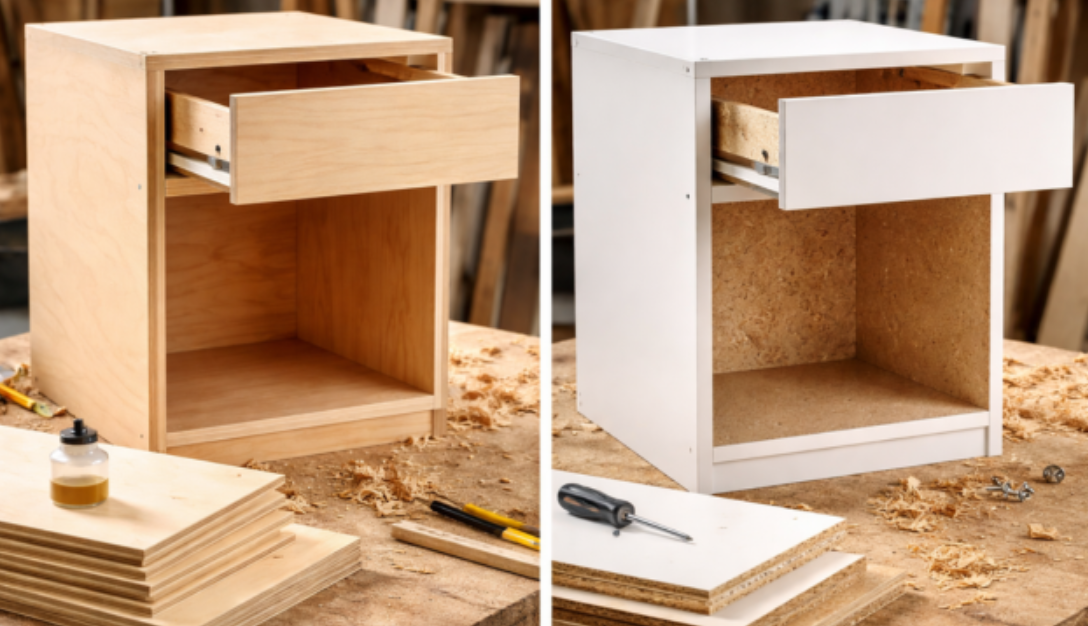
Fact: P2-grade particle board in a kitchen or bathroom isn’t a budget decision. It’s a countdown.
Place standard P2 board near a dishwasher, and the damage starts the day installation ends. EN 312 Type P2 is rated for dry interior use — the standard is clear, with zero room for exceptions. Yet it keeps showing up in bathroom vanities and kitchen cabinets. The reason is simple: the spec sheet said “interior grade,” and no one asked what that meant.
Here’s what happens on a real timeline:
Months 1–6: Bathroom steam causes thickness swelling of 5–10%. Drawer faces go out of alignment. Unsealed edges begin to split.
Months 6–12: Rippling shows up under countertop surfaces. Shelving starts to bow under normal weight — stacked plates, everyday pantry items.
Years 1–3: Full structural failure. Buckling, layer separation, and permanent warping. At this stage, replacement is not a choice.
Solid wood under the same conditions lasts 10+ years. That’s not a debate about material science. It’s a replacement invoice — one you pay now or pay later at 2–3x the original cost.
Where the grade limits actually fall:
| Grade | Safe Environment | Hard Limit |
|---|---|---|
| P2 | Dry interiors | Fails at sustained >70% RH within months |
| P3 | Sealed humid areas, RH <65% | Cannot handle direct splashes or leaks |
| P5 | Sealed wet rooms, condensation-prone | Not rated for direct water contact |
P3 and P5 are not waterproof upgrades. Both need full edge sealing. They hold up against indirect vapor — not leaks, not splashes, not the steam from a dishwasher running twice a day.
Need something stronger? Here’s where the material choices shift:
MR MDF ($35–60/sqm): 20% less swelling than standard particle board. Good for sealed bathroom cabinetry away from direct water zones.
Moisture-resistant plywood ($50–80/sqm): Carries heavier loads and warps less. Suited for kitchen carcasses near sink areas.
Marine-grade plywood ($70–120/sqm): BS 1088-rated, direct water resistant, 15+ year lifespan. This is the right spec for high-traffic wet environments.
What to ask from suppliers for kitchen and bathroom applications:
Grade confirmation: P5 minimum, with full sealing documentation
Edge treatment specs: melamine or laminate at ≥0.6mm on all exposed edges
Application suitability declaration — get it in writing, not just on a product brochure
Standard particle board runs $20–40/sqm. Replacing it after early failure costs several times that — plus labor, downtime, and warranty exposure. The grade you choose at procurement is the one moment where the numbers still work in your favor.
Myth #4: MR Particle Board Performs on Par With Plywood in Wet Conditions
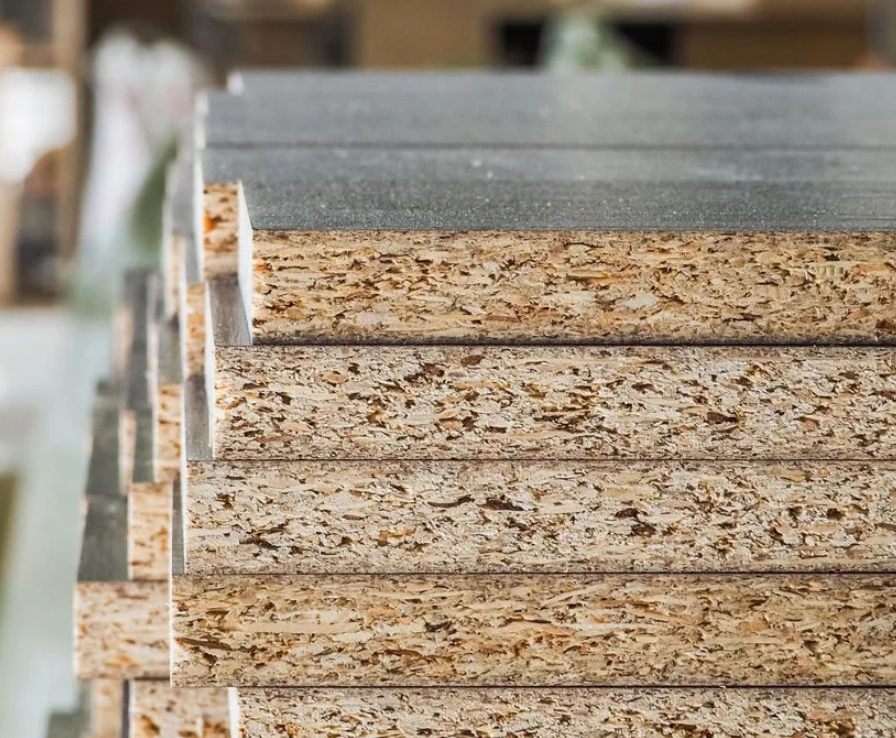
Fact: MR particle board and plywood aren’t even in the same league once water gets involved.
The numbers tell the story fast. After 24-hour submersion, MR particle board swells 10–15% — and that’s the good version with hydrophobic resins. Standard plywood stays below 5%. Marine plywood stays below 2%. You don’t need a lab to see the difference. A 30-minute standing water spill warps MR particle board. Sealed plywood holds its shape completely.
The key structural difference comes down to how plywood is built. Plywood uses cross-laminated veneer layers. Moisture hits the panel, and those alternating grain layers spread the stress evenly across the surface. Particle board has none of that. It’s just compressed fragments bonded with resin. Push the humidity above 70% RH for long enough, and that resin bond breaks down. Internal bond strength drops 40–60% after repeated humidity cycles. Plywood holds 85–95% of its original strength under the same test conditions.
Edge exposure is where MR particle board falls apart the fastest. One wet-dry cycle raises screw pullout resistance by 50–70% — but not in a good way. The fastener tears straight out of the weakened material instead of gripping it. Plywood edges, sealed correctly, hold over 150 kg sustained. MR particle board edges crumble under 50 kg after moisture exposure.
The lifespan gap is significant:
| Condition | MR Particle Board | Plywood |
|---|---|---|
| Kitchen/bathroom service life | 5–10 years | 30–50+ years |
| Load retention post-moisture | Sags 20–30% under 100 kg | Stable, no measurable sag |
| Edge screw retention after 1 wet cycle | Fails at <10% load | Retains 70% load capacity |
Where MR particle board works — and where it doesn’t:
Acceptable: Hidden interior panels with no edge exposure, dry storage furniture, temporary shelving under 50 kg with a 5-year horizon
Upgrade required: Kitchens, bathrooms, load-bearing shelves above 75 kg, any edge-exposed or screw-heavy application near moisture
The cost math is simple. MR particle board fails 3–5x faster than plywood in wet environments. Marine-grade plywood runs $70–120/sqm against particle board’s $20–40. That price gap looks manageable upfront. But a 6–12 month failure cycle adds replacement labor, downtime, and warranty claims to the bill. The “cheaper” option stops looking cheap very fast.
For wet-zone cabinetry, structural panels, or heavier load applications, a plywood manufacturer page can help buyers compare glue type, core structure, and moisture grade before replacing particle board in the specification.
Myth #5: Marketing Claims Like “Water-Resistant” Guarantee Actual Performance
Fact: “Water-resistant” is a marketing position. It is not a performance guarantee.
Three words on a spec sheet — water-resistant particle board — and procurement teams stop asking questions. That’s the whole point of the label.
Here’s what no supplier brochure will tell you: “water-resistant” has no universal legal definition in the engineered wood industry. A manufacturer can print it on chipboard that fails after 90 minutes of humidity exposure and still be accurate. The claim stands as long as some resistance exists under some conditions. Regulators go after false claims. Vague ones pass right through.
The certification confusion makes it worse. CARB certification — often cited alongside moisture-resistance claims — governs formaldehyde emissions. It says nothing about humidity tolerance, thickness swelling, or adhesive bond strength under wet conditions. EN 312 P3 covers swelling behavior, not real-world water-resistance. These are separate measurements. Suppliers know that. Many count on buyers not knowing it. For U.S. compliance, buyers should remember that EPA TSCA Title VI and CARB-related rules focus on formaldehyde emissions in composite wood products, not moisture resistance or swelling performance.
The language gap costs money:
| Claim | What It Measures | What It Doesn’t Cover |
|---|---|---|
| “Water-resistant” | Unspecified — varies by supplier | Sustained humidity, direct splashes, immersion |
| “Moisture-resistant (MR)” | Short-term humidity per EN 312 P3 | RH above 70% for extended periods |
| CARB Certified | Formaldehyde emission limits | Any moisture or swelling performance |
| EN 312 P3 | Thickness swelling ≤14% after 24hr immersion | Real-world field water-resistance |
Red flags worth walking away from:
“Waterproof” stated without an IP rating or immersion depth and duration
“Completely sealed” with no cross-section data or coating thickness specs
Warranty terms that exclude water damage on a product marketed as water-resistant
Test reports from the manufacturer’s own lab, with no third-party accreditation listed
What to demand instead:
Lock the language down in the purchase agreement. Require suppliers to specify the tested standard, test duration, humidity level, temperature conditions, and the accreditation body. SGS and TÜV reports carry weight. Internal datasheets don’t.
A supplier who resists giving you a full third-party test report — not a marketing summary, the full report — has already given you your answer.
Particle Board Moisture Resistance Grades Decoded: P2 vs P3 vs P5 vs P7
Four grades. One letter separates them. Get this wrong, and the cost difference runs into the tens of thousands — before labor even enters the picture. For European procurement, EN 312 should be treated as the reference standard for particleboard grade classification and performance requirements.
EN 312 defines the classification system. But these grades don’t sit on a single sliding scale from “dry” to “waterproof.” That’s where procurement teams get burned. Two of the four grades have zero moisture resistance. One handles humid environments. And one is a heavy-duty structural spec with no water protection at all.
Here’s what each grade means:
| Grade | Moisture Resistance | Thickness Swell (24h) | Density | Min IB (dry/humid) | Typical Price (18mm) |
|---|---|---|---|---|---|
| P2 | None | ≤18% | 600–650 kg/m³ | 0.35 N/mm² / — | $5–8/m² |
| P3 | None | ≤18% | ~650 kg/m³ | 0.5 N/mm² / — | $7–10/m² |
| P5 | Yes (humid use) | ≤12% | ~700 kg/m³ | 0.6 / 0.25 N/mm² | $10–15/m² |
| P7 | None (dry use) | ≤18% | ~700 kg/m³ | 0.7 N/mm² / — | $12–18/m² |
P7 catches buyers off guard more than any other grade. The density is high — ~700 kg/m³. Load rating tops 100 lb/ft² on an 18mm sheet. MOR exceeds 20 N/mm². MOE clears 4,500 MPa. Strong numbers across the board. But zero moisture resistance. Spec P7 for a humid-environment floor and you’ve paid a structural premium for a board that still fails in wet conditions.
P5 is the one grade in this group with a dual IB rating — 0.6 N/mm² dry, 0.25 N/mm² under humid conditions. That second number is what separates it from everything else. It’s also why P5 carries a 40–80% price premium over P2. The additive package — 5–7% paraffin wax plus upgraded resin — costs real money. A supplier quoting P5 at P2 prices? That number deserves a hard look.
Application mapping, by the numbers:
Kitchen and bathroom cabinet bases: P5 is mandatory. P2 in the same spot swells up to 70% under sustained humidity. That’s a documented failure, not a theoretical risk.
Loft and attic flooring with live loads above 200 kg/m²: P5 minimum, 22mm thickness. Use P3 or P7 only in confirmed dry conditions.
Interior furniture side panels in conditioned spaces below 60% RH: P2 or P3 works fine. Above 60% RH, step up to P5.
How to Verify You’re Getting Real P5
Grade fraud in particle board procurement happens. Suppliers relabel low-grade boards. The verification process is simple — push back from a supplier on any of these checks is itself a red flag.
Three field-verifiable checks:
Thickness swell test: Soak a sample for 24 hours. P5 must stay at or below 12%. P2 and P3 allow up to 18%. That 6-point gap is easy to measure with a caliper and a bucket of water.
Density check: P5 and P7 run ~700 kg/m³. Weigh a 1m² cut at known thickness. P2 grades come in below 650 kg/m³. The scale tells you straight.
Certification with batch IB data: A real EN 312 P5 certificate lists humid internal bond strength — minimum 0.25 N/mm². Generic certs with no batch-specific IB data under humid conditions are a clear red flag. Stop there.
The grade printed on a spec sheet costs nothing to change. The test data underneath it does not lie.
Material Comparison: Particle Board vs Plywood vs MDF in Humid Environments
Three materials. One humid environment. The performance gap between them isn’t gradual — it’s a cliff edge.
Run MR particle board, MR MDF, and marine-grade plywood through 70–90% RH conditions. You get three different outcomes. Particle board swells 10–15% and crumbles at cut edges. MR MDF lands at 5–8% — better, but still vulnerable without full edge sealing. Treated plywood? 2–4%. That’s not a small difference. A cabinet built with plywood holds for a decade. One built with particle board may fail before you even have the warranty conversation. If the order involves mixed materials, this furniture boards comparison helps buyers understand where particle board, MDF, plywood, and OSB each fit.
What the Numbers Look Like Side by Side
| Metric | MR Particle Board | MR MDF | Plywood (BWR/Marine) |
|---|---|---|---|
| Swell Rate (%) | 10–15 | 5–8 | 2–4 |
| Screw Holding | Limited | Moderate | Excellent |
| Strength in Damp | Low | Moderate | Excellent |
| Humid Lifespan | Fails fast | 8–12 yrs (sealed) | 15–20 yrs |
| Cost per Sheet | $10–15 | $20–30 | $30–50+ |
Screw holding drops across all three under sustained humidity — but not at the same rate. Plywood runs at 600–700 kg/m³. It keeps its structural grip long after the other two start losing theirs. Particle board sits at 500–650 kg/m³. It’s the first to go. Place it near a sink after one wet cycle and the fasteners won’t hold. They pull straight through.
The Procurement Logic for Bulk Orders
High-volume sourcing isn’t about picking one material. It’s about knowing where each material stops doing its job.
Hidden interior panels, dry storage, <60% RH: MR particle board holds up and keeps cost down. It can cover about 60% of total volume in a mixed order.
Exposed surfaces, cabinet doors, laminates: Step up to MR MDF. The 20% lower swell rate justifies the price on anything visible.
Wet zones — near sinks, dishwashers, bathroom floors: BWR or marine-grade plywood. No exceptions.
Most procurement specs miss one key step: acclimate all panels 48 hours to one week before installation. That one step cuts humidity-related failure rates by 50%. Add proper edge banding, and you prevent close to 80% of the premature failures that trigger warranty claims.
The cheapest panel on the order form and the cheapest outcome on the job site are not the same thing. When visible surfaces, cabinet doors, or smoother machining performance matter, buyers should also compare moisture-resistant MDF board options before finalizing the panel mix.
The Procurement Checklist: How to Verify Moisture Resistance Before Bulk Orders
Paperwork lies. Samples don’t.
Once a bulk order lands on your receiving dock, the leverage is gone. Your verification window opens before you sign the purchase order. It closes the moment the shipment leaves the factory. That window is the only time you have real control.
Here’s the checklist that keeps it open.
Before You Place the Order: Supplier Verification
Lock these into your RFQ process — not your follow-up email. Put them in the contract.
Documentation requirements (non-negotiable):
– Third-party test report confirming EN 312 P5 compliance — SGS or TÜV accreditation only. Internal datasheets don’t count.
– Batch-specific internal bond data under humid conditions: minimum 0.25 N/mm²
– Resin type declaration in writing: MDI or PF resin confirmed, UF excluded
– Edge treatment specification: melamine or laminate coating at ≥0.6mm on all exposed edges
Pre-shipment supplier questions — ask these before signing anything:
– Is storage indoor and climate-controlled at all times?
– What is the documented moisture content at time of packing?
– Are panels wrapped with pallet caps before shipment?
– Has a pre-shipment moisture inspection been done — and can you provide photos?
A supplier who hesitates on any of these questions has already answered the most important one.
At Arrival: Physical Inspection Protocol
Don’t inspect the top layer and call it done. Moisture damage builds up at the bottom, at edges, and in the middle of stacked panels. A quick walkthrough misses all three spots.
Sampling plan for bulk panel orders:
– Per pallet: inspect 5–10 panels — 2 from the top, 2–3 from the middle, 1–2 from the bottom
– Multiple pallets: minimum 30 panels sampled across the full lot
– Trigger threshold: quarantine the lot if ≥10% of sampled panels show moisture indicators. Reject the lot outright if damage is widespread.
Visual red flags — reject these on sight:
– Tide marks or waterlines along bottom edges and corners
– Discoloration, staining, or mold spotting on panel surfaces
– Delamination at cut edges or visible green core discoloration
– Seam or surface degradation concentrated at base layers
Sensory checks:
– Dampness or clamminess to the touch = automatic hold
– Musty or mildew odor = immediate escalation
– Water staining plus odor together = lot rejection, no exceptions
Defect rate benchmark: ≤1% on arrival. One hundred defective panels in a 10,000-unit order is a failed shipment. Document it. Photograph it. Invoke your contract clause before accepting delivery.
Contract Language That Protects You
“Moisture-resistant” in a product brochure is a marketing claim. The contract is where it becomes a performance obligation.
Put these specifications in writing — no exceptions:
– Tested standard, test duration, humidity level, temperature, and accreditation body — all four, not just the grade label
– Third-party moisture test reports as a delivery condition, not an optional attachment
– Escalation clause: lot rejection rights triggered at ≥10% panel failure rate on arrival inspection
– Penalty terms tied to verified spec non-conformity — not vague “quality assurance” language
A supplier who pushes back on third-party test reports is sending a disqualification signal. A manufacturer who stands behind their product’s moisture resistance has no reason to ask you to take their word for it.
The grade on the spec sheet costs nothing to print. The test data underneath it is what you’re paying for.
Best Practices to Protect Particle Board from Moisture Damage Post-Procurement
Selecting the right grade gets you to the finish line. What happens after delivery determines whether you stay there.
Certified P5 boards still fail early if you ignore storage, sealing, and installation steps. These aren’t optional. They’re the difference between a five-year product and a two-year warranty claim.
Seal It Right or Don’t Bother
Unsealed edges are where particle board fails first. The cut face absorbs moisture at 3–5x the rate of a laminated surface. Apply sealant within one hour of any on-site cutting — that window matters. Waiting until the next day is too long.
For the sealing sequence:
- Prime first: Use a latex-based MDF-compatible primer. Roll it on flat surfaces with a 3/8-inch roller. Brush the edges and corners. Let it dry six hours — not four, not “until it looks dry.”
- First topcoat: Apply oil-based polyurethane, varnish, or acrylic latex. Allow four hours of dry time per coat.
- Final coat: Full cure takes 48–72 hours. That cured surface resists humidity — but it won’t survive standing water.
Your sealer choice makes a real difference in the final result:
| Sealer Type | Water Resistance | Dry Time | Best Use |
|---|---|---|---|
| Oil-based polyurethane | High | 4 hrs/coat | Edges, multi-coat applications |
| Enamel paint | High | 2–4 hrs | Long-term scratch/stain resistance |
| Epoxy sealant | Very high | 24 hrs | High-exposure surfaces |
| Silicone sealant | Medium-high | 1–2 hrs | Expansion joints, corners |
Here’s the number that matters: sealed particle board absorbs less than 5% moisture after 24-hour submersion. Untreated board absorbs 20–30% under the same test. One process step closes that entire gap.
Melamine-faced boards already cut water uptake by 50–60% before you add any topcoat. Apply a varnish layer in 2–3 thin coats — sand between each one — and you’ve pushed the protection as far as standard particle board can go.
Storage Conditions That Prevent Failure Before Installation Begins
Moisture damage doesn’t always start on the job site. It starts in the warehouse, on the loading dock, or stacked flat on a concrete floor with no airflow.
Keep these variables in check:
- Humidity ceiling: Store boards below 60% RH. Above 70% RH, untreated boards swell 5–10% within 48 hours — before a single panel gets installed.
- Stack elevation: Raise boards at least 4–6 inches off the ground. Keep them flat, with 1/8-inch gaps between boards for airflow and natural expansion.
- Cover with breathable tarps — not plastic sheeting. Plastic traps condensation against the panel surface.
- Acclimate before installation: Leave boards at job-site humidity conditions for 48 hours to one week. This cuts failure rates by 50%.
Maintenance Benchmarks Worth Building Into Your QC Process
Run visual inspections every month after installation. Catching problems early keeps repair on the table. Past certain swelling thresholds, repair stops making sense:
| Damage Level | Symptoms | Action |
|---|---|---|
| Minor (<5% swell, surface only) | Slight puffing, no warp | Sand, re-prime, reseal — 80% recovery rate |
| Moderate (5–15% swell, edges) | Visible expansion, minor delamination | Partial fix if <10% of area; otherwise replace section |
| Severe (>15% swell, warp/delamination) | Structural failure, >20% weight gain | Reject and replace — non-repairable at this stage |
For a simple field check, weigh sample panels before and after humidity exposure. A weight gain above 10% is a rejection threshold — not a repair opportunity.
Apply silicone or fluoropolymer water repellent once a year — brushed or soaked in post-seal. This adds 20–30% more resistance on top of the base sealing layer. Build it into your maintenance schedule. The cost is a fraction of what a replacement order runs.
Conclusion
Particle board marketing and particle board performance in humid environments are two different things. That gap is where procurement decisions go wrong.
Informed buyers stop asking “is this moisture-resistant?” They start asking “what grade, what standard, what test data?” A P5 certification and a verified thickness swelling rate below 15% tells you something real. A label that says “water-resistant” tells you almost nothing.
Before your next bulk order, run every panel specification through the procurement checklist in this guide. Check these key points:
- Verify the EN 312 grade
- Confirm the adhesive formulation
- Ask for lab documentation — not just a product brochure
In particle board procurement, the most expensive mistake isn’t choosing the wrong price. It’s trusting the wrong claim.
Know the standard. Demand the data. Protect the build.