
Particle board is widely used in office furniture manufacturing because of its low cost and flexible processing. However, it is not suitable for all applications.
In many commercial furniture projects, using particle board in the wrong structure can lead to deformation, weak joints, and reduced product lifespan.
For manufacturers and buyers, the key is not just how particle board is used, but where it should be used — and where alternative materials such as MDF or plywood are more suitable.
What Buyers Must Consider When Using Particle Board
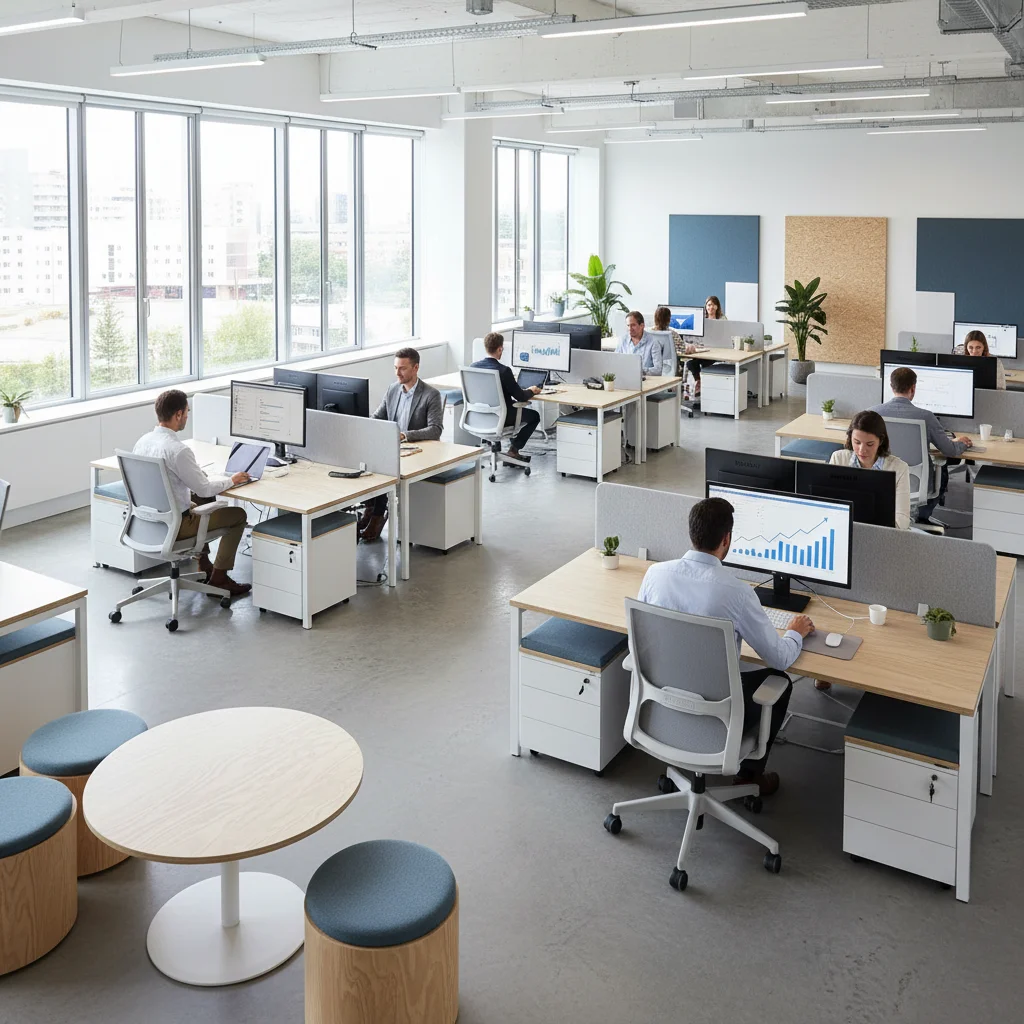
Before selecting particle board for office furniture, evaluate how this material performs under real commercial conditions, not just on a spec sheet:
Load-bearing requirements (shelves, desks, cabinets) — particle board has limited bending strength (MOR) and modulus of elasticity (MOE); exceeding load thresholds leads to rapid deflection and shelf sagging.
Moisture exposure in office environments — standard particle board panels are highly sensitive to humidity; without proper sealing, thickness swelling and internal bond (IB) degradation can occur.
Surface finishing (melamine, laminate, veneer) — melamine-faced particle board (MFC) improves abrasion resistance, however, edge banding quality determines true moisture protection.
Screw holding strength and joint stability — compared to MDF or plywood, particle board has weaker screw withdrawal resistance, increasing risk of joint loosening.
Expected product lifespan vs cost — lower upfront cost often results in shorter service life and higher replacement frequency.
Particle board is typically suitable for low-load, non-structural office furniture applications, but improper specification or misuse can significantly reduce durability and structural performance.
Particle Board vs MDF vs Plywood: Practical Selection Guide
In office furniture manufacturing, materials are chosen based on performance requirements:
– Particle board → cost-efficient, suitable for internal panels and low-load components
– MDF → higher density and smoother surface, suitable for doors and visible panels
– Plywood → stronger and more moisture-resistant, used for structural or high-load parts
In many projects, combining these materials is the most common approach to balance cost and performance.
Common Mistakes When Using Particle Board
Common issues in office furniture projects include:
– Using particle board for load-bearing shelves or desks
– Ignoring moisture exposure in certain office environments
– Assuming all particle board has the same density and quality
– Overlooking joint reinforcement in assembly
These mistakes often lead to structural instability, shorter lifespan, and increased replacement costs.
Modular Workstation Systems and Collaborative Spaces
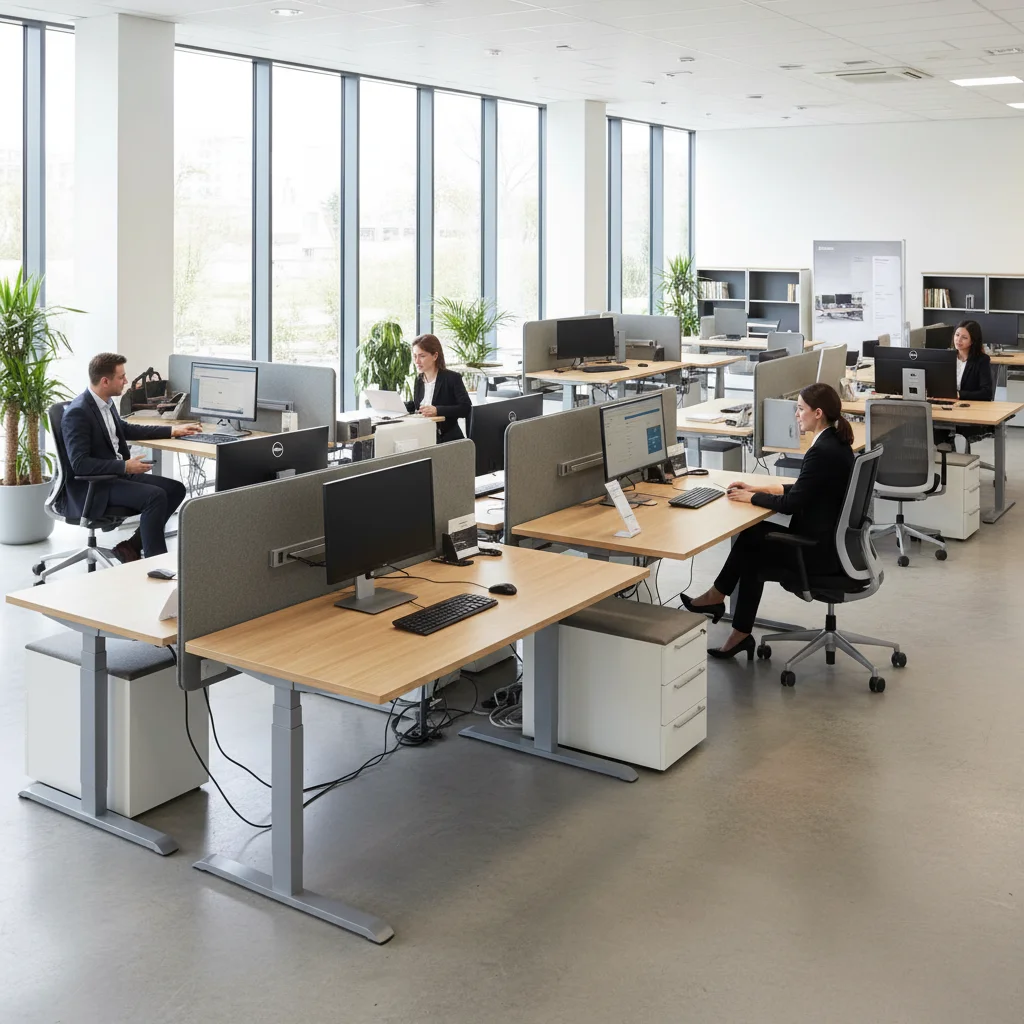
Density grading helps particle board fit collaborative spaces. Low-density boards at 400 to 600 kg/m³ make lightweight dividers. These panels absorb sound above 0.6 NRC. Teams can move them fast for quick changes. Medium-density boards at 600 to 800 kg/m³ hold desktop setups. They carry 50 to 100 kg per square meter. This supports multiple screens and shared tools in busy areas.
Quick Assembly Systems
Tool-free connectors let you swap panels in under five minutes. Modular frames adjust from 60 to 120 centimeters tall. Pin-locking makes height changes easy. Stackable dividers go from 120 to 180 centimeters. Teams can reset entire layouts in under one hour. Old systems take one to three days for the same job.
North America holds 38% of the market in 2026. Asia-Pacific grows fastest. Small and mid-size firms in India, China, and Japan use modular setups. Products like Lenovo ThinkStation P2 and P3 lead this shift. These workstations match with particle board furniture for tech and design teams. Thirty-five percent of tower workstations feature modular, upgradable builds for CAD and 3D tasks.
The ROI shows real results. Sixty-five percent of companies hit or beat their automation targets with modular systems. Seventy percent work with Windows-compatible team software.
suitable for office desks
From a practical perspective, particle board is suitable for office desks when used with proper surface finishing such as melamine or laminate.
However, it is generally recommended for light to medium load applications. For large workstations or desks expected to carry heavy equipment, higher-density materials or reinforced structures are often required.
In many projects, improper use in load-bearing desk structures can lead to bending or reduced joint stability over time.
*This application is suitable for particle board only under controlled load and environmental conditions, and should not be used for structural or high-load components.
Smart Storage and Filing Solutions
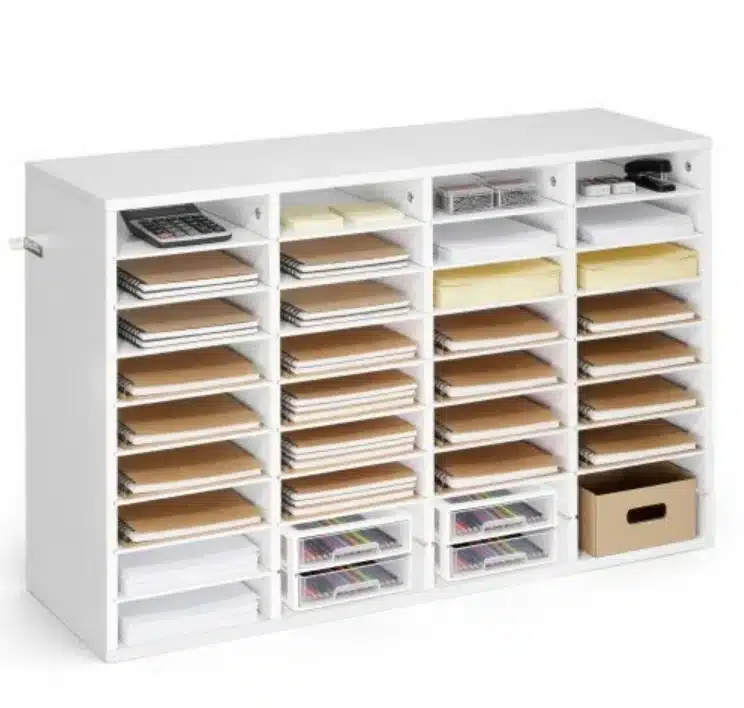
These aren’t your old metal filing systems. Modern units track access. They monitor climate. They connect to company portals 24/7.
Particle board makes tech integration simple. The material machines well for sensor mounts and cable routing. Manufacturers cut precise openings for smart locks. No splitting. No cracking. Climate-controlled units protect electronics, artwork, and sensitive documents. Temperature stability matters here. Particle board’s consistent density maintains internal conditions better than metal cabinets. Metal conducts heat. Particle board doesn’t.
Mobile and Modular Filing
Portable storage systems use particle board to cut weight. These mobile units move between workstations as teams shift.
*This application is suitable for particle board only under controlled load and environmental conditions, and should not be used for structural or high-load components.
Acoustic Management Applications
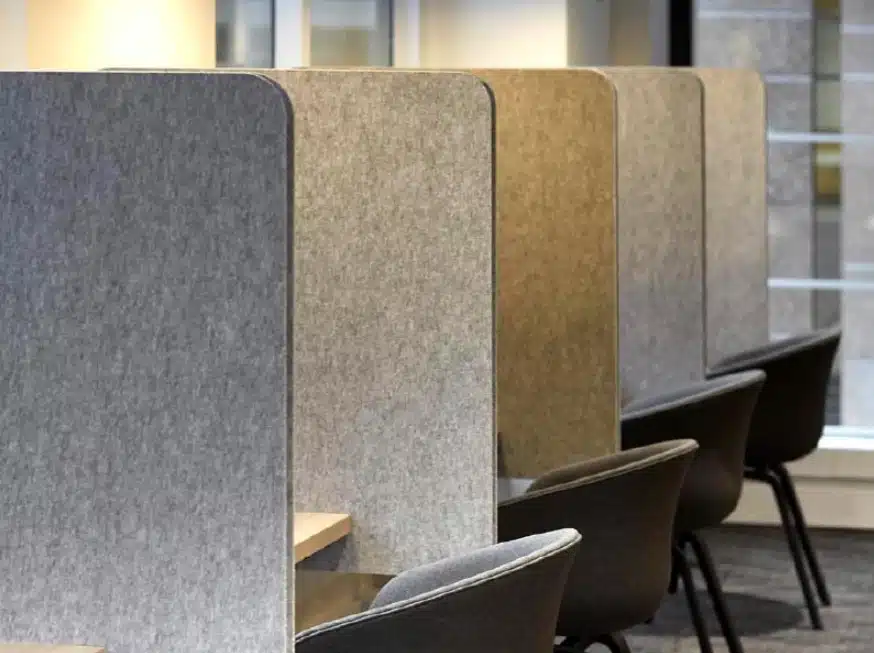
Noise kills productivity. Open offices make it worse. Particle board acoustic panels cut sound levels by 15 to 25 decibels in office spaces.
Particle board works because density controls sound. Medium-density boards absorb frequencies from 500 to 2,000 Hz. That’s where human speech sits. IT offices and business parks add these panels to walls and ceilings. New buildings include them from the start. LEED, WELL, and BREEAM certifications now require noise control metrics. You can’t skip this anymore.
Sound Level Performance
Real-world tests show what works. Gulf of Mexico office sites hit median sound pressure levels of 104.1 dB in low frequencies up to 200 Hz. Alaskan Arctic offices drop to 77.9 dB with proper panel setup. American Samoa and Caribbean sites keep the most steady levels—standard deviation stays between 2.5 and 4 dB. Particle board panels steady these numbers. They cut variation. Teams focus better with steady background noise.
*This application is suitable for particle board only under controlled load and environmental conditions, and should not be used for structural or high-load components.
Sustainable Office Furniture Solutions
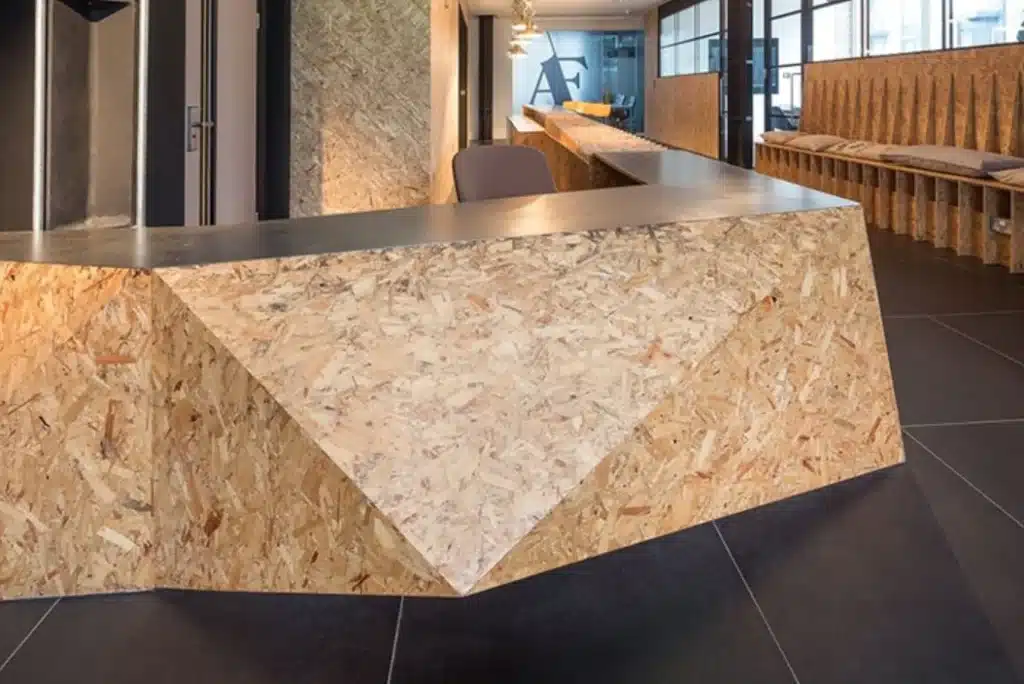
The sustainable furniture uses recycled wood fibers. Less waste comes out during manufacturing. They cost less than solid wood alternatives. Companies hit LEED and WELL certification targets. Budgets stay intact.
Chairs drive the biggest revenue share in 2025. Office replacement cycles push this number. Tables grow fastest, though. Tool-free repair systems make them last longer. Modular tops help too. Reclaimed wood and FSC-certified materials take 34.60% of 2025 sales. Bamboo and renewable grasses grab 6.66% annual growth. Bamboo matures in five years. It matches steel in strength tests.
Commercial Adoption and Certification
Buyers ask for 3D models with EPDs—environmental product declarations. GSA’s Buy Clean initiative logged over 17,000 EPDs by mid-2024. This creates opportunities for recycled metal frames. Bio-based foams work too. Low-VOC particle board finishes round out the options.
Carbon-smart processing makes it work. IKEA’s Mittzon line from 2025 shows how. Wood fiber construction brings natural elements into offices at scale.
*This application is suitable for particle board only under controlled load and environmental conditions, and should not be used for structural or high-load components.
Breakroom and Pantry Applications
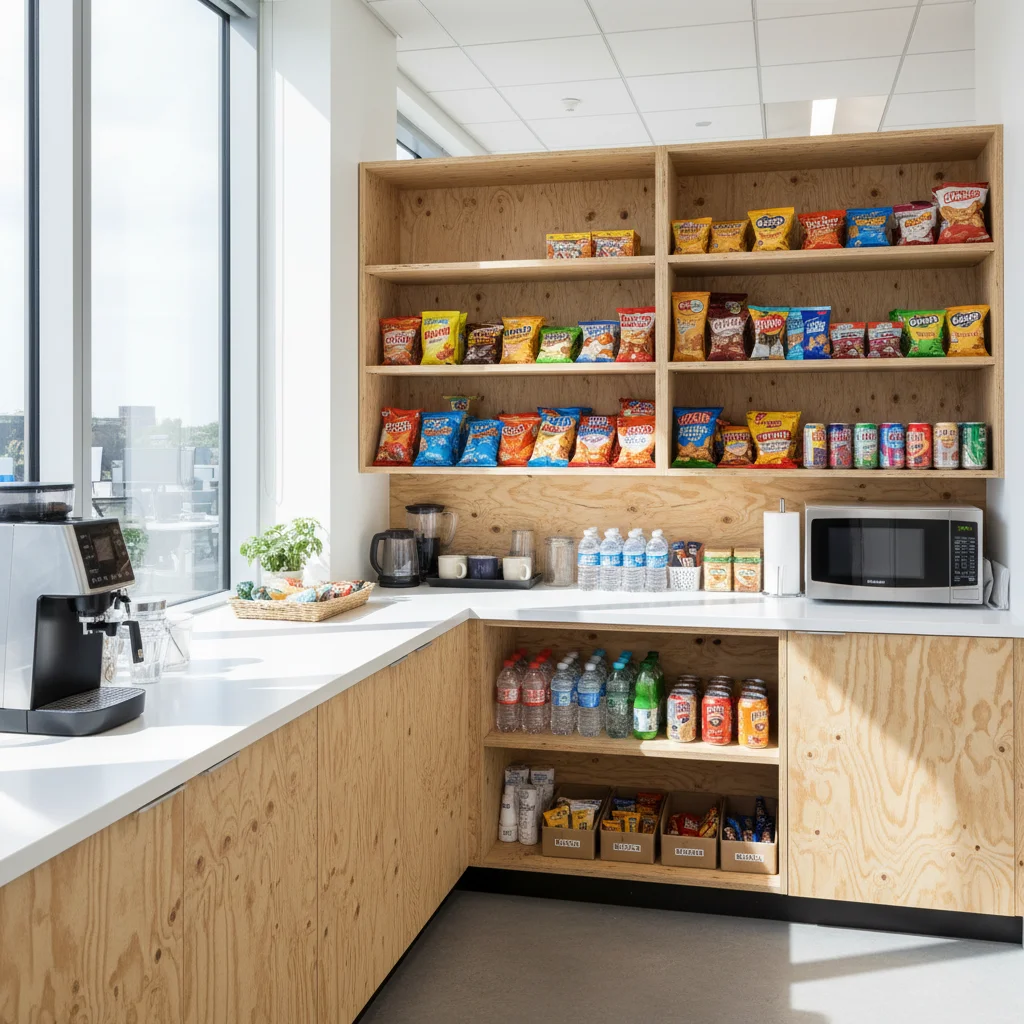
Particle board creates the setup that keeps office pantries running. The average company spend hit a lot in Q2 2025—. That money goes into storage cabinets, shelving units, and countertops that handle everyday wear. Particle board makes this scale work. You skip commercial kitchen budgets.
Bars take 9% of spending. These items need organized storage. Particle board shelving systems hold weight of 50 to 100 kg per linear meter for medium-density boards. Adjustable shelves let you stack inventory as product mix changes. Sodas grew 150% year-over-year. Deli items jumped 112%. Your storage adapts or you run out of space.
Countertops handle prep work and microwave stations. High-pressure laminate over particle board cores resists moisture from lunch prep. Sealed edges stop water damage. Companies average $8,645 per month per office on food programs. That volume needs surfaces that clean fast and last years.
Seventy-eight percent of employees say food access makes them feel valued. Break room upgrades return up to 150% in employee retention. Particle board keeps renovation costs low. This justifies the investment.
Load-Bearing Capacity Optimization
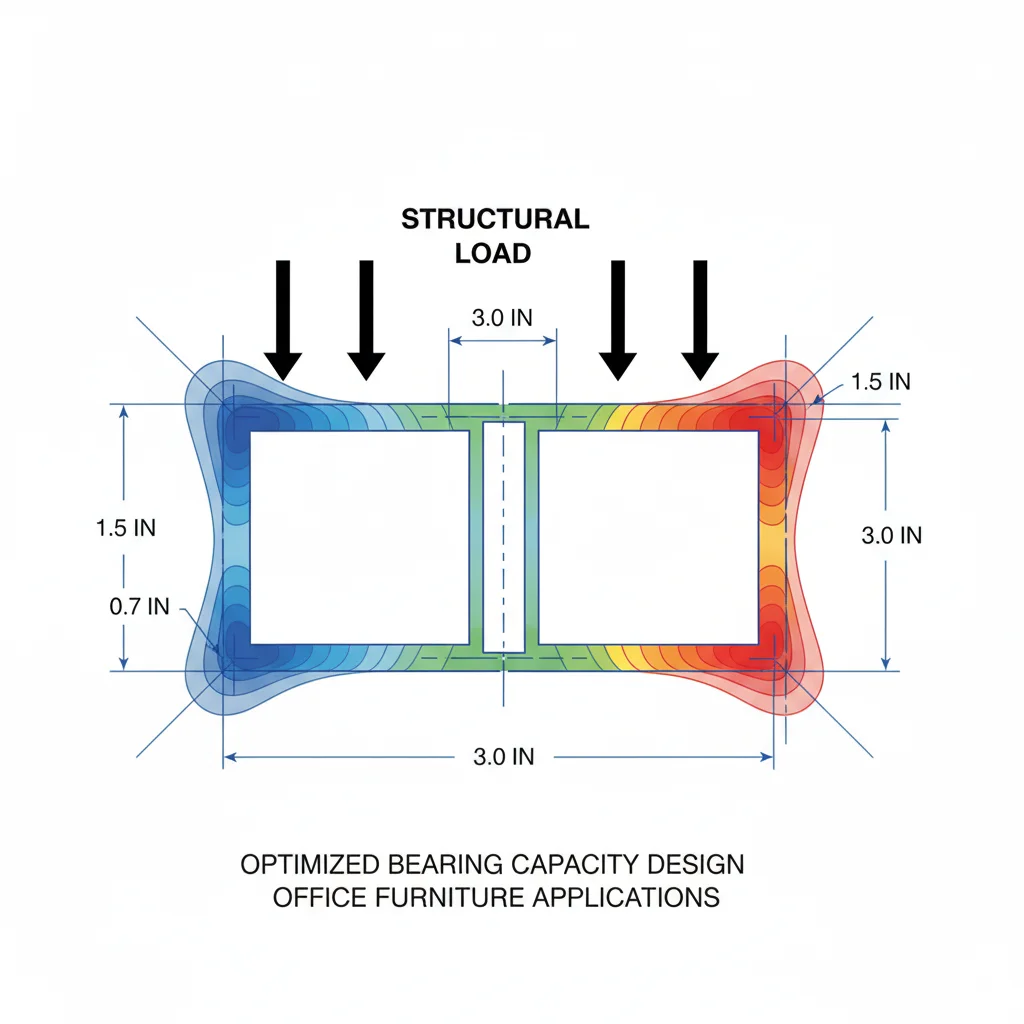
Precise engineering makes particle board structures perform better than expected. Two-cell box girder setups boost bearing capacity by 20%. No extra weight needed. Local stress modeling creates this gain. Maximum deflection stays within 4% deviation. Tests against FEM and ANSYS benchmarks prove this. The numbers confirm what designers know—smart geometry works better than adding more material.
Multicell box girder designs handle more load than traditional single-cell systems. You get more support per kilogram of material. Buckling resistance goes up. Stress spreads through multiple paths. No single point of failure exists. The structure bends in expected ways under different loads.
Structural Constraint Mathematics
Maximum stress constraints use simple formulas. Stress equals force times length divided by four times section modulus. Section modulus must be at or above force times length divided by four times allowable stress. Deflection follows the same logic. Moment of inertia must meet or beat force times length cubed divided by 48 times elastic modulus times allowed deflection. These equations work in real life. They show what particle board furniture can support in actual offices.
Anisotropic nodes in shear wall uses reach 7.6 MPa maximum shear strength. Optimization algorithms run 160 minimum cycles to find stable answers. The system checks 4,500 best strategies for different load cases. Anti-overturning ratios drop a lot—0.45 for wind loads and 0.13 for seismic events. Particle board structures handle side forces better. Engineers just need to account for directional material traits.
Topology optimization cuts computing time. Accuracy stays high. Simplified damage models create topologies that match complete nonlinear analysis results. Efficiency holds steady. Design teams get quick answers that pass testing. This speeds up product development for load-critical particle board uses in desks, storage systems, and modular walls.
Customization and Rapid Manufacturing
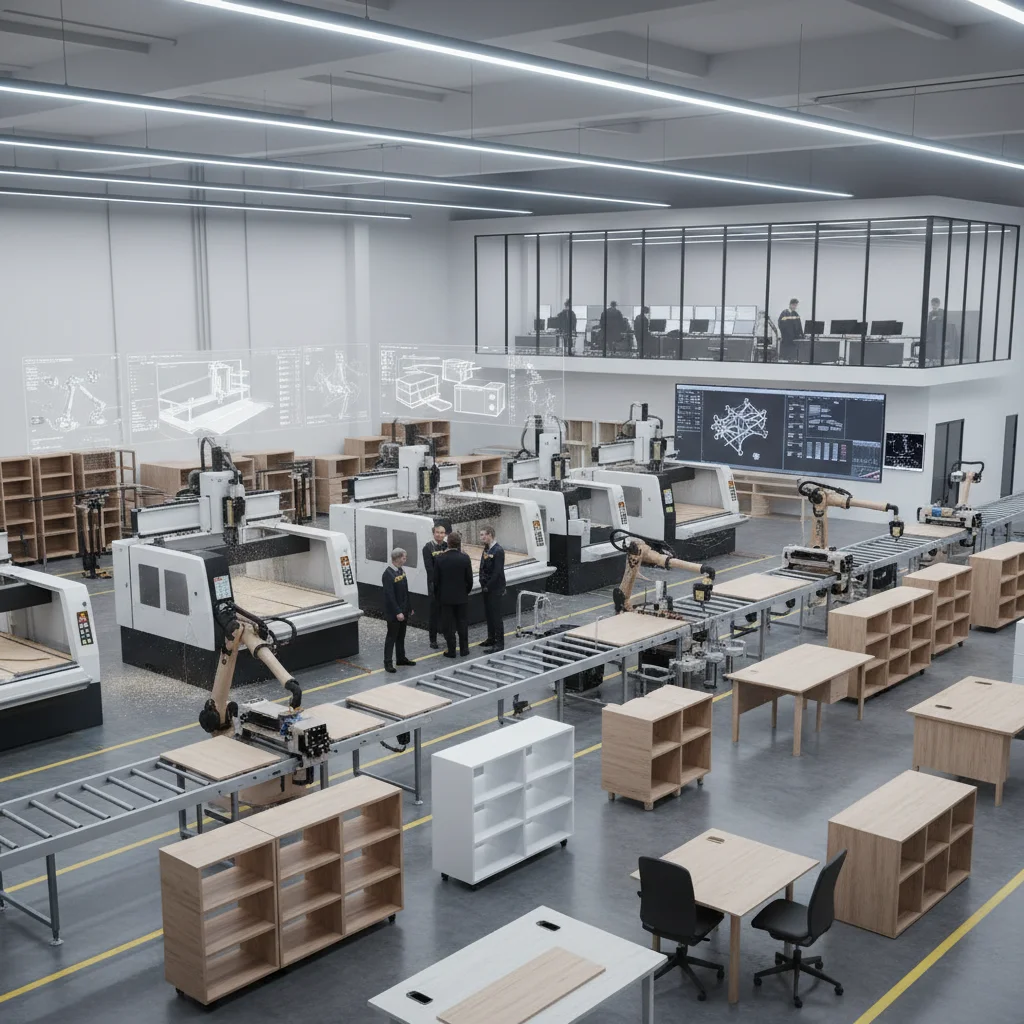
CAD/CAM integration powers this speed. Design files go from concept to cut in hours, not days. CNC machines just need raw particle board sheets on-site. No precut stock sits in warehouses. Last-minute changes happen without wasting materials. A client wants logo placement moved three inches left? Done before lunch. Old methods took days for the same edit.
AI and cloud systems connect production across continents. Siemens proved this by linking Germany and China factories. Quality control catches defects as they happen. Machines get fixed before breakdowns delay orders. Your custom conference table ships on time. No waiting on parts that broke down last week.
On-Demand Design Flexibility
Hybrid manufacturing mixes 3D printing with CNC cutting. Edge profiles that used to need five setups now need two. Replacement parts print in less time than warehouse shipping. Nike’s NIKEiD model shows how networked production handles custom orders at scale. Customers add personal touches. Systems route orders. Factories make them without slow handoffs.
Eighty percent of executives put twenty percent or more of budgets into smart manufacturing for 2026. Twenty-two percent plan physical AI robots—up from nine percent last year. Particle board furniture makers use flexible tech for small custom batches. Product platforms speed up market launches. Sales teams, engineers, and factory floors work through shared systems. Customer data shapes designs before you build prototypes.
Long-Term Durability in Commercial Settings
Commercial particle board furniture lasts longer than most people think. Spec it right and you’ll see the difference. Office desks and storage systems built from quality particle board run eight to fifteen years with daily use. That beats the industry assumption of five to seven years. The difference? Density grade, surface treatment, and edge sealing—not the base material itself.
Medium-density particle board at 600 to 800 kg/m³ handles commercial loads. Desktops support 50 to 100 kg per square meter. Filing cabinets handle drawer slides that open and close 10,000 cycles before showing wear. Compare this to building systems. HVAC units need replacement every eight to twenty years. Roof surfaces last fifteen to thirty years. Your particle board workstations sit in the middle of that range. They’re not structural steel at 100-plus years. They don’t need to be.
Maintenance Requirements vs. Building Systems
Particle board furniture needs little work. Wipe surfaces clean. Check fasteners once a year. Tighten loose screws before they strip threads. That’s it. No tuck-pointing like brick veneer at seventy years. No EPDM roof membrane replacement at twenty-five years. Office furniture maintenance costs stay predictable. Budget fifteen minutes per workstation each quarter. Multiply by unit count. You’ve got your labor estimate.
Surface damage happens. Coffee spills. Chair arms scrape desk edges. High-pressure laminate repairs in minutes with color-matched filler sticks. Veneer chips need edge banding tape and a heat iron. Both fixes cost under fifty dollars in materials. A facility manager handles this without calling contractors. Building envelope repairs don’t work that way. Aluminum siding lasts twenty-five to forty years, then you’re looking at five-figure replacement projects.
Location changes the numbers. Coastal offices with salt air see metal components corrode faster. Particle board stays stable. High-humidity climates need sealed edges and moisture-resistant cores. Specify this upfront. The upgrade costs ten to fifteen percent more. It prevents the thirty percent replacement rate humid environments cause in standard grades. Industrial facilities with chemical exposure need different furniture. Particle board works in standard office conditions—not lab spaces or manufacturing floors.
Preventative maintenance extends lifespan more than initial quality in some cases. A $600 desk with inspections each year outlasts a $1,200 desk left unchecked. Fasteners loosen. Weight distribution shifts. Small problems grow. Facilities teams that track furniture condition catch issues fast. They swap damaged panels before units fail. This approach matches how commercial buildings handle brick masonry. The structure lasts 100-plus years because crews fix mortar joints at seventy-five years. Same principle, different scale.
Conclusion
Particle board remains a cost-effective material in office furniture manufacturing, but its performance depends heavily on correct application.
For buyers and manufacturers, the key is understanding where particle board works best — and when stronger materials are required to ensure durability and long-term value.
Better manufacturing methods have made a difference. So has eco-friendly sourcing. New surface treatments help too. Particle board is no longer just a cheap option. Organizations now choose it as a smart strategy.
Today’s particle board solutions offer more than low cost. They meet tough commercial standards. Plus, they support your company’s green goals.
Planning a full office redesign? Upgrading some furniture systems? Partner with manufacturers who know their stuff. Look for those who understand weight limits, finish durability, and commercial-grade building.
Ready to transform your workspace? Check your current furniture against the standards we’ve covered here. Find suppliers who can show you quality certifications and real case studies. Your employees will notice the difference. Your budget will too.