
Australia’s commercial flooring market is changing fast, and procurement teams are under pressure to keep up. Fluctuating raw material costs, evolving supplier networks out of China, and a construction sector that demands waterproof, high-traffic solutions have made the Australia SPC flooring supplier market a puzzle for buyers trying to get fair pricing without sacrificing quality. Add in the ongoing comparisons between rigid core products, LVT, and traditional tile, and contractors and developers are searching for clarity, not sales pitches.
This report breaks down where prices actually sit right now, what’s driving demand across office fit-outs, retail spaces, and hospitality projects, and how stone plastic composite flooring stacks up against the alternatives you’re likely already weighing. If you’re building a procurement strategy for the next quarter—or the next five years—the numbers ahead will matter more than the marketing.
Australia SPC Flooring Market Size & 2024-2029 Growth Outlook
The Australia SPC flooring market stood at USD 38.01 million in 2024, and one widely cited projection puts it at USD 140.52 million by 2033, a 15.73% CAGR (2025-2033). It’s a niche segment scaling fast.
Year-by-year growth:
-
2025: ~USD 44.0M
-
2026: ~USD 50.9M
-
2027: ~USD 59.0M
-
2028: ~USD 68.2M
-
2029: ~USD 79.0M
Roughly double the market size in five years. For procurement teams, that trajectory signals rising competition for supply and potentially firmer pricing as demand outpaces production capacity.
Australia’s broader plastics floor/wall/ceiling coverings market hit USD 529 million in 2024 but grows at a 3.7% CAGR through 2035. SPC’s growth rate is more than four times faster. That gap points to genuine category-shift dynamics—buyers moving away from laminate and timber toward rigid core flooring.
Import data backs this up independently. Australia’s SPC imports grew 17.51% from 2023 to 2024, with a 10.79% CAGR from 2020 to 2024. Two different data sources, same demand-upcycle signal.
Demand concentration:
-
Sydney: CBD, North Sydney, Parramatta—bank branches, retail rollouts, workplace fit-outs
-
Melbourne: CBD, Southbank, Docklands—major projects and office refurbishments
-
Brisbane: corporate towers, government service centres, South East Queensland retail programs
Sydney and Melbourne lead procurement volume. Brisbane trails as a solid third market, driven by refurbishment cycles rather than new-build activity.
Australia’s total flooring market sits at USD 8.95 billion in 2024, forecast to reach USD 17.28 billion by 2033 at 6.8% CAGR. This broader construction context is also reflected in Australian building activity data, which provides a useful reference for assessing commercial construction demand. SPC’s faster growth suggests it’s capturing disproportionate share within that broader renovation and light-commercial wave—exactly where B2B buyers should be watching closest.
SPC Flooring Price Breakdown by Grade: Entry vs Mid-Range vs Premium
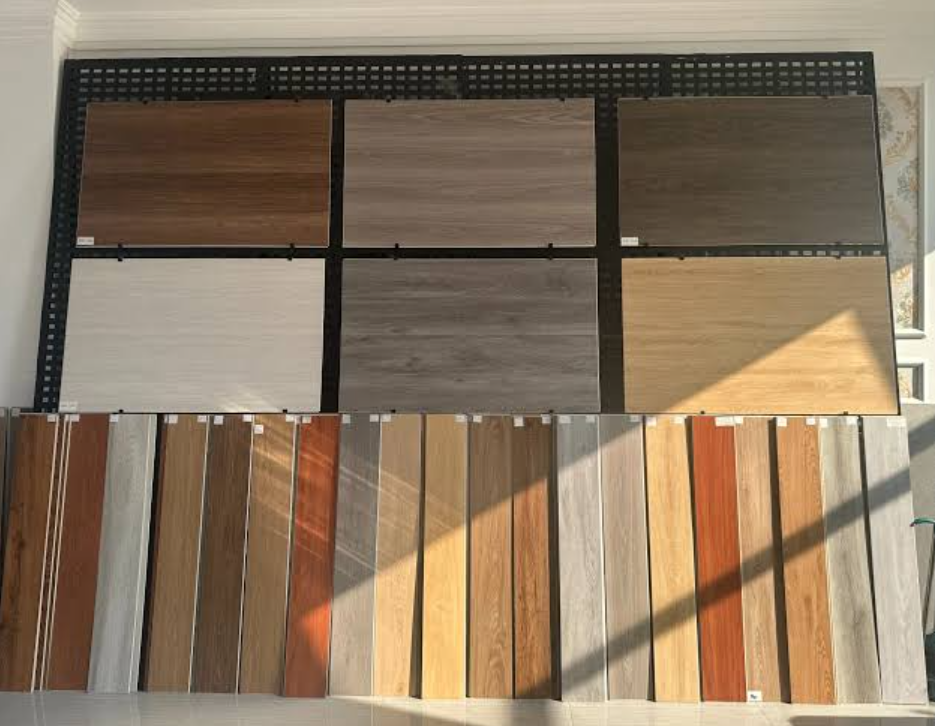
Not all SPC is priced the same, and it shouldn’t be. Three distinct tiers dominate the Australian market, each with real structural differences.
Hardware/bargain (A$15–39/m²): Clearance stock, big-box retailers, budget online listings. Typical spec: 4–6.5mm thickness, 0.2–0.3mm wear layer. Some listings skip wear layer specs entirely, a red flag for procurement teams doing due diligence.
Specialist entry (A$35–45/m²): The sweet spot for most commercial buyers. 5–7mm boards, 0.3–0.5mm wear layer, usually with IXPE underlay attached.
Premium (A$55–70+/m²): 6.5–9.5mm cores, 0.5–0.7mm+ wear layers, embossed-in-register finishes, wider planks, reinforced click lock SPC flooring systems.
Supply vs Installed: Where the Real Cost Sits
|
Tier |
Supply-only |
Installed |
Wear Layer |
Core |
|---|---|---|---|---|
|
Hardware |
A$15–39/m² |
A$45–80/m² |
0.2–0.3mm |
4–5mm |
|
Specialist |
A$35–45/m² |
A$60–90/m² |
0.3–0.5mm |
5–7mm |
|
Premium |
A$55–70+/m² |
A$95–110+/m² |
0.5–0.7mm+ |
6.5–9.5mm |
Installation adds A$25–45/m² on top of supply cost. Labor alone runs A$20–35/m², climbing to A$45/m² in Sydney. For procurement teams comparing installed costs, reviewing SPC flooring installation requirements early can help identify subfloor and installation risks before ordering. Labor alone runs A$20–35/m², climbing to A$45/m² in Sydney. Subfloor prep, demolition, and access issues like stairs, tight cuts, and furniture removal push jobs toward the higher end fast.
Below A$20/m², you’re buying thin cores and thin wear layers. Expect scuffing, edge chipping, and lock failure sooner.
Residential vs Commercial Demand Drivers in Australia SPC Market
Two separate engines power SPC demand in Australia, and they don’t run on the same fuel. Residential renovation drives volume. Commercial procurement drives margin logic. Understanding which one you’re selling into determines how you approach pricing conversations.
Residential demand is broad and consumer-led. Australian households spend an average of AUD 22,000 per renovation, and the National Housing Accord’s target of 1.2 million new well-located homes, plus renovation of existing stock, keeps flooring refreshes coming. Homeowners buy SPC for water resistance, low maintenance, timber-look aesthetics, and DIY-friendly click-lock installation. Nobody’s running a TCO spreadsheet on a weekend reno.
Commercial buyers think differently. Purchase decisions center on lifecycle cost. Scratch and impact resistance matter. So does install speed. SPC’s rigid core resists the dimensional movement that temperature and humidity swings cause in large-format commercial interiors, which means fewer callbacks and less maintenance.
The numbers back this up. Click-lock SPC installs up to 40% faster than glue-down floors, and labor time drops by as much as 30%. In retail and hospitality, that speed translates directly into revenue protection because store closures and guest disruption cost more than material price gaps ever will.
Best-fit commercial subsegments:
-
Offices: fast refits, stable appearance, low wet-cleaning demand
-
Retail: overnight or weekend installs, minimal downtime
-
Hotels/hospitality: guestrooms and corridors needing quick turnover
-
Short-stay rentals: waterproof, scratch-resistant flooring that survives constant occupancy changes
Residential buys on trend and moisture concerns. Commercial buys on capex cycles, tenancy handovers, and disruption avoidance.
Best-Fit Commercial Applications: Where SPC Flooring Works (and Where It Doesn’t)
Not every commercial floor plan suits SPC. Match the space to the spec, and the material earns its keep. Get it wrong, and you’re paying premium prices for a floor that fails early.
Where SPC excels:
-
Offices — Open-plan floors, meeting rooms, and executive suites spec 0.5mm wear layers with strong castor chair resistance. Under commercial wear ratings, Class 31 covers private offices, small retail fitting rooms, and hotel guest rooms. Class 32 fits open-plan offices, boutique retail, and hotel corridors.
-
Retail — Boutiques, apparel, showrooms, and grocery sales floors run 0.5–0.55mm wear layers. Stockrooms and pallet Jack zones need 0.7mm+ with reinforced locking.
-
Hospitality — Guest rooms and suites run 5.5–7.0mm cores with 0.5mm wear layers. Corridors step up to 7.0mm + 0.55–0.60mm for heavier foot traffic. For broader project requirements, see our hotel flooring solutions for guidance on material selection across guestrooms, corridors, and public areas.
-
Back-of-house areas — Service corridors and staff zones favor fast installation, moisture tolerance, and easy spot repair over premium aesthetics.
Real-world payoff: One 50-store retail chain installed 50,000 sqm of SPC and reported 63% lower maintenance costs, saving $180,000 annually. A 25-hotel rollout using click-lock systems achieved 46% faster installation with zero revenue loss during renovation. A Miami five-star property covering 15,000 m² saw 3% wear in high-traffic corridors after two years, with 45% lower upkeep costs versus the tile it replaced.
Where SPC hits its ceiling: Very high-traffic public corridors and heavy point-load zones—fixed shelving, dense filing systems, permanent display units—push past SPC’s practical limits. SPC handles point loads up to 2,500N, but sustained extreme loading favors porcelain tile or specialist commercial vinyl instead. Tile delivers superior static load capacity, provided the subfloor is dead flat—otherwise grout cracking becomes a real risk. Specialist commercial vinyl handles the harshest wear-and-tear conditions SPC wasn’t built for.
Quick reference:
-
Choose SPC: offices, boutique retail, hotel rooms and corridors, restaurant front-of-house, back-of-house service areas
-
Think twice: ultra-high-traffic public thoroughfares, permanent heavy storage, fixed equipment zones
-
Go tile or specialist vinyl: extreme point-load areas, warehouse boundaries, equipment-dense commercial floors
SPC vs LVT vs Tile: Commercial Flooring Comparison for B2B Buyers
Numbers settle most flooring debates. On dent resistance, SPC beats LVT by a wide margin: 1,200 psi vs 850 psi at 2.5mm, 1,800 psi vs 1,100 psi at 6mm. One commercial benchmark puts it even starker—1,500 psi for SPC against 800 psi for LVT. The reason comes down to core structure. SPC’s rigid mineral core is denser and stiffer, so it doesn’t need a perfect subfloor to perform. LVT flexes more, which makes it forgiving over minor irregularities but weaker under sustained point loads.
Dimensional stability tells the same story. SPC shrinkage sits around 0.05% or less under ASTM-based testing, versus LVT’s 0.1% minimum. In offices, retail, and healthcare corridors—anywhere point loads and temperature swings are constant—SPC wins on stability.
SPC vs Tile: the real cost comparison
This is where SPC flooring wholesale price advantages hold up under scrutiny. Commercial SPC installed runs $30–50/m², and one 2026 comparison shows SPC total 5-year TCO at roughly $15/m² against ceramic tile’s $23/m². Installation speed widens that gap further—click-lock SPC covers 100m² in half a day; porcelain tile needs mortar, cutting, grout, and 48-hour curing before foot traffic returns.
Tile still wins in wet-heavy zones. Commercial kitchens, wash-down areas, and spa-wet rooms need grout-managed drainage and higher heat tolerance than SPC or LVT commonly certify for.
|
Material |
Price Range |
Best Fit |
Service Life |
|---|---|---|---|
|
SPC |
$30–50/m² installed |
Retail, offices, healthcare |
10–20+ years |
|
LVT |
Varies by grade |
Uneven subfloors, hospitality |
10–15 years |
|
Tile |
$35–55/m² material |
Wet zones, kitchens |
20+ years |
Choose SPC for speed and dent resistance, LVT for forgiving installs on rough subfloors, tile for anything genuinely wet or heat-intensive.
B2B Procurement Checklist: How to Evaluate SPC Flooring Suppliers in Australia
When a cheap SPC flooring wholesale quote lands on your desk, it usually means something got cut from the spec. Before you sign a purchase order, you need a checklist that tells genuine commercial-grade boards from relabeled residential stock.
Technical parameters to verify
Wear layer: the common Australian tiers are 0.3mm, 0.5mm, 0.55mm, and 0.7mm. Light commercial and most commercial projects need 0.5mm or more. 0.3mm belongs in entry or light-duty spec only.
Core and total thickness: standard builds run 4mm, 5mm, 5.5mm, 6mm, or 7mm. Check the exact structure. A 4mm core with 0.5mm wear layer and 1.5mm underlay gives you 6mm total.
Attached underlay: usually 1.0mm EVA or 1.5mm IXPE. This improves install speed and sound reduction but does not add durability. Make sure it is included in the stated total thickness.
Commercial warranty: terms range from 5, 6, 10, to 15 years. Check what “wear” actually means. Is it pattern-layer breakthrough? And are gloss reduction, edge wear, or indentation excluded?
Documents to request
Ask for the full spec sheet with thickness, wear layer, core, underlay, click lock mechanism, and application rating. Get the complete warranty text including all exclusions and what proof you need to file a claim. Request slip rating and fire or compliance certificates. Get written lead time confirmation showing whether it is stock, production, or shipping time. Clarify MOQ per color, per order, and whether mixed-container options exist. Ask for the installation manual, subfloor moisture limits, and maintenance guide.
Spotting low-price traps
A $39.96/m² listing at 5mm with a 4mm core, 1mm EVA, and 0.3mm wear layer is common. If a supplier quotes that low but claims a 0.5mm wear layer and a commercial warranty, the numbers do not hold. Watch for “thick but thin-skinned” boards where a high total thickness hides a 0.15–0.3mm wear layer. Also watch for long warranties with a narrow claim scope.
For commercial projects, require 0.5mm+ wear layer and 10+ year commercial warranty. For high-traffic public zones, push to 0.55mm+ with full test documentation.
Current Market Price Signals: Real Retail & Wholesale Examples in Australia
Pricing patterns across Australian retail and trade channels are worth watching if you’re in procurement. A$18.99 means mass-market or promo-driven pricing. A$34.99–A$34.41 ex GST is where mid-tier trade anchors sit. A$39.95–A$40.29 ex GST is where real wholesale leverage starts. A$44.40–A$49.99 pushes into premium-accessible territory, usually for branded or specialist goods, not commodity stock.
Channel matters as much as the number. Hardware and electrical wholesalers quote ex GST, with tighter visible margins. Specialist suppliers use trade-access language—MOQ from five units, pay-on-invoice terms.
For batch buying, MOQ 5–20 gives you the highest per-unit cost, but it works for SKU testing. MOQ 50–100 is where trade pricing starts to improve. Go past MOQ 100–500+, and you can negotiate tiered discounts of 10%–20%+. That’s ground worth covering when you evaluate any SPC flooring wholesale price quote.
Conclusion
The numbers are clear. Australia’s SPC flooring market isn’t a fad—it’s changing how commercial spaces get built. Prices are stabilizing after years of volatility, wholesale margins are tightening as more manufacturers compete, and commercial demand is outpacing residential growth for the first time in this category’s history.
For procurement teams, the message is simple. Waiting for prices to drop is a losing bet—supply chain pressures and rising material costs suggest the opposite is coming. The smarter move is locking in supplier relationships now, before Q3 demand spikes push wholesale SPC flooring pricing higher across the board.
If you’re evaluating vendors for an upcoming commercial project, don’t just compare quotes. Compare warranty terms, lead times, and production capacity. That’s where real cost differences show up six months down the line.
Request a wholesale quote today and benchmark your next project against current market rates.