
Laminate flooring installation is not just a technical process — it is a key factor that determines product lifespan, warranty risk, and project profitability.
In most commercial and export projects, flooring failures are rarely caused by product defects. They are usually the result of incorrect installation practices, poor subfloor preparation, or missing expansion control.
This guide is based on real installation experience across large-scale projects. It focuses not only on how to install laminate flooring, but on how to avoid the mistakes that lead to costly rework, complaints, and premature failure.
If you are a contractor, distributor, or bulk buyer, this is the part that matters most.
Step 1: What We Always Do Before Laying Laminate Flooring
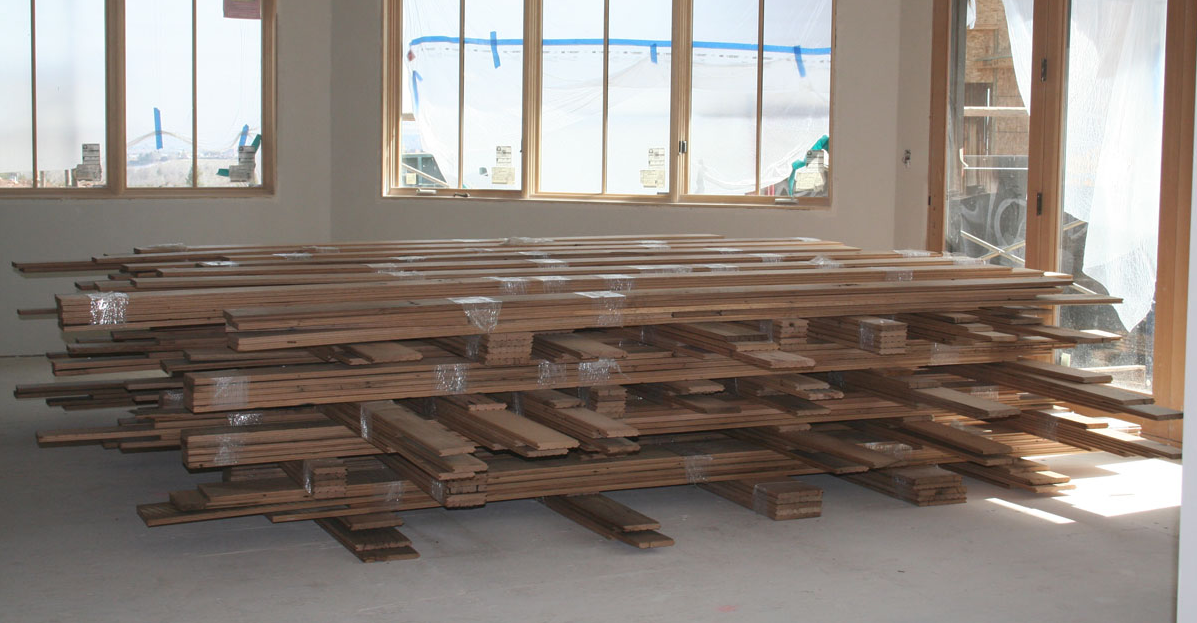
At Baier, as a top laminate flooring supplier and OEM manufacturer, we know a thing or two about what makes a bulk flooring job go smoothly. One step we never skip? Let the laminate planks acclimate before you lay them down.
No matter if you’re a contractor, flooring pro, or distributor, here’s our tip: leave those unopened boxes right in the room where the floor’s going for at least 48 hours. Let the boards get comfy with the temperature and humidity.
Keep the room cozy—around 18 to 24°C (64 to 75°F) and humidity between 45% and 65%. No crazy hot or cold swings.
Why bother? Laminate flooring reacts to moisture and temperature changes. If you throw down boards fresh from a chilly warehouse or hot truck, they’ll move around once inside—leading to gaps, warping, or buckling. And trust me, that’s a headache nobody wants.
For our OEM partners and bulk buyers, this simple step can save you tons of money on callbacks or replacements. At Baier, we’re all about making sure your flooring installs right the first time and lasts for years.
Most buyers overlook this step, especially in fast-moving projects.
Skipping acclimation often leads to internal stress release after installation. In real projects, this typically shows up as joint gaps, edge lifting, or visible deformation within a short period after installation.
In bulk supply or OEM projects, this is one of the most common causes of post-installation complaints.
So, take that little pause, let the flooring settle in, and you’re one step closer to a perfect floor.
Check the Subfloor Conditions
| Requirement | Details |
|---|---|
| Clean |
|
| Level |
|
| Dry |
|
| Solid |
|
Plan Your Layout
Dry-fit a few rows without adhesive to visualize the layout.
Adjust the first row to avoid ending up with very narrow planks on either side.
If needed, trim the bottom of door frames so the planks can slide under smoothly.
This is where many installation failures actually begin.
An uneven or weak subfloor creates continuous stress on the locking system. Over time, this leads to joint damage, noise, or visible movement between planks.
Moisture issues are even more critical. Once moisture enters the HDF core, the damage is irreversible and usually requires full or partial replacement.
Step 2: How We Properly Install the Underlayment
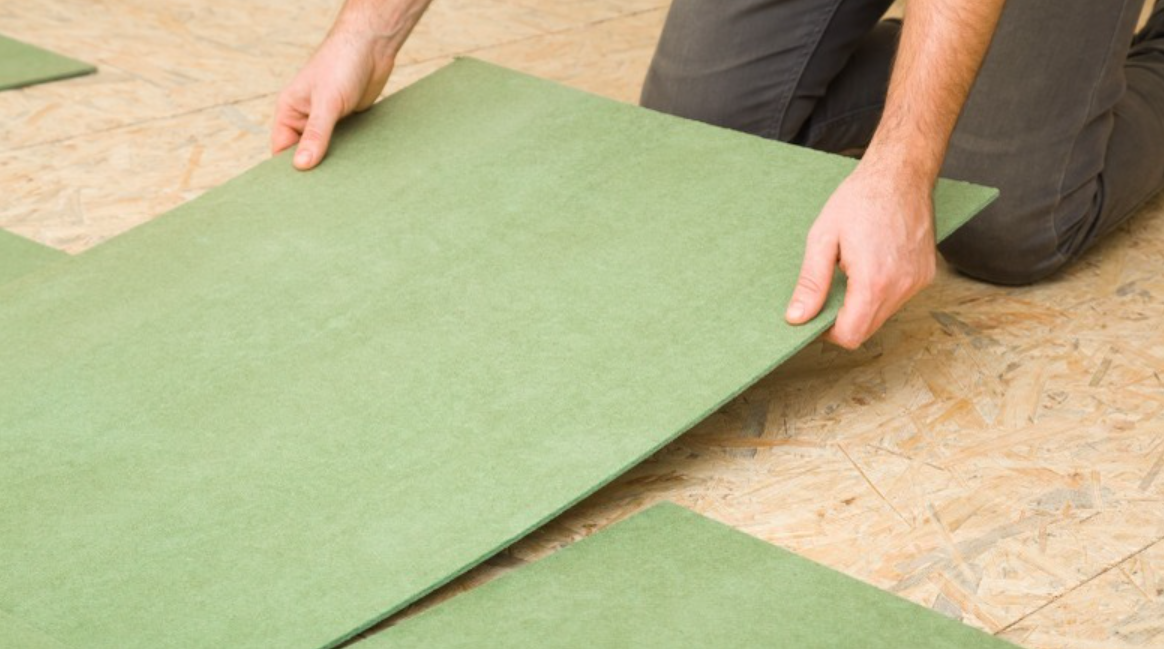
Choose the Right Underlay for Your Laminate Flooring
At Baier, as your laminate Flooring Supplier and OEM manufacturer, we always tell our partners: picking the right underlay is a game-changer for a smooth install and a floor that lasts.
Depending on your subfloor type, here’s what we usually recommend:
-
EPE or IXPE foam underlay — these are solid choices for cushioning and keeping moisture at bay.
-
Cork underlay — if you want something natural that also helps cut down noise and keeps the floor feeling cozy.
The right underlay doesn’t just protect your laminate—it makes the whole space feel better underfoot and quieter, which matters a lot whether it’s a home or a commercial spot.
If you’re ordering bulk laminate flooring from Baier, we’re happy to guide you on which underlay fits your project best.
Underlay is often treated as a secondary material, but in practice, it directly affects installation stability and long-term performance.
Using overly thick underlay can create a soft, unstable base, which increases stress on the locking system. On the other hand, insufficient moisture protection can allow vapor to penetrate from the subfloor, leading to swelling or deformation over time.
In commercial environments, these issues often result in noise complaints rather than visible damage — which makes them harder to diagnose but more frequent.
Install It Right
At Baier, we always make sure the underlay is laid flat with no gaps or overlaps. Wrinkles or seams left open can cause moisture problems or make the floor uneven and noisy.
We overlap the edges slightly and tape them down to keep everything sealed. Usually, we use underlay between 1–3mm thick—too thick feels bouncy, too thin loses cushioning.
For our bulk laminate flooring and OEM clients, this step is key to a smooth, lasting install. Skipping it just isn’t worth the risk.
Tape all seams tightly using proper moisture barrier tape.
At the edges, let the underlay curl up 5–10mm against the wall for added moisture protection.
Step 3: How We Make Sure Expansion Gaps Are Perfect
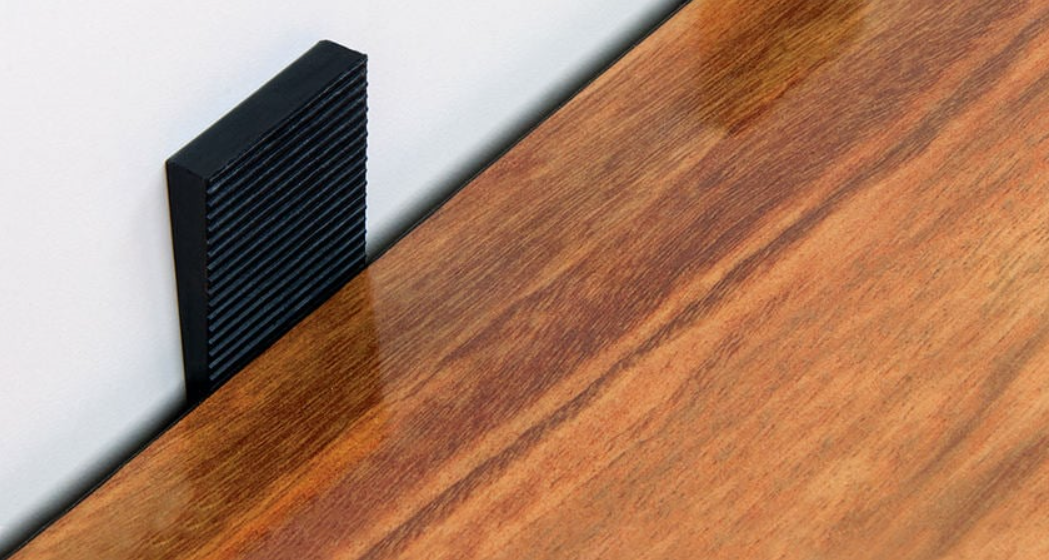
Why Expansion Gaps Matter
Okay, so here’s the thing about laminate floors—they’re floating floors, which means they need some space to move around.
You’ve gotta leave an 8–10mm (about 1/4 inch) gap around the walls and doorways. This gives the floor room to breathe and expand.
We always recommend using those little plastic spacers to keep the gaps nice and even while you’re working.
And don’t worry—once you put the baseboards on, you won’t see those gaps at all.
If you’re doing a bulk laminate flooring install or handling an OEM Flooring project, trust me, leaving those gaps will save you a ton of hassle later, like warping or the floor buckling.
Ignoring expansion gaps is one of the fastest ways to cause installation failure.
When laminate flooring expands without sufficient space, pressure builds up across the floor surface. This typically results in buckling or peak formation, especially in large continuous areas.
In large-scale installations, this issue can affect entire zones rather than isolated sections, making repairs significantly more complex.
Step 4: Our Best Techniques for Installing Laminate Flooring
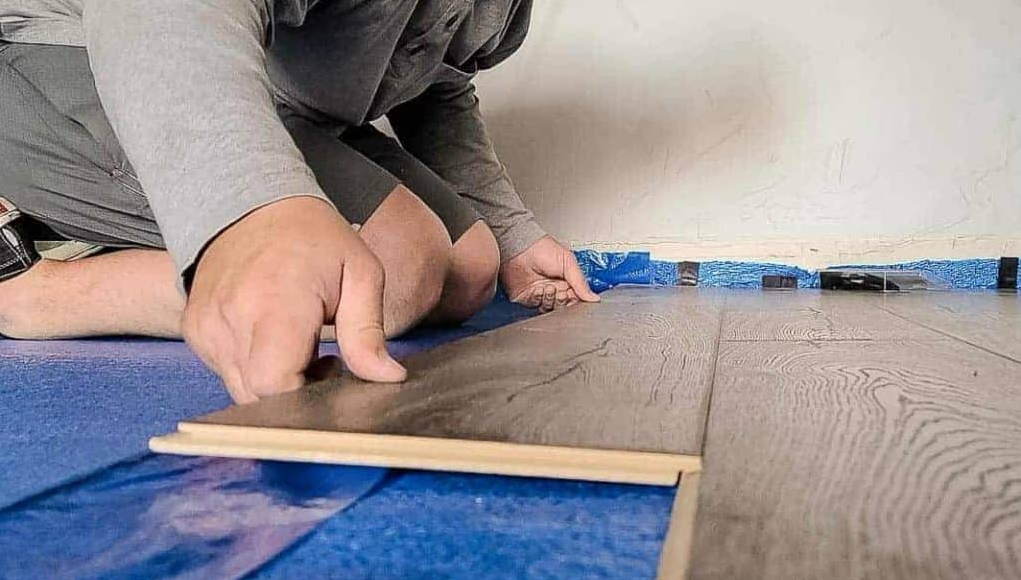
First Row: The Foundation of a Flawless Laminate Flooring Job
Alright, here’s how you get that first row in and make sure everything else goes smooth. Start by laying the first plank with the tongue side against the wall.
This is key to making sure the locking system clicks right. Then, grab a tool and trim off the tongue edge along the wall for a flush fit—this makes everything look clean, no gaps, no mess.
After that, just snap each plank into place with the locking system. It’s quick and easy, and before you know it, you’ve got a floor that’s solid, sturdy, and ready to last.
At Baier, we’ve got the expertise to make sure you’re set up for success, whether you’re doing a home or commercial job. Just follow the steps, and you’ll have a floor that looks pro and stays that way.
Next Rows: Keep It Strong and Tight
Next rows: Stagger the joints by at least 30cm (12 inches) between each row for that added strength and sleek look.
Start each new row with the offcut from the previous one—only if it’s long enough.
This not only helps you save material but also keeps that clean, seamless pattern going. Keep the momentum, and you’ll have a floor that’s solid, stylish, and built to last.
Clicking Technique:
Align the short edge first and click it in.
Then press the long edge down until it locks with a “click”.
Use a tapping block and rubber mallet if needed for a tight seal.
Not all locking systems perform the same in real installation conditions.
Lower-quality locking profiles may appear functional during installation but fail under repeated stress or minor subfloor imperfections. This is where product quality and installation technique interact.
For buyers sourcing laminate flooring, it is critical to verify the locking system performance, not just appearance or thickness.
Cutting the Planks
Measure twice, cut once with a tape measure and pencil.
Cutting tips:
Use a hand saw with the decorative side facing up.
Use a power saw with the decorative side facing down.
Always aim for clean, splinter-free cuts.
Final Row Handling
Measure and cut lengthwise to fit the final row.
Use a pull bar to lock the last planks tightly in place.
Don’t forget to maintain the expansion gap at the wall.
Common Mistakes Buyers Make in Laminate Flooring Installation
Even experienced buyers and contractors make avoidable mistakes during laminate flooring installation. These mistakes usually don’t show immediately, but they lead to long-term issues.
• Skipping acclimation due to tight schedules
• Ignoring subfloor flatness and moisture conditions
• Choosing underlay based on price rather than performance
• Not leaving sufficient expansion gaps
• Using incompatible or low-quality locking systems
In most cases, these decisions are made to save time or cost — but they result in higher replacement and maintenance costs later.
How to Verify Laminate Flooring Quality Before Installation
Installation success does not depend only on technique — it also depends on product consistency.
Before installation, buyers should verify the following:
• Locking system precision — check tightness and repeat installation performance
• Core density stability — inconsistent density leads to uneven expansion
• Moisture resistance performance — especially for humid environments
• Certification compliance — such as E1, E0, or CARB P2 standards
• Batch consistency — compare multiple boxes to ensure uniform quality
Most suppliers present ideal samples, but bulk production may vary. Verifying consistency is essential in OEM and large-scale orders.
Real-World Application Scenarios
Different projects require different installation priorities.
Residential projects
Focus on comfort, noise reduction, and appearance consistency.
Commercial spaces (offices, retail)
Require higher wear resistance (commonly AC4 or above) and stricter installation precision to handle traffic.
Large-scale export projects
Prioritize installation efficiency, material consistency, and reduced failure rates to minimize after-sales risk.
Understanding the project type helps determine the correct installation approach and material selection.
Step 5: How We Perfect the Finishing Touches
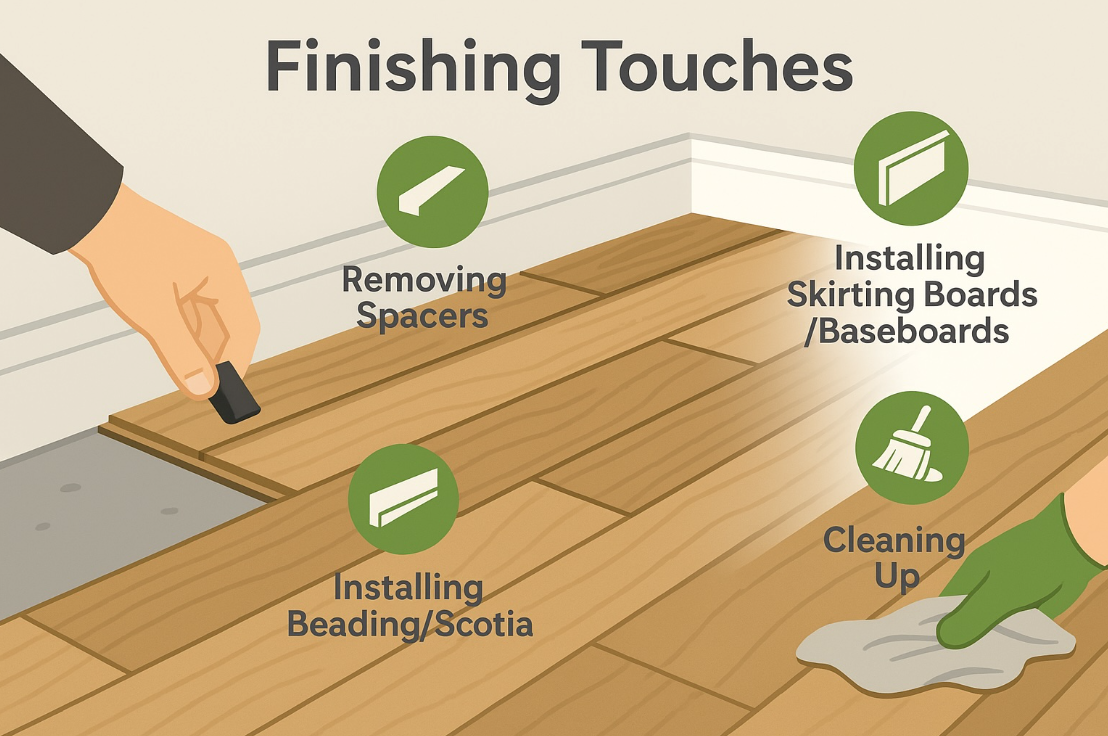
Remove All Spacers
Carefully take out the spacers—don’t chip the edges of the floor.
Install the Baseboards
The baseboard should cover the expansion gap completely.
Nail it to the wall, not to the floor, so the flooring can still expand and float freely.
Special Treatment for Wet Areas
For areas near kitchens or bathrooms:
Insert foam backer rod into the expansion gap.
Apply moisture-resistant sealant like Aqua Sealant.
Optional: Add a clear waterproof strip under the baseboard for extra protection.
Install Floor Accessories
Transition strips between laminate and other floor types.
Pipe covers around heating pipes.
Door thresholds for clean transitions at entrances.
Pro Tips and Key Rules to Remember
Floating Floor Rules
No glue or nails — laminate flooring must be installed as a floating floor.
Don’t fix it to the subfloor, or it will buckle.
Installation Habits That Help
Work while standing or kneeling on the installed flooring to prevent movement.
Mix planks from multiple boxes to blend natural color variations.
Follow the Manufacturer’s Guide
My final advice: always follow the official laminate flooring installation guide provided by the manufacturer. It ensures quality—and keeps your warranty valid.
Quick-Step Checklist for Laminate Flooring Installation
Quick Decision Checklist for Buyers & Installers
✓ Acclimation completed (minimum 48 hours in controlled conditions)
✓ Subfloor inspected (flat, dry, structurally sound)
✓ Underlay selected based on environment, not just cost
✓ Expansion gaps reserved (8–10mm in all directions)
✓ Locking system tested before full installation
✓ Planks mixed from multiple boxes for consistency
✓ Installation follows manufacturer specifications
✓ Moisture-sensitive areas properly sealed
Skipping any of these steps increases the risk of failure.
Nail It: Your Go-To Guide for a Flawless Laminate Floor Installation
Expert Opinion:
“From my experience with thousands of laminate installations, I can show you what separates amateur work from a professional job. The difference is following the systematic approach I’ve laid out here. The main point isn’t just to follow steps. You need to understand why each one matters.
I have seen contractors who skip acclimation or rush the subfloor prep. They end up with callbacks about failed floors within months. In my experience, when you use the correct technique from the start, these floors last for decades without issues.
These methods are more than just good ideas. They are the foundation of every installation we back with a warranty.”
———— Jack , Senior Installation Engineer at Baier Flooring with 15+ years in commercial laminate flooring systems
Laminate flooring installation is not just about following steps — it is about controlling risk across the entire project.
From subfloor preparation to material selection and installation technique, every detail affects long-term performance.
For distributors, contractors, and bulk buyers, the goal is not just a finished floor — it is a floor that performs consistently across different environments and over time.
At Baier, we focus not only on supplying laminate flooring, but also on ensuring that it performs correctly in real-world applications. Because in large-scale projects, installation success is what ultimately protects your margins and reputation.