
For Guatemala’s furniture SMEs, raw material costs don’t just eat into margins. They decide whether a product line survives at all.
Right now, most small manufacturers are missing their biggest cost lever — MDF sourcing. The right laminated melamine MDF sheets in Guatemala for furniture production can cut real dollars off every cabinet run, every wardrobe panel, every office desk batch. You keep the surface quality your end customers care about. You just pay less for it.
The hard part? Finding a cost-efficient manufacturer who delivers furniture-grade specs, solid lead times, and fair wholesale pricing. That’s where most SMEs burn weeks on back-and-forth with the wrong suppliers.
Here’s what this guide covers — and why each part matters to your bottom line.
What you’ll find in this resource:
Product specifications — standard sheet sizes (1220 × 2440 mm), thickness from 8–25 mm, surface finish options, and density benchmarks for kitchen cabinets, wardrobes, and office furniture
Pricing benchmarks — melamine MDF export prices range from US$2.10–19.95 per piece. The final price depends on thickness, finish, and order volume
Supplier evaluation criteria — filter manufacturers by MOQ, lead time, customization options, and emission class (E0/E1/CARB)
Procurement checklist — the exact specs to include in your RFQ: EXW/FOB price, core density, moisture resistance, packing method, and container load estimates
Cost comparison framework — delivered cost per usable square meter gives you a clearer picture than sheet price alone
Each section serves one purpose. It helps Guatemala furniture SMEs make faster, smarter sourcing decisions on melamine faced MDF panels — without wasting time on suppliers who can’t deliver.
Why Laminated Melamine MDF Sheets Are the Smart Material Choice for Guatemala Furniture SMEs
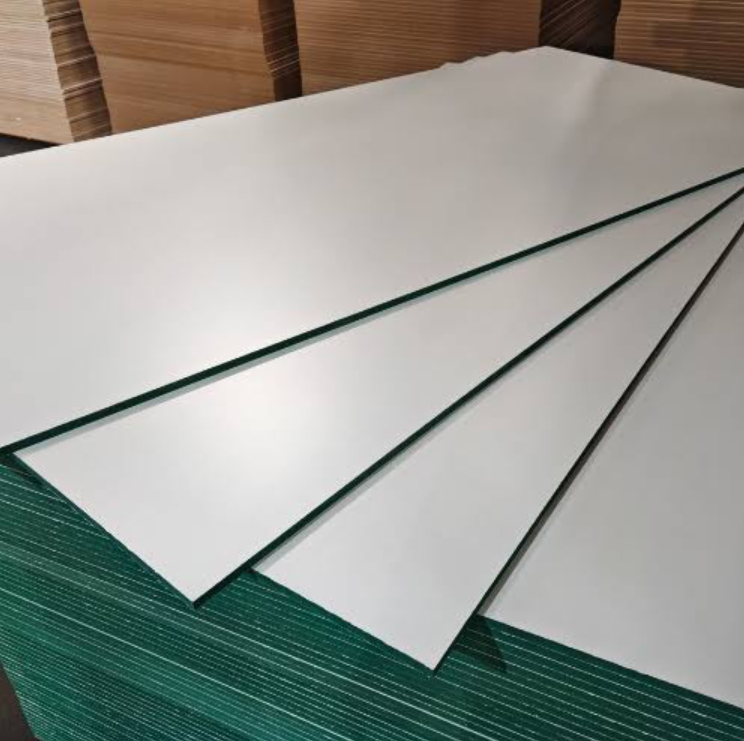
Visit any competitive furniture workshop in Guatemala City. You’ll spot the same pattern: the businesses making consistent profit aren’t buying the most expensive materials. They’re buying the smartest ones.
Melamine faced MDF panels cut your cost structure at multiple points at once. No other engineered wood panel product does this as cleanly or as fast.
The No-Finish Advantage Changes Your Entire BOM
Every sheet arrives ready to use. No primer. No topcoat. No sanding between passes.
For a typical 3-meter kitchen cabinet run, your bill of materials drops to four line items: Mdf Board, edge banding, hardware, and fasteners. Compare that to solid wood or unfinished plywood builds. With those, paint materials, thinners, hardeners, and abrasives alone eat up 10–20% of total finished product cost.
The production workflow shrinks just as much. Melamine surface finish board cuts your process from 7–10 steps down to four: cut, edge, drill, assemble. That gives you 30–50% fewer labor hours per unit — a real number, not a rough estimate.
Performance Holds Across Every Application
The melamine resin surface isn’t just cosmetic. It’s built to perform.
Kitchen cabinets: resists grease, coffee stains, and moderate heat from everyday cooking — wipes clean with a damp cloth
Wardrobes: color and grain stay stable across high-volume batches, with no natural knots or warping
Office desks: low-maintenance surface that outlasts painted alternatives, no refinishing needed
Furniture grade MDF sheets at standard 18 mm thickness also give you strong, consistent screw-holding across the core. That matters for cabinet hinges taking regular stress from constant use.
The math is simple. One interior furniture material choice wipes out an entire cost category from your operation.
Key Specifications: What Furniture-Grade Laminated MDF Sheets Must Deliver
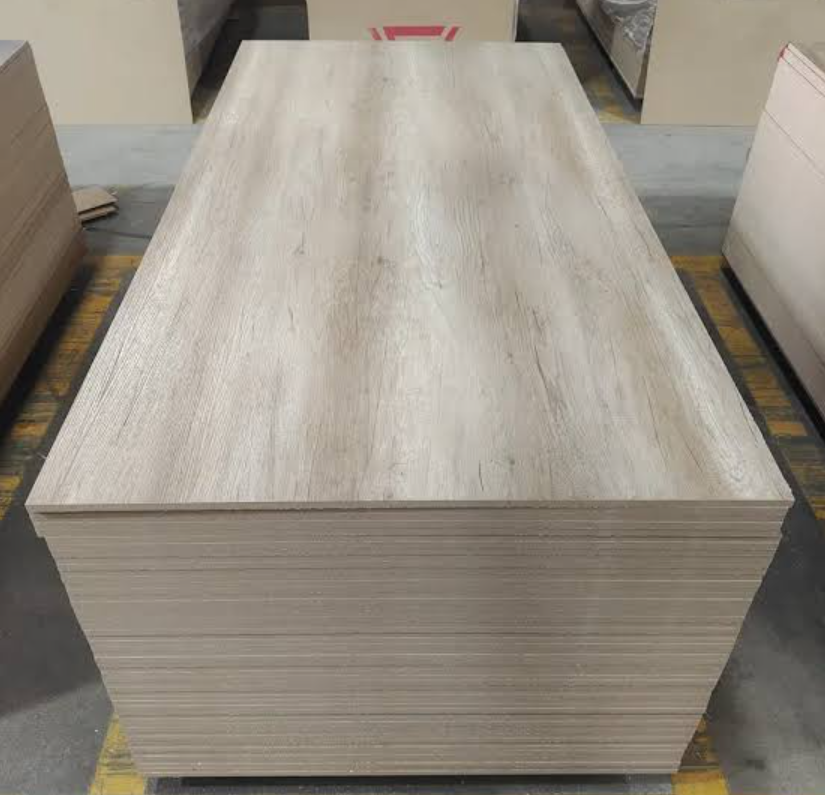
Spec sheets lie by omission. A supplier quotes you “18mm melamine MDF” and leaves out density, emission class, and thickness tolerance. Those three numbers decide whether your cabinet hinges hold — or your panels warp inside six months.
Furniture grade MDF sheets come down to five dimensions. Get all five right, and the material works. Miss one, and you absorb the cost in warranty repairs, customer returns, or production rework.
The Five Dimensions That Matter
1. Thickness — matched to application, not preference
3mm: back panels, decorative overlays, lightweight components
12mm: drawer bottoms, light-load partitions
15mm: mid-weight cabinet bodies, door panels, structural sections
18mm: the standard for cabinet carcasses, wardrobes, and kitchen boxes — the global benchmark for furniture-grade use
Shelves spanning more than 60cm need heavier stock. Thin material on a wide span bends under load.
2. Sheet dimensionsStandard size is 1220 × 2440mm (4 × 8 ft). This format fits CNC nesting well, cuts offcut waste, and loads into standard containers without issues. Some manufacturers also offer 1220 × 3050mm for large-format projects.
3. Density
Target ≥ 700 kg/m³ for furniture use. Below that number, screws lose grip, edges chip during routing, and edge banding sticks unevenly. Put the number in your RFQ — don’t leave it open.
4. Surface performance on melamine surface finish board
Double-sided lamination cuts warping and keeps both faces consistent. That matters for door panels and exposed sides. For kitchens or any area near moisture, specify MR (Moisture Resistant) grade. Confirm edge sealing is part of the order too.
5. Formaldehyde emission class- E1: the standard baseline for interior furniture across most markets- E0 / CARB: needed for export projects or higher indoor air quality standards
For Guatemala furniture SMEs, the safe default is E1 for standard production, E0/CARB for export or premium product lines.
The Six Lines Every RFQ Should Include
Contacting a melamine MDF wholesale supplier? Your spec should state this directly:
|
Spec |
Target Value |
|---|---|
|
Thickness tolerance |
±0.2–0.5mm |
|
Density |
≥ 700 kg/m³ |
|
Sheet size |
1220 × 2440mm |
|
Emission class |
E1 minimum (E0/CARB for export) |
|
Surface |
Double-sided melamine laminated |
|
Edge treatment |
Sealed — for kitchen and high-humidity use |
Vague specs produce vague quotes. These six lines remove the guesswork on both sides of the negotiation.
How to Evaluate a Manufacturer’s Cost-Efficiency — Beyond the Sheet Price
The lowest sheet price on a quote rarely belongs to the lowest-cost supplier. Guatemala furniture SMEs learn this the hard way — after the rework bills arrive.
What you need is a Total Cost of Ownership (TCO) model. Not complex accounting. Just a structured way to compare what a sheet costs once it reaches your production floor — versus what the invoice said.
Build Your TCO Waterfall Line by Line
Every supplier quote runs through the same cost buckets. Work down this sequence:
Price → Freight → Duty → Inventory → Quality → Downtime → Payment Terms
For melamine MDF wholesale sourcing into Guatemala, these are the numbers that move the model most:
Inbound logistics — ocean freight, port handling, inland trucking to your workshop
Customs and import duties — these vary by origin country and declared material classification
Inventory carrying cost — the cash tied up in cycle stock, safety stock, and panels sitting in transit
Quality cost — scrap rate, rework labor, edge-banding touch-ups, customer returns
Downtime cost — one late container or one defective batch can stop a cabinet run for days
A supplier offering melamine MDF wholesale price at 8% below market looks attractive. Run the waterfall first. Say their defect rate adds rework on 3% of panels. Their lead time forces you to carry four extra weeks of safety stock. Plus, they ship EXW instead of FOB. That price gap disappears — or flips against you.
The MOQ Trap Is a Cash Flow Problem in Disguise
High-MOQ suppliers often offer the best unit prices on engineered wood panels. The math looks clean until you count what doesn’t appear on the invoice.
A large MOQ tied to a 45-day ocean transit means your cash sits idle for weeks. Not a single furniture grade MDF sheet reaches your saw during that time. There’s another issue too. A high MOQ can force partial-container loading. Fixed port and freight charges then spread across fewer sheets. Your per-sheet logistics cost climbs fast.
Test the break-even point: unit-price savings must exceed extra freight + storage + shrinkage + financing cost. They don’t always. A lower-MOQ supplier with a higher sticker price can still win on total loaded cost.
Three Scenarios Every SME Should Run
Before selecting a melamine faced MDF panels supplier, stress-test your model across three cases:
|
Scenario |
What to Vary |
|---|---|
|
Base case |
Current freight rates, quoted unit price, standard lead time |
|
High freight |
Ocean rates +25–30%, port congestion delays |
|
Defect/rework case |
Defect rate at 3–5%, one production stoppage per quarter |
Some suppliers look great in the base case and fall apart in the other two. The ones worth a long-term MDF sheet cutting service and supply agreement are those that hold up across all three scenarios — not just the favorable one.
The One Number That Cuts Through the Noise
Lowest invoice price is a distraction. The metric that matters for cabinet-making materials MDF procurement is fully loaded cost per usable square meter of delivered sheet.
That single number captures price, freight, duty, yield loss, and rework. It puts every option on the same honest footing — local distributor, direct import, or regional agent. Build it once. Use it every time you evaluate a new source of laminated melamine MDF sheets in Guatemala for furniture production.
Top Manufacturer & Supplier Options Serving Guatemala’s Furniture Market
Three sourcing channels serve Guatemala’s furniture market right now. Each one does something different. None of them does everything. The decision of which to use — and when — separates workshops running on margin from ones running on hope.
Here’s how the landscape breaks down.
Channel 1: Chinese Export Manufacturers (Direct Container Import)

Chinese engineered wood panels manufacturers — including established exporters like Chanta Group — are the most cost-competitive option for volume purchasing of laminated melamine MDF sheets in Guatemala for furniture production.
What the numbers look like:
FOB prices listed on Alibaba run USD 6.20–12.10 per piece for standard melamine faced MDF panels in 3–18 mm thickness, 1220 × 2440 mm format. Those sheets don’t arrive at that price. Add ocean freight, port handling, customs clearance, and inland trucking. Your landed cost will run 15–30% above FOB. That’s the real number to build your BOM around.
MOQ reality check:
Standard MOQ sits at 1,000 pieces minimum — equal to one 20′ GP container loaded with 18 mm furniture grade MDF sheets. That volume works well for mid-sized cabinet manufacturers with consistent orders each month. It’s the wrong fit for small workshops buying on a project-by-project basis.
Certifications to require in writing:
Don’t accept a supplier’s marketing language on emissions. Request documentation for melamine surface finish board used in interior furniture:
E1 standard for general production (formaldehyde ≤ 0.124 mg/m³)
E0 or CARB P2 for export lines or premium product tiers
Third-party test reports from SGS or TÜV, dated within the last 12 months
Build a simple QC requirement into every purchase order. Get a COA plus factory quality certificate before shipment. Run one independent local lab retest every 2–3 container batches.
Lead time from order to workshop floor: 40–60 days total — 15–25 days production, 25–35 days ocean transit plus clearance.
Channel 2: Local Guatemala Distributors (Small Batch + Cut-to-Size)

For orders under 50 sheets or 3 m³, local MDF sheet cutting service distributors on Facebook and WhatsApp are the faster, leaner option.
Most carry 9, 12, 15, and 18 mm MDF and MDP as live inventory. E0/E1 surface options are common, often marketed as “libre de formaldehído.” Retail pricing for 18 mm cabinet making materials MDF in Guatemala City runs USD 20–30 per sheet. That’s higher per-unit than direct import. But there’s no container commitment and no 45-day cash lockup.
What local distributors offer:
Cut-to-size service with ±1–2 mm precision (charged per cut or per sheet)
Same-city delivery within 1–3 days, Q50–Q150 per run (USD 6–18)
Mixed thickness and color runs from a single order
Best fit: prototyping, urgent fills, custom one-off projects, and early-stage businesses confirming designs before committing to container volumes.
Channel 3: B2B Platform Sourcing (Alibaba, GlobalWood — Manufacturer Vetting)
To evaluate melamine MDF wholesale suppliers through B2B platforms, filter on five criteria before making contact:
|
Filter |
Minimum Threshold |
|---|---|
|
Latin America transaction history |
Confirmed shipments to Mexico, Panama, Costa Rica, or Guatemala |
|
Online transaction records |
≥ 50 completed orders |
|
Buyer rating |
≥ 4.5 / 5 with ≥ 20 reviews |
|
Certification validity |
E1/E0 or CARB P2 test reports dated within 12 months |
|
Customization capability |
Non-standard thickness, custom decor paper available |
Reviews mentioning surface flatness, color consistency, formaldehyde odor, and on-time delivery tell you more than the star rating alone. Read those comments before sending an RFQ.
Standard production and delivery benchmarks for Guatemala:
– Production lead time: 15–25 days
– Ocean freight (China to Pacific port, Guatemala): 25–35 days
– Total expected lead time: 40–60 days
A Practical Sourcing Checklist: Guatemala Furniture SMEs Before Requesting Quotes
Suppliers quote what you give them. Send a vague RFQ and you get vague pricing, wrong specs, and a purchase order that costs three times what it should.
Before reaching any melamine MDF wholesale supplier — local distributor or direct-import manufacturer — lock down these six parameters first.
The Six Things to Specify in Every RFQ
1. Sheet dimensions and tolerances
Standard import format is 2440 × 1220 mm. State your tolerance clearly: ±0.3 mm is the working standard. Need mixed sizes in one order? Say so upfront.
2. Thickness — per application, per quantity
List each thickness with a sheet count attached. Don’t write “18 mm MDF.” Write “18 mm × 400 sheets for cabinet carcasses, 12 mm × 150 sheets for drawer bottoms.” Keep thickness tolerance at ±0.2 mm for furniture grade MDF sheets.
3. Color, décor code, and finish
For melamine surface finish board, include the exact brand color code — Egger, Kronospan, Arauco, or equivalent. Add gloss level: matte (<10 GU), semi-matte (10–30 GU), or high-gloss (>70 GU). Grain direction matters too. Vertical or horizontal — put it in writing.
4. Formaldehyde emission classWrite this as a hard constraint, not a preference:- Standard production: “E1 compliant — test report required”- Export or premium lines: “CARB Phase 2 / TSCA Title VI — third-party certificate required”
5. Quantity format
State sheet count and total m². For cabinet making materials MDF procurement, flag whether this is a trial order (<100 sheets) or a container-volume commitment. That one distinction shifts the price you’re offered.
6. Cut-to-size and edge banding requirements
Need an MDF sheet cutting service? Attach a cutting list: finished dimensions, quantity, grain direction, and tolerance (±0.5 mm). For edge banding, specify the material (PVC, ABS, or melamine), thickness (0.4–2 mm), and which edges on each panel — visible face versus hidden face.
Every blank you leave is a decision the supplier makes for you. Get these six points into every RFQ before you hit send.
Cutting, Edgebanding & Storage: Operational Tips to Protect Your Melamine MDF Investment
The sheet price is part of what you pay — but not all of it. How you cut the panels, how you seal the edges, where you stack them — all of that decides how much material makes it into finished furniture.
Poor cutting and bad storage push real waste rates above 8–12%. Fix those three areas and that number falls below 3%.
Cutting: Blade Selection Decides Your Scrap Rate
Melamine MDF chips. That’s not a material flaw — it’s what happens with the wrong blade.
What to use:
– Triple-chip carbide (C3 micro-grain) blade geometry for melamine and MDF. Skip standard rip blades.
– Negative hook angle (-2° to -10°) — this one spec change cuts tearout more than any other adjustment.
– 80–100 teeth on a 10″ (254 mm) table saw blade for near chip-free cuts on melamine surfaces. For general MDF, 50–80 teeth works. For melamine, don’t go below 80.
Blade setup that protects your panels:
– Set blade height no more than 6 mm above the panel surface. More exposure creates more heat, more friction, more chipping.
– Check the blade before every production run. Dull teeth and resin buildup double your scrap rate on melamine surface finish board.
The scoring cut method is the most underused technique in small furniture workshops:
1. First pass: drop blade to 3 mm depth, score the cut line.
2. Second pass: raise blade to full cutting height, complete the cut.
This two-pass method stops bottom-face tearout on double-sided melamine panels. That’s the tearout that shows up on cabinet sides and door panels where both faces are visible.
One rule to follow: orient the show face toward the blade’s attack direction. On a table saw, that means face up. On a handheld circular saw, face down. Tearout concentrates on the exit side. Keep it on the hidden face.
Edgebanding: The Step That Decides How Long Your Furniture Lasts
Unfinished MDF edges are slow failures waiting to happen. The core pulls in moisture through exposed cross-sections. In kitchen or bathroom environments, an unsealed edge exposed to humidity for 24–72 hours can swell more than 10% in thickness. Sealed edges hold that to 2–4% — a real difference that shows up in warranty returns and customer complaints.
Material selection by application:
– 0.4–0.8 mm PVC or ABS: interior panels, fixed shelves, hidden partitions
– 1.0–2.0 mm ABS or PVC: door panels, countertops, high-traffic cabinet edges — thicker banding takes impact without showing dents
Melamine Paper tape costs less. It also fails faster in humid environments. For interior furniture materials going into Guatemalan kitchens and baths, PVC or ABS is the specification to run. Nothing else holds up.
For small workshops using manual tools:
– Iron or heat gun to 180–200°C, press banding at a steady, consistent pace along the edge
– After cooling, trim with a sharp flush-trim knife — no forcing
– Finish with P180–P240 sandpaper across the transition zone, light touch — smooth the joint, don’t sand through the melamine face
For mid-sized operations with an automatic edgebander:
– Set hot-melt glue temperature between 190–210°C, adjusted for your glue and banding material
– Feed rate: 8–12 m/min handles most SME batch sizes without dropping quality
– Keep panel edges square and straight on infeed. Any bow or moisture warp in the panel creates uneven glue lines. Banding lifts within months.
Clean cutting plus proper edgebanding brings scrap and rework rates below 2–3% on standard cabinet production. That’s the target for any furniture grade MDF sheets workflow.
Storage: Where Purchased Material Disappears
MDF doesn’t show damage as it happens. Panels warp, absorb moisture, and develop surface defects in storage. You find out about the loss mid-cut on a production run — not before.
Stack flat, always:
– Flat, horizontal stacking on at least 3 spaced bearers, 500–800 mm apart
– Leaning panels against a wall creates permanent bow within days. Those panels won’t cut straight and won’t edge-band flat.
Environmental conditions that protect your stock:
– Target 40–60% relative humidity in your storage area. Above 75% RH, edge swelling, surface bubbling, and core delamination start showing up in melamine faced MDF panels.
– Keep panels off concrete floors and away from exterior walls — both transfer moisture.
– Temperature range: 15–30°C. Direct sun and heat sources bleach melamine surfaces and cause uneven core shrinkage.
One step most workshops skip: let new panels acclimate for 24–48 hours at your production temperature and humidity before cutting. Panels cut straight from a cold shipping container tend to move after machining as they adjust to workshop conditions.
Leave factory wrapping on until you need the sheets. Once open, cover the top of the stack with a protective board or moisture barrier sheet.
Frequently Asked Questions from Guatemala Furniture SMEs About Melamine MDF Sourcing
These questions come up on every sourcing conversation. Here are straight answers.
What’s the minimum order quantity (MOQ)?
One 20′ GP container — about 600–750 sheets of 18 mm board (1220 × 2440 mm). Suppliers with standard colors and thicknesses will mix SKUs in one container, as long as total volume hits MOQ. Custom décor papers or non-standard thicknesses push that floor to ≥50 m³.
How long does delivery take?
Standard specs: 10–15 days production after deposit. Custom colors or cut-to-size: 15–25 days. Add 25–35 days ocean transit from China to Guatemala’s Pacific ports. Total: plan for 45–60 days. Chilean or Brazilian supply runs 35–50 days.
Can suppliers cut panels to size?
Most export factories ship standard sheets only. Factory-side cutting needs a detailed cutting list. You’ll also need a full 40′ HQ minimum, plus a 5–15% surcharge. For most SMEs, the better path is simpler: import full sheets, cut locally at Q0.20–0.60 per linear meter.
How do I claim damaged panels?
Photograph everything on arrival. Capture full pallets and individual damage, with labels visible. Submit within 7–10 days with your bill of lading and container number. Most factories settle at 50–100% credit on damaged piece count toward your next order. Severe transit damage needs a separate insurance claim. File that within 3–5 days.
MDF or particleboard core — which one?
MDF core density runs 650–800 kg/m³. Particleboard runs 600–680 kg/m³. That gap matters for cabinet hinges under repeated stress. Particleboard holes enlarge and strip over time. Melamine particleboard costs 10–20% less per sheet. That gap shrinks to 5–10% once you count better MDF edge quality and less rework.
A practical split worth using:
– Particleboard → hidden shelves and price-sensitive components
– MDF → door panels, drawer fronts, and any visible edge
E0 vs. E1 — when does the upgrade pay off?
E0 runs 8–15% more per sheet than E1 at factory price. Add CARB P2 certification and that gap reaches 15–25%. For children’s furniture and closed bedroom wardrobes, E0 is the right call. For office furniture and well-ventilated commercial spaces, E1 works fine — and keeps your BOM tighter.
Conclusion
Sourcing laminated melamine MDF sheets in Guatemala for furniture production isn’t just a procurement decision — it’s a margin decision.
Every millimeter of board thickness you spec wrong adds up. Every unreliable supplier you stick with out of habit costs you. Every shipment delay you absorb without pushing back eats into your profit. These aren’t small losses.
The furniture SMEs winning in Guatemala’s market right now all share one habit. They treat material sourcing as a strategic lever, not an afterthought. They know their thickness specs cold. They’ve checked their supplier’s certifications. And they’re not paying premium prices for panels that fail to deliver.
You now have the framework to do the same.
Here’s your next move:
-
Request quotes from at least two qualified engineered wood panels manufacturers
-
Bring your spec sheet to every supplier conversation
-
Ask the hard questions — MOQ, lead time, and cut-to-size flexibility
The best time to lock in a better supply chain was last quarter. The second best time is today.