
Brazil’s flooring landscape is shifting fast, and the numbers tell a story most importers and distributors haven’t caught up to yet. Humidity-prone climates and cost-conscious construction projects are encouraging more builders to consider SPC as an alternative. The Brazil SPC flooring industry is becoming the material of choice for developers who need durability without the price tag of imported hardwood. The demand is concentrated in specific places, with particular buyers, and certain commercial segments are still wide open for the right supplier to claim.
This guide breaks down the growth drivers behind Brazil’s rigid core flooring boom, maps out where SPC is winning against competing materials, and identifies the residential, commercial, and hospitality niches ready for new partnerships so you can decide if this market deserves your next move. For buyers looking for a reliable SPC flooring manufacturer, understanding long-term supply capabilities is just as important as tracking market growth.
Brazil SPC Flooring Market Size & Growth Trajectory
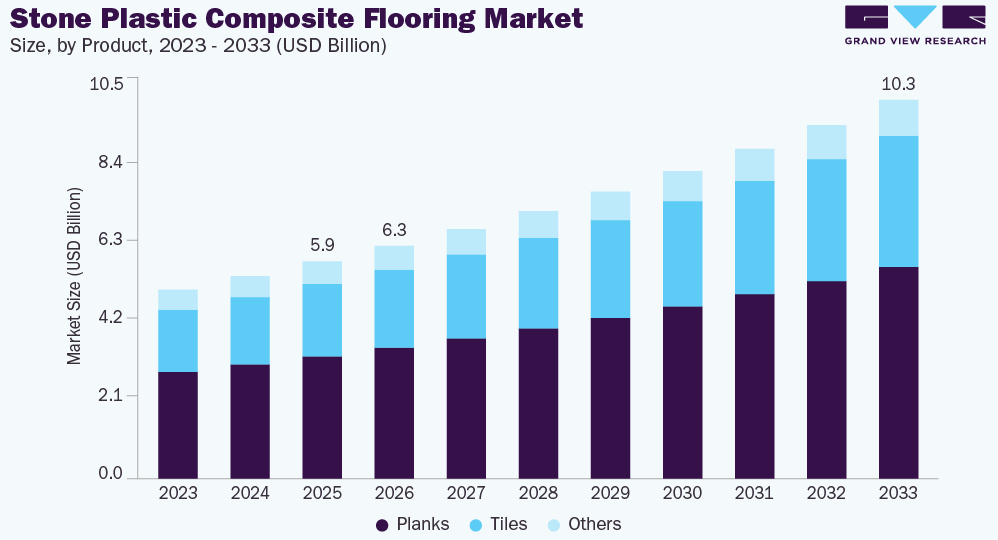
The Brazil SPC flooring industry was worth USD 112.65 million in 2024. By 2033, projections put it at USD 429.27 million, growing at a 16.04% CAGR between 2025 and 2033. That is roughly a 3.8x expansion in under a decade.
Context helps here. Brazil’s entire floor covering market—ceramic, laminate, vinyl, everything—was worth USD 11.99 billion in 2025, expected to hit USD 16.13 billion by 2031 at a 4.62% CAGR. Stone plastic composite flooring currently represents less than 1% of the total market. Small slice, growing far faster than the pie itself.
Why this matters for market entry:
Ceramic and porcelain still dominate Brazil’s flooring category, holding 46.61% market share in 2025
Vinyl flooring Brazil market (LVT, sheet, VCT) is the closest competing segment, expanding at 4.69% CAGR
SPC’s growth rate more than triples that pace, positioning it as a high-growth niche rather than a mainstream category
Regionally, Brazil leads Latin America’s rigid core flooring boom. One benchmark study pegs Brazil at ~40% of the entire Latin American SPC flooring market in 2024, with the regional CAGR at 16.65%.
For buyers and distributors: Brazil is the anchor point for anyone serious about waterproof flooring demand across South America. The category is small today, but the growth curve says that won’t last long.
Key Demand Drivers Behind Brazil SPC Flooring Growth
Seven forces are pushing Brazil’s SPC flooring industry from a rounding error to a real category. None of them are temporary.
Urbanization and Government Housing Programs
87% of Brazilians now live in urban areas. That concentration alone creates massive flooring volume in cities. But the real accelerant is government spending. Minha Casa Minha Vida (MCMV) Phase IV is funding 2 million housing units by 2026, and specifications are shifting from basic ceramic toward localized SPC/LVT for moisture-prone and social housing segments. The PAC infrastructure program adds fuel on the commercial side—offices, retail, healthcare, and schools increasingly spec durable, low-maintenance vinyl and SPC.
Middle-Class Renovation Demand
Rising disposable income is changing what Brazilians expect from their floors. Consumers want scratch-resistant, waterproof surfaces, not entry-level ceramic. Renovation is now a major volume driver globally, and SPC’s click-lock, glue-less installation makes it the obvious retrofit choice. No demolition, no downtime. One global report links this convenience factor to a 54% increase in SPC installations across residential and commercial projects.
Climate, Design, and Regulation
Brazil’s humid, tropical climate makes water resistance non-negotiable, especially in Northeast coastal cities and dense urban apartments. SPC delivers that, plus high-fidelity wood and stone visuals that satisfy style-conscious buyers without the price tag of hardwood. Add Brazil’s 2026 Green Building Code, requiring 30% low-VOC finishes in qualifying projects, and SPC’s recyclable, low-emission profile becomes a specification advantage, not just a preference.
Residential Application Scenarios for SPC Flooring in Brazil
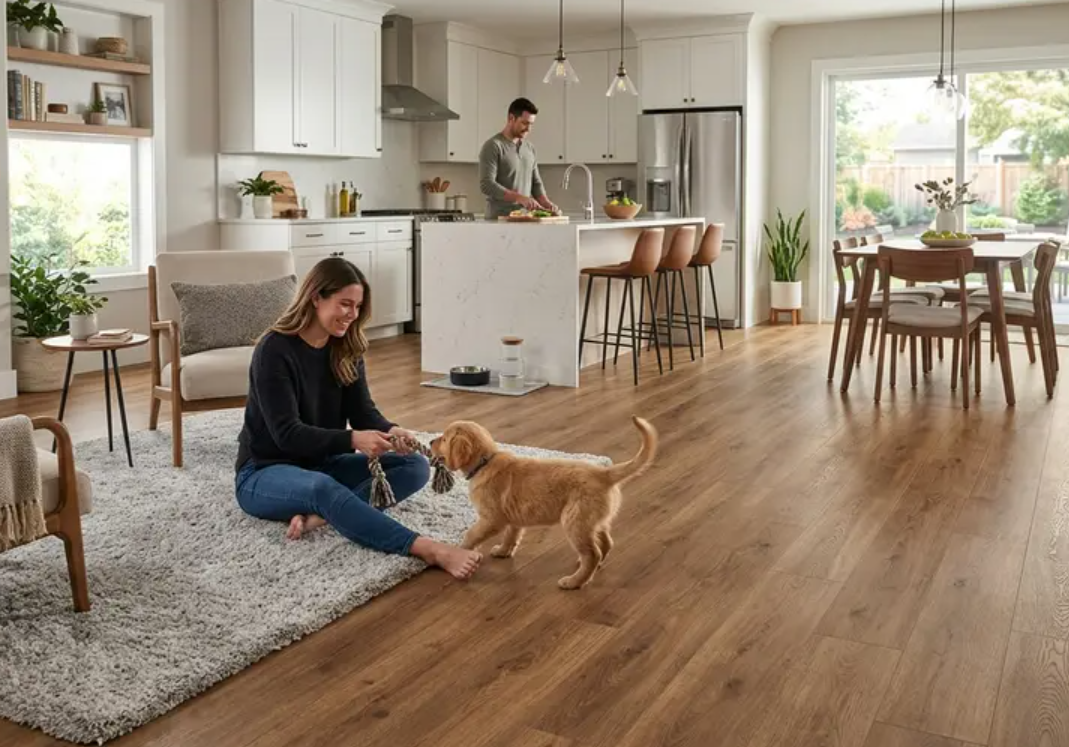
Residential floor coverings dominate Brazil’s flooring market, ahead of both commercial and industrial segments in total volume. Inside that category, SPC is carving out specific footholds — the room-by-room breakdown tells you where.
Apartamentos e condomínios (flats/condos) lead adoption. Living rooms, bedrooms, kitchens, and bathrooms are the standard zones, with Brazilian suppliers marketing SPC as suitable for “uso residencial ou comercial.” Acoustic compliance drives much of this: multi-family buildings require impact sound insulation, so SPC planks ship with an attached manta de absorção (acoustic underlay), delivering impact sound reduction of ΔLw ≥ 19 dB. That single spec often decides the material choice over bare ceramic on concrete.
High-rise residential projects favor click-lock SPC for a different reason — installation speed. No glue, no wet mortar, faster turnover across hundreds of units. Waterproofing and dimensional stability matter most in kitchens and bathrooms.
Townhouses and row houses use SPC more flexibly, replacing cold ceramic on ground-floor living zones and running continuous flooring into kitchens and laundry rooms, where spill resistance and pet traffic make waterproof performance non-negotiable.
Across all three scenarios, common specs recur: 4.0 mm rigid core planks (7″ x 48″), 25-year residential warranties, and 0.3–0.5 mm wear layers built for family and pet households. MCMV’s 2-million-unit pipeline through 2026 prioritizes this durable-yet-affordable profile, positioning SPC as the practical upgrade from basic ceramic in Brazil’s mass residential market.
Commercial & Institutional Applications Driving B2B Demand
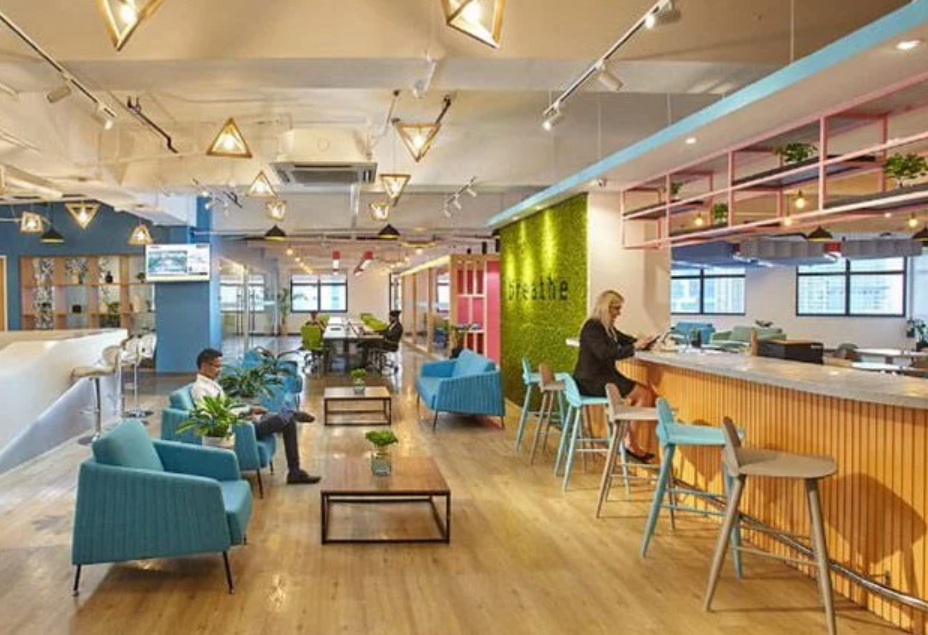
Four commercial segments are absorbing most of Brazil’s SPC flooring supply right now. Each has its own technical bar suppliers need to clear.
Retail requires AC4–AC5 wear ratings (4,000–6,000+ Taber cycles), slip resistance of R9–R10, and coatings that survive 500+ cleaning cycles without dulling. Office towers need the same AC4–AC5 rating, plus ΔLw ≥18–20 dB acoustic performance for open-plan floors and chair-caster durability rated to 25,000+ rolls. Hotels demand AC5 in public areas, AC4 in guest rooms. Wet zones like spas and pools push slip resistance to R11+, with ΔLw ≥20–22 dB soundproofing standard in upscale properties. Healthcare and education need AC5-grade planks with heat-welded seams and 99%+ antimicrobial performance, non-negotiable for hospitals and clinics. Many developers now prioritize commercial flooring solutions that combine durability, low maintenance, and fast installation.
Why the Growth Curve Favors SPC
Global commercial flooring is growing at roughly 5.12% CAGR, fueled by retail chains expanding store counts 5–10% annually, hotel renovation cycles every 7–12 years, and office/retail complexes specifying elastic flooring across 40–60% of total floor area. SPC is already replacing tile and sheet vinyl at 30–40% in retail and hotel guest rooms, a substitution rate developers can’t ignore.
Lifecycle cost beats sticker price for Brazilian contractors. A 10–15 year design life and 10–30% lower annual maintenance versus tile make SPC the default spec for commercial flooring once decision-makers run the numbers.
Competitive Landscape: SPC vs Ceramic, Laminate & Imported Alternatives
Ceramic still owns Brazil’s floors. Roughly 60% market share, with wood flooring holding about 25%, and laminate-plus-vinyl — SPC included — sitting near 10%. But the trend line tells a different story than today’s snapshot.
Category Share Is Migrating Toward SPC
Over the past decade, ceramic’s share slid from ~70% to ~60%, hit by high installation costs and cold, rigid surfaces that frustrate renovation buyers. Wood flooring barely held its ground, dropping from ~25–30% to ~25%, squeezed by upkeep costs. Laminate and vinyl doubled — from ~5% to 10%+ — and rigid core flooring is capturing most of that gain. That’s 1–2 percentage points of category migration opening up every year, flowing almost entirely into SPC, LVT, and premium laminate.
Price, Performance, and Lifecycle Comparison
Recent changes in flooring prices in Brazil are also influencing material selection for residential and commercial projects.
Laminate: USD 1–5/sq ft, 10–15 year lifespan, edge swelling risk of 6–15% in humid zones
SPC: USD 3–8/sq ft, 15–25 year lifespan, near-zero water absorption, indentation ≤0.05 mm
Ceramic: USD 5–20+/sq ft, 30–50 year structural life, but grout demands maintenance every 3–5 years
SPC’s click-lock installation cuts labor time 20–40% versus ceramic’s mortar-and-grout process. That’s a real edge for commercial flooring solutions on tight construction timelines. Buyers comparing SPC with the laminate flooring market in Brazil should evaluate lifecycle cost rather than purchase price alone.
The Import Gap Is the Real Opportunity
China supplies 60–70% of Brazil’s SPC imports; Vietnam covers 20–30%. Local factories run at 50–100k m²/year per line, roughly one generation behind Asian plants producing 100–200k m²/year. Domestic capacity covers under 30–40% of demand — a gap that’s wide open for new SPC flooring suppliers and flooring distributor Brazil partnerships to close.
Commercial Opportunities: Target Segments & Value Proposition
Residential renovation and commercial projects solve different business problems. Split the market by revenue potential, and a clear picture emerges for anyone building a flooring distributor strategy in Brazil.
Segment Priority Matrix
Residential renovation accounts for 55–65% of Brazil’s flooring demand. Commercial (office, retail, hotel) takes 35–45%. But commercial deals run 2–3 times larger per transaction.
High-end residential: 60–120 m² projects, R$120–220/m² retail installed, with a 2–6 week sales cycle through home improvement stores and design firms.
Retail chains: 150–500 m² per store, R$90–150/m² negotiated, with 3–9 month cycles through contractors and HQ procurement. They generate repeat orders as chains expand.
Small offices: 300–800 m² per floor.
Boutique hotels: 400–1,000 m² per level, R$90–150/m² range.
For volume and brand visibility, prioritize retail chains, then offices, then premium residential. For margin and showcase value, flip the order: boutique hotels and high-end residential, then design-driven premium projects.
Why Buyers Choose SPC Over Alternatives
A 300 m² retail store closing for tile replacement loses 5–7 days of revenue—roughly R$40,000–56,000 at R$8,000/day. SPC’s click-lock install cuts that to 2–3 days, saving 40–60% in downtime losses.
Over a 10-year total cost of ownership model, SPC (R$11,200–16,400 total) runs slightly above ceramic (R$9,500–15,000) on an 80 m² residential job. But once you factor in renovation disruption and per-plank repair costs, SPC wins.
Spec Requirements by Segment
Residential SPC runs 4.0–5.0mm with 0.3mm wear layers and 20-year warranties. Commercial-grade product needs 5.0–6.0mm, 0.5mm+ wear layers, EN 13501-1 Bfl-s1 fire ratings, and R9–R10 slip resistance for tender compliance. Those are critical specs for suppliers targeting Brazil’s institutional pipeline.
Go-to-Market Strategy: Channels & Partnership Models
Four channel types control access to Brazil’s flooring buyers. Pick the wrong one, and even great product specs won’t save you. SPC flooring is also benefiting from broader changes across the Brazil building materials market, where demand for durable and sustainable products continues to increase.
Flooring distributors and wholesalers get you fastest regional coverage because they already own the sales relationships you’d spend years building. Building materials importers handle customs, compliance, and local warehousing, cutting your entry costs before you commit to a full team. Home improvement retail chains work best for standardized SKUs with predictable, stable supply. Project-side partners—construction firms, designers, hotel developers—respond to co-marketing and referral deals, not cold outreach.
Three Partnership Models, Three Different Bets
Local distribution: Fast multi-state entry, but you’re dependent on partner inventory and after-sales support.
Direct import: Full control over pricing and brand, works if you already have Brazilian project leads and predictable order volume.
Joint venture manufacturing: Solves tariff and logistics friction, makes sense only at scale—think large retail rollouts or major hotel contracts.
Screen partners on four hard filters: audience overlap, complementary capabilities (customs, installation, design), fair commercial terms, and pilot-first execution. Run a small test before scaling territory or product lines.
Risk Factors & Market Entry Considerations
Labor rules will bite you before your first container clears customs. Brazilian law caps foreign staffing hard: local workers must make up at least 2/3 of headcount and payroll. Actual approval rates for foreign technicians usually land well below that ceiling. That means you can’t fly in a crew of Chinese installers and call it a strategy. You need a “few core trainers, many local hires” model instead.
The economics push in the same direction. Brazil’s manufacturing wage averages 3,300–3,400 reais/month. A 10-person installation crew for one month of training runs roughly 34,000 reais — before a single plank goes down correctly.
Installation skill gaps translate directly into cash losses:
A 1,000 m² commercial job with 10% rework from failed click-lock engagement can cost ~109,000 reais in materials alone (at 1,092.53 reais/m² material cost)
Property values average 9,516 reais/m² — flooring defects on high-value builds create outsized brand and liability risk for new SPC flooring suppliers
Regulatory and Tax Complexity
Brazil allows 100% foreign ownership in most sectors — equity access isn’t the barrier. Tax layering is. Nominal import duties on PVC and composite flooring run 10–18%, but stack in IPI and PIS/COFINS, and total landed cost markup hits 30–50% over CIF. Certification and lab testing per product line can take 6–12 months and cost thousands to tens of thousands of reais per SKU — a real constraint on how fast you scale your catalog in the Brazil building materials market.
Why Click-Lock Design Mitigates the Risk
SPC’s installation simplicity is your hedge. Click-lock systems cut skill dependency versus mortar-based tile work — no leveling compound, fewer irreversible errors. Structuring a 10–15 step training module with photo/video guides can get local crews field-ready in 1–2 days, not months. Track m²/person/day and lock-failure rates from day one; that data becomes your pitch to distributors on lower rework costs and faster project turnover.
Strategic Recommendations for Manufacturers & Distributors
Timing decides who wins Brazil’s SPC flooring industry. At 16% CAGR, the market doubles every five years. The math rewards whoever moves first.
Your entry window is 0–24 months. Lock 10–15% share in your target region before year three, and compounding scale effects work in your favor for a decade.
Budget and Priorities
Allocate 8–12% of projected year-three regional revenue to channel building:
40–50% to distributor incentives and co-marketing
20–30% to installer training and technical content
20–30% to showroom samples and project support
Push your brand’s growth 6–9 points above market pace (22–25% annually), and three-year revenue outpaces passive market-following by 20–30%.
First 90 Days
Vet 3–5 distributor candidates on coverage, capability, culture
Target 85% regional distribution coverage in year one
Launch pilots in 2+ regions with shared CRM data feeds
Track win rate, quote-response time (under 48 hours), and SKU availability (over 95%). These three numbers separate serious SPC flooring suppliers from short-term opportunists in the Brazil building materials market.
Conclusion
Brazil’s SPC flooring industry is driven by urbanization, rising middle-class spending, and a construction sector hungry for durable, waterproof flooring. Rigid core flooring is outpacing ceramic and laminate in high-rise residential towers in São Paulo and hotel renovations in Rio, and the demand curve is only getting steeper.
This market rewards early movers. Distributors and manufacturers who establish local partnerships now, before competition intensifies, will own the best margins and the strongest brand positioning.
If you’re evaluating whether to enter Brazil’s SPC flooring market, don’t just watch from the sidelines. Reach out to established suppliers, request product samples, and start conversations with regional distributors this quarter. If you’re planning to expand into Brazil’s SPC flooring market, contact our team to discuss product specifications, OEM options, and project support.