
Most export buyers don’t lose money on plywood prices. They lose it on glue. Glue specification also becomes critical when buyers compare different engineered wood materials used in furniture and construction projects.
Choosing the wrong plywood adhesive often leads to problems that only appear after shipment — failed compliance inspections, delamination in humid environments, or rejected construction materials months after installation. Buyers comparing different panel materials should also understand how plywood fits into the wider category of engineered wood panels used in global manufacturing.
Plywood glue types determine two critical specifications: bond durability and formaldehyde emissions. These two factors affect where a panel can be used, whether it meets international regulations, and whether it survives real-world conditions.
Yet many purchase orders only mention one of them — or neither clearly.
This guide explains the main plywood glue types used in export manufacturing, including UF, MUF, and phenolic (PF) adhesives. You’ll learn how each adhesive performs, where it fails, and how to specify the correct glue type and emission standard before placing a plywood order.
What Plywood Glue Type Actually Controls in Panel Performance
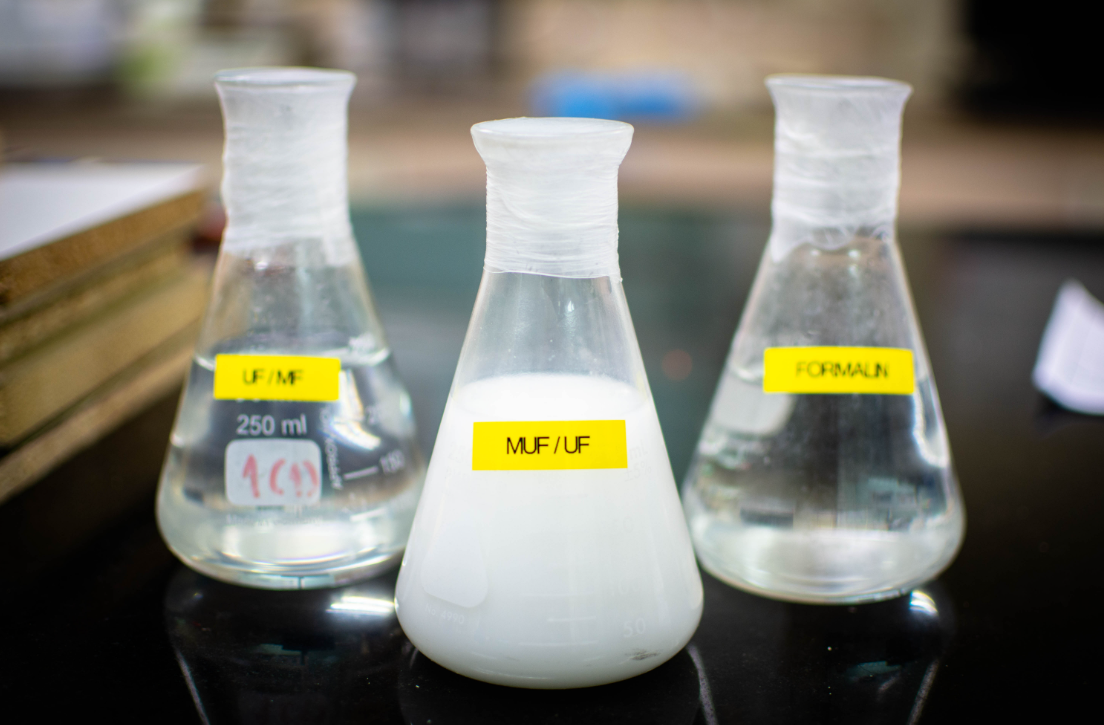
Plywood glue type controls two things — and most exporters think about only one of them.
The first is bond performance: how well the panel holds together under moisture, heat, and weather exposure. The second is formaldehyde emission: how much gas the adhesive releases into the air after installation. These are two separate specifications. They do not affect each other. You can have E0 emissions with a weak interior-only bond. You can have a boil-proof WBP bond that emits at E2 levels. One axis does not satisfy the other.
This is where exporters keep getting it wrong.
The Two-Axis Problem
Axis 1 — Bond performance runs from interior-only to fully weatherproof:
UF (urea-formaldehyde) — moisture-resistant only. This glue covers about 80% of plywood production because it’s cheap and fast-curing. Fine for dry interior use. Put it in a humid or exterior environment and delamination follows.
MUF (melamine-urea-formaldehyde) — better waterproofing through melamine content (20–25% of urea weight). Handles humid and short-term wet exposure. It breaks down under sustained rain or long-term weather contact.
PF/PUF (phenolic) — true WBP classification. Survives boiling water. Stable up to 220°C. The only real choice for full exterior, marine, or high-cycle formwork applications.
Axis 2 — Formaldehyde emission runs from E2 down to E0 (≤0.03 ppm). Here’s what most people miss: UF and MUF can both be modified to reach E0 through scavengers or adjusted resin ratios. A 3% melamine addition combined with 1% PVA of urea weight can deliver E0 emissions and a 0.70 MPa bond strength at the same time. So E0 tells you nothing about bond class. It never did.
Where the Rejection Happens
The most common failure pattern goes like this:
A buyer specifies E0. They assume that signals a higher-quality, more durable product. The exporter supplies UF-based plywood with E0 emission treatment — compliant on emissions, wrong on bond performance. The shipment reaches an exterior or humid application. It fails EN314-2 Class 2 or Class 3 shear testing. Panels delaminate.
That’s not a quality control failure. It’s a specification gap — one that started before the order was even placed.
| Glue Type | Bond Class | Max Exposure | Emission Possible | Primary Failure Mode |
|---|---|---|---|---|
| UF | Interior/MR | Dry interior only | E0–E2 (with additives) | Exterior delamination |
| MUF | MR/limited WBP | Humid, short wet | E0 (3% melamine) | Degrades under sustained rain |
| PF/PUF | Full WBP | Exterior, marine | Moderate | None under correct application |
What the Spec Needs to Say
Your purchase order must address both axes clearly — not one, not implied, both. State glue type and emission class together: “PF + E1” or “MUF (min. 20% melamine) + E0.” Leave either axis open and the factory will substitute toward whatever is cheapest to produce.
Then verify it. WBP claims get tested through boil resistance protocols (BS 1203). Emission levels are measured in ppm. Don’t take either on a supplier’s word alone.
Urea-Formaldehyde (UF) Glue: Interior-Grade Plywood Adhesive
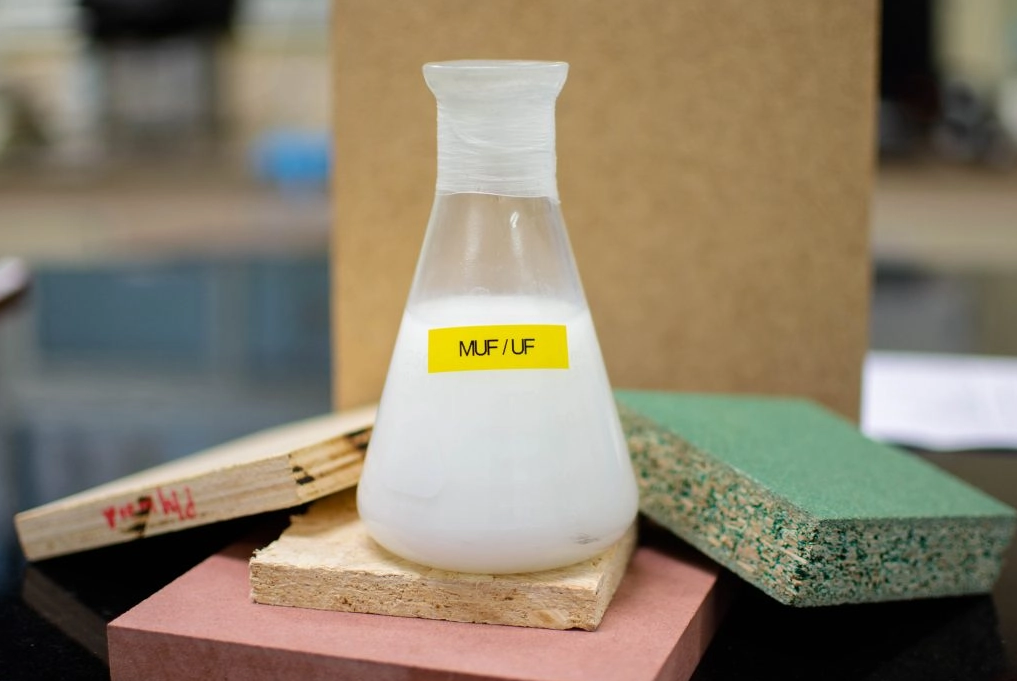
UF glue built the modern plywood industry. It’s cheap, it cures fast, and it covers about 80% of global plywood production. Those three facts explain why it causes so many export problems.
The performance ceiling is tight — and fixed. UF bonds start breaking down above 35–40% relative humidity. Put a UF-bonded panel in a humid environment — anything above 60% RH on a regular basis — and the bond life drops to under five to ten years. That’s not a worst-case number. That’s what happens in the field.
Temperature makes it worse. Aging tests at 70°F (±5°F) under 35–40% RH already show real bond deterioration after 45 days. Push conditions past those thresholds, and delamination stops being a risk. It becomes a countdown.
The Emissions Problem Is Worse Than Most Buyers Realize
UF doesn’t just fail on bond strength. It also creates a compliance problem that catches many buyers off guard.
Standard UF plywood emits 0.1–0.3 ppm formaldehyde under ASTM E1333 chamber testing. Compare that to actual regulatory limits:
| Standard | Limit | UF Typical | Passes? |
|---|---|---|---|
| TSCA Title VI (HWPW) | 0.05 ppm | 0.1–0.3 ppm | No |
| CARB Phase 2 (PB) | 0.09 ppm | >0.09 ppm | No |
| EU E1 | 0.124 mg/m³ | Exceeds | No |
| Japan F★★★★ | ≤0.3 mg/L | Exceeds | No |
Standard UF fails every major destination market at its base emission level. The EU requires E1 as a minimum. The US CARB Phase 2 and TSCA Title VI cap hardwood plywood at 0.05 ppm. Japan’s F★★★★ sits at ≤0.3 mg/L — and untreated UF blows past that limit.
Laminated products don’t escape this either. UF in the core still requires the veneered face to certify to 0.05 ppm under ASTM E1333 or D6007. The laminate layer does not block formaldehyde emissions from the core.
One specific trap stands out: manufactured housing and RVs. HUD 24 CFR 3280.308 requires TSCA alignment for manufactured homes. UF panels don’t qualify — full stop. Any supplier claiming UF-bonded panels work for manufactured homes or recreational vehicles is creating a regulatory liability. Not just a quality problem. A legal one.
Where UF Belongs
The 20–30% cost advantage over PF or MF adhesives is real. It’s also valid — in the right setting.
UF-bonded plywood holds up where conditions stay controlled:
Dry-interior furniture — office desks, storage units in climate-managed spaces below 40% RH. Interior-grade adhesives are often used in furniture board materials where moisture exposure remains minimal during the product lifecycle.
Cabinet interiors — kitchen cabinet boxes with no exterior exposure
Office fixtures — shelving and partitions in air-conditioned spaces that stay below 70°F
These aren’t limited uses. They’re the correct ones. The spec breaks down once UF panels move into semi-exterior applications — patio cabinetry, garage shelving, anything exposed to seasonal humidity above 50% RH. Suppliers labeling UF as “exterior-grade” for those contexts follow one of the most common misrepresentation patterns in this product category.
The rule is simple: dry interior, climate-controlled, no moisture exposure. Outside those conditions, UF isn’t a cost saving. It’s a deferred rejection.
Melamine-Urea-Formaldehyde (MUF) Glue: Moisture-Resistant Plywood Adhesive
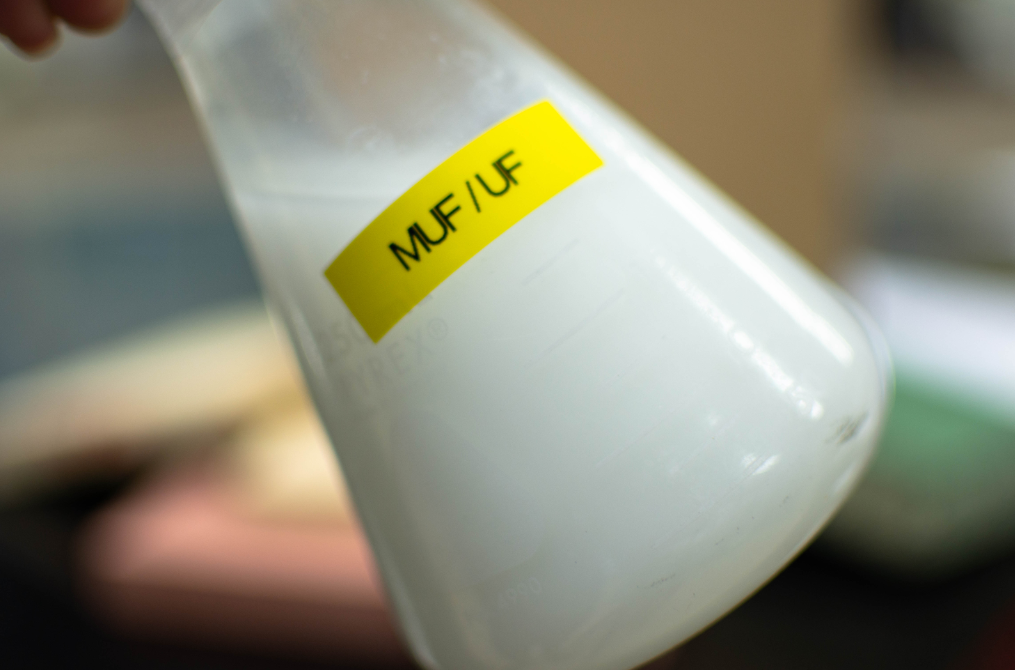
MUF sits in an awkward spot — better than UF, worse than PF, and sold as something it isn’t far too often.
The melamine addition (20–25% of urea weight) does improve moisture resistance over standard UF. MUF handles seasonal humidity swings, damp interior spaces, and short-term wet exposure without losing its bond. That’s a real gain. But there’s a hard ceiling — and it shows up faster than most suppliers will admit.
Continuous outdoor exposure breaks MUF down. Rain cycles, prolonged humidity above 80% RH, sustained water contact — these conditions eat away at the bond over time. MUF doesn’t fail all at once overnight. It weakens in small steps, which makes it harder to catch before your panels are already installed and your client is already unhappy.
Where MUF Works
The real use cases are specific:
Interior furniture — kitchens, bathrooms, damp basements with seasonal moisture swings. Many commercial furniture manufacturers choose panel materials like melamine MDF panels specifically designed for interior decorative applications.
Glulam beams and structural timber in covered, interior structural applications
MDF, particleboard, interior door skins where a clean glueline matters more than PF’s dark bond line
That last point catches buyers off guard. PF leaves a visible dark glueline. MUF doesn’t. For exposed interior joints where looks count, MUF earns its price premium over UF on appearance alone — and that’s a fair reason to choose it.
Emissions Compliance — Read the Fine Print
MUF can meet TSCA Title VI limits with the right formulation:
| Product Type | TSCA Limit | MUF Capable? |
|---|---|---|
| Hardwood plywood | 0.05 ppm | Yes — with correct formulation |
| Particleboard | 0.09 ppm | Yes |
| MDF | 0.11 ppm | Yes |
That phrase — with correct formulation — carries a lot of weight. Not every MUF adhesive qualifies. Suppliers that market panels as “moisture-resistant” or “low-formaldehyde” MUF are not handing you a TSCA-compliant or WBP-grade product by default. Those are marketing labels, nothing more. Real compliance means third-party certification records, documented melamine proportions, and actual ppm test data matched to your specific product category.
One date worth marking: as of March 22, 2024, laminated products using non-exempt resins — anything outside PF or NAF formulations — count as hardwood plywood. That means full third-party producer certification under TSCA Title VI is required. Your supplier is applying a laminate over a MUF-bonded core and hasn’t sorted this out? Your shipment has a compliance gap before it even gets packed.
The Price Logic
MUF costs more than UF. Less than PF. The price bump makes sense in a narrow set of conditions: interior use with some moisture exposure, a lifespan expectation beyond five to ten years in variable indoor humidity, and no need for true outdoor durability. Add continuous moisture or outdoor exposure to the picture, and you’re not saving money by picking MUF over PF — you’re pushing a failure down the road.
Phenol-Formaldehyde (PF) Glue: The Standard WBP Adhesive for Exterior Plywood
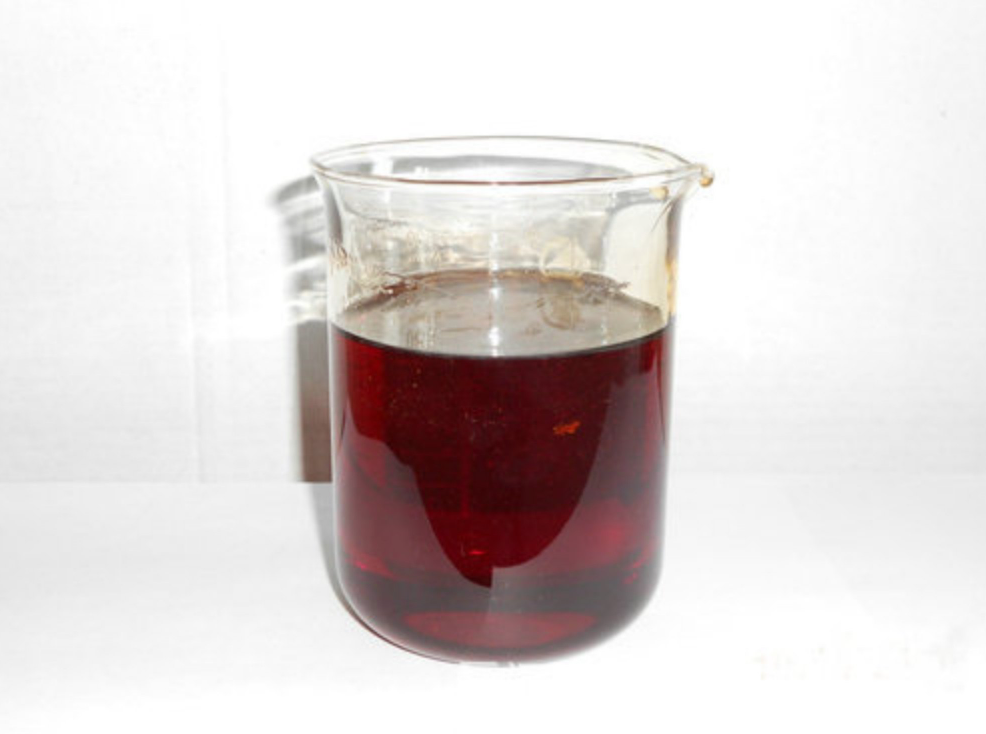
PF glue doesn’t negotiate with water. It won’t soften under heavy rain. It won’t weaken through humidity cycles. It won’t break down in marine exposure either. After 72 hours submerged in boiling water — the benchmark test under BS 1203 and EN 314-2 — a PF-bonded panel still holds shear strength above 1.0 MPa. UF panels fail that test. That’s the difference.
PF is the one plywood glue type with verified, third-party-confirmed performance across structural, exterior, and marine applications. Every other glue type has a ceiling. PF doesn’t — at least not one that real-world export conditions will ever reach.
Where PF Is Mandatory, Not Optional
Some applications leave no room for judgment. They require PF by standard:
Structural plywood under EN 636-2S Class 2/3 demands dry shear strength above 2.5 MPa and wet strength above 1.0 MPa post-boil. PF delivers both. No other glue type does it reliably.
Marine-grade panels certified to BS 1088 require PF resin and a passed 72-hour boil test. No substitutions qualify.
Construction formwork governed by EN 12812 mandates PF for any exterior wet-exposure scenario.
CE-marked exterior cladding under EN 13986 specifies Durability Class 3 — PF is the required resin here too.
Get the glue spec wrong on any of these, and the CE mark, the structural rating, or the Lloyd’s Register certification becomes invalid. That’s not a paperwork issue. That’s a liability sitting on your delivery dock.
The Tradeoffs You Need to Price In
PF performs. It also costs more to produce — and that gap shows up in ways buyers often miss.
Cure temperatures run 130–150°C with press times of 5–10 minutes. Energy use runs 20–30% higher than UF lines. Lead times stretch to 4–6 weeks. MOQs sit at 50–100m³ per specification. Build that into your timeline before you lock in a delivery window.
Two physical characteristics matter for your specification decisions:
Dark glueline: PF cures black-brown, leaving a 0.1–0.2mm visible line on panel edges. Against light-colored wood species, that line reads as a defect without edge banding. Specify edge treatment if exposed joints are part of the final product.
Cold brittleness: PF’s glass transition temperature sits at 150–170°C, but below 0°C, impact strength drops 20–30% compared to UF. Panels shipping into cold-climate applications with mechanical stress — that’s a real number you need to plan around.
How to Verify the PF Claim Before the Container Leaves
Suppliers label panels as phenolic. Not all of them actually are. At this specification level, you can’t skip verification.
Your checklist:
Mill certificates: Confirm PF resin type and formaldehyde emissions ≤0.3 ppm (E1 per GB/T 17657-2013)
Third-party boil test reports: Look for post-960-hour aging strength loss below 20% for BMPF variants
Physical markings: CE (EN 13986), CARB Phase 2, EPAL stamps — each one must reference phenolic resin directly
Bonding data: Dry strength ≥1.5 MPa, wet post-boil ≥1.0 MPa; FT-IR spectroscopy peaks at 2924/2854 cm⁻¹ confirm methylene bridge bonding chemistry
Resin synthesis audit: Phenol-to-formaldehyde molar ratio should fall between 1:1.2 and 1:1.5
One shortcut worth knowing: PF-bonded panels hit 1.5–2.5 MPa dry strength and hold aging loss below 15% after 960 hours. UF panels under the same conditions lose more than 30% strength over that same period. A supplier’s test data that doesn’t show that gap is a clear signal — the resin isn’t what they’re claiming.
Quick Glue Selection Guide
| Application | Recommended Glue | Reason |
|---|---|---|
| Interior furniture | UF | lowest cost, dry environment |
| Humid interior | MUF | improved moisture resistance |
| Exterior construction | PF | WBP durability |
| Marine plywood | PF | boil-proof bonding |
MR vs WBP Plywood Glue: Understanding the Bond Rating System
Two letters separate a panel that holds from one that doesn’t. Get them wrong on a purchase order, and the cost shows up six months later — a delamination claim, a failed site inspection, or a shipment stuck at customs.
MR (Moisture Resistant) means the bond survives a 12-hour boiling water test. The resin is MUF — melamine-urea-formaldehyde. It handles humidity, damp interiors, and seasonal moisture swings. It does not handle continuous wet exposure, standing water, or outdoor conditions.
WBP (Weather and Boil Proof) means the bond stays intact after 72 hours in boiling water. The resin is PF — phenol-formaldehyde. Use it for exterior, marine, formwork, and continuous wet exposure. This is the spec that means weatherproof — full stop.
Many construction projects that rely on durable structural plywood panels require adhesive systems that can support long-term performance in demanding environments.
That’s a 6x difference in test duration. Not a minor technical detail. It’s the line between interior and exterior use.
| Property | MR (MUF) | WBP (PF) |
|---|---|---|
| Boiling Test | 12 hours | 72 hours |
| Exposure Rating | Interior / humid | Exterior / marine |
| Glueline Color | Light / off-white | Dark brown / black |
| Cost Premium vs. MR E1 | Base | +10–20% |
Standard Combinations You’ll See on Purchase Orders
Every PO needs two specs, not one — glue type and emission class. Here’s how they pair up in practice:
- MR + E0 — Premium interior furniture; formaldehyde ≤0.5 mg/m³
- MR + E1 — Standard commercial interior; ≤1.5 mg/m³
- WBP + E1 — Film-faced formwork, marine standard tier
- WBP + E0 — High-spec exterior construction; expect a 20–30% cost premium over MR E1 baseline
How to Read — and Write — a Glue Spec That Holds
Reading a spec comes down to three steps. First, confirm the glue type by its boil test duration — 12h or 72h. Second, verify the emission class on its own. Third, require a third-party test certificate matched to that specific shipment batch.
Writing the spec is where most buyers leave the door open. Vague language lets suppliers swap in cheaper materials. Lock it down instead:
“WBP Phenolic resin only — 72-hour boiling water test pass per EN 314-2 or equivalent. No melamine substitution. FTIR confirmation required if disputed. 10% liquidated damages per non-compliant lot.”
For MR orders: “MUF, 12-hour boiling test pass, E0 emission ≤0.5 mg/m³ per EN 13986. Batch-specific boil test results required with each shipment.”
One phrase worth cutting from your vocabulary now: “WBP melamine.” It doesn’t exist. Melamine resin passes a 12-hour boil test at best — that’s MR, not WBP. Any supplier using that label without a 72-hour test report is either confused or counting on you to be.
Formaldehyde Emission Standards for Plywood in Global Export Markets
Emission compliance doesn’t care about your supplier relationship. It doesn’t care that your factory has been producing plywood for thirty years, or that your last ten containers cleared without a single issue. The rules are market-specific, rigid by procedure, and — this is the part that catches buyers — separate from glue type.
Here’s what each major destination market requires, and what you need to clear customs.
The US: CARB P2 / TSCA Title VI
The US runs the strictest procedural compliance system of any major import market. Since March 22, 2019, every composite wood product entering any US state must meet TSCA Title VI — no exceptions, no state-by-state variation.
The emission limits break down by product:
| Product Type | Limit |
|---|---|
| Hardwood plywood (veneer core) | ≤0.05 ppm |
| Particleboard | ≤0.09 ppm |
| MDF | ≤0.11 ppm |
| Thin MDF (≤8mm) | ≤0.13 ppm |
All tested via ASTM E1333 or D6007.
Here’s the failure most importers don’t see coming: CARB flat-out rejects European E0 and E1 certificates — even when the actual formaldehyde levels match ≤0.05 ppm in chemical terms. The shipment gets rejected not because your panels are out of spec. It gets rejected because the paperwork is wrong.
The documentation requirements are specific and non-negotiable:
TSCA Title VI compliance declaration on both the commercial invoice and bill of lading
Certificate issued by a CARB-approved Third-Party Certifier (TPC) — an ISO 17025 lab certificate alone does not qualify
TPC number printed on every panel — mandatory labeling, not optional
TPC audits on the production side every quarter
Importers must keep records for 3 years
Plan your budget for this: CARB P2 certification adds a +15–20% cost premium over standard E1 product. That’s before freight or compliance admin.
The EU: E1 Baseline, E.LES Tightening, and the 2026 Transition
E1 (≤0.124 mg/m³ under EN 717-1) is the minimum accepted standard for EU market entry under EN 13986:2004. E2-grade panels — anything above that threshold — get blocked by REACH regulations. Don’t source them for EU-bound shipments.
The more pressing issue is E.LES — the European Low Emission Standard. It tightens the limit to ≤0.065 ppm for plywood and particleboard. This standard targets children’s furniture, bedroom products, and healthcare interiors. Your buyer operates in any of those segments? E1 alone won’t protect you.
One technical point to flag: desiccator-method E0 certificates are not accepted for EU compliance by default. The EU test standard is EN 717-1 gas chamber method. A certificate from a different test method — even one showing a compliant ppm figure — doesn’t transfer. Check the test method on every certificate before you ship.
Mark August 2026 in your sourcing calendar. That’s when the EU REACH update transition takes effect. Long-term contracts running past that date need to account for the regulatory shift. Miss it, and you’ll be renegotiating specifications mid-contract under time pressure.
Japan: F★★★★ and Why Nothing Transfers
Japan runs on a separate measurement framework. The F-Star system measures flux rate (mg/m²·h), tested via JIS A1460 desiccator — not a chamber method, not ASTM, not EN 717-1.
| Grade | Limit | Typical Application |
|---|---|---|
| F★★★★ | ≤0.005 mg/m²·h | Schools, homes, sensitive environments |
| F★★★ | ≤0.02 mg/m²·h | Standard residential |
| F★★ | ≤0.12 mg/m²·h | Restricted use only |
F★★★★ is the practical equivalent of a “no formaldehyde added” standard. Japanese buyers require it for interior residential and institutional applications. It also requires JAS-recognized body certification — a converted E0 certificate from your EU supplier won’t work here.
The equivalence question comes up a lot: F★★★★ ≈ E0 in chemical terms. That chemical similarity is real. The paperwork is not interchangeable. Present an E0 certificate at Japanese customs, and it doesn’t count. Budget for separate certification if Japan is a destination market.
The Specification Gap That Creates Clearance Failures
Lock this in as a core procurement fact: glue type and emission class are independent variables. They measure different things with different tests.
| Specification | Measures | Test Method |
|---|---|---|
| MR (Melamine Resin) | Water resistance — 12h boil | Bond delamination |
| WBP (Phenolic Resin) | Water resistance — 72h boil | Bond delamination |
| E0 / E1 / CARB P2 | Formaldehyde gas release | Chamber or desiccator |
A WBP phenolic panel can fail E0. That happens when resin formulation, glue spread rate, pressing temperature, or moisture content are managed poorly during production. On the other side, a MR melamine panel can hit E0 with the right low-emission MUF adhesive and controlled pressing parameters (130–145°C for melamine formulations). Same adhesive chemistry, different manufacturing process — different emission outcome.
The term “E0 glue” does not exist as a product category. Any supplier listing it on a spec sheet is either using the wrong terminology or hoping you won’t ask for the actual documentation. Request glue chemistry and emission test data as two separate documents — every time.
Write your specifications this way:
✅ Glue: Melamine (MR) | Emission: E0
❌ Glue: MR, E0 — conflated, unverifiable, wrong
Certification Pathways at a Glance
| Market | Accepted Certifier | Audit Frequency | Panel Labeling | Records |
|---|---|---|---|---|
| US (CARB P2) | CARB-approved TPC only | Quarterly | Mandatory (TPC number) | 3 years |
| EU (E0/E1) | Any ISO 17025 accredited lab | Annual | Optional | No mandated timeframe |
| Japan (F★★★★) | JAS-recognized body | — | Required under JAS | — |
One pricing point to build into your sourcing model: E0 adds a +10–15% premium over E1. CARB P2 adds +15–20%. E0 certification is also product-specific — five panel types means five separate test reports. No E0 certificate and no non-CARB certificate gets your shipment through US customs. The actual ppm reading on the panel doesn’t change that.
Emerging Plywood Adhesives: MDI and Bio-Based Glue Alternatives
The adhesive market is shifting fast. It matters for buyers sourcing into green-certified projects.
MDI (methylene diphenyl diisocyanate) and bio-based glues are a small but growing part of the plywood glue types landscape. They’re not replacing PF or MUF at volume. Not yet. Your buyer may be chasing LEED points, BREEAM credits, or a zero-formaldehyde spec. These options are worth knowing before your competitor does.
MDI: Formaldehyde-Free, Strong Bond Performance
MDI is a polyurethane-based binder. No formaldehyde. No emission class headache. That’s the bottom line.
The global MDI market reached USD 7.19 billion in 2025. It’s tracking toward USD 11.8 billion by 2034 at a 4.9% CAGR. Construction use alone took 31.94% of that market. Adhesives and engineered wood panels are a well-established segment. MDI-based binders already serve composite wood and flooring laminates at commercial scale across Asia-Pacific. That region controls 46%+ of global MDI volume.
The supply base is solid:
– China’s Wanhua complex anchors regional production capacity
– Vietnam and Indonesia are scaling up for furniture export
– The infrastructure is already in place
The gap is export-ready plywood at a verified specification. Most Southeast Asian mills using MDI binders focus on foam and mattress production. They don’t run structural panel lines. To find a mill that can certify MDI-bonded plywood against your bond strength spec — not just claim it — you’ll need more supplier qualification work than a standard PF order requires.
Bio-Based Glues: Strong Investment Signal, Limited Commercial Scale
Bio-adhesives are pulling in serious capital. Brightplus closed $2.3M to scale bio-based material technology. Other players in the coatings space are raising $9.2M rounds aimed at advanced materials. The investment direction is clear.
The reality for export plywood buyers is narrower: no identified supplier offers bio-adhesive plywood at export volume with verifiable certification right now. These products move through premium and pilot channels. Standard container orders are not yet in the picture.
Green certification is a hard requirement on your next project? MDI is the more practical path today. Bio-based options are worth watching for 2026 and beyond — Europe’s zero-emission building mandates are tightening procurement standards across construction supply chains, and that pressure will only grow.
How Export Buyers Should Specify and Verify Plywood Glue Types
Vague specs invite substitution. Every gap in a purchase order gets filled by the factory — with whatever costs them least to produce.
Here’s how to close that gap before it costs you.
Write the Spec So It Can’t Be Misread
Your RFQ and purchase contract need clear, non-negotiable language. Skip the category labels and implied standards. Use this structure as your baseline:
Expert Opinion:
“I’ve reviewed hundreds of failed plywood shipments. The most consistent problem isn’t the bond class — it’s the purchase order language. Buyers keep mixing up glue type with emission grade. I’ve seen buyers write ‘WBP E0’ as one specification. In reality, it covers two separate performance axes. Each one needs its own verification. A solid purchase order should list every field like this:
Glue Type: PF (Phenol-Formaldehyde)
Bond Class: WBP per EN 314-2 Class 3
Boil Test: 72-hour pass
Emission Standard: E0 ≤0.03 ppm per EN 717-1
Third-Party Certification: CARB-approved TPC or ISO 17025 accredited lab
Batch-specific test report required prior to shipment release
Every field must be clear and direct. Leave one axis vague, and you’ve given the factory permission to use whatever is cheapest. And they will.”
———— Liu, Senior Wood Products Compliance Specialist, 20+ years in international timber trade regulation and engineered wood panel certification
Every field filled. Zero room for guessing.
Pre-Shipment: What to Check at the Mill
Don’t skip the glue room. Five checkpoints matter:
Storage conditions: 15–25°C, humidity below 60%, lots kept separate by type
Equipment calibration: NIST-traceable per MIL-STD-45662
Batch traceability: Lot numbers tracked from raw receipt through final mix
Sampling logs: Every batch tested, out-of-spec results recorded and filed
Third-party audit records: ISO 9001 and REACH on file
What a Legitimate Bond Test Report Contains
A real report shows the lot number, production date, and test methods used — ASTM D2095 tensile, D905 shear, D903 peel. Results must show dry bond strength ≥25 MPa and ≥15 MPa after a 72-hour boil test. The report needs a third-party lab signature from SGS, Intertek, or Eurofins. It also needs NIST-traceable calibration dates listed.
No report hitting that standard? Don’t clear the shipment.
Red Flags That Signal Substitution Risk
“Water-resistant” claims with no ANSI/HPVA HP-1 test data attached
Verbal certification — “certified” without COA or SDS documentation
Grade escape clauses: “May use interior grade if unavailable” buried in T&Cs
No batch traceability or NIST calibration records provided
Sample Testing Before Full Order
Budget $500–$2,000 per test set. Request 5–10kg samples from the exact production batch. Run adhesion, cure speed (30–60 min target), thermal range (−20°C to 80°C), and UV/water durability trials. Use a First Article Inspection checklist.
Verbal confirmation means nothing. Get the data in writing before you sign off.
FAQ
What glue is used in exterior plywood?
Exterior plywood normally uses phenol-formaldehyde (PF) adhesive, which qualifies as WBP (Weather and Boil Proof).
PF resin can survive prolonged water exposure and boiling-water testing required under standards such as EN 314-2.
What is the difference between MR and WBP plywood glue?
MR (Moisture Resistant) plywood normally uses melamine-urea-formaldehyde (MUF) resin and passes a 12-hour boiling test.
WBP plywood uses phenol-formaldehyde (PF) resin and must pass a 72-hour boiling test, making it suitable for exterior and marine environments.
Can E0 plywood still fail in humid environments?
Yes.
E0 only describes formaldehyde emission levels, not bond durability.
A plywood panel can meet E0 emission limits while still using UF glue that fails under moisture exposure.
Conclusion
Plywood glue types aren’t a footnote on your purchase order. They’re the variable that decides whether your shipment clears customs or gets held, rejected, or recalled. For buyers sourcing flooring and panel materials together, adhesive performance often determines how well wood-based surfaces perform across long-term construction use.
The rule is simple: UF stays indoors. PF goes where moisture and structural load are real factors. Anything in between needs clear documentation before it ships. Emission standards differ across markets. Assuming they don’t is an expensive mistake — and most buyers make it once.
Get the specification in writing. Reference the standard by name. Request the test report before production closes — not after the container is loaded.
The buyers who get this right aren’t more experienced. They’re just more deliberate about one step most people skip.
Sourcing plywood for export? Start with the glue line. Grade, thickness, face veneer — all of it comes second. Getting that single specification right is what the rest depends on.
That’s where compliance lives. That’s where margin gets protected.