
Herringbone laminate flooring installation is significantly more demanding than standard straight-lay laminate flooring. In most commercial or residential projects, installation failures are not caused by tools or materials, but by incorrect layout logic, plank sequencing, and subfloor preparation.
For buyers, contractors, and distributors, the key is not just how to install it — but whether the product, subfloor condition, and installer capability are properly matched. A small mistake in the early stage can result in full reinstallation.
Step 1: Plan the Layout and Find the Center Line
Good planning and precise measuring are key to a great herringbone floor. This step focuses on establishing a precise layout, which is critical for maintaining pattern alignment throughout the installation.:
Measuring the Center of the Room
Use a tape measure to find the exact midpoint between the two opposite walls.
Do not measure right against the baseboard. Measure about 6–8 inches (a hand’s width) away from the wall. This leaves room for the expansion gap and helps to avoid problems from uneven walls.
Example: For a room 150 inches wide, mark at 75 inches from each wall.
Marking and Connecting the Center Line
Use a pencil or chalk to mark the midpoints and label them “Center” on both ends, so as not to get confused.
Snap a chalk line between these marks to make a straight centerline down the length of the room. This line is the main guide and helps keep the pattern straight and even.
Deciding Pattern Direction
Choose a direction for the herringbone pattern. Align the pattern with the main window or the room’s longest wall. This uses natural light well and creates a nice flow.
In a rectangular room, running the pattern along the longest side can make the space feel bigger.
Creating Perpendicular Guidelines
Use a rafter square to mark 45-degree guidelines from the centerline, establishing the placement direction for the first planks. Depending on the laminate plank dimensions, offset lines (e.g., 46mm on each side of the centerline) may be required to maintain pattern symmetry.
Unlike standard laminate installation, herringbone layouts should not begin from the wall. A central reference line with an accurate 90° angle must be established before installation.
A dry layout of several rows is recommended prior to locking the planks, as it verifies alignment and minimizes cumulative errors. Inaccurate initial positioning can cause the pattern to drift, leading to asymmetry and increased edge cutting.
Step 2: Lay Out a Dry Run (Optional but Recommended)
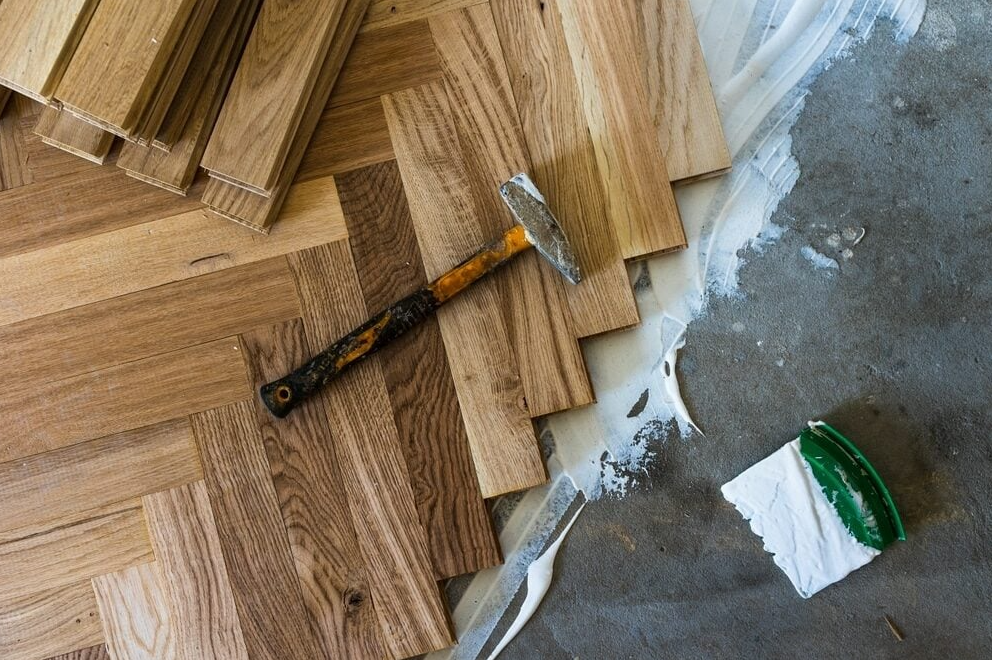
A dry run helps to check that the herringbone pattern is straight and looks balanced before installing it for good.
How to Arrange a Dry Run for Herringbone Laminate Flooring
Lay out 10–20 laminate planks on the subfloor without locking them, following a herringbone pattern aligned to the established centerline. The first “V” configuration should be positioned at the midpoint to ensure symmetrical distribution across the room. Alternating A and B panels is essential to maintain the structural integrity of the herringbone layout.
Inspect edge conditions carefully—if narrow cuts appear along walls, the entire layout can be slightly shifted to optimize plank distribution and reduce material waste. A pre-installation dry layout significantly improves cutting efficiency and final visual balance.
Ensuring Consistent Angles and Accurate Alignment
Each “V” joint must form a precise 90° angle, with pattern points consistently aligned to guideline references. In irregular room layouts, segmented dry runs help evaluate pattern transitions around corners, doorways, and obstacles. Documenting the layout with reference photos supports consistency during final installation.
A dry run typically helps identify alignment issues early and reduces installation errors in most projects.
Dry Run Checklist
Planks are laid face-up without locking
A/B panel alternation is consistent
Centerline and guide markings remain visible
All “V” joints maintain a 90° angle
Edge gaps are assessed for cut planning
Obstacle areas (vents, doorways) are pre-marked
Layout reference photos are documented
However, subfloor flatness requirements for herringbone laminate flooring are significantly stricter than for standard laminate flooring. Due to the higher joint density and alignment sensitivity, even minor deviations can result in joint separation and visible pattern distortion. In many cases, installation failures are not caused by the laminate flooring itself, but by underestimated subfloor irregularities during preparation.
A/B Plank Sequencing — A Critical Requirement in Herringbone Installation
Most herringbone laminate flooring systems use dedicated A and B planks (left and right boards). These planks must be installed in the correct sequence to form the pattern and ensure proper locking.
Incorrect sequencing is one of the most common installation issues. If A and B planks are mixed improperly, joints may not lock correctly, and the pattern structure will fail.
This is where many first-time installers encounter serious problems.
Step 3: Build the Starting Triangles for Herringbone Laminate Floor

The installation begins with assembling the starting triangles, which form the structural foundation of the herringbone pattern. The first thing to do is build the starting triangles, which are sometimes called chevrons or “V” shapes. Getting this step right is the most important part because it ensures the whole floor looks straight and even.
Lay Out and Align the First Triangles
Start at the center line, the one I marked in Step 1.
Suggest making sure the tip of this middle triangle lines up right on the centerline. This is how I keep the pattern consistent and true across the room.
Use A-panels and B-panels one after the other:
Place B-panels (which are beveled to the left) on the left side.
Place A-panels (beveled to the right) on the right side.
Techniques for Good Assembly
Make sure each triangle locks together at a 90-degree angle. The tops should be flush, and the joints should fit tightly with no edges sticking out.
A rubber hammer to tap the boards together. Follow the instruction manual for the specific locking system of the laminate product.
Keep a 10-12mm expansion gap along the wall.Do this by placing expansion wedges for all laminate flooring. It gives the boards room to expand and shrink so they don’t buckle.
After every 2–3 triangles, take a straightedge to check the alignment along the centerline. Checking now stops the pattern from getting crooked later.
Layout Examples and How Many Panels to use
In a typical home, the starting row needs about 5–7 panels. This number can change based on the plank width. Most planks are 100–120mm wide and 600–700mm long.
For the layout, try three triangles to the left and two to the right of the center. This creates a central meeting point at a 45-degree angle that I feel anchors the whole design.
To work efficiently, if I assemble an even number of triangles, I set one aside for now. If I have an odd number, I remove the two outermost triangles. I can adjust them later. This makes it easier to get a perfect fit.
Step 4: Guide to Installing the First Full Row
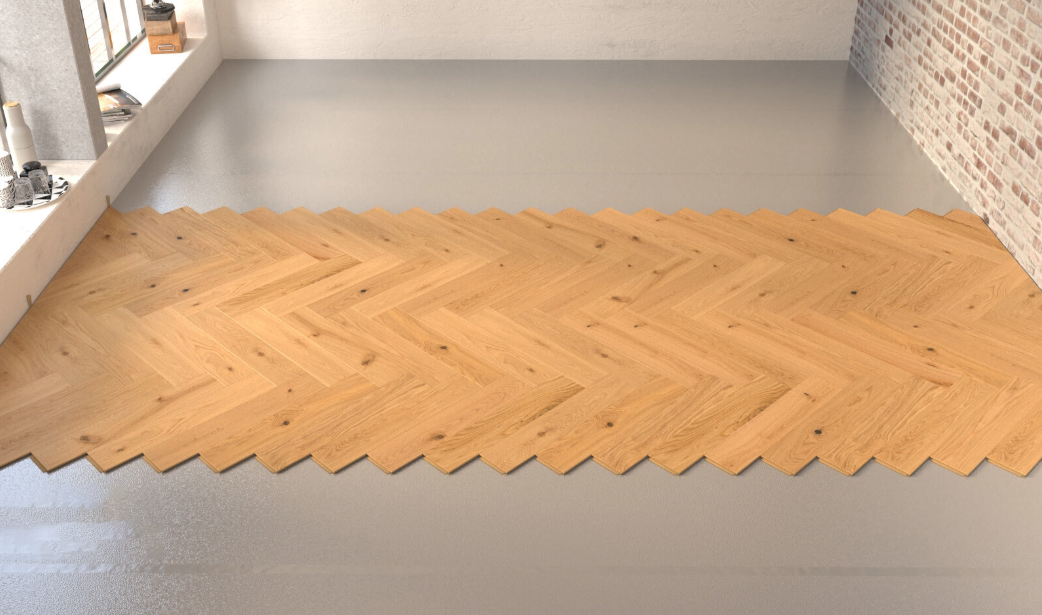
I can’t stress this enough: getting the first row right is the key to a great-looking herringbone floor. This row acts as the foundation for everything that follows.
Center and Align the First Row
Start by finding the room’s centerline. Measure the longest wall and mark its middle point. Then, I snap a chalk line down the floor to get a straight guide.
Next, lay out the A and B planks on opposite sides of the centerline, ensuring a clear directional structure for the herringbone pattern. A panels are positioned on one side, while B panels are aligned on the other, allowing the interlocking system to form the characteristic “V” shape. Correct placement at this stage is essential, as any misalignment between A and B planks can disrupt the pattern geometry and affect the overall visual symmetry of the floor.
Assembling and Locking the Planks Together
Begin forming the first triangular section at the intersection of the chalk lines, ensuring all “V” shapes are oriented in the same direction to maintain pattern consistency. Alignment should be checked frequently, as even slight deviations at this stage can amplify across the layout.
As planks are connected, a tapping block and mallet help achieve a tight, gap-free joint. Proper locking is typically indicated by a distinct “click” sound and seamless plank edges, confirming that the joint system is fully engaged without visible gaps.
Making Sure the First Row is Centered
It is essential to verify that the first row is properly centered before proceeding. If the remaining space at the wall is narrower than the width of a full plank, the entire layout should be adjusted to avoid creating narrow, impractical edge cuts. In center-based installations, offcuts typically range from 250–400 mm in smaller rooms and can extend up to 600 mm in larger spaces, supporting a more balanced visual outcome.
If joints fail to lock smoothly during installation, excessive force should be avoided. Such resistance usually indicates alignment or sequencing errors rather than defects in the locking system, and forcing the connection may damage the joint profile.
Step 5: Continue Laying the Pattern Row by Row
Keeping the herringbone pattern consistent requires patience. It needs to work in a set, repeatable way. This is the process after the first row to get a precise, professional look.
How I Lay A-Panels and B-Panels for the Pattern
Start each new row with A-panels. I work left to right. First, lock the short edge of an A-panel into the previous row. Then, fold it down and click the edges into place.
Once the A panels in a row are completed, the B panels are installed from right to left, using a fold-and-click method to lock each plank into place and complete the “V” formation. This sequencing is critical for achieving the characteristic herringbone zigzag pattern with tight, uniform joints.
Maintaining a consistent installation system across all rows is essential—any change in panel order or installation direction can disrupt alignment, leading to pattern inconsistency and potential joint issues.
Keeping the Right Expansion Gaps and Fit
Insufficient expansion space can lead to floor buckling, edge lifting, and long-term stress on the locking system, especially in environments with temperature or humidity fluctuations.
Step 6: Keep Joints Staggered and Aligned for a Perfect Herringbone Floor
To get a good-looking and long-lasting floor, I make sure every joint is staggered. The planks must stay straight and tight.
Maintain Herringbone Pattern Alignment
After installing a section, check the alignment. The plank edges and herringbone pattern must line up with the center line. A small error here can grow and ruin the look of the whole room.
Use a straight edge often. Place it on the main center line or chalk lines to check for any drift. It is much easier to make small fixes now than to deal with big problems later.
Step 7: Cutting Herringbone Laminate Planks for Walls, Corners, and Obstacles
To achieve a clean finish on the herringbone floor, planks need to be cut to fit at walls and around things. I’ve found this is a key step. It makes the floor look seamless and helps it last a long time.
Measuring and Marking for Precision
Measure each cut location with care: A tape measure to make a fine pencil mark on the plank.
For corners or odd shapes, use an angle measurer. This tool helps get the angles just right.
An expansion gap must be maintained to accommodate dimensional movement in laminate flooring. A 7 mm gap is recommended at all room perimeters, transition zones, and around fixed elements such as columns or pipes. Spacers are used to keep this gap consistent during installation, preventing compressive stress that can lead to buckling or joint failure over time.
Before cutting any plank, measurements should be rechecked to ensure accuracy. Clearly marked cut lines improve precision and reduce material waste, especially in edge and detail areas.
Handling Obstacles and Edges
Corners: For corners, I measure the length with a tape and an angle finder. Then I mark, cut, and place the piece. Leave a 7 mm spacer in place to double-check the gap.
Doors: Base molding may need to be removed to achieve a clean installation. A plank is placed flat and slid under the door jamb to capture the exact profile, then the shape is traced onto the plank. A jigsaw is used to cut along this outline, allowing the plank to fit tightly beneath the jamb for a seamless finish.
Pipes: The pipe position is marked on the plank, followed by drilling a hole slightly larger than the pipe diameter to allow for the required expansion gap. The plank is then split through the center of the hole, enabling installation around the pipe. The smaller cut section is reattached behind the pipe using adhesive, creating a discreet and professional finish.
45-Degree End Cuts: At pattern edges, 45-degree angle cuts are required to complete the “V” formation. Accurate angle cutting ensures the herringbone pattern remains visually consistent and extends cleanly to the wall boundary.
Step 8: Finishing the Last Row of Herringbone Flooring
To get a Professional look on the last row, I focus on careful measuring and precise cuts. Here is the step-by-step process I follow:
Measure and Plan for the Final Row
Start by measuring the gap width between the installed row and the wall in several spots. In experience, it must leave a 10–12mm expansion gap. Don’t skip this part.
using spacers or expansion wedges every meter. This ensures the expansion gap stays even.
Trim and Fit the Planks
Mark each plank: I lay the plank loosely next to the gap. Then a pencil to mark where I need to cut it. Double-check that all A and B panels are in the right position to keep the herringbone pattern correct.
Cut the planks to size. A jigsaw or a laminate cutter. For example, in a 2.5m wide room, it has to trim every plank in the final row. This can leave me with narrow strips, sometimes only 8–12cm wide.
Test-fit every piece. Make sure the plank fits before installing it. Each piece should lock in without pressing against the wall.
Install the Final Row
To fit a plank, I angle its long side up to about 30°.
Use a rubber mallet to tap the short ends of the planks together. This gives me a tight, flush seam.
For the smallest pieces, use a small dab of laminate glue. The locking system might not hold tiny triangles, and glue stops them from shifting.
For example, in a 4m x 3m room, I often need to fit 6–10 separate pieces for the last row. This is common when walls are not straight.
Step 9: Install Flooring in Doorways and Thresholds: Expansion Gap & Trim Guide
When I install herringbone laminate in doorways and at thresholds, I focus on two things. First, the look needs to be seamless. Second, the floor must have room to move.
Essential Steps for Fitting Herringbone Laminate in Doorways
Leave a 10mm Expansion Gap:
Seave a 10mm gap between the new laminate and any old flooring. This gap stops the floor from buckling when it expands or contracts.
Undercut Doorjambs for a Professional Finish:
Before fitting planks in a doorway, the doorframe should be undercut to match the exact thickness of the laminate flooring. A scrap plank can be placed flat against the jamb to accurately mark the cutting line. Once marked, a handsaw or oscillating multi-tool is used to create a clean, level cut. This method ensures the laminate plank can slide smoothly underneath the frame, achieving a tighter fit and a more professional, seamless installation finish.
Tip: With this method, no need to cut the laminate to fit around the frame.
Cut Planks for the Doorway:
Measure the doorway’s width and subtract 10mm for the expansion gap. This means 5mm on each side. A try square and a pencil to get accurate marks. Cutting the plank with the décor side down for the cleanest edge.
Install Planks Halfway Under the Door:
For the best look, laying the floor so it ends halfway under the closed door. This makes the transition between rooms look sharp. It also hides the expansion gap under the door.
Adding Threshold Bars & Finishing Touches
Fit the Threshold Bar or Transition Trim:
After I lock the planks in, I add a threshold bar or a matching trim. I make sure it’s one that the manufacturer recommends. This bar covers the expansion gap. It also creates a strong and clean transition. This works very well between two different floor types or at an exterior door.
For a standard UK doorway (about 762mm wide), the plank cut is 742mm to allow for the gap.
Finalize the Fit:
Slide each cut plank into place under the jamb. Double-check that the threshold bar sits level and lines up with both floors.
Data Point: The expansion gap needs to be 10mm.
For a high-end look, a threshold bar that is thick enough to sit flush with both floors.
FINALS
Common Mistakes When Installing Herringbone Laminate Flooring
Treating herringbone laminate like standard straight-lay flooring
Starting installation from the wall instead of a central reference line
Ignoring A/B plank sequencing requirements
Using overly soft or thick underlay
Forcing planks to lock when alignment is incorrect
In most projects, these mistakes lead to pattern misalignment or joint failure, often requiring partial or complete reinstallation.
How to Verify Herringbone Laminate Flooring Before Installation
Before purchasing or installing herringbone laminate flooring, buyers should confirm the following:
Whether the product uses a true A/B plank system
Locking system precision and edge quality
Core board density and structural stability
Consistency between batches (especially for large projects)
Most installation problems attributed to “installation errors” are actually related to product inconsistency or insufficient locking precision.
Where Herringbone Laminate Flooring Works Best
Herringbone laminate flooring is commonly used in:
Residential interiors such as living rooms and bedrooms
Boutique retail spaces
Hotel rooms and decorative commercial areas
However, it may not be ideal for:
Uneven subfloors or renovation projects with poor base conditions
High-moisture environments
Large open commercial areas without proper expansion planning
Quick Installation Checklist
Before starting installation, confirm the following:
Is the subfloor flat enough for herringbone alignment?
Is the installer familiar with A/B plank systems?
Has the layout been tested with a dry run?
Is the underlay suitable for laminate click systems?
Are expansion gaps properly planned?