
You can re-edge the same panel three times, change the glue, recalibrate the machine, and still get the same failure.
In many cases, edge banding problems do not start with the adhesive or the machine settings. They start with the board itself. Low-quality melamine MDF creates weak edges, unstable bonding surfaces, and inconsistent internal structure that make clean edge banding difficult from the beginning.
This is why problems such as peeling, bubbling, corner chipping, and open glue joints often keep returning even after process adjustments.
This guide explains how low-quality melamine MDF causes edge banding failure, how to diagnose whether the board is the real problem, and how buyers can choose better melamine MDF specifications before the issue reaches the production line. For buyers comparing different engineered wood panel solutions, board consistency matters just as much as decorative finish, especially in projects that require precise machining and edge treatment.
What Makes Melamine MDF Low Quality
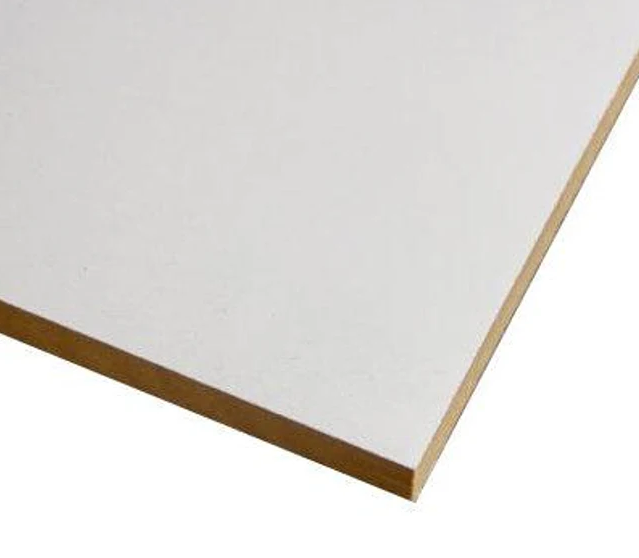
Not all MDF is created equal. The gap between premium and low-quality boards isn’t cosmetic. It’s structural. It’s chemical. And you’ll see it show up right on your edge banding line.
Density is where the story starts. Premium melamine MDF runs between 700–770 kg/m³, meeting ANSI A208.2 MD-130 standards. Low-quality boards often fall below 620 kg/m³. That difference isn’t just a number on a spec sheet. It’s the reason your router leaves a rough, porous edge that adhesives can’t grip. Projects that depend on MDF boards designed for furniture manufacturing usually require more consistent density and moisture control than low-grade boards can provide.
Then there’s resin. Quality boards fuse at 350–400 PSI and 380–400°F. That pressure locks the melamine facing to the core. Budget MDF skips that step. Poor resin penetration leaves the core-facing bond weak — before your banding machine even touches it. Add heat and pressure from the banding process, and delamination follows.
The melamine surface layer matters too. Thin or uneven facing — anything outside EN 14322 tolerances — chips during application. That exposes the porous MDF core underneath. Once the core is exposed, glue doesn’t bond. It sits there. Then it fails.
Here’s a quick reference for what separates the two:
| Quality Marker | Premium MDF | Low-Quality MDF |
|---|---|---|
| Density | 700–770 kg/m³ | Below 620 kg/m³ |
| Fusion Pressure | 350–400 PSI | Under 350 PSI |
| Surface Standard | EN 14322 compliant | Inconsistent, thin facing |
| Formaldehyde Emissions | ≤0.09 ppm (CARB Phase 2) | Often exceeds limits |
That last row catches most people off guard. Excess formaldehyde from low-quality MDF disrupts EVA and PUR adhesive bonds. The result? 20–30% higher failure rates in humid environments. That’s not a minor issue — it’s a pattern.
The bottom line: low-quality melamine MDF doesn’t just underperform. It fights against your edge banding process at every stage — machining, bonding, and long-term durability.
Common Edge Banding Failures
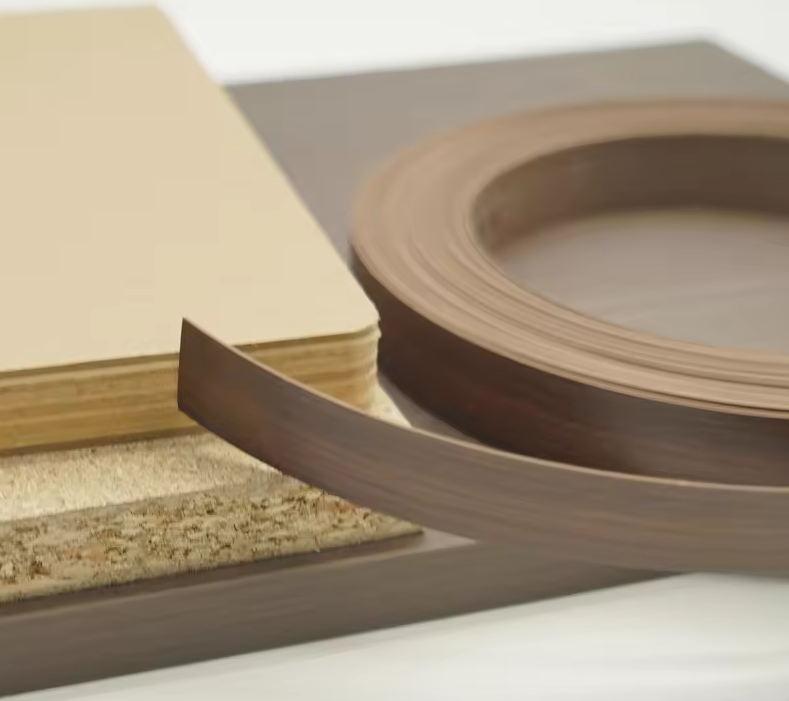
Five failures. Five different symptoms. One root cause hiding in plain sight: the board itself.
Low-quality melamine MDF doesn’t announce itself. It waits. Then it shows up — fuzz on a machined edge, a bubble that appeared overnight, a corner that crumbles the moment a customer touches it. Each failure looks different. Each one points back to the same source.
Here’s what’s happening — failure by failure.
1. Fuzzy, Fibrous Edges That Won’t Clean Up
You sand it. You prime it. The fuzz comes back.
This isn’t a finishing problem. Low-density MDF has loose fiber bundles. They break apart under a router bit — not in a clean line, but in a rough, ragged way. The edge turns porous, almost sponge-like. Adhesive soaks in instead of bonding. The banding has nothing solid to grip.
Premium MDF, pressed at proper density (700–770 kg/m³), cuts clean. Budget board, pressed below 620 kg/m³, does not.
2. Substrate Texture Telegraphing Through the Banding
The board’s internal structure shows through the edge banding. It looks like the panel is wearing its skeleton on the outside.
The banding is too thin for the substrate’s surface variation. That’s the core issue. Low-quality MDF has uneven core density across the panel. This creates small waves and bumps at the micro level. Those imperfections push through — especially with thin banding.
The fix starts with materials. Use 1mm+ edgebanding. Also, choose higher-quality MDF over particleboard. The smoother and more consistent the core, the better the finish you’ll get. Requirements for melamine-faced boards for interior use are also defined in EN 14322, which is widely used as a reference for decorative surface quality and surface performance.
3. Edge Bursting and Corner Chipping
Low-quality MDF often has hidden stress fractures inside. You can’t see them on the surface. They only show up once a milling cutter passes through. The result — chipping, tear-outs, burst edges — looks like a dull cutter problem. It’s not.
Check the board before blaming the machine. Run a test cut. Chipping persists even with sharp, well-calibrated tooling? The board is the culprit. Switch your material source and run the test again.
4. Poor Adhesion and Open Glue Joints
Cold boards kill adhesive bonds. MDF pulled straight from an unheated warehouse and run through the banding line creates a thermal mismatch. The adhesive cools too fast. It can’t penetrate the surface properly.
The fix: condition panels at 35–45% relative humidity and 70°F (21°C). Target an EMC between 6–9%. Also confirm ambient temperature stays above 20°C and that pressure settings are correct. Skip any of those steps and even the best PUR adhesive won’t hold.
5. Uneven Ends, Scraper Marks, and Height Mismatches
Low-quality MDF absorbs moisture at different rates across the panel. It swells — but not evenly. Panel height shifts. The pressure beam no longer sits flush. Scrapers dig in at the wrong angle, leaving stress marks or whitening the surface.
Keep scraper depth at 0.1mm and trimmer RPM between 15,000–18,000. But those settings only matter if your panels are stable to begin with. Warped, swollen boards from low-grade stock make every downstream adjustment pointless. Check dimensional stability before the panel ever reaches the machine.
Each of these failures has a fix. The most effective fix happens before the panel reaches your line — at the sourcing stage, the moment you choose the board.
Matching Edge Banding to MDF
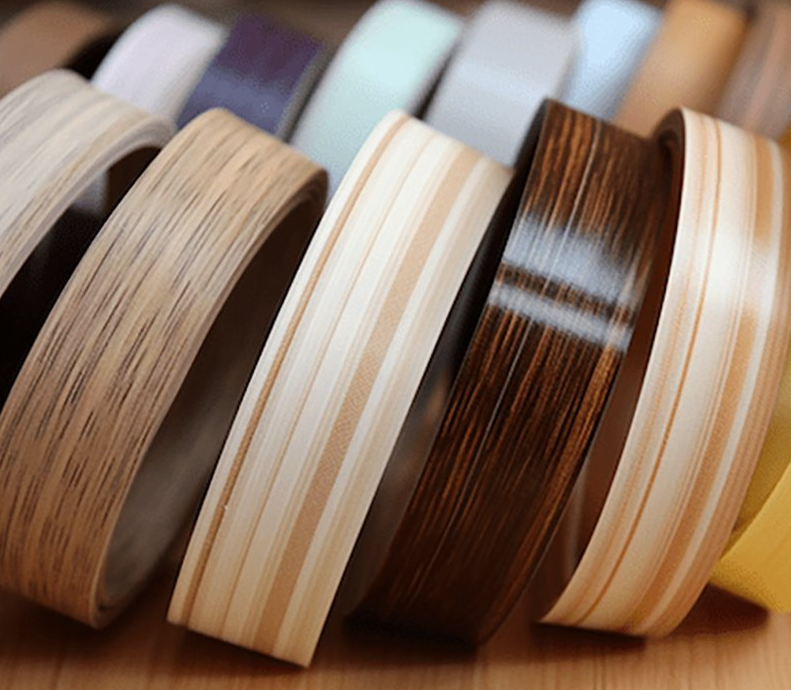
The board grade you choose doesn’t just affect how a panel looks. It determines which edge banding materials will work on it.
This is where most sourcing decisions go wrong. People pick banding based on price or color match. They forget to ask whether the substrate beneath can hold that banding in place. With low-quality melamine MDF, that mistake costs you — peeled edges, failed adhesion, and panels that don’t survive their first season in the field.
Here’s the match that matters most: laminated MDF surfaces pair with ABS or melamine edge banding. ABS gives you flexibility and impact resistance. Melamine keeps the visual continuity clean. Neither performs well on a porous, low-density core that hasn’t been prepared right.
Thickness is the second variable most people underestimate.
Thinner banding — 0.5mm to 1mm — needs a smoother, more consistent substrate surface. Low-quality MDF has uneven core density. That unevenness pushes every flaw through thin material. Your MDF quality is questionable? Step up to 1mm minimum. It covers surface variation that thinner tape can’t hide.
For applications needing 3mm banding, ANSI/AWI 0641-2019 permits radiused, beveled, or square edges on both horizontal and vertical components. At 6.4mm or thicker on the face, mitered edges are required — no exceptions.
Preparation determines outcome. Do this before banding touches the panel.
Sand MDF edges to 240-grit. That one step boosts adhesive grip on a board whose surface integrity is already borderline. Cut banding a bit longer than the edge. Trim it clean after application. This protects the corner from chipping — something low-grade core material is already prone to.
Then check what you’re working with using measurable standards:
- Color consistency: Spectrophotometer readings should show Delta E ≤ 1. Go higher and your color match starts drifting. On lower-quality boards with inconsistent surface absorption, that drift compounds fast.
- Adhesion rating: Cross-hatch testing on a 0B–5B scale. A 5B rating means no coating removed. A 0B means significant failure. On low-quality melamine MDF, adhesion ratings drop fast without surface prep.
- Straightness: Wavy or bowed banding — what manufacturers call “banana-curve” — creates uneven contact with the board edge. On stable, premium MDF this is manageable. On a board that’s already off-dimension, it’s a failure that builds on itself.
- Concavity: A slight inward bow keeps banding in tight contact during processing. Too flat and the material lifts. Too concave and adhesion suffers. This matters more as thickness increases — and even more when the substrate isn’t holding its dimensions.
One function of edge banding on MDF gets missed too often: moisture protection. Raw MDF edges absorb moisture. Without banding, they swell. They warp. They fail — and they fail faster on low-density boards that weren’t pressed to spec in the first place.
Getting the material match right won’t fix a bad board. But it gives a good board its best shot — and it keeps a marginal one from failing ahead of its time.
Process Adjustments
No process tweak turns a bad board into a good one. But the right adjustments can separate a panel that survives production from one that fails quality check.
Low-quality melamine MDF hits your line — by accident or budget pressure. Here are the levers worth pulling.
Sand Smarter, Not Harder
Surface roughness is where lower-grade MDF betrays you first. The fix starts with your sanding sequence.
Work through P150 to P400 grit in steps. Research on HDF/MDF sanding shows higher grain sizes cut surface roughness amplitude by up to 31%. P400 — the highest grit — delivers the lowest Ra values. That smoother surface gives adhesive something solid to grip.
Two things matter beyond grit selection:
Direction: Sand along the grain. Longitudinal passes give lower roughness readings than cross cuts. On a board with uneven core density, that gap gets wider.
Feed speed: Slower conveyor speed improves dust removal and surface smoothing. At higher feed speeds, use coarser belts (P150) to prep the surface without losing quality.
Moisture Content Is Your Most Underrated Variable
Low-quality MDF is inconsistent by nature. Moisture content management is one of the few tools that creates consistency where the board offers none.
Target these ranges based on your press type:
| Press Type | Target MC |
|---|---|
| Continuous hot press | ~5% |
| Multi-layer press | ~10% |
| Surface fibers vs. core | Surface runs 2% higher |
Low-density panels — those below 620 kg/m³, which is typical of low-quality melamine MDF — need mat MC between 12.1–15.3% to get the best Internal Bonding. Medium and high-density panels need tighter, lower MC ranges. Pushing density up through process control also strengthens mechanical properties. Plus, it slows the erratic core temperature rise that causes bonding failure later in production.
These adjustments don’t fix a sourcing problem. They manage it. The boards that cause the most damage aren’t the obvious rejects — they’re the borderline ones that almost work. Process discipline keeps those panels from turning into a quality crisis. The smarter long-term move: know exactly what grade of MDF you’re buying, every time, before it reaches your line.
Quick Decision Guide: How to Avoid Edge Banding Failures
If you need a fast way to reduce edge banding problems, focus on three key checks before production starts.
First, verify MDF density and consistency. Panels below 700 kg/m³ are more likely to produce weak edges and unstable bonding surfaces.
Second, match edge banding thickness to board quality. Lower-quality MDF requires thicker banding (1mm or above) to compensate for surface irregularities.
Third, confirm storage and conditioning conditions. Panels should be stabilized at controlled temperature and humidity before processing.
If all three conditions are met, most edge banding failures can be prevented without adjusting machine parameters.
The board you buy today is the problem you’ll diagnose six months from now. So make the right call before anything reaches your line.
How to Choose Melamine MDF That Prevents Edge Banding Problems
Four decisions determine whether your MDF works with edge banding: density, moisture resistance, thickness, and the band itself. Get all four right, and most of the problems covered earlier in this guide won’t touch your production.
Start with density — and treat 720 kg/m³ as your floor, not your target.
IS 12406 sets 720 kg/m³ as the minimum. At that threshold, edge swelling stays in the 2–5mm range at 85–95% humidity over 48 hours. Screw pull-out strength holds at ≥300N. Drop below it, and you’re back to porous edges, weak glue bonds, and fuzzy fiber that no sanding sequence can fix.
For kitchens and bathrooms, step up to HDFWR (800–900 kg/m³).
Yes, it costs 30–40% more. Here’s what you get: edges that swell 50–70% less during monsoon season, and a core that holds firm even with steam exposure every day. Standard MDF (650–750 kg/m³) breaks down fast within 600mm of a water source. HDFWR doesn’t. For buyers still comparing substrate options in cabinetry, it also helps to understand why MDF boards are used in cabinet production before deciding how much edge durability the project actually needs.
Specify 18mm+ for any wet or high-load application — with ±0.3mm thickness tolerance. Maximum spans: 900mm for shelves, 2,100mm for doors. Thicker panels cut down post-laminate waviness too. That has a direct impact on how flat your band sits.
Match the band to the board:
| Usage Area | Core MDF Spec | Edge Band Spec | Key Metric |
|---|---|---|---|
| Kitchen | MR/HDFWR, 700–900 kg/m³, 18mm | 1mm ABS/MABS, 23mm width | Edge swell <2mm |
| Bathroom | MR/HDFWR, 800+ kg/m³, 18mm+ | 1mm ABS/MABS, 23mm, soft touch | No delamination at 85–95% humidity |
| High-Traffic/Commercial | HDFWR/FR, 800+ kg/m³, 18–25mm | 2mm thick, 23mm width | ≥300N screw hold |
| Low-Use (Closet/Storage) | Standard 650–750 kg/m³, 16–18mm | 0.8–1mm, 22–23mm | Seal within 24hrs of cut |
For most cabinetry, 1mm ABS or MABS on 3/4″ (19mm) MDF is the go-to default. A 23mm band width covers 95% of standard panels from EGGER, FORMICA, and Baier — with trim room to spare. Impact resistance holds. Moisture resistance holds. The band trims clean without lifting.
Before anything leaves the shop, run these checks:
Weigh sample cuts to verify density claims. Use calipers at five points per sheet to confirm thickness tolerance.
Pre-seal factory-cut edges right away. Raw MDF edges absorb moisture within hours — not days.
Cut banding 5–10% longer than the edge. Trim after bonding, not before.
In wet areas, keep a 5mm floor gap. Use HDFWR spec within 600mm of any water source.
Use PU-based adhesive or pre-applied glue. Sand edges to 240-grit before application.
None of this is complicated. It’s just specific — and that specificity is what low-quality melamine MDF sourcing tends to skip. The panels that cause the most production grief aren’t the obvious rejects. They’re the ones that almost meet spec. These numbers keep you on the right side of that line. Buyers sourcing panels for office fixtures and retail interiors can also review how melamine MDF enhances commercial furniture boards when consistency, machinability, and decorative performance matter together.
Common Buyer Mistakes When Selecting Melamine MDF for Edge Banding
Most edge banding failures are not caused by complex technical issues. They come from a few repeated sourcing mistakes that buyers underestimate at the beginning of a project.
The first mistake is choosing MDF based on price per sheet instead of density and consistency. Lower-cost boards often fall below the required density range, which leads directly to weak edge structure and poor adhesive bonding.
The second mistake is assuming that machine adjustments can compensate for material defects. In reality, no amount of temperature or pressure tuning can stabilize a porous or inconsistent core.
The third mistake is ignoring moisture conditions during storage and processing. Even acceptable MDF can fail if panels are not conditioned before edge banding.
The fourth mistake is using the same edge banding specification across different MDF grades. Thinner banding materials require higher substrate quality, and mismatching the two increases failure risk.
Avoiding these mistakes at the sourcing stage reduces most edge banding issues before they appear on the production line.
Conclusion
Most edge banding failures aren’t machine problems. They’re material problems wearing a machine problem’s disguise. For manufacturers sourcing wood panels and interior materials from one supplier, preventing edge banding failure starts with choosing the right board specification before production begins.
Low-quality melamine MDF is often the hidden culprit — and it shows up in three ways: inconsistent density, poor surface adhesion, and moisture instability. Once you see this, you stop chasing symptoms. You start fixing root causes instead. That shift saves you time, materials, and the endless frustration of rework that never truly stops.
The good news? You have more control than you think. Here’s where to start:
Choose better-grade MDF upfront — don’t cut corners on the base material
Match your banding material to your MDF grade — mismatched materials cause most adhesion failures
Dial in your process settings with purpose — pressure, temperature, and speed all matter
Failure has already happened on some pieces? The repair strategies in this guide give you a practical path forward. It’s not a permanent fix, but it gets the job done.
So here’s your next step: pull out your current MDF supplier specs and ask the hard questions. The cost of low-quality melamine MDF never shows up on the invoice. It shows up on the shop floor — one peeling edge at a time.