
Asia’s particle board export market is hitting a major turning point as we head into 2026. Three big forces are reshaping the industry. Southeast Asia is rapidly building new production capacity. Environmental rules in traditional markets keep changing. And furniture makers are shifting how they manufacture products.
Malaysia and Thailand have dominated exports for years. But now they’re seeing profits squeeze as raw material prices climb. Vietnam and Indonesia are grabbing market share fast. They offer lower prices and sit closer to growing markets.
This analysis digs past basic trade numbers. We examine the real competitive forces changing Asia’s particle board export landscape. Take the Malaysia-China trade route—it moves $2.3 billion in goods. Or look at Vietnam’s explosive 47% export growth rate since 2022.
You might be a manufacturer planning where to invest in new capacity. Or a trader figuring out better sourcing options. Maybe you’re an analyst watching how supply chains evolve. Either way, the data and forecasts here will help you spot real opportunities. This regional export market is worth $8.7 billion and growing.
2024 Status of Asia’s Particle Board Export Market
China’s particle board export numbers show massive volume growth but stalled pricing power. The country shipped 840,000 m³ in 2024—a 34.61% jump year-over-year. Export revenue climbed just 10.7% to $300 million. That gap shows what’s happening: producers trade profit margins for market share.
Weight-based data confirms the surge. 528,600 tons crossed borders in 2024, up 34.40% from 2023. Standard particle board led shipments. Oriented Strand Board (OSB) exports hit about half that volume. OSB plays second in China’s export mix.
Exporters face tough times with pricing. Average unit prices dropped hard. Standard particle board fell to $592.07 per ton—down 16.14%. OSB got hit worse at $471.39 per ton, down 26.99%. Volume growth can’t fix this price drop. Pressure to add value keeps building into 2026.
Four Forces Driving Growth
Global construction and furniture demand bounced back. Economies recovered from pandemic hits. Chinese manufacturers upgraded their production tech. Quality standards now match what the world expects. This opened new markets.
Emerging buyers changed the landscape. Nigeria, Chile, and Vietnam broke into the top five. They replaced Saudi Arabia and UAE. Peru’s imports from China shot up 102.04% in 2024. Vietnam grew at a similar pace.
Traditional producers couldn’t keep up with demand. Gaps appeared. Chinese exporters jumped in fast. They used their 66 million m³ annual capacity built by end of 2024.
Market Landscape Reshaping
China exported to 163 countries and regions in 2024. Taiwan took the lead with 100,800 m³—the biggest single buyer. Mongolia came second. Asia dominated the top ten markets. The United States stood out as the main Western buyer.
Mature markets tell a different story. U.S., U.K., Japan, and South Korea all bought less. Britain’s drop stings most—falling from 6th place in 2021 to 24th in 2024. Chinese exporters had to find new buyers fast.
The top five destinations by revenue growth show the shift:
|
Destination |
2024 Export Revenue Growth |
|---|---|
|
Mongolia |
+90.91% |
|
Chile |
+50.00% |
|
Taiwan (China) |
+34.38% |
|
Vietnam |
+20.00% |
|
Nigeria |
+8.33% |
Competitive Pressure and Market Barriers
Thailand and Brazil compete hard. Their raw material costs run lower. Labor costs beat China’s too. This puts pressure on Chinese prices. Trade barriers grew through 2024. Anti-dumping probes started. Tariffs added costs that exporters didn’t expect.
China still bought 764,800 tons of particle board in 2024—up 1.03% year-over-year. Thailand and Brazil sent most of it. Here’s the odd part: China exports massive volumes but still imports certain grades and types.
Asia kept strong momentum in 2024’s first half. Mainland China and Hong Kong shipments rose 24% by weight—double the 12% global average. Central Asia jumped 36%. Middle East/South Asia grew 20%. Asia-Pacific climbed 19%. The broader OSB market reached $15.13 billion, heading toward 5.9% CAGR through 2033.
Volume and value tell different stories heading into 2026. Exporters won on tonnage. They lost on pricing. That truth shapes every strategic choice right now.
Competitive Landscape and Growth Drivers of Major Exporting Countries
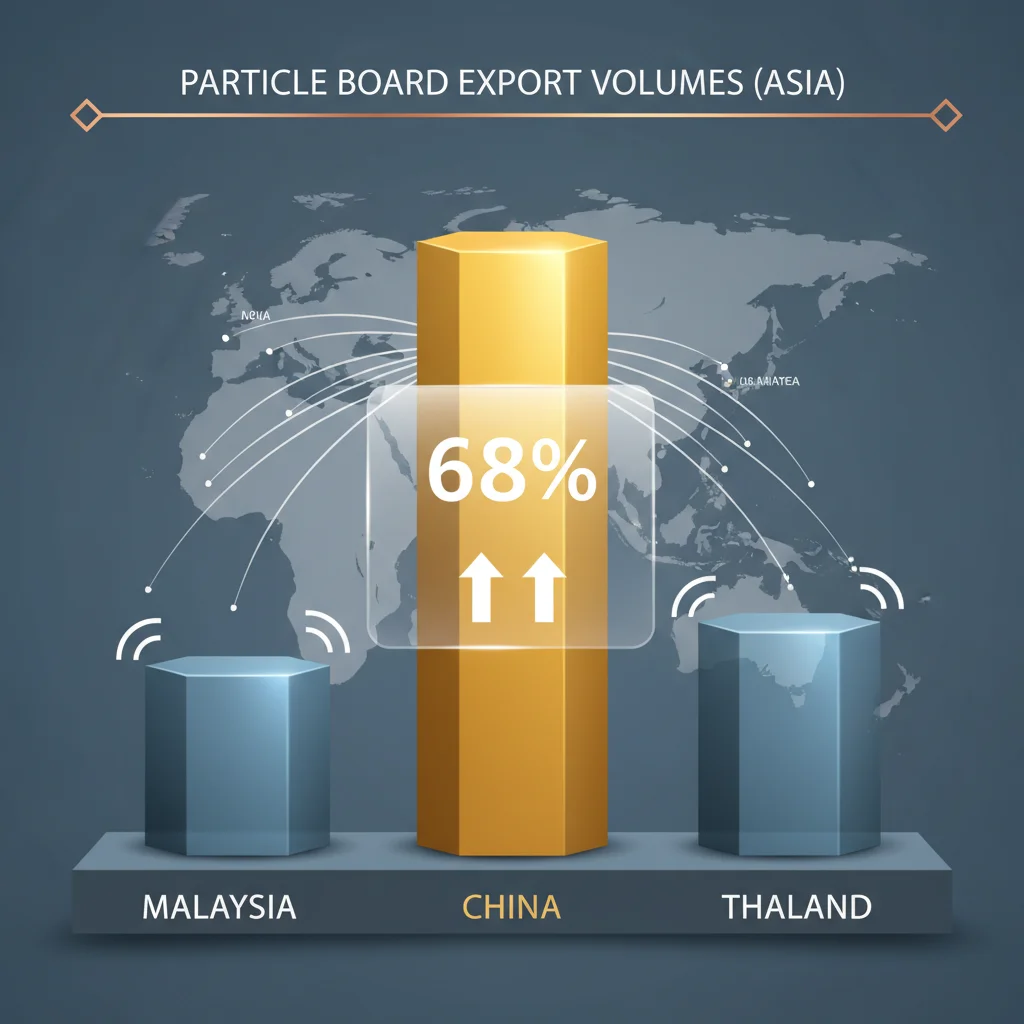
Three countries control 68% of Asia’s particle board export flows in 2026. China sits at the top with structural advantages nobody else can match. Malaysia and Thailand fight for second place. But the real story isn’t who leads today—it’s how fast the gap is closing.
China’s Scale Advantage and High-End Transformation
China shipped 45.47 trillion yuan worth of goods in 2025—up 3.8% from the year before. That’s 7.1% average annual growth since 2020. The country doesn’t just dominate particle board. It controls entire supply chains that feed the industry.
High-tech product exports jumped 13.2% in 2025. This matters for particle board makers. Chinese manufacturers now produce advanced machinery, precision cutting tools, and Formaldehyde-free adhesives. Their equipment matches European quality. You source everything from local suppliers. This drops export costs.
Here’s what changed the game: China’s trade concentration fell to 47.7% across its top ten partners. That’s 2 percentage points lower than 2024. Risk spreads across more buyers. Europe slows down? African and Latin American orders fill the gap.
The Belt and Road Initiative moves $154.21 billion monthly as of November 2025. That’s 1.6 times bigger than RCEP trade volumes. Particle board uses these established logistics routes. Malaysian and Thai exporters? They can’t access this infrastructure.
Belt and Road Unlocks Emerging Markets
China trades with over 60% of countries across all five continents now. It’s the main partner for 160+ nations—that’s 20 more than in 2020. Particle board export channels follow Chinese construction companies. They build projects, the channels follow.
India and Russia lead Belt and Road imports. Together they take close to 50% of the top ten destinations. UAE, Saudi Arabia, and Turkey add steady Middle Eastern demand. This geographic spread covers South Asia, Central Asia, West Asia, North Africa, and Southeast Asia. It creates buffer zones against regional downturns.
November 2025 data shows the momentum. Australia’s imports from China shot up over 20% month-over-month. European countries posted gains. Asian neighbors posted gains. Emerging markets posted gains. Four markets declined: United States, Singapore, Philippines, and South Africa.
High-Value Products Drive Profit Recovery
China’s high-value exports grew 7.9% each year on average. The “New Three” categories hit 1.3 trillion yuan in 2025. That’s electric vehicles, solar panels, and lithium batteries. This number is 3.5 times the 2020 level.
Particle board makers learned from this shift. Premium moisture-resistant boards now command better margins. Low-emission certified panels do too. So do specialty grades. Basic commodity products? They don’t cut it anymore. Exporters who stuck with basic particle board watched their 2026 pricing power disappear.
Cross-border e-commerce reached 2.75 trillion yuan in 2025—up 69.7%. Direct-to-buyer channels cut out middlemen. Smaller particle board orders ship straight to furniture workshops. Peru gets them. Nigeria gets them. Chile gets them. No traditional importers needed.
China ran a $1.076 trillion trade surplus through November 2025. Net goods exports contributed 32.7% to economic growth. That surplus funds R&D investments. These investments keep Chinese particle board competitive on quality. Not just price—quality.
2026 Export Forecasts and Market Opportunities
Four major banks agree on particle board export growth for 2026: about 6% expansion. Goldman Sachs forecasts 5.6% growth in dollar terms. Deutsche Bank projects 6%. CICC estimates around 6%. Bank of China predicts 4%. This agreement matters. Banks don’t usually match this well on emerging market forecasts.
Goldman’s data shows more detail. Export volume should grow 5-6% each year. That beats global trade growth by 2-3 percentage points. Asia’s particle board makers will take share from other regions. Check the numbers against Asia-Pacific’s 53 million m³ production capacity in 2025. The capacity growth feeds export gains.
Deutsche Bank adds key context. Net exports will add 0.5 percentage points to GDP growth in 2026. That’s big. Export activity pushes wider economic growth. Particle board shipments benefit from this trend. Construction projects in developing markets need materials. Chinese and Southeast Asian exporters provide them.
ASEAN and Belt and Road as Growth Engines
ASEAN trade flows jumped in the first ten months of 2025. Exports to ASEAN members rose 14.3%. That’s 3.5 percentage points faster than last year. Vietnam became the top buyer. Chinese exports to Vietnam grew fast across key areas: telecom equipment up 29.7%, electronic parts up 48.6%, auto parts up 24.3%.
These products aren’t finished goods. They’re parts and materials. Vietnamese factories use them to make final products for export. This builds steady demand. Vietnam bought 5.08 million m³ of particle board materials. That gap creates chances for 2026 exporters.
Belt and Road countries show stronger trends. Direct investment in Belt and Road nations grew 23.7% through October 2025. Two-way investment topped $240 billion. China sent $160 billion out. Infrastructure projects use particle board for temporary structures, formwork, and interior work. Investment figures turn into material orders.
High-Value Categories Drive Export Structure Upgrading
Electromechanical products pushed 7.8% export growth in the first ten months of 2025. Integrated circuits jumped 23.7%. Cars climbed 13.4%. Ships surged 25%. These areas boost particle board demand. Electric vehicle production uses interior panels. Ship interiors need moisture-resistant boards. Electronics makers use anti-static packaging from particle board materials.
The “New Three” areas—electric vehicles, lithium batteries, solar panels—added 4.5 percentage points to total export growth. Henan province hit big numbers: EV exports up 20.7%, lithium batteries up 35.2%, solar panels up 117.7%. These gains aren’t just provincial wins. They show where China’s export mix goes next.
High-tech exports grew over 13% in 2025. Private firms and Belt and Road markets took most of this growth. Advanced manufacturing clusters need support materials. Particle board suppliers who meet precision standards and green certifications will get better prices in 2026.
Quantified Market Opportunity Matrix
|
Target Market |
2026 Growth Rate |
Key Drivers |
Capacity Match |
|---|---|---|---|
|
ASEAN Overall |
14.3% |
Intermediate goods demand |
High |
|
Vietnam |
48.6% (electronics) |
Manufacturing relocation |
Medium |
|
Belt and Road |
23.7% (investment) |
Infrastructure projects |
High |
|
Non-U.S. Markets |
5–6% |
Trade diversification |
High |
Asia-Pacific held 53 million m³ production capacity in 2025. This puts exporters in a strong spot. Vietnam’s 5.08 million m³ import gap alone takes major volumes. Singapore and Palestinian territories add more demand. The supply-demand balance fits.
Three priorities matter for 2026. First, focus on non-U.S. and emerging markets with double-digit growth. Second, match products with fast-growing areas—electromechanical goods, integrated circuits, parts for Vietnamese electronics at 48.6% growth. Third, use Asia-Pacific’s production capacity to fill regional gaps before European or North American rivals catch up.
China holds 15% of global export share through 2030 based on current forecasts. That stable position plus 5-6% annual volume growth means particle board export revenues will grow steadily. Exporters who act now secure distribution channels before competition heats up.
Downstream Demand Drivers Analysis
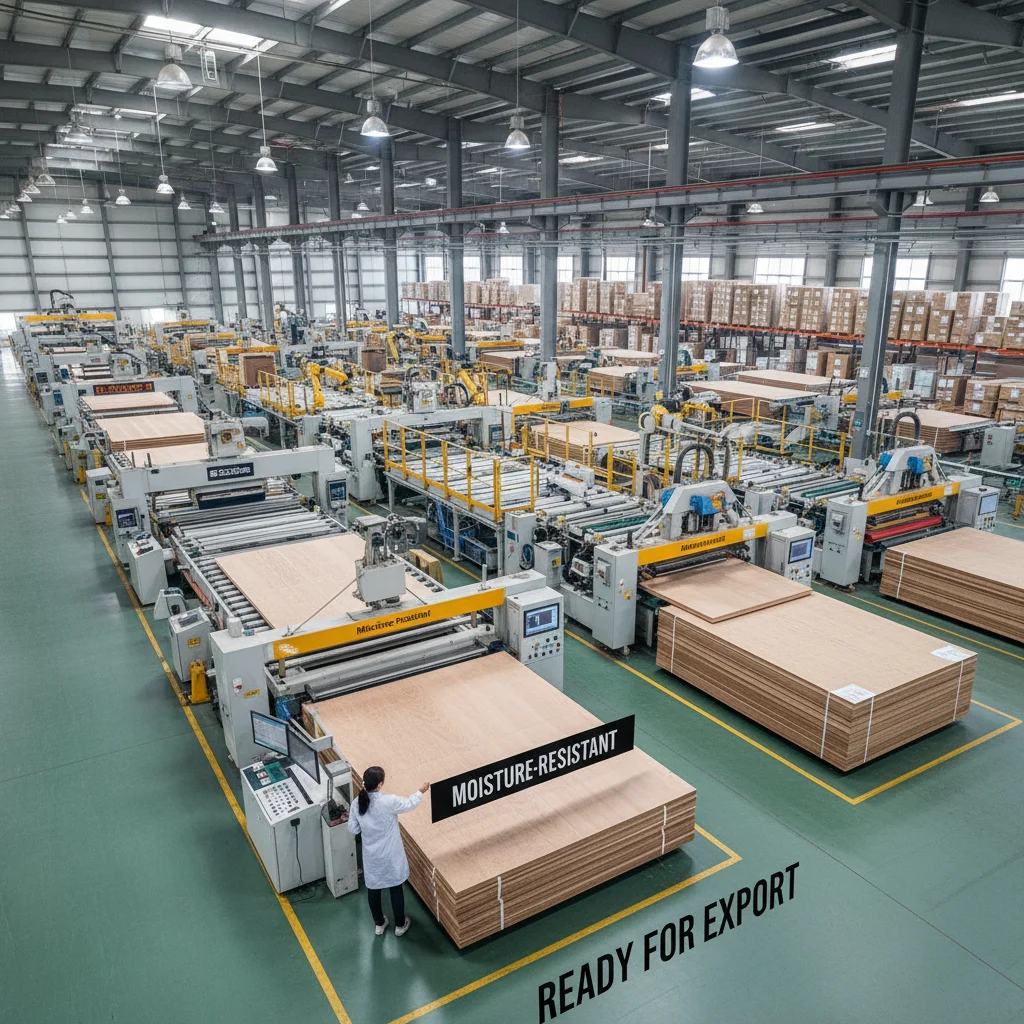
Furniture makers and construction firms drive particle board export demand in 2026. Their buying choices affect the whole supply chain. 73.3% of particle board makers report that customer demand pushes them to change their business. This is real market pressure, not a suggestion.
Customer Innovation Forces Product Upgrades
Buyers push suppliers hard. Most exporters don’t see this coming. Furniture makers want boards that resist moisture. They want zero formaldehyde emissions too. Construction firms need fire-rated panels. These panels must meet new building codes. So particle board makers have to spend on R&D.
This happens through three ways. First, market signals trigger fast action. Take this example: A Vietnamese furniture exporter needs 20,000 m³ of E0-grade particle board by Q3 2026. That one order forces suppliers to upgrade their glue systems. Second, tech knowledge moves fast between companies. One major buyer shares quality specs. Other suppliers copy them to compete.
Distance makes this stronger. Far-away markets push harder for new ideas. Nigerian buyers pay extra for boards that handle tropical humidity. That price difference makes R&D worth it more than local orders do. Market concentration plays a role too. Markets with high HHI scores react faster to customer needs. Suppliers with good financing can innovate faster.
Segmented Market Demand Structure
People’s buying power shapes demand by region. Countries with rising per capita disposable income buy more furniture. That furniture uses particle board. Population trends matter just as much. Young families in Southeast Asia need furniture. They create steady demand. Better-educated people spend more on quality home design.
Trade patterns change the game. Some markets start making their own particle board. This cuts demand for imports. But furniture makers who export keep buying. They need the same quality for foreign orders. Demand stays stable even if local sales drop.
Data isolation damages 55.6% of exporters. They can’t track customer demand changes fast enough. Slow decisions lose market share. Smart exporters now connect with major furniture buyers. Real-time demand data works better than reports every three months.
Capacity Expansion and Supply Chain Restructuring
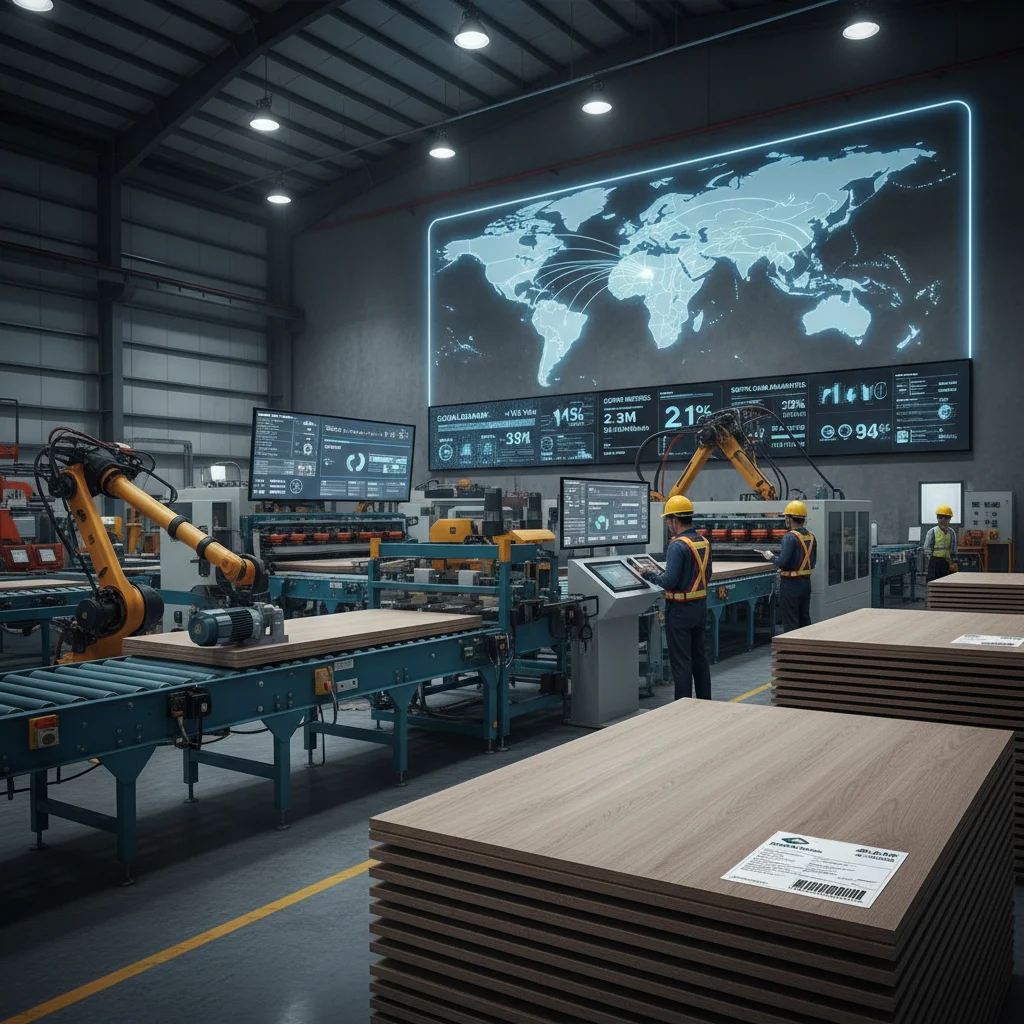
Three forces rewrote particle board export capacity rules in 2026: cost pressures, technology upgrades, and geopolitical competition. Nearshoring and friendshoring policies pushed production into four hot zones—ASEAN, India, Latin America, and Central/Eastern Europe. These aren’t theory. They’re real capacity moves. They decide who wins export contracts.
Digital Transformation of China’s Capacity Advantage
China holds 30% of global manufacturing value-added as of 2021. That’s up from 18.2% in 2010. The country produces over 40% of the world’s top 500 industrial products. Particle board sits in this mix. Chinese makers control critical chain nodes. Competitors can’t replace them fast.
But volume alone doesn’t guarantee 2026 export growth. Industrial automation changed things. AI-driven production changed things. 5G-connected factories changed things. UN Conference on Trade and Development data from 2019 showed digital transformation boosts value-added output. It also boosts chain efficiency. Chinese particle board plants now run lights-out shifts. One operator monitors ten production lines from a control room.
Green requirements hit harder each year. Carbon neutrality targets force chain redesigns. Low-emission particle board commands premium pricing. Plants without green certifications? European and North American buyers drop them. Digital tools track emissions per cubic meter. This transparency separates compliant exporters from fake sustainability claims.
Conclusion

The Asian particle board export landscape is entering a key phase. By 2026, manufacturers need to do three things: adapt to sustainability rules, invest in value-added products, and diversify their export portfolios. Do this, and you’ll capture major growth opportunities. The data shows markets like Vietnam, Indonesia, and Malaysia are boosting production capacity. Traditional powerhouses are also sharpening their competitive edge.
Strategic agility separates winners from everyone else. Track your export performance against the key indicators we’ve outlined. These include moisture-resistant board demand and logistics cost cuts. Use downstream demand drivers to guide your product development choices.
Your next move? Audit your current export strategy against 2026 market projections. Find which markets match your capacity expansion plans. Then build partnerships with distributors in high-growth regions before your competitors do. The particle board export 2026 opportunity window is open now. It won’t stay that way forever.
The question isn’t whether Asian particle board exports will grow. It’s whether you’ll be ready to profit from it.