
For many buyers in Central Asia, sourcing wood-based panels from China has always involved the same trade-off: good factory pricing, but slow and inflexible delivery.
A standard export order often starts with factory scheduling, then moves to packing, container loading, customs procedures, and cross-border transit. Even when production is smooth, the logistics chain itself can stretch delivery into weeks. That creates a familiar set of problems for distributors, furniture manufacturers, interior contractors, and project buyers: too much capital tied up in inventory, too little flexibility when demand changes, and no efficient answer when a customer needs replenishment fast.
Baier’s Xinjiang dispatch warehouse was built to solve that exact gap.
Instead of waiting for each order to start from the factory, we position regular inventory closer to the Central Asia market. From this warehouse, standard wood-based panels can be dispatched by bulk truck transport rather than containerized export, serving the five core Central Asian markets of Kazakhstan, Uzbekistan, Kyrgyzstan, Tajikistan, and Turkmenistan. In practical terms, that changes the conversation from “next month delivery” to “stock-based regional delivery,” with typical transport times of around 1–3 days for regular routes within our coverage model.
That is not just a logistics improvement. For many buyers, it is a purchasing model change.
Why the Traditional China-to-Central Asia Supply Model Is Too Slow for Many Buyers
The traditional export model works well when buyers place large, predictable orders far in advance. But not every customer operates like that.
Distributors need to replenish fast-moving decors before they run out. Furniture factories do not want production lines waiting on one missing board specification. Project buyers often face schedule compression, especially when fit-out timelines change. In all of these cases, long lead times become a direct commercial risk.
A conventional factory-to-border shipment usually includes several time-consuming steps:
production scheduling
order consolidation
container booking
loading and documentation
customs handling
long-distance cross-border transit
The problem is not just the total transit time. It is the lack of flexibility built into the process. Once the shipment is organized around container export, buyers usually have to commit to larger order sizes, longer planning cycles, and more safety stock than they actually want.
For standard, repeat-demand panel products, that is often inefficient.
What the Xinjiang Warehouse Changes
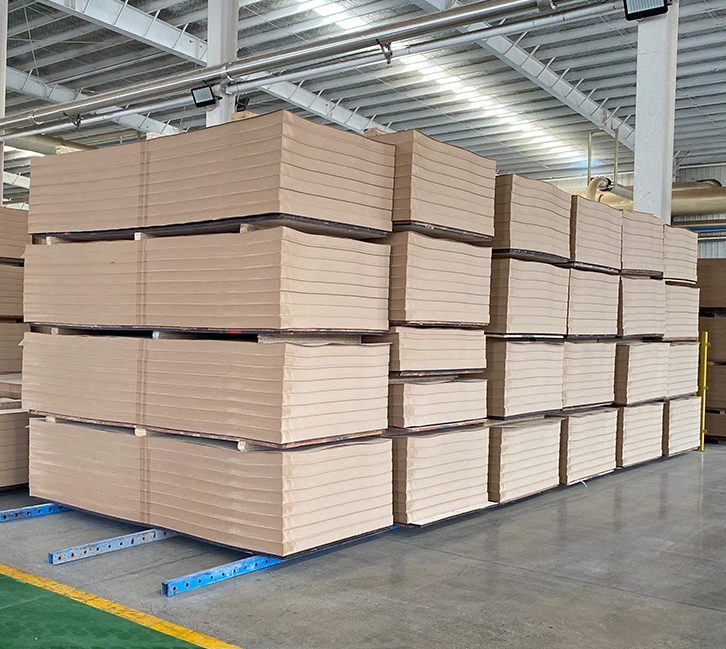
Baier’s Xinjiang warehouse functions as a regional forward-stock hub for Central Asia.
Instead of treating every order as a factory-start export, we pre-position regular products near the target market and dispatch them through overland transport routes. That creates three immediate advantages.
First, it shortens lead time.
Second, it reduces dependence on full-container planning.
Third, it allows buyers to purchase more responsively, especially when the order is based on standard sizes and regular decors.
This model is particularly useful for customers who do not need a fully customized production run every time. If the requirement is a commonly used board specification already held in stock, dispatch can move much faster than the normal export cycle.
Which Markets the Warehouse Serves
The warehouse is designed around the demand pattern of the five major Central Asian markets:
Kazakhstan
Uzbekistan
Kyrgyzstan
Tajikistan
Turkmenistan
These are not treated as occasional destinations. They are part of a planned regional supply logic. Stock is prepared around the specifications, dimensions, and decor preferences commonly requested in these markets, so the warehouse is not just a storage point. It is an inventory model built around regional repeat demand.
Why We Use Bulk Truck Transport Instead of Container Shipping
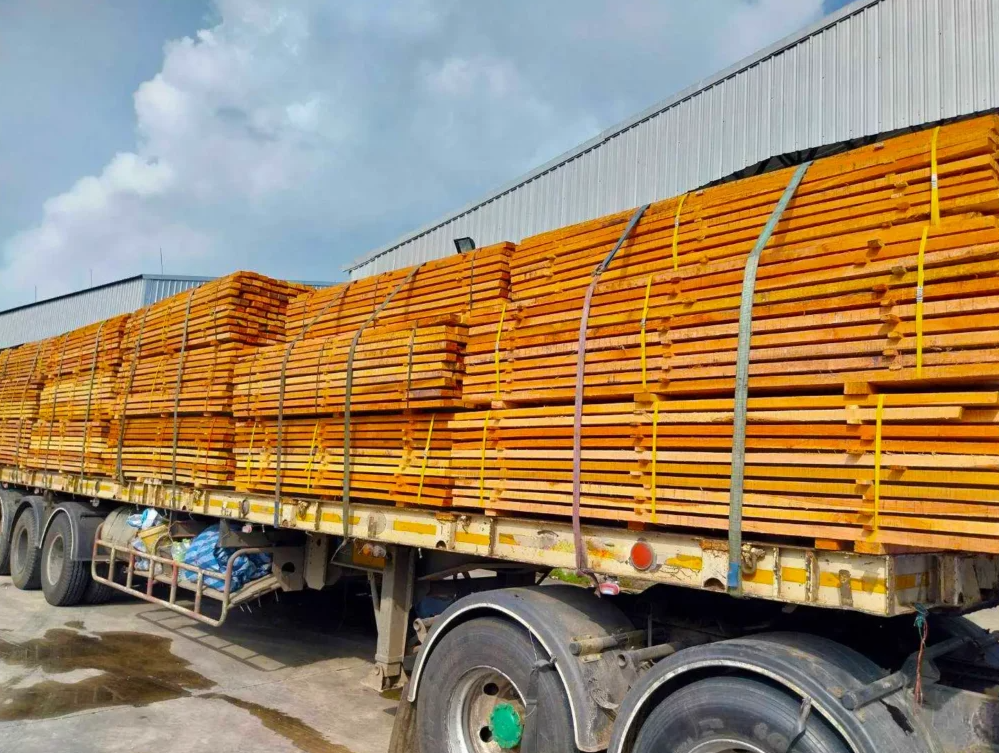
A key part of this logistics model is the transport method itself.
Shipments from the Xinjiang warehouse are arranged primarily by bulk truck transport, not by standard seaborne container export. That matters because road dispatch is often more flexible for the type of replenishment many Central Asia buyers actually need.
With bulk truck transport, buyers do not have to wait for container scheduling in the same way they would under a port-based export model. Loading is more flexible, dispatch can be organized faster, and the shipment structure is better suited to repeat orders of standard products.
This is especially useful when the customer’s priority is not “the absolute maximum shipment volume,” but rather:
faster turnaround
practical replenishment
better response to project timing
reduced inventory pressure at destination
For regular panel orders, speed and flexibility often matter more than theoretical container optimization.
How Much Can One Truck Load? A Practical Comparison Buyers Can Understand
This is where many buyers ask the most practical question: how much can one truck actually carry?
A standard 40ft high-cube dry container typically offers about 76.4 m³ of cubic capacity, with a maximum payload of around 28.66 tons according to MSC’s published specs.
A typical curtain-side road trailer can have an internal volume of about 91 m³ and a technical payload capacity up to 32.8 tons, although actual legal and route-specific loading depends on road regulations, axle limits, and the cargo itself.
That sounds as if the truck should carry more than a 40HQ. In pure equipment specs, it can. But for wood-based panels, the limiting factor is usually weight before space. MDF, particle board, and melamine-faced panels are dense cargoes. In real operations, that means the practical question is not “How many cubic meters fit?” but “At what tonnage does the shipment stop?”
For this reason, a realistic commercial description is:
One bulk truck load is typically slightly below one 40ft high-cube container in actual panel-cargo payload, usually around 24–27 tons per truck in practical dispatch conditions.
That range is commercially credible because it leaves room for:
route-specific road limits
product density differences
stacking and protection requirements
mixed-SKU loading
handling tolerance and dispatch safety margin
So if you want a simple buyer-facing comparison, the cleanest wording is:
40HQ reference payload: about 28.66 tons
Practical bulk truck loading for panels: about 24–27 tons per truck
Commercial takeaway: usually a little less than one 40HQ, but much faster and more flexible for regional dispatch
Quick Logistics Reference
|
Item |
Typical Reference |
|---|---|
|
Coverage markets |
Kazakhstan, Uzbekistan, Kyrgyzstan, Tajikistan, Turkmenistan |
|
Main transport method |
Bulk truck transport |
|
Typical delivery time |
1–3 days |
|
40ft high-cube container payload |
about 28.66 tons |
|
40ft high-cube container cubic capacity |
about 76.4 m³ |
|
Typical practical truck loading for panel cargo |
about 24–27 tons |
|
Commercial comparison |
slightly below one 40HQ |
|
18mm MDF 1220×2440 at 24 tons |
about 659 sheets |
|
18mm particle board 1220×2440 at 24 tons |
about 689 sheets |
What That Means in Sheet Quantity Terms
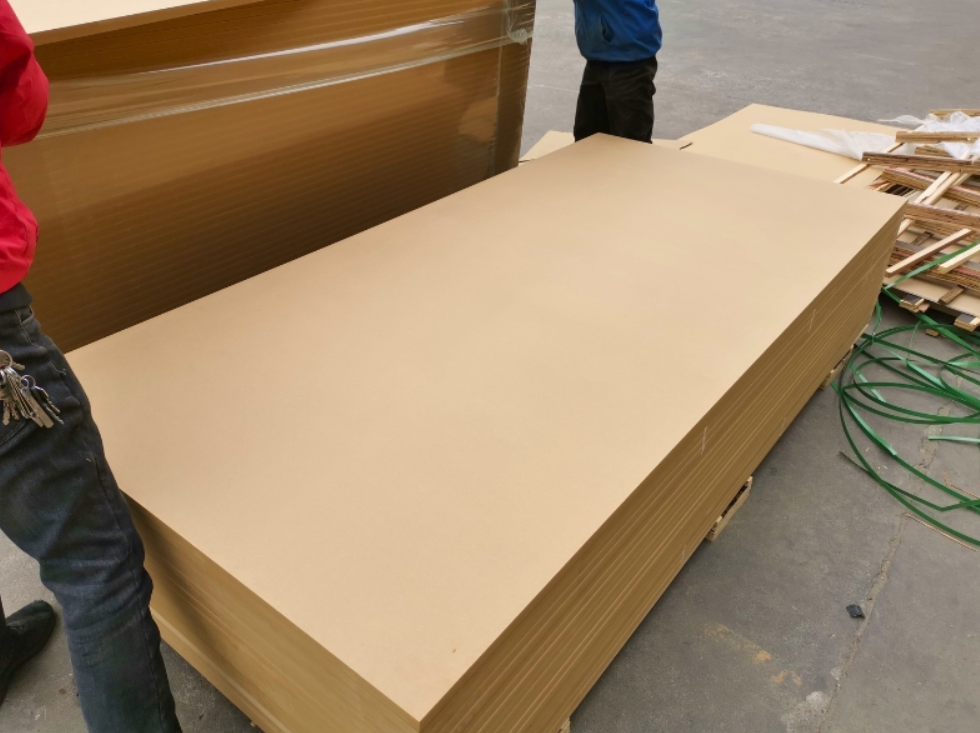
Buyers often understand tonnage, but many understand sheet counts even faster.
Take a typical 18mm 1220 × 2440 mm MDF panel. Using a representative MDF density of 680 kg/m³, one sheet weighs about 36.44 kg.
At 24 tons, that works out to roughly 659 sheets. At the full 28.66-ton 40HQ reference payload, it would be about 787 sheets.
For a typical 18mm 1220 × 2440 mm particle board at around 650 kg/m³, one sheet weighs about 34.83 kg. That gives roughly 689 sheets at 24 tons and about 823 sheets at 28.66 tons.
These figures are not meant to promise a fixed loading count for every order. They are a planning reference. Real loading varies by:
thickness
panel density
board type
palletization or loose loading method
whether the load mixes multiple SKUs
route and vehicle constraints
Still, they give buyers a useful benchmark: a single truck can already move a substantial quantity of standard panel cargo, enough for many distributors’ replenishment needs or mid-size project supply cycles.
Why 1–3 Day Delivery Matters More Than Buyers Think
The headline number is speed: 1–3 days.
But the deeper value is what that speed changes operationally.
When supply can move within days instead of weeks, buyers do not need to build the same level of buffer stock. That reduces capital lock-up. It also lowers the risk of over-ordering slow-moving decors just to protect against long lead times.
For distributors, this supports faster turnover.
For furniture factories, it reduces material interruption risk.
For project buyers, it creates more room to adjust scheduling without reopening a full import cycle.
In short, faster delivery is not only about convenience. It directly affects:
stock efficiency
procurement flexibility
project responsiveness
cash flow pressure
What Products Are Kept as Regular Stock
The warehouse is designed around high-frequency demand, not random inventory.
That means stock is focused on the kinds of products buyers in Central Asia repeatedly need:
1. Standard board sizes
Regular market sizes used in furniture production, cabinetry, interior fit-out, and general panel applications.
2. Common decors and finishes
Popular melamine colors, woodgrains, and other commercially proven surface options aligned with regional buying habits.
3. Core wood-based panel categories
Depending on the warehouse plan and stock cycle, this can include products such as:
melamine MDF
particle board
selected decorative panels
other repeat-demand engineered boards
The key principle is simple: this warehouse is not for every possible customized SKU. It is for standard products with repeat turnover, which is exactly why it can support fast dispatch.
Who Benefits Most From This Warehouse Model
This warehouse model is especially suitable for customers who need:
fast restocking
repeat purchases of standard specifications
flexible order timing
regional delivery without waiting for full export cycles
It is a strong fit for:
distributors
wholesalers
furniture manufacturers
interior contractors
project procurement teams
For highly customized products, unusual dimensions, non-standard decor development, or large made-to-order production runs, direct factory supply may still be the better route. But for regular market-demand products, the Xinjiang dispatch warehouse gives buyers a much more agile option.
How This Improves Supply Stability in Central Asia
Many buyers talk about fast delivery. Fewer talk about supply stability.
That is where a regional dispatch warehouse has strategic value.
A buyer that depends only on long-cycle factory export is always more exposed to scheduling delays, production queues, and container coordination. A buyer that can source repeat-demand goods from regional stock has a second layer of protection.
That does not replace factory manufacturing. It complements it.
In practice, the model works like this:
Factory production supports deep inventory and customized supply
Xinjiang warehouse stock supports speed, continuity, and replenishment
Together, that creates a more resilient supply structure for Central Asia.
A More Practical Purchasing Model for Central Asia Buyers
The main value of Baier’s Xinjiang warehouse is not just that goods move fast. It is that buyers can purchase in a way that better matches how their business actually runs.
Instead of planning everything around long export cycles, customers can combine factory sourcing with regional stock dispatch. That means standard panels can move faster, replenishment becomes simpler, and common decors no longer need to be treated like custom import projects.
For Central Asia buyers, that is a real operational advantage.
If your business needs standard wood-based panels, faster replenishment, and more flexible regional delivery, a Xinjiang dispatch model can remove a large part of the delay built into traditional export logistics.
And for many routine orders, that is exactly the difference between a procurement system that feels heavy — and one that actually supports growth.