
Introduction
Wood-based panels make up over 410 million cubic meters of global production each year. They form the backbone of modern construction and furniture making. These engineered material sheets—plywood, MDF, particleboard, and OSB—have changed how we build. They offer consistency and performance that solid wood can’t match on a large scale.
Asia leads production with over 50% of global output. Europe follows at 25–30%. North America adds 10–15%. This huge manufacturing presence shows a key benefit: these panels turn sawmill waste, wood chips, and small logs into quality building materials. The process gets over 85% material yield. Resources once seen as scrap become structural-grade products.
Why do material sheets matter so much? In developed markets, 70–80% of panel-based furniture—your kitchen cabinets, office desks, ready-to-assemble bookcases—use particleboard or MDF cores. They cost 30–60% less than plywood per square meter. Plus, they give you the smooth surface that decorative laminates and veneers need. Builders get structural strength from OSB and plywood. These materials reach elasticity ratings of 10,000 N/mm². Many solid woods can’t compete with that.
Know these four panel types, and you control cost, performance, and finish quality in every project.
What Is MDF?
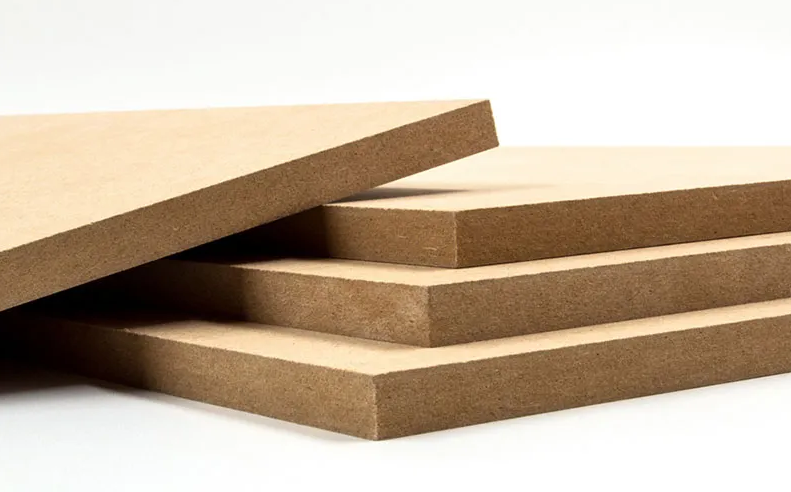
MDF stands for Medium Density Fiberboard. It’s an engineered wood panel built from wood fibers, synthetic resin, and wax compressed into a solid sheet. Solid lumber and plywood use whole wood pieces or layers. MDF is different. It grinds wood down to individual fibers. Then it mixes them with urea-Formaldehyde resin (8–12% by weight). Molten paraffin wax goes in for moisture resistance. Everything gets pressed under extreme heat and pressure.
The manufacturing numbers tell the story. Manufacturers heat press the fiber mat at 150–200°C. Pressure exceeds 3,000 psi (around 20–21 MPa). This intense process fuses fibers into a uniform panel. Density sits between 600–800 kg/m³. Compare that to solid pine at 500 kg/m³ or plywood around 550 kg/m³. MDF packs more material into the same volume.
How Manufacturers Build the Material
Start with wood chips screened to 0–50 mm. Most plants use softwoods like eucalyptus or mixed sawmill waste. These chips enter a defibrator. Steam at 10.5 atmospheres softens the lignin for 4 minutes. The defibrator breaks chips into fibers 7.5–11.5 micrometers thick in just 2 minutes. One study measured fiber freeness at 27.61 defibrator-seconds. This technical spec shows how well fibers flow and bond.
After drying to precise moisture levels, the coated fibers form a multi-layer mat. Fine fibers go to outer layers for smooth surfaces. Coarser fibers fill the core. This staged structure creates higher-density face layers and a less dense core. Bending strength goes up without adding weight. The mat starts at 1.5× the final board thickness. Pre-pressing compacts it before the main hot press cycle.
The result? Uniform density from edge to edge. Smooth, fine surfaces ready for paint, laminate, veneer, or CNC machining. Tight thickness tolerances that solid wood can’t match. These sheets deliver consistency at industrial scale. Critical for identical parts across thousands of cabinet doors or furniture components.
What Is Plywood?
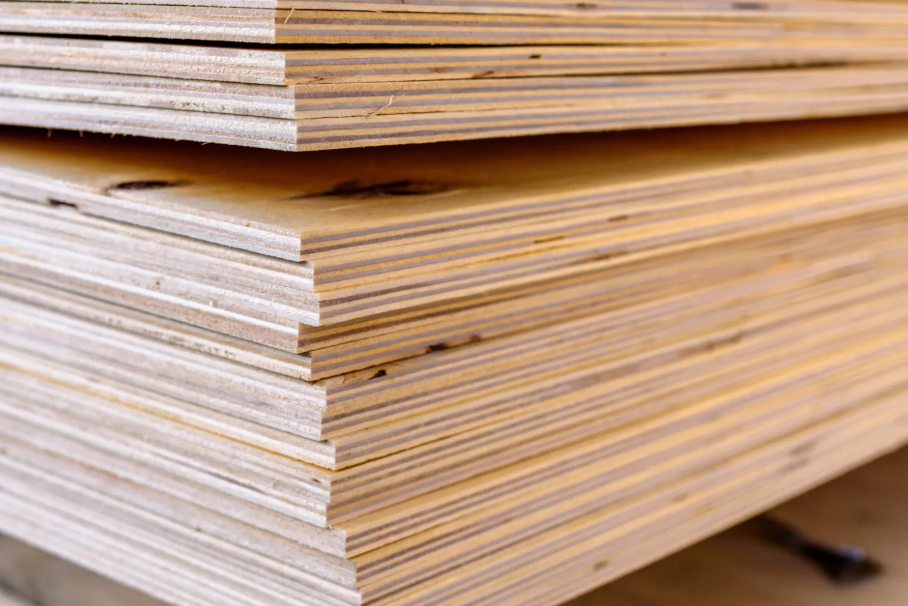
Plywood gets its strength from layers. MDF uses compressed fibers. Plywood takes a different approach. It bonds 3 or more thin wood sheets—called plies—together in a cross-pattern. Each sheet sits at 90° angles to the next one. This makes the panel incredibly strong. The design spreads weight in all directions. It fights warping better than solid wood of equal thickness.
Panels always use odd numbers: 3-ply, 5-ply, 7-ply, 9-ply, up to 11-ply or more. This keeps the sheet balanced. Each sheet measures 1.5–3.2 mm thick. Thickness changes based on grade and wood type. The outer layers are your visible surfaces. Inner layers build the core. Some makers change the grain patterns. You’ll find cross-and-parallel combinations or all-parallel setups based on what the panel needs to do.
Manufacturing Process: Turning Logs Into Layered Strength
Production begins with log prep. Mills store timber blocks. They strip bark and cut precise lengths. Next comes heat treatment. Logs soak in heated water at 40–60°C. Some reach 93°C (200°F) using hot water, steam, or spray. Heat softens the wood fibers. This makes logs easier to peel.
A rotary lathe unrolls treated logs into continuous sheets. Think of peeling an apple in one long spiral. For decorative faces, workers slice instead. This creates finer grain patterns. They cut sheets to size and grade them. Face-quality sheets get separated from core material. Defects are removed here.
Controlled drying brings sheets to the right moisture level. This step uses major energy, just like pressing. After drying, glue gets applied. Glue covers both sides of every other sheet in the stack. Tough jobs like film-faced formwork plywood need phenol-formaldehyde (PF) glue. PF resists water extremely well. It handles repeated soaking on construction sites.
Workers stack the sheets in their cross-pattern. Cold pressing flattens the stack first. This spreads glue evenly before the main bond. Hot pressing finishes the cure. Hydraulic presses apply heat and pressure at the same time. The glue hardens. Sheets bond for good. This step creates the internal bond strength—what makes your panel reliable.
Finishing means seasoning, cooling, and cutting to standard sizes like 1220 × 2440 mm (4×8 ft). Workers calibrate and sand the faces smooth. Some panels get film coating. Heat and pressure press resin-soaked paper or phenolic film onto surfaces. Resin soaks into the core. This creates a harder, water-proof face. Waterproof paint seals the edges for extra protection on formwork panels.
Finished plywood runs 3–25 mm thick. Stack the right number of sheets to get there. The cross-grain design gives you superior bending strength, stiffness in both directions, and size stability that solid wood can’t deliver. These panels resist splitting and warping. This matters for structural framing, roof boards, floor underlayment, and cabinets that need to stay precise for years.
What Is Particle Board?
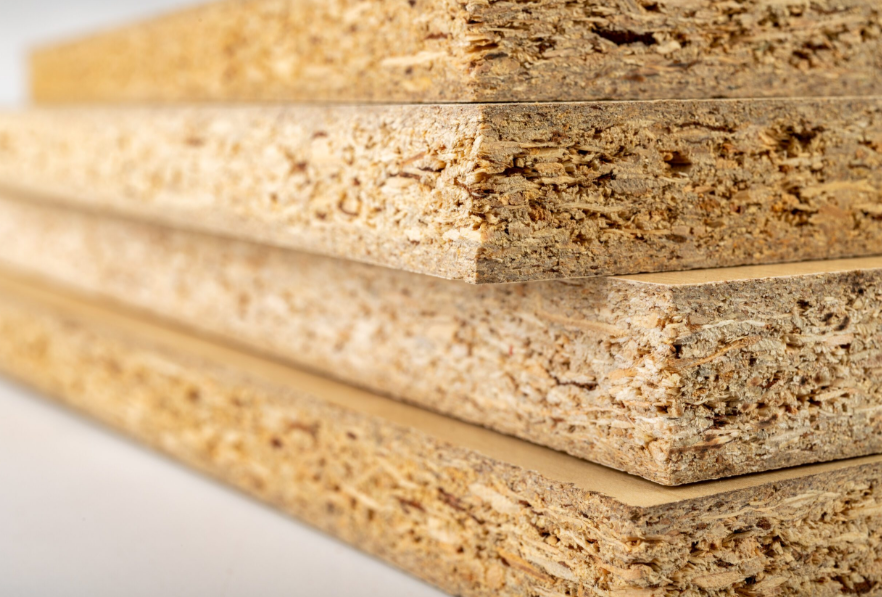
Particle board turns wood waste into workable material sheets. The panel uses wood particles—chips, shavings, sawdust, and flakes mixed with synthetic resin. Heat and high pressure bond everything into a solid board. MDF uses fine fibers. Plywood uses layered sheets. Particle board relies on larger wood fragments. Many modern mills run on 100% recycled and recovered wood: old pallets, discarded furniture, sawmill offcuts. This makes it one of the most resource-efficient panels you can buy.
The structure follows a three-layer sandwich design. Face layers use fine, thin particles for smooth surfaces ready for laminate or veneer. The core layer packs larger, stronger chips that add bulk and strength. Mills sort particles by size and weight. They use mechanical screens or air separators. This layout mirrors MDF’s density strategy. But particle size stays bigger throughout.
How Mills Transform Scrap Into Panels
Production starts with sorting. Wood residue arrives at the plant. It gets stored in bins. Drum chippers break logs and waste into chips. A knife-ring flaker reduces chips further. You get uniform flakes. These pieces enter rotary drum dryers. Hot air or flue gases drop moisture to 2–6%. Precise drying matters. Too much moisture causes internal breaks during pressing. Too little stops proper glue coverage.
Dried particles pass through screens. Oversized material goes back to the mill. The rest separates into core flakes and surface flakes. Each batch moves to glue mixers. Mills measure resin—often urea-formaldehyde (UF) or melamine-urea-formaldehyde (MUF)—plus wax and other additives. This mix controls final density. It also controls board performance.
A forming machine spreads the glued particles into a uniform mat on a moving conveyor. Fine particles sit outside. Coarse chips fill the core. Light pre-pressing removes air. It stabilizes the mat for handling. The hot press delivers the final bond. Platens heat to ≈200–204°C (≈400°F). Pressure hits 20–40 kg/cm² (about 2–4 MPa). This force eliminates voids between particles. Heat activates the resin. Permanent bonding locks the panel together.
Pressed boards cool in star-coolers or rotating racks. Cross and lengthwise saws cut them to standard sizes like 4×8 ft or 6×10 ft. Sanding removes tiny surface bumps and excess glue. Inspectors grade panels by thickness and quality before stacking. The result? Affordable material sheets with consistent thickness, smooth faces, and decent strength. Perfect for cabinet cores, shelving, and budget furniture.
What Is OSB?
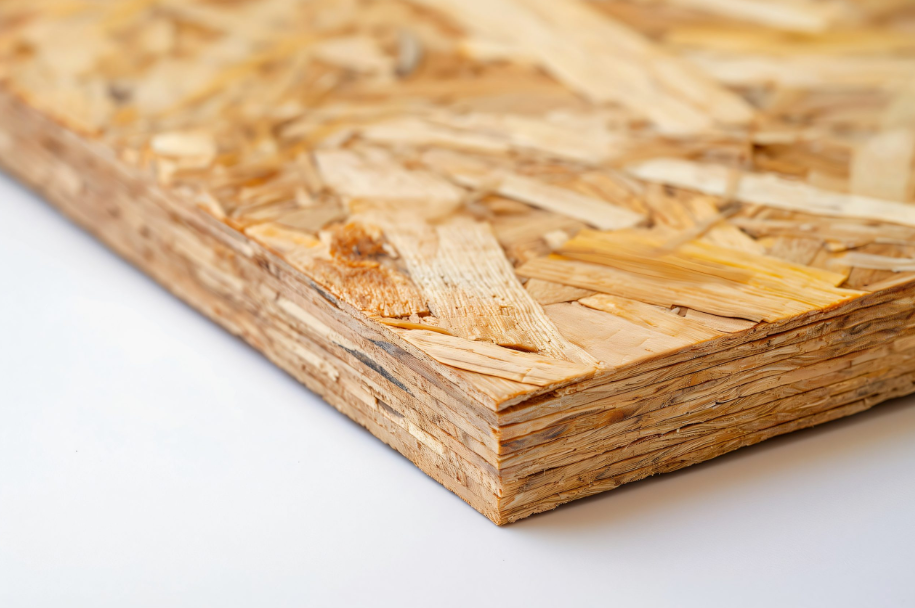
OSB—Oriented Strand Board—gets its strength from long wood strands pressed into a cross-layered structure. Particle board uses random chips. MDF uses fine fibers. OSB is different. It uses thin wood strands measuring about 2 in × 6 in × 0.03 in (≈50 mm × 150 mm × 0.8 mm). These strands come from fast-growing small-diameter trees, usually 8–12 inches in diameter at breast height. Mills take younger timber and turn it into sheets that perform as well as plywood.
The panel has a three-layer sandwich design. Face layers run parallel to the panel’s length—the machine direction. The core layer sits perpendicular. This cross-grain pattern copies plywood’s strength principle. But OSB does it with wood strands instead of continuous sheets. The oriented design gives you directional bending strength. Load-bearing capacity changes based on which way you install the panel.
How Mills Turn Logs Into Structural Panels
Production starts at the strander. Debarked logs enter rotating knife assemblies. Some machines run 48 knife sets at over 2,000 rpm. These cut logs into precise strands. Tight size control matters here. Strand thickness and width affect final panel quality.
Fresh strands carry too much moisture. Large rotary drum dryers reduce water content to below 3%. Proper drying prevents steam pockets during hot pressing. It also ensures good resin bond. After drying, screens sort strands by size. Larger strands become face layers. Smaller pieces fill the core.
Blending comes next. Dried strands mix with PMDI resin (often formaldehyde-free) and wax in rotating drums. Mills measure additives with precision. Resin creates the structural bond. Wax adds moisture resistance. This combo makes OSB weather-resistant enough for roof sheathing and exterior wall panels.
Machines spread the coated strands into a multi-layer mat. Face strands align lengthwise. Core strands run crosswise. The formed mat reaches 150–200 mm thick—much thicker than the final panel. Saws cut the mat to panel length before pressing.
Hot pressing transforms the mat into solid board. Presses use 500–600 psi (≈3.4–4.1 MPa) at 400–425°F (≈200–220°C). Some continuous press lines stretch 30 meters long. Heat activates the resin. Pressure compresses that thick mat down to final thicknesses of 9–25+ mm (3/8 in to >1 in). Panels exit the press above 300°F (≈150°C).
Finishing includes trimming to standard building sizes like 4×8 ft. Some panels get tongue-and-groove edges for subfloor use. Others get edge sealant, radiant barrier foil, or moisture-blocking coatings. The entire process—log to finished panel—takes under one hour. Mills stack, barcode, strap, and ship these affordable sheets for framing, roofing, and structural flooring projects.
Comparison of Wood-Based Panels
Each wood panel type performs differently in real projects. Pick between plywood, OSB, particleboard, and MDF based on three factors: structural demands, moisture exposure, and surface finish requirements. Know these differences. You’ll save money and avoid failures.
| Material | Bending Strength (MOR) | Elastic Modulus | Internal Bond & Fastener Holding | Moisture Performance (24h) | Surface & Machinability | Dimensional Stability | Typical Applications |
|---|---|---|---|---|---|---|---|
| Plywood | 30–60 N/mm² | 6,000–10,000 N/mm² | Face: 1,500–2,500 NEdge: 1,200–2,000 N | 1–6% swelling (WBP)Best wet resistance | Visible grain, good machining | Stable, minor cupping possible | Subfloors, roof decking, structural walls |
| OSB (OSB/3–OSB/4) | 22–40 N/mm² | 3,500–7,000 N/mm² | Moderate holdingDirectional strength | 10–15% swelling (MR grades) | Rough surface, limited finishing | Moderate, directional movement | Wall sheathing, roof & floor decking |
| MDF | 20–40 N/mm² | 2,500–4,000 N/mm² | IB 0.5–1.0 N/mm²Face: 900–1,600 NEdge: 700–1,300 N | 15–30% (standard)8–15% (MR MDF) | Very smooth, excellent CNC | Very stable, no warping | Cabinets, shelving, furniture panels |
| HDF | 25–45 N/mm² (typical) | 3,000–4,500 N/mm² | IB 0.7–1.2 N/mm²Excellent screw holding | 8–15% (MR HDF) | Ultra-smooth, precise machining | Excellent stability | Laminate flooring cores |
| Particleboard | 11–20 N/mm² | 2,000–3,500 N/mm² | Face: 800–1,400 NEdge: 500–1,000 N | 20–35% (standard)10–18% (MR) | Rough surface, chips easily | Poor, edge swelling | Budget furniture, non-load panels |
Choosing the Right Panel
Match the panel to your job needs. Structural load, moisture level, and finish quality drive your choice. A kitchen cabinet needs different material sheets than roof sheathing. Budget matters, but the wrong panel costs more once projects fail or look cheap.
For Furniture and Cabinets: MDF vs. Plywood
Cabinet boxes carry real weight. Hinges, drawer slides, and wall brackets create constant stress. 3/4 in (18–19 mm) plywood dominates here. Cross-layered veneers hold screws better. Edge fasteners stay tight through years of door swings and drawer pulls. Plywood density sits at 500–700 kg/m³. A 4×8 ft sheet weighs 50–65 lb. Easy to handle solo.
MDF works better for painted surfaces and visible panels. Fiber density reaches 600–800 kg/m³. That same 3/4 in sheet weighs 60–70 lb. The uniform structure gives you smooth faces. Paint sticks without showing wood grain. No filler needed.
But MDF has weak edge holding. Pre-drill every screw hole. Confirm that screws and shelf pins work better than standard wood screws. Moisture kills standard MDF fast. Cabinet areas near sinks need MR (moisture-resistant) MDF or plywood instead. Bathroom vanities use plywood or exterior-grade material sheets.
Common practice: Plywood for box construction. Veneered MDF for doors and drawer fronts. This combo gives you strength where it counts and beauty where it shows.
For Structural Support and Subfloors: OSB Wins on Cost
Floor joists spaced 24 inches on center need 23/32 in (18–19 mm) OSB rated 24 oc or 24/16. Tongue-and-groove edges lock panels together. This stops squeaks and bounce. Panel sizes run 4×8 ft, 4×9 ft, or 4×10 ft. Longer sheets mean fewer seams.
OSB/3 or OSB/4 grades (EN 300) handle load-bearing in humid conditions. OSB/1 fails under structural use. Interior spaces, non-load bearing tasks. Fastening follows building codes: nails or screws at 6 in (150 mm) spacing on edges and 12 in (300 mm) in the field. This stops movement and creaking.
OSB swells at edges with water contact. The panel is rated Exposure 1 for construction moisture. Rain during framing, yes. Permanent exterior exposure, no. Leave 1/8 in gaps between sheets. This lets panels expand without buckling. Structural plywood costs 30–50% more but handles repeated wetting better. Roof decks in high-rain zones often use PS 1 / PS 2 rated plywood with span ratings like 32/16 (roof span / floor span in inches).
Choose OSB for budget subfloors and wall sheathing. Pick plywood for better moisture resistance.
For Budget Projects: Particle Board Trade-offs
Particle board costs less per square foot than other furniture-grade material sheets. Density runs 650–750 kg/m³. Random chip structure means lower strength. MOR around 11–20 MPa compared to plywood’s 30–45 MPa. Use it for light shelving, closet interiors, and flat-pack furniture cores.
Screw holding ranks weakest here. Standard wood screws strip fast. Confirmat screws grip better. These specialized fasteners thread into both face and edge. Avoid cantilevered shelves or heavy-duty joints. Particle board works best with light, spread-out loads.
Moisture destroys standard particle board fast. Thickness swelling often hits 15–18% in 24 hours. Edges swell first. Damage stays permanent. P3 / moisture-resistant grades cut swelling below 10%. Still not safe for bathrooms or kitchens near sinks. Save this material for dry, protected spaces where looks matter less than cost.
Quick Selection by Moisture Exposure
Dry interior, no liquid contact: Standard MDF, particle board, or interior plywood all work. Pick based on finish needs and budget.
Humid interior (kitchens, bathrooms, laundry): Use MR MDF, MR particle board, or exterior-glue plywood. Plywood wins for sink bases and floor contact. It handles occasional spills better.
Occasional wetting or structural duty: Exterior plywood (WBP rated), OSB/3, or OSB/4 handle construction moisture and outdoor exposure during building. Not for permanent cladding.
Continuous exterior exposure: Skip standard wood panels. Go with exterior plywood, specialized exterior OSB, or switch to cement board and phenolic panels. Standard MDF and particle board fail outdoors. Even moisture-resistant grades won’t last.
Check this moisture guide first. Then match strength, surface quality, and cost to finish your decision.
Conclusion
MDF, plywood, particle board, and OSB each serve different purposes. Know their differences. This helps you choose wisely for your next project. MDF gives you a smooth finish—great for painted furniture. Plywood offers strong structure for cabinetry. Particle board saves money on temporary setups. OSB resists moisture in construction work.
Your choice depends on three things: what your project needs, the environment it faces, and your budget. The variety helps you, not hurts you. Match each panel’s features to what you need. You’ll get better results and spend smarter.
Ready to start? Check the comparison table above. It shows which material fits your goals. The best material? Not always the priciest one. It’s the one that fits your purpose. Your project needs the right base, and you’ve got the knowledge now.