
You’ve received three quotes from Chinese suppliers for the exact same product specification. One is 30% cheaper than the others. Another sits in the middle. The third seems way too expensive.
Your first instinct? Blame it on material quality differences.
But here’s what most procurement professionals discover too late: raw materials account for 40-60% of your final product cost. The price differences between Chinese suppliers often have nothing to do with the steel, plastic, or fabric they’re using.
The real cost drivers hide in plain sight. They’re buried in factory capabilities, timing strategies, and negotiation leverage points. These factors separate savvy buyers from those who leave money on the table.
Comparing quotes that don’t make sense? Trying to understand why your “cheaper” supplier ended up costing more? The factors we’re breaking down will change how you evaluate supplier pricing. They’ll also change how you negotiate your next contract.
Order Volume and Minimum Order Quantities (MOQs)
A supplier’s minimum order quantity isn’t random. It’s a calculated threshold where they stop losing money on your order.
You request 100 units. Their MOQ sits at 1,000. You’re asking them to absorb costs they can’t spread across enough products. The math is simple: Fixed Production Costs ÷ (Unit Selling Price – Unit Variable Costs) = Supplier MOQ. Machine setup, mold prep, and production line setup all carry fixed costs. These costs don’t shrink whether they make 50 pieces or 5,000.
This explains why small batch orders cost more. Orders below MOQ force suppliers to split fixed setup costs across fewer units. This drives per-unit prices up by 20-30%. The machinery still needs the same setup time. Raw materials still require minimum purchase amounts. These cost 10-50% more at smaller volumes. Admin and shipping costs per order stay constant no matter the quantity.
Here’s a widget example: A supplier sets their MOQ at 100 units priced at $100 each. This creates a $10,000 order minimum. This covers their setup costs, raw material minimums, and admin overhead while staying profitable. Order 1,000 units instead. Those same fixed costs spread thinner. Your per-unit price drops. Scale to 10,000 units. The math gets even better.
Price differences between Chinese suppliers often reflect how flexible they are with these limits. Larger manufacturers run consistent production schedules. They can afford lower MOQs because they’re always running similar products. Smaller operations run custom batches. They need higher minimums to cover line switching costs and production breaks.
Breaking the MOQ Barrier Without Breaking Your Budget
You can negotiate lower minimums. You don’t have to sacrifice quality or strain supplier relationships.
Order consolidation gives you quick leverage. Combine multiple SKUs into a single production run. Or stagger different products together. Suppliers care about total order value, not individual product quantities. A $15,000 order split across three products carries more weight than a $5,000 single-SKU request.
Partnership agreements change everything. Suppliers drop strict MOQs for established customers. Predictable order patterns cut their risk. They’ll reserve production capacity knowing you’ll return every quarter. No gambling on one-off orders.
Calculate your best order quantity using the EOQ formula: √(2 × Annual Demand × Ordering Cost) ÷ (Unit Cost × Annual Holding Cost %). Show this data during talks. Suppliers see you’ve done the math on holding costs versus ordering frequency. They know you understand the trade-offs. Many will meet you at 80-90% of their standard MOQ if your EOQ calculation backs it up.
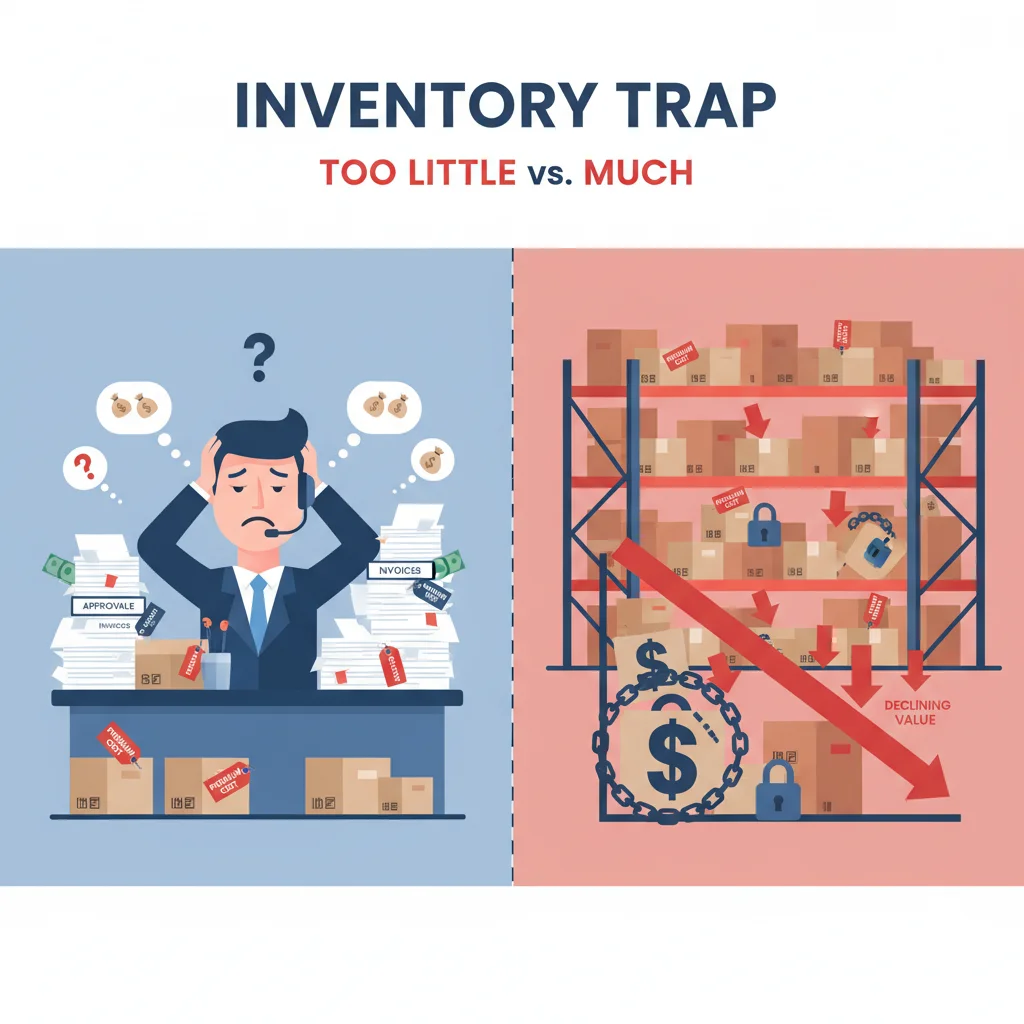
The hidden cost trap hits both ends. Order too little? You’re paying premiums plus frequent reorder admin costs. Order too much? You’re tying up capital in inventory. That inventory loses 20-30% value each year through holding costs alone. This doesn’t count obsolescence risk.
Supplier Market Position and Competition Levels
The supplier landscape splits into two distinct worlds. Your pricing depends on which one you’re playing in.
Red ocean markets flood with competitors fighting over razor-thin margins. Think consumer electronics, basic textiles, or standard plastic components. Suppliers here operate in survival mode. They’ll undercut each other by 5-10% just to keep production lines running. Price differences between Chinese suppliers in these saturated sectors reflect desperation more than capability. You’ll find quotes varying wildly—not because of quality gaps. Different factories are at different stages of cash flow crisis.
Blue ocean markets tell a different story. Specialized manufacturers with unique capabilities or proprietary processes command premium positions. They’re not competing on price because they’re not competing at all. A factory producing medical-grade silicone components or aerospace-certified fasteners sets rates based on certification costs and technical requirements. Their quotes stay consistent because alternatives don’t exist.
63% of companies implementing supplier diversification strategies aren’t just spreading risk. They’re gaining negotiation power. Split orders across three regional suppliers instead of one. You create competitive pressure that drops quotes by 2% on average. Multi-sourcing forces suppliers to bid against invisible alternatives. They know losing your 30% allocation means another factory wins it.
How Market Leaders Price Versus Small Players
Top-tier suppliers bank on relationship value, not volume wars. They’ve invested in sustainability certifications, quality management systems, and innovation partnerships. This infrastructure costs money. The data shows these head suppliers command 71% higher premiums than baseline manufacturers—up 13% from 2021. Buyers pay extra for guaranteed delivery windows, consistent quality controls, and technical support that prevents production disasters.
Small and medium enterprises take the opposite approach. Their survival depends on winning volume. They’ll accept lower margins to fill capacity, undercutting established competitors by 10% in tight markets. The trade-off? Higher disruption risk. Raw material prices spike or regulations change. Smaller operations lack the buffers to absorb shocks. Your “cheaper” supplier might disappear mid-contract.
Asia-based organizations recovered 2 percentage points of margin through strategic multi-shoring. They’re not just diversifying geography. They’re playing head suppliers against SMEs, premium quality against aggressive pricing, relationship stability against opportunistic deals. The procurement teams winning these negotiations maintain detailed supplier scorecards. They track reliability, innovation contributions, and financial stability alongside unit costs.
Regional Manufacturing Clusters and Price Volatility
Shenzhen electronics suppliers face different competitive dynamics than Yiwu commodity exporters. Cluster concentration creates both advantages and vulnerabilities that swing prices overnight.
Tariff announcements hit concentrated regions hardest. A single policy shift affecting Asian electronics manufacturing can alter landed costs by 10%+ across entire supplier networks. 50% of companies adopting balanced multi-shoring aren’t just hedging tariff exposure. They’re building leverage. One cluster faces disruption. Your alternative suppliers in different regions become more valuable. This positional advantage translates to better quotes.
Port closures, regulatory changes, and geopolitical tensions affect clusters in various ways. Nearshoring gains efficiency advantages in stable corridors while global networks absorb volatility better. The 10-percentage-point reliability improvement from multi-hub strategies doesn’t just reduce risk. It creates negotiating room. Suppliers know buyers with working alternatives won’t tolerate price gouging during regional disruptions.
Turning Competitive Dynamics Into Quote Advantages
Real-time market intelligence separates sophisticated buyers from reactive ones. Automated monitoring of pricing trends, capacity utilization rates, and competitive moves enables dynamic bidding strategies. You know a supplier’s competitor just lost a major contract. You leverage that capacity gap. Cluster-wide order volumes drop 15%. You negotiate harder.
43% of trade professionals reporting enhanced procurement influence didn’t gain power through volume alone. They built supplier ecosystems before crises hit. Developing qualified alternatives takes 6-12 months. Start that process during an emergency and you’ll pay premiums. Start it during stable periods and you’ll have options available for market shifts.
Risk profiling transforms supplier competition into quantifiable advantage. Category suppliers by financial stability, technical capability, and substitution difficulty. Pit head suppliers against SMEs for specific product categories. Use premium manufacturers for critical components requiring guaranteed performance. Deploy volume-hungry smaller players for standardized parts where switching costs stay low.
Companies modeling P&L impacts across supplier scenarios gain 43% more budget flexibility for competitive sourcing. They’re not guessing which supplier offers better value. They’re calculating how much a 2% price reduction versus a 10% reliability improvement affects total cost of ownership. This analysis reveals paying premiums makes financial sense in some cases. In others, commodity bidding wins.
Currency Exchange Rate Fluctuations

Exchange rates reshape your costs. They don’t touch product specs. A 3% currency swing erases negotiated savings or hands you unexpected profit. Your supplier does nothing different.
The Chinese yuan shifted from 6.9876 to a forecasted 6.8000 CNY per USD by year-end 2026. That 1.3% appreciation means your $100,000 order costs $1,300 less in dollars if the rate moves as predicted. Scale that across your annual buying volume. You’re looking at real money. But here’s the trap: currencies don’t move in straight lines. They bounce between quarterly forecasts. Your Q1 purchase at 6.9500 gets better pricing than your Q3 buy at 6.8500—assuming MUFG’s forecasts hold.
The USD weakened 3.8% against trading partners between Q2 2024 and Q2 2025. That volatility hit emerging market currencies harder than developed ones. Advanced economy currencies saw USD drop 6.7%. Emerging markets moved just 1.0%. Price differences between Chinese suppliers often reflect how they’re managing this uncertainty. One factory locks rates early. Another passes currency risk straight to buyers through floating pricing.
Real Contract Protection Beyond Hope and Prayer
Fixed exchange rate contracts cut out the guesswork. You lock CNY/USD at 7.00 at signing. The market rate hits 6.80 three months later. Your supplier absorbs that difference. The rate climbs to 7.20. You’re protected from the increase. This works great for 3-6 month contracts where currency direction seems clear. It fails when forecasts miss. It also fails when timelines stretch beyond hedge horizons.
Price adjustment clauses build flexibility into longer relationships. The setup ties pricing to 30-day average rates. It resets each quarter. CNY drops more than 3% from baseline. Your price adjusts up 5%. Most contracts cap movement at ±10%. This prevents extreme swings from destroying deal economics. A practical clause reads: “Baseline rate set at 6.95 CNY/USD based on 30-day average prior to contract date. Adjustment applies each quarter if deviation exceeds 5%, with maximum adjustment of ±8% per quarter.”
Forward FX contracts cost 1-2% per year in developed currency pairs. That premium buys certainty. You commit to buying yuan at 6.85 in six months regardless of spot rates. The math works when contract values exceed $50,000. Timelines need to stretch past 90 days. Below those thresholds, hedging costs eat your savings. Options offer one-sided protection—cap your downside while keeping upside potential. But premiums run 2-5% of contract value depending on market volatility.
Batch payment structures spread currency exposure across time. Pay 25% upfront at today’s rate. Send 50% mid-production at the current average. Pay the final 25% upon completion at end-rate. This approach beats single lump sum payments. It averages out volatility spikes. You won’t catch the absolute best rate. You also won’t get crushed by the worst timing.
Building Clauses That Work
Strong contract language defines every variable before disputes arise. Spell out your baseline rate calculation method. Write adjustment thresholds in absolute numbers, not percentages open to debate. Include caps and floors with clear sharing formulas for extremes. “Maximum adjustment of ±8% applies; excess currency impact beyond 8% splits 50/50 between parties” removes confusion.
Hedging cost allocation shifts depending on leverage. Suppliers managing 70% of exposure via forwards might request buyers cover 1% of hedging costs if rates move in their favor. This sharing model aligns goals—both parties benefit from stable rates and lose from volatility. Force majeure triggers belong in every currency clause for long-term contracts. BIS volatility indices exceed 20% of three-month averages? Automatic renegotiation rights protect both sides from market chaos neither party controls.
Termination provisions create exit ramps. Use them when currency movements exceed contract tolerance. A 30-day notice option kicks in after cumulative 15% impact. This gives both parties breathing room. You’re not trapped in a deal that’s become unprofitable. Your supplier isn’t forced to fulfill orders at rates that could bankrupt them.
Supply-Demand Dynamics and Market Timing
Factory capacity sits at 70% in February. That same production line runs at 95% by September. Your unit costs just jumped 15-20% because you ordered during peak season. The product didn’t change. The supplier’s efficiency did.
Supply and demand imbalances create pricing windows. These windows shift faster than most buyers can track. Pandemic disruptions hit global chains hard. PCE inflation spiked to a 7.2% peak by June 2022. Fiscal stimulus drove demand up. Labor shortages and trade disruptions choked supply at the same time. Unemployment dropped to 3.4% by April 2023. These opposing forces pushed up costs across manufacturing sectors. Suppliers passed every penny to buyers.
The recovery pattern shows the opportunity. Productivity growth averaged 2.2% per year from 2020 through Q3 2025. This beats the 1.5% of prior cycles. This productivity surge boosted capacity. It also reduced price pressures. Factories that couldn’t fill orders in 2022 now compete for volume in 2025. Price differences between Chinese suppliers often reflect where they sit in this capacity cycle.
Reading Inventory Signals for Better Timing
Oil markets show how supply and demand math translates to real pricing power. Brent crude prices fall from $69 per barrel in 2025 to projected $58 in 2026, then $53 by 2027. This 24% drop stems from supply exceeding demand by 2.3 million barrels per day. Non-OECD markets build strategic reserves. China alone stockpiles at 1.0 million barrels per day. OPEC+ production hikes plus non-OPEC growth from Brazil, Guyana, and Argentina flood markets. Demand slows down at the same time.
Manufacturing follows the same patterns. Monitor implied inventory changes through supply and demand gaps. Suppliers building stock during low-demand phases need to move volume. They’ll cut prices 8-12% to maintain cash flow and avoid storage costs. Order during these inventory build periods. You solve their problem. You capture savings.
Gold demand grew 3% year-over-year in Q3 2025 despite record prices. This signals that supply constraints still pinch certain markets. PCE inflation trends toward 3% by 2026, driven by demand rather than the supply shocks of 2022-2023. Does your category face supply limits or demand surges? This determines your negotiation strategy.
Executing Off-Peak Timing Strategies
Lock orders during capacity gaps. Target periods following major production cycles or ahead of traditional slow seasons. Chinese New Year preparations create a rush through January. February and March often bring softer demand as factories restart. Summer months see Western buyer pullback. These windows offer 10-15% better pricing for the same specifications.
Long-term forecasting turns macro trends into procurement advantages. Leverage productivity improvements and non-OPEC output growth patterns to lock rates before demand swings upward. Here’s a step-by-step approach: First, monitor supply and demand gaps in your category. Second, stockpile inventory during low-demand phases. Suppliers seek volume during these times. Third, negotiate hard during build periods. Excess capacity pressures margins then. Fourth, hedge against geopolitical risks that could reverse favorable conditions overnight.
Benchmark your timing against market movements. Brent’s 16% drop from persistent inventory builds proves the model works across commodities and manufactured goods. Avoid ordering during peak demand windows. Policy stimulus risks triggering inflation spikes. The spread between off-peak and peak pricing often exceeds your negotiated discount percentages.
Hidden Logistics and Compliance Costs
Your supplier quotes $12 per unit. Customs clearance adds $0.85. Freight tacks on another $1.20. Warehousing eats $0.40. Non-compliance penalties from outdated safety documentation? That’s $2,300 per shipment. Regulators catch you. These aren’t line items on your initial quote comparison. They’re the silent killers. Your “best price” becomes your most expensive mistake.
Price differences between Chinese suppliers don’t show the compliance infrastructure behind each factory. One supplier maintains real-time customs documentation systems. Another uses spreadsheets. Updates happen monthly. Both quote the same FOB price. The first clears customs in 48 hours. The second sits in holding for two weeks. Brokers chase missing certificates. Your carrying costs just jumped 15%. Someone’s compliance system runs on Excel.
The Inventory Drift Tax
Inventory drift costs you money before products reach customers. Ohio warehouses hold regional overstock. Los Angeles distribution centers run emergency air freight to cover shortages. The math looks clean on reports. Your network-wide fill rate hits 94%. But expedited freight costs climbed 23% quarter-over-quarter. Inventory landed in the wrong locations.
Traditional metrics hide this bleeding. Average inventory turns show healthy movement. OTIF performance meets targets. Your team burns overtime hours. They reconcile system data with physical counts. Transportation costs spike. You shuttle products between facilities. Service commitments fail in high-demand regions. Surplus inventory ages out in low-velocity markets.
The 2026 cost landscape punishes slow decisions harder than changing demand. SKU growth across regional markets means problems. One supplier’s distribution logic might strand inventory. Another’s network design keeps products flowing. Suppliers with real-time visibility systems adjust faster. Those running on batch updates lag behind actual demand patterns.
Compliance Gaps That Destroy Margins
Global regulatory fines hit record levels in 2024. The companies paying these penalties believed they were compliant. Their systems became outdated. Regulations evolved. Most suppliers don’t mention compliance infrastructure during price talks. You discover gaps after your first shipment. Safety audits or customs holds get triggered.
Non-compliance costs go beyond fines. Operational shutdowns freeze your pipeline. Loss of public trust damages your brand. Supplier violations make headlines. Severe safety incidents create legal exposure. This dwarfs any per-unit savings. These risks grow fast. Suppliers use disconnected systems and manual data inputs. Compliance teams can’t catch errors they can’t see.
Automation delivers measurable ROI here. Deepwater Subsea cut compliance reporting time by 95%. Integrated systems did this. PETRONAS reduced operator alarm rates by 90% with real-time monitoring. Biomass Industries Associates eliminated 80% of compliance errors. They replaced manual processes with digital integration. Suppliers investing in these systems cost more upfront. They also don’t trigger $50,000 penalty letters from customs authorities.
Predictive compliance creates a competitive advantage. Real-time monitoring tools provide instant risk insight. You address potential violations before they become actual problems. This needs teamwork between legal, operations, sustainability, and chain teams. Suppliers with this infrastructure built in save you from building it yourself.
Transportation Volatility and Hidden Freight Costs
Transportation ranks among the highest controllable costs in manufacturing. Freight rates, fuel surcharges, and maintenance expenses change constantly. Budgeting becomes a moving target. Equipment availability challenges force manufacturers to maximize fewer assets. Demand remains unpredictable.
Dedicated transportation strategies stabilize these costs. Suppliers with contracted carrier relationships absorb rate changes better. Compare this to bidding spot market freight for every shipment. Predictive maintenance programs reduce downtime. Fleet life extends. Optimized routing through analytics forecasts maintenance needs. This happens before breakdowns strand your products mid-transit.
The carrier capacity crunch makes these issues worse. Non-domiciled CDL driver restrictions could remove significant truckload capacity from available networks. Carrier bankruptcies are rising. Fraud knocks legitimate carriers out of markets. Demand ticks up even 5%? Routing guides and rates could shift overnight. Suppliers with diverse carrier partnerships weather these disruptions. Those dependent on single carriers pass emergency freight premiums to you.
Customs Data Blind Spots
Customs data remains the weakest link in chain resilience. Most companies lack visibility. Information scatters across multiple brokers, tools, formats, and systems. Your supplier uses three different customs brokers across their export markets. Each maintains separate documentation standards. You’re reconciling conflicting data sets. You’re trying to forecast landed costs.
Non-tariff barriers are expanding faster than tariff policies. China tightens export controls on critical minerals and high-tech components. Europe rolls out CBAM carbon border adjustments and due-diligence rules. The United States strengthens domestic-content requirements. It expands controls on advanced technologies. Each regulation creates documentation requirements. Each requirement creates compliance costs. Suppliers absorb these costs based on their systems and expertise.
Tariff changes add another layer. The White House reported $150 billion in tariff revenue between 2024-2025. Court scrutiny of Trump-era tariffs adds legal uncertainty. Import volumes and landed costs face this uncertainty. Suppliers quoting prices today can’t predict which tariffs survive judicial review next quarter. This uncertainty forces risk premiums into quotes. Or it leaves you exposed to surprise adjustments mid-contract.
The Parcel Cost Equation Nobody Shows You
Carriers investing in automation and network upgrades are passing higher rates to shippers. New cost structures emerge from infrastructure updates. Your small-batch orders face per-package charges climbing 8-12% each year. Carriers recover investment costs. Suppliers shipping high volumes negotiate better rates. Those moving smaller quantities pay premiums. You inherit these through product pricing.
Document automation separates efficient suppliers from administrative disasters. BOLs, PODs, invoices, and customs documents get requested, organized, and validated in modern systems. This happens on its own. Less time chasing paperwork. Faster billing and claims resolution. Manual processes create delays. These compound into storage fees, demurrage charges, and rush orders to cover gaps. One supplier’s automation advantage becomes your cost savings. Faster, cleaner transactions.
Cost Structure Transparency and Negotiation Tactics

Should-cost analysis delivered $54 million in savings on a $150 million category spend. That’s a 36% reduction from understanding where money goes. The procurement team built a cost breakdown model. They challenged vendor pricing with real data. Suppliers couldn’t justify inflated margins when confronted with line-by-line evidence. This was math, not aggressive posturing.
Most buyers accept quotes at face value. They compare total numbers without questioning the components underneath. This leaves massive savings on the table. Price differences between Chinese suppliers often hide in cost allocation methods rather than production expenses. One factory might bury profit margins in “overhead.” Another splits the same costs across transparent categories. You’re comparing apples to oranges until you normalize the data.
Demanding Cost Breakdowns That Mean Something
Request standardized cost tables from every supplier. The format matters as much as the numbers. Materials should represent 40-60% of total costs for most manufactured products. Labor runs 20-30%. Overhead claims 10-20%. Profit margins land between 5-15% in competitive markets. Anything outside these ranges needs justification.
A proper breakdown looks like this:
| Cost Component | Percentage | Per-Unit Amount | Justification |
|---|---|---|---|
| Raw Materials | 48% | $48.00 | Premium steel with certified sourcing |
| Direct Labor | 24% | $24.00 | Skilled assembly, 2.5 hours per unit |
| Manufacturing Overhead | 16% | $16.00 | Equipment amortization, facility costs |
| Profit Margin | 12% | $12.00 | Industry standard for custom production |
| Total | 100% | $100.00 | – |
Link each cost element to tangible value. Premium materials should connect to reliability metrics or compliance requirements. Higher labor percentages need to explain specialized skills or quality control processes. Overhead expenses need breakdowns into equipment depreciation, facility maintenance, and quality certifications.
Centralize this data in a procurement database. Automate updates for real-time accuracy during negotiations. Share accessible figures with suppliers upfront—this signals you’re serious about transparency. Highlight cost factors that matter most to your specific requirements. Medical device buyers care about material certifications. Consumer electronics companies focus on labor efficiency and defect rates.
Reading the Red Flags in Supplier Quotes
Quotes exceeding market averages by 10-20% signal potential overcharging. Cross-reference against Total Cost of Care (TiC) databases or Healthcare Payment Transparency (HPT) tools for industry benchmark rates. These platforms track transaction prices across thousands of suppliers. Your quote sits 25% above the 75th percentile? You’re paying a premium that needs explaining.
Cost logic failures expose inflated pricing faster than any benchmark. A supplier quotes steel components with material costs at 35%. Steel indexing data shows 50% is standard for that specification. Someone’s math doesn’t add up. Labor percentages claiming 40% for automated production? That’s a manual assembly rate. Flag these inconsistencies right away.
Data completeness matters just as much as the numbers themselves. Suppliers providing breakdowns with gaps exceeding 20% of total costs aren’t being transparent. They’re hiding something. Overhead listed as “miscellaneous factory expenses” without detail? Profit margins buried in markup rather than stated clearly? These tactics prevent meaningful comparison and negotiation.
Target an efficiency ratio above 5:1 for negotiation effort versus savings generated. Spending 20 hours to save $50,000 works. Burning 40 hours for $5,000? You’re wasting time. Calculate this ratio before diving deep into cost analysis. Some suppliers won’t budge regardless of evidence. Others will cut prices the moment you show them data.
Triangulate cost claims against multiple sources. Medicare cost reports, supplier financial statements, and industry publications all provide validation points. Reliability metrics below 80% completeness create grounds for dispute. Challenge any cost element that doesn’t align with at least two independent verification sources.
The Comparison Framework That Eliminates Confusion
Normalize all quotes to identical units and volumes first. One supplier quotes per 1,000 units. Another prices per 100. A third uses weight-based calculations. Convert everything to the same baseline before comparing anything else.
Use transparency scoring for each quote. Suppliers achieving 90%+ completeness in cost breakdown documentation earn higher credibility ratings. Those providing vague categories or refusing detail get flagged for risk. This scoring system prevents comparing high-transparency quotes against black-box pricing.
Build a total cost of ownership model that extends beyond unit prices. Factor in quality failure rates, delivery consistency, payment terms, and technical support costs. The automotive industry case proves this works: a 50 million euro three-year steel contract combined should-cost analysis with volume guarantees and raw material indexing. The result? 8% cost savings plus a strategic partnership that delivered value through joint development projects.
Negotiation Tactics That Move Numbers
Prepare 2-3 alternative suppliers before entering serious negotiations. Share your should-cost analysis as evidence, not opinion. Suppliers respect data-backed positions. They dismiss gut feelings and empty threats.
Volume commitments create leverage fast. Guarantee 20-50% order increases in exchange for 5-10% price reductions. Lock these arrangements into multi-year agreements with clear performance metrics. The automotive supplier example demonstrates this model. Volume guarantees paired with raw material indexing formulas produced measurable savings while protecting both parties from market volatility.
Define what’s negotiable versus what’s fixed upfront. Material costs fluctuate with commodity markets—index these rather than fighting over percentages. Labor rates in specific regions face minimum wage regulations—accept those constraints. Profit margins between 10-15%? That’s your negotiation zone. Overhead allocation methods? Negotiable. Quality premiums for certified processes? Justify them with failure rate data or accept market rates.
Transparency-first positioning reduces endless haggling by 50% or more. Lead with upfront cost discussions. Explain why you’re willing to pay 5% premiums for documented quality improvements. Link value to price clearly. This approach shifted 66% of negotiations toward higher mutual acceptance rates while still achieving 8-36% savings through data-backed challenges to unjustified costs.
Use provider-payer positioning data from TiC and HPT platforms. These tools show where suppliers rank relative to market rates. A factory in the top quartile for pricing needs to justify premium positioning with top-quartile performance metrics. Bottom-half pricing should trigger quality verification—why so cheap? Mid-range quotes often represent the sweet spot where competitive pressure keeps margins honest.
Factory Capability and Quality System Costs
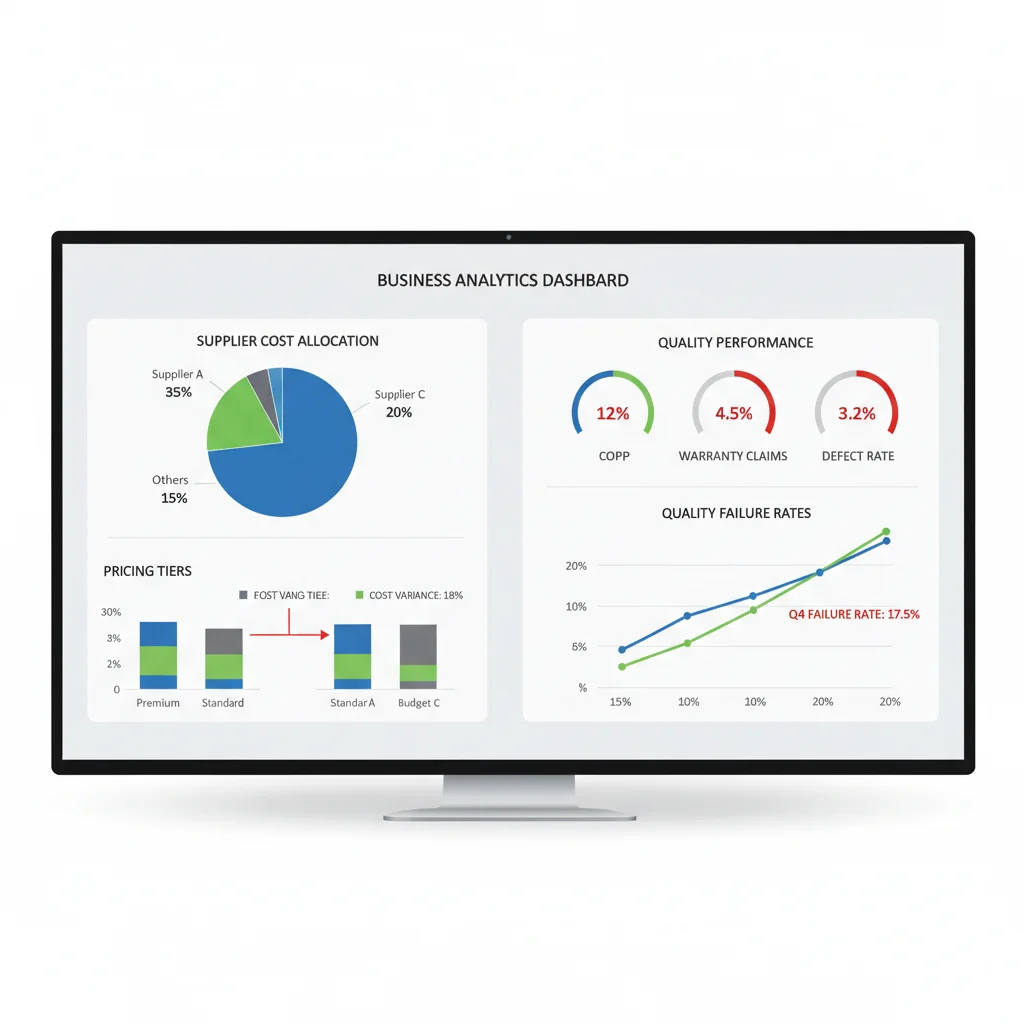
Quality failures eat up 15-20% of total sales at average factories. A $10 million operation loses $1.5-2 million each year through defects, rework, and warranty claims. Most companies guess their Cost of Poor Quality (COPQ) sits around 10%. The real number? Usually 20%. Poor performers see this climb past 30%. Top-tier manufacturers keep it below 10%.
This gap explains price differences between suppliers making identical products. A factory charging 25% more might be using that extra money to prevent quality problems. Cheaper options will pass those problems straight to you.
One global manufacturer cut waste costs by 30% by fixing issues early. They solved problems during design and setup instead of catching defects at final inspection. Warranty claims dropped. Material waste fell. Rework hours vanished. They gained pricing advantages competitors couldn’t match without making the same investments.
The Real Math Behind Quality System Investments
Quality costs break into four buckets:
- Prevention spending covers training, equipment setup, certifications, and maintenance schedules
- Appraisal costs fund inspections and testing
- Internal failure expenses include scrap, rework labor, retesting, and downtime
- External failures trigger warranties, returns, and recalls
The formula looks simple: COPQ = (Waste + Defects) × Time Spent Fixing. But the real impact goes beyond this basic math. One biopharma plant cut mistakes by 50% and slashed waste by 75%. This freed up 25% of employee time that was spent fighting quality fires. That time went to productive work. Output grew without hiring more people.
Top performers get results that seem impossible. One medical-device maker runs waste costs at one-fifth the industry average. A top pharma producer operates at one-fourteenth the average. These aren’t small gains. They show completely different ways of running a factory based on quality maturity.
Automation ROI That Changes Price Structures
A generic drug maker invested in quality analytics and process controls. Productivity jumped 15%. Right-First-Time (RFT) rates climbed from 83% to over 92%. Customer complaints fell by 25%. Quality costs dropped by 25%. The best part? They did this without huge IT upgrades or new equipment.
TrakSYS at another plant delivered clear savings each year. Error rates fell 28%. Fix speed improved 30%. Quality control salary savings hit $165,600 per year. Lower maintenance costs added another $213,000 each year. Total savings exceeded $375,000 every year.
Look at a kettle maker producing 40,000 units. Inspection costs run $5 per unit, totaling $200,000. But total COPQ hits $2.2 million—over 20% of sales. Suppliers carrying these quality costs can’t compete on price against factories that removed them through better processes.
Why Cheaper Quotes Hide Expensive Surprises
Price gaps between Chinese suppliers often show their quality maturity level. A factory quoting rock-bottom prices might be skipping prevention costs. No preventive maintenance. Little operator training. Basic or missing quality planning. They don’t charge you for these because they don’t do them.
You’ll pay anyway. Just later. Through high defect rates, inconsistent output, and rush shipments to replace failed batches. Your total cost beats what you’d pay a higher-priced supplier with strong quality systems from day one.
Research from LNS shows Enterprise Quality Management Systems (EQMS) with closed-loop CAPA (Corrective and Preventive Action) processes improve Cost of Quality over time. Prevention becomes routine instead of reactive. This cuts Cost of Good Quality (COGQ). One biopharma site doubled production yield in under two years through data-driven quality fixes. Small investment. Huge returns.
High-performing suppliers pass inspections clean. Their RFT rates top 92%. Mistakes drop by half. Waste falls 75%. These numbers don’t happen by luck. They need quality infrastructure investments. You see these in unit pricing. But they vanish from your total cost of ownership.
Conclusion

Price differences between Chinese suppliers go deeper than raw material costs. Factories quote different prices because they run on different business models, market pressures, and cost structures. They’re not trying to deceive you.
Some suppliers understand order volumes well. They show transparent cost breakdowns and invest in quality systems. Their higher prices make sense – you get fewer defects, faster turnaround, and lower total ownership costs. Rock-bottom quotes often hide problems. Think compliance issues, MOQ traps, or currency tricks that eat away your savings.
Your next move? Build a supplier evaluation matrix. Weight these seven factors based on what matters to your business. Ask your top three candidates for detailed cost breakdowns. Don’t shy away from tough questions about quality systems, capacity limits, and real lead times. Good suppliers welcome these questions. They know their value goes beyond the initial quote.
The cheapest supplier seldom gives the best value. Choose with strategy. Negotiate smart. Build relationships with partners who get that fair pricing creates lasting business.