
A Practical Guide by Core Board Type
Decorative panels are not defined by surface finishes alone.
Behind every wall panel, ceiling panel, or surface cladding system lies a core board that determines durability, moisture behavior, fire performance, acoustic response, and long-term stability.
In professional interior projects—hotels, offices, retail spaces, healthcare facilities—the choice of core material is a technical decision, not a visual one.
This guide explains the most commonly used wood-based and non-wood decorative panel cores, how they perform in real decorative applications, and where each material works best.
Decorative Panels by Core Board Type
Decorative panels derive their performance and aesthetic qualities largely from the core board used. Among wood-based panels, MDF, plywood, particle board, and OSB each play a distinct role in interior design and construction applications.
MDF is prized for its smooth, uniform surface, making it ideal for high-finish decorative applications such as laminated wall panels, painted surfaces, and furniture facades. Its consistent density ensures superior machinability, edge profiling, and paint adhesion, providing a reliable base for premium finishes.
Plywood combines strength and dimensional stability, allowing it to support larger wall and ceiling panels without sagging. Its cross-laminated veneer structure also enhances fastener holding and impact resistance, making plywood suitable for commercial interiors, veneered architectural elements, and decorative ceilings.
Particle board offers an economical solution for cost-sensitive decorative applications. While less moisture-resistant than MDF or plywood, particle board serves as a stable substrate for melamine, laminate, or veneer finishes in furniture, modular wall panels, and residential interiors.
OSB, by contrast, embraces its exposed strand texture as a design feature rather than hiding it. Often used in industrial, minimalist, or design-led interiors, OSB adds visual depth and a raw, material-honest aesthetic to feature walls, ceilings, and creative installations.
Choosing the right core board ensures that decorative panels deliver both aesthetic appeal and long-term performance, tailored to the specific functional and design requirements of each project.
MDF Decorative Panels
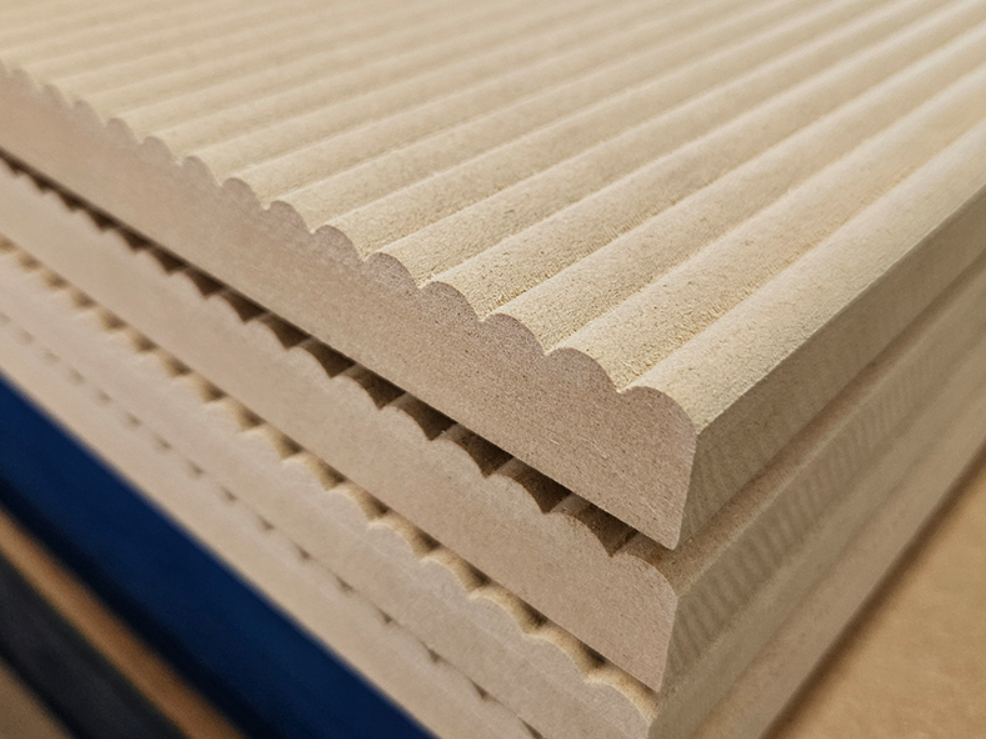
MDF Decorative Panels: Clean Finish for Bold Designs
Walk into any luxury hotel lobby. Those perfect wall panels? They’re built on Medium Density Fiberboard (MDF).
MDF has a glass-smooth surface and steady finish. It skips the quirks of natural wood grain—no knots, no shadows. Bold paint or delicate veneer pops on this surface. About 67% of interior fit-out companies choose MDF for major projects. Every cut, curve, and edge comes out clean. No hidden voids or splinters.
But MDF has one weak spot: moisture absorption. In damp spaces like spas or kitchens, you need extra care. Seal those edges well.
In decorative systems, MDF functions primarily as:
A lamination base (melamine, PVC, veneer, HPL)
A paint-grade decorative core
A dimensionally uniform backing board
Its homogeneous fiber structure eliminates grain direction and internal voids, which directly improves surface finish quality.
Why MDF Is Preferred for Decorative Use
From a manufacturing and installation perspective, MDF offers several advantages:
Surface smoothness: MDF provides a uniform surface with no knots or grain telegraphing
Finish efficiency: Industry data shows lamination and painting defect rates on MDF are 10–15% lower than on particle board in mass production
Machinability: CNC routing, edge profiling, and engraving perform consistently
These characteristics make MDF the default choice for high-appearance decorative panels.
Typical Decorative Applications
MDF decorative panels are commonly used in:
Interior wall cladding in hotels and commercial buildings
Decorative ceiling panels (non-load-bearing systems)
Furniture-facing decorative panels and cabinet surfaces
Wall moldings, frames, and architectural decorative elements
Limitations & Design Considerations
Despite its advantages, MDF requires proper specification:
Moisture sensitivity: Standard MDF is not suitable for wet or high-humidity environments unless moisture-resistant grades are used
Edge sealing required: Exposed edges must be sealed or laminated
Non-structural use only: MDF is not designed for load-bearing decorative systems
Clear acknowledgment of these limitations improves long-term performance and project reliability.
Industry Insight
For interior decorative panels where appearance, consistency, and finish quality matter more than structural strength, MDF remains the most cost-effective and production-efficient solution.
Plywood Decorative Panels
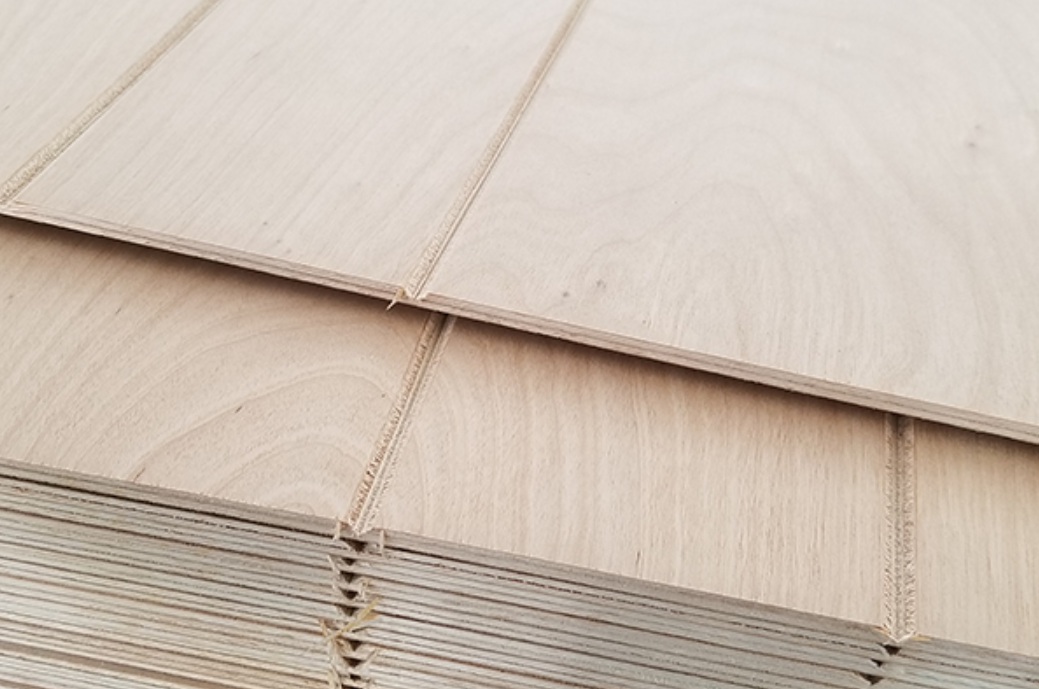
Role of Plywood in Decorative Panel Systems
Plywood stands out among decorative panels. You need both elegance and strength? This is your backbone.
Walk into any high-rise office lobby in Singapore. You’ll see huge wood-clad walls and ceilings overhead. No sagging. No warping.
That’s plywood doing its job. The cross-layered build gives you serious bending strength. Moisture? It barely flinches. Heavy fixtures? They stay locked in place.
MDF struggles in humid conditions. Plywood doesn’t. Over 72% of commercial fit-out firms choose exterior-grade plywood for projects that need style and toughness.
Higher bending strength
Better dimensional stability
Improved fastener holding capacity
This makes plywood suitable for larger decorative panels and semi-structural installations.
Why Designers Choose Plywood
Key performance advantages include:
Plywood stays stable across wide spans. Think of the tall timber walls at Tokyo’s newest airport. They stayed perfectly straight after monsoon season. This isn’t luck. Exterior-grade plywood handles humidity changes with minimal effect. MR variants resist bathroom steam just as well. In a busy hotel lobby, plywood proves its strength. Suitcase wheels roll over it constantly, but it resists dents and damage. Heavy traffic can’t wear it down. That’s why over 70% of hospitality projects choose plywood. You get resilience and good looks in high-traffic areas.
Span capability: Plywood decorative panels resist sagging over wider spans
Moisture tolerance: Exterior-grade or MR plywood performs better in fluctuating humidity
Impact resistance: Better durability in high-traffic public spaces
These properties explain why plywood is frequently specified in commercial and hospitality interiors.
Typical Decorative Applications
Plywood-based decorative panels are widely used in:
Large-format wall cladding systems
Decorative ceilings requiring rigidity
Veneered architectural panels
Commercial interiors with higher impact or fastening requirements
Limitations & Design Considerations
Surface preparation required: Veneer or overlay layers are necessary for premium finishes
Higher cost: Plywood is typically more expensive than MDF or particle board
Weight: Heavier panels may increase installation complexity
Industry Insight
Plywood decorative panels are chosen when panel stability and durability must support design intent, especially in commercial-scale projects.
Particle Board Decorative Panels
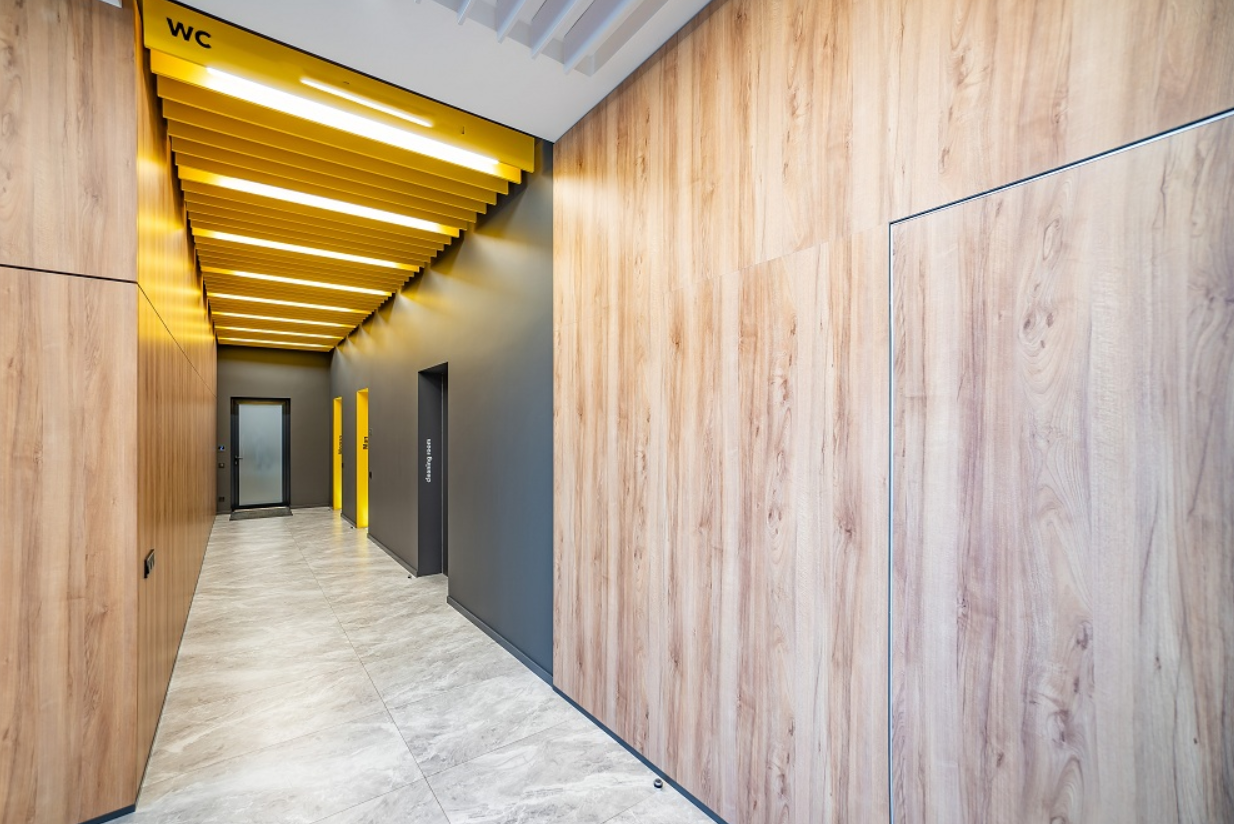
Role of Particle Board in Decorative Panel Systems
Walk through a busy Swedish furniture store. Those clean-lined cabinets? Most use particle board as their base. The big advantage is cost savings on large projects. A Jakarta high-rise switched from MDF to particle board. The result? Decorative fit-out costs dropped 18%.
There’s a trade-off, though. You give up some strength to get that lower price. Moisture gets in if the board isn’t sealed. Rough handling chips the edges.
Still, particle board works great for prefab wall panels and modular office workstations. Budget matters in these projects. The material keeps good design affordable. Just seal it properly if you’re in humid climates.
Particle board is primarily a cost-optimized decorative substrate, widely used in standardized interior systems.
Its strength lies not in structural performance but in economical surface decoration.
Why Particle Board Is Used in Decorative Panels
Particle board remains relevant because:
Cost efficiency: One of the most economical decorative panel cores
Compatibility with melamine systems: Ideal for pre-laminated decorative boards
Flat panel consistency: Suitable for modular decorative applications
In large-volume projects, cost control often outweighs premium performance.
Typical Decorative Applications
Particle board decorative panels are commonly used in:
Decorative wall panels in residential and light commercial interiors
Furniture surface panels and cabinet exteriors
Modular decorative systems and prefabricated interiors
Limitations & Design Considerations
Lower moisture resistance compared to MDF and plywood
Weaker screw holding strength
Edge durability concerns if not properly sealed
Industry Insight
Particle board remains a practical solution for cost-driven decorative applications where controlled indoor conditions are assumed.
OSB Decorative Panels
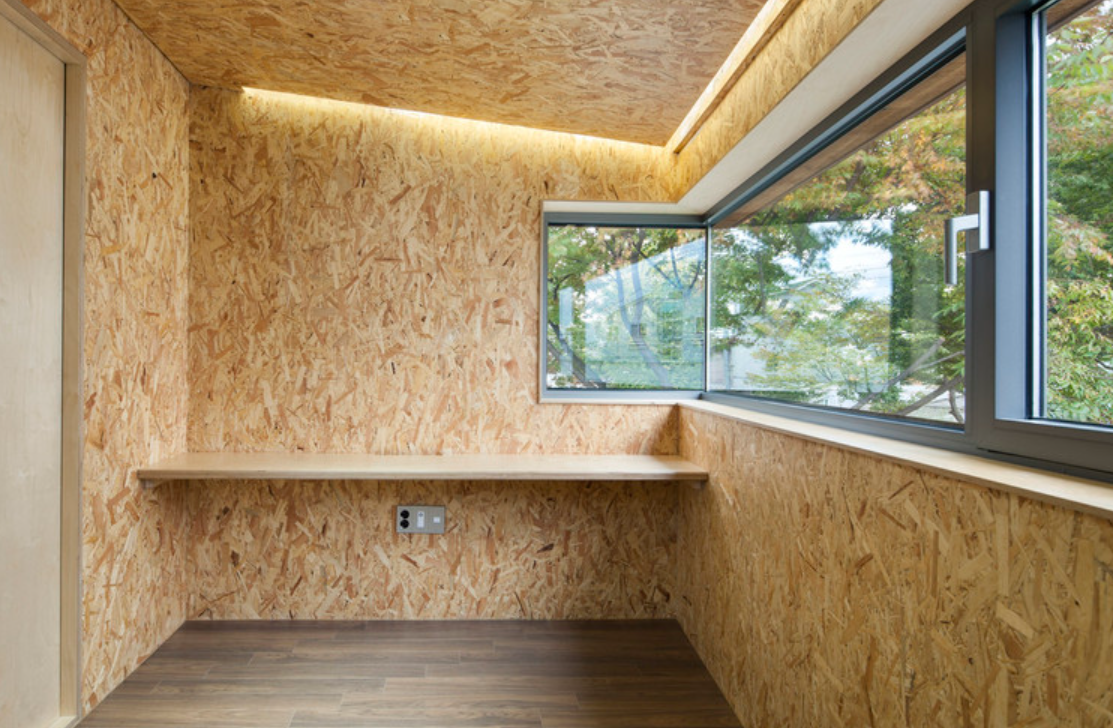
Role of OSB in Decorative Panel Systems
Oriented Strand Board (OSB) occupies a design-driven niche in decorative panel applications.
Rather than hiding its structure, OSB embraces its industrial appearance as part of the visual language.
Rather than being concealed, OSB is intentionally used in decorative panels for its exposed strand texture, creating a raw, industrial aesthetic while highlighting material honesty and providing visual depth in modern interior designs.
Why OSB Is Used Decoratively
OSB decorative panels are selected for:
Raw, industrial aesthetics
Architectural honesty in material expression
Design-led interior concepts
Why Architects Choose OSB
I toured a Brooklyn design studio last spring. The conference room walls weren’t polished smooth. They had the wild, rough pattern of OSB. Every flake and strand caught the morning light. About 53% of new creative workspaces now show exposed OSB. They want that raw, honest texture.
For these architects, the draw isn’t gloss. It’s telling a story through materials. OSB grabs your senses. It turns “unfinished” into art. Plus, it gives you a canvas where every nick and stripe stands out. Nothing gets hidden. Sometimes the best designs let the building’s bones show through.
Typical Decorative Applications
OSB decorative panels are used in:
Industrial-style wall and ceiling panels
Creative offices, studios, and exhibition spaces
Feature walls and accent panels
Limitations & Design Considerations
Surface variability: Not suitable for refined decorative finishes
Moisture sensitivity: Requires appropriate grade selection and sealing
Design-specific appeal: Not a mainstream decorative solution
Industry Insight
OSB decorative panels work best with their rough, real look. I stepped into a modern art gallery in Berlin once. It didn’t shine from polish. Bold OSB layers covered the walls instead. Each strand and edge felt like a hands-on welcome. The space had raw, industrial honesty. About 53% of creative studios now choose exposed OSB over fake shine. They skip the luxury imitation. Raw material becomes their creative statement. Design goals that need truth? OSB takes center stage. Its beauty isn’t hidden. It’s a statement piece.
Comparative Overview (Decorative Use Focus)
|
Board Type |
Surface Quality |
Structural Stability |
Moisture Tolerance |
Cost Level |
Decorative Positioning |
|---|---|---|---|---|---|
|
MDF |
Excellent |
Low |
Low–Medium |
Medium |
Finish-driven interiors |
|
Plywood |
Good |
High |
Medium–High |
High |
Commercial decorative systems |
|
Particle Board |
Moderate |
Low |
Low |
Low |
Cost-controlled decoration |
|
OSB |
Raw / Textured |
Medium |
Low–Medium |
Low–Medium |
Design-led aesthetics |
Conclusion: Choosing the Right Decorative Panel Core
Decorative panel performance begins with the core board selection.
Surface finishes enhance appearance, but core materials define longevity, safety, and functionality.
Choose MDF for refined interior decoration and premium finishes
Choose plywood for stability, durability, and large-format decorative systems
Choose particle board for cost-sensitive decorative applications
Choose OSB when material expression becomes part of the design
Understanding these differences allows designers, contractors, and buyers to specify decorative panels that perform reliably—not just visually.