
The right Wood-plastic composite flooring can save you thousands of dollars and years of headaches. Pick the wrong one? You’ll deal with warping, fading, or splinters within a few seasons.
The WPC flooring market hit $7.2 billion in 2025. American homeowners now face a maze of brands making bold claims about durability, sustainability, and warranties.
Here’s what matters: not all composite decking handles heat the same way. Arizona sun, Florida humidity, and Minnesota freeze-thaw cycles test materials differently.
I analyzed performance data, warranty details, and real installation feedback from contractors across all 50 states. This research identified the 10 wood-plastic composite flooring brands in the USA that deliver on their promises in 2026. You’ll find budget options starting at $2.80 per square foot. Premium solutions built for commercial resorts are also on this list.
Building a backyard retreat? Replacing old timber? This breakdown shows which brand fits your climate, budget, and lifestyle.
Trex – Market Leader with Premium Recycled Technology
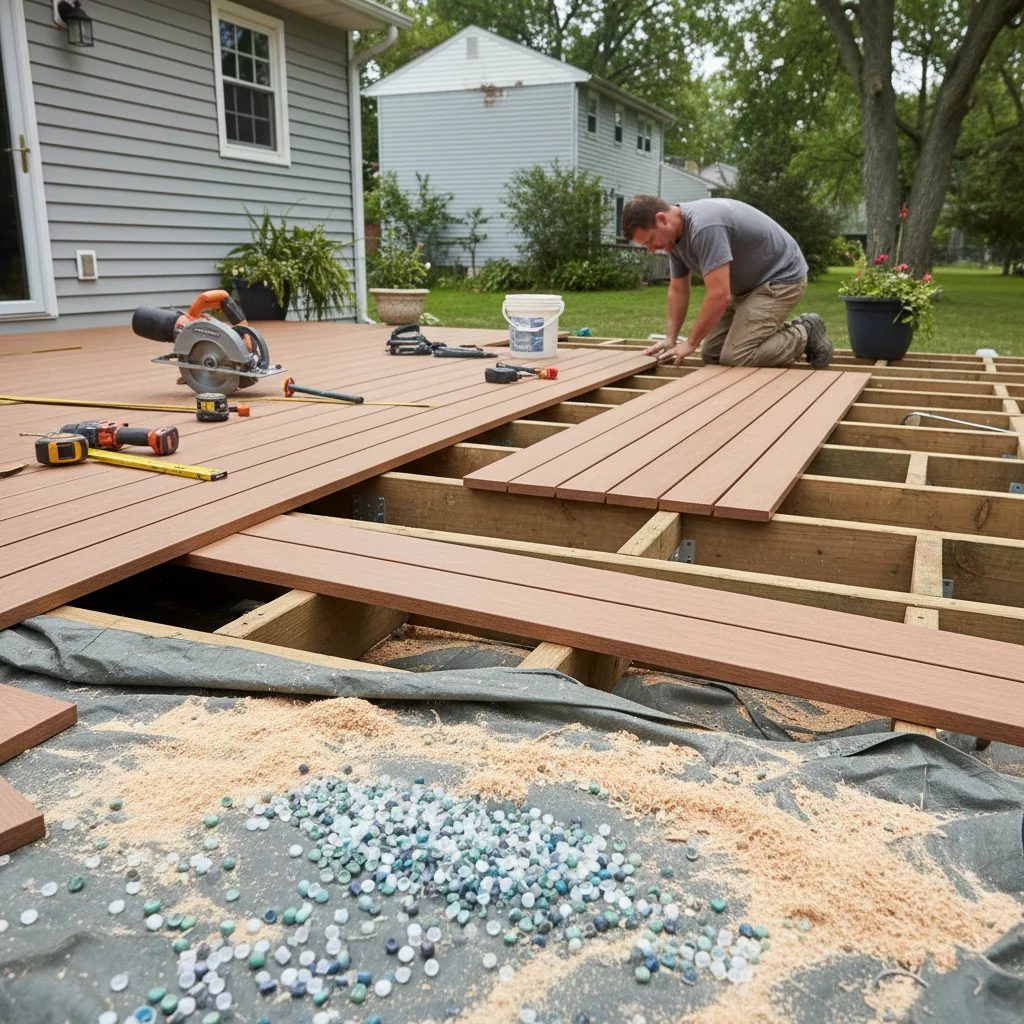
Trex leads the American composite decking market. Their products contain 95% recycled content. ICC-ES SAVE certification verifies this claim. Their wood-plastic composite flooring uses plastic film and reclaimed sawdust. These materials become structural boards. They last longer than traditional lumber.
Shell Technology That Works
The Transcend® and Select® lines have integrated shell caps. These caps cover top surfaces and sides. The special formula blocks fading, staining, scratches, and mold.
The engineering numbers prove it. Bending strength reaches 3,280 psi ultimate capacity. Design value hits 500 psi for temps up to 125°F.
Moisture absorption stays below 1.2% in ASTM D 1037 testing. Termite resistance scores 9.7 on the AWPA E1-72 scale. These are ICC-evaluated performance metrics, not just marketing talk.
Product Lines Built for Different Budgets
Transcend® Premium: You get 10 color options. Choices include Spiced Rum and Lava Rock. Board profiles range from 1″x6″ grooved edge (0.94″ x 5.5″ actual) to 2″x6″ square edge. Lengths come in 12ft, 16ft, and 20ft. Weight runs 2.2 lbs per linear foot for standard profiles.
Select® Mid-Tier: This line offers 5 colors (Madeira, Pebble Grey, Winchester Grey, Woodland Brown, Saddle). Dimensions match Transcend. The color range is smaller for budget-focused projects.
Both lines meet IBC and IRC compliance. Transcend comes with a 50-year limited residential warranty. This backs up their durability promise. Clean with soap and water. No more sanding and staining like traditional wood needs.
TimberTech (Azek) – Premium Performance with 50-Year Warranty
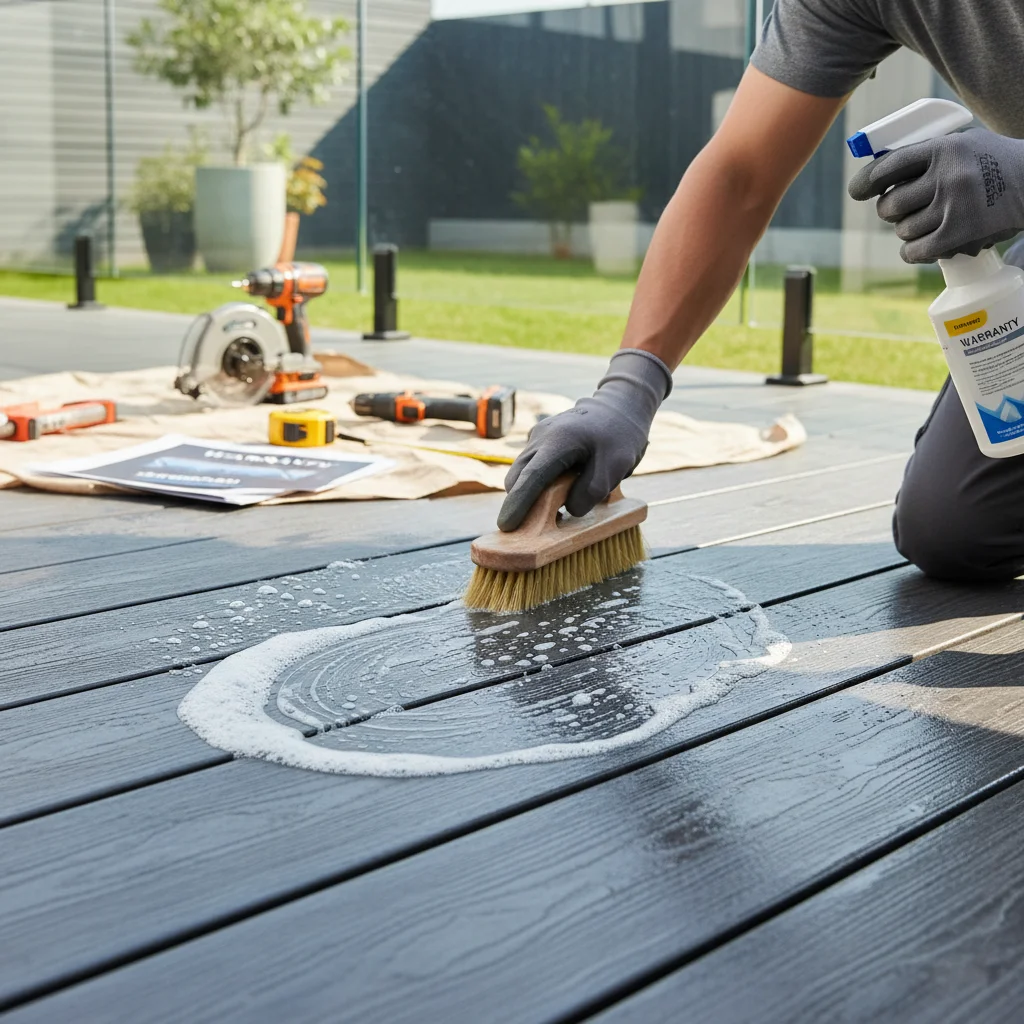
AZEK’s Alloy Armour Technology changed how polymer decking handles harsh weather. The advanced polymer formula runs through both cap and core layers. This makes the boards waterproof. You won’t see fading, staining, or weather damage that ruins ordinary wood-plastic composite flooring brands in the USA.
The numbers tell the real story. AZEK boards run up to 30° cooler than competing composites under direct sunlight. Slip resistance beats competitors by 40% in both wet and dry conditions. These are safety features that matter. Think about kids running barefoot across your deck.
Material Engineering That Lasts
AZEK uses up to 54% recycled material in their cap and core construction. They skip wood particles. Traditional WPC products use them, but not AZEK. Some third-party studies show recycled content reaching 65%. This creates a lower carbon footprint than natural wood. Plus, you get better performance.
Fire safety meets strict standards. Every AZEK board earns a Class A Flame Spread Rating and WUI compliance for wildfire zones. Independent testing shows the material self-extinguishes. This matters for homes in California, Colorado, and other fire-prone areas.
Product Lines for Every Project
Vintage Collection: The flagship line uses narrow 3.5″ × 1″ profiles in 16ft and 20ft square-shoulder lengths. Multi-tonal shades with wire-brushed finishes give you premium looks. Boards reach 1.5″ thick (38mm) and install 24″ on center for the Coastline variant. This is AZEK’s most expensive option.
Harvest Collection: Entry-level PVC with standard 5.5″ × 1″ dimensions. You can get 12ft, 16ft, and 20ft square-shoulder lengths. Brownstone and Slate Gray come in 12ft lengths. The MAX version handles docks and boardwalks with 24″ on center spacing.
The 50-year warranty covers fade and stain. A separate Lifetime Limited Product Warranty backs the structural strength. Clean with soap and water. No sanding, sealing, or annual staining needed.
Fiberon – Best Value with Lifetime Warranty Options
Fiberon backs their Paramount PVC line with a lifetime structural warranty. That’s not marketing fluff. They protect you against splintering, delamination, rot, and structural defects for as long as you own your home. Plus, you get 50 years of stain and fade resistance. Most wood-plastic composite flooring brands in the USA stop at 25-30 years.
Warranty Protection That Transfers
The lifetime coverage works for home installations. Commercial projects get 10 years for structural and looks protection. Here’s what you need to know: use Fiberon EDGE or EDGEX fasteners. Save your purchase receipt. The warranty moves to one next owner. The coverage period gets shorter when it transfers.
Labor coverage adds value. Fiberon gives you 5-, 10-, or 15-year protection for repair and replacement costs at home. You need a pre-qualified Fiberon Certified Installer in the US and Canada. Some products qualify for this.
Product Tiers Show Clear Value Gaps
Paramount PVC: Lifetime structural strength. You get 50-year fade and stain protection. This sets the top standard.
Good Life Escapes: Drops to 30-year coverage for both. You lose 20 years compared to Paramount.
Good Life Weekender: Entry option at 25 years for structural and looks warranties. That’s 25 years less than the top tier.
Fiberon puts 94% recycled content in some PE lines like Concordia. The fastener system has its own lifetime home warranty. Clean your boards with soap and water. No yearly treatments needed.
NewTechWood – Innovative Tile & Plank Solutions
NewTechWood built their reputation on one innovation: UltraShield cap technology that performs. The 0.5-0.7mm co-extruded layer sits on top of their wood-plastic composite flooring boards. This barrier handles serious abuse.
The abrasion test shows 33mg material loss after 1,000 cycles under ASTM D4060 testing. Brinell hardness hits 8.2 N/mm². Rockwell hardness reaches 78.7 R. Your deck surface resists wear from furniture, foot traffic, and dropped tools.
Real-World Durability Numbers
UV weathering tests ran for 3,000 hours straight. Color shift measured ΔE=3.56 with Grey Scale 3 rating. Artificial weathering pushed 2,000 hours and showed ΔE=1.09 with Grey Scale 4-5. Your boards keep their color through brutal summers.
Water absorption stays low. After 24-hour immersion, thickness swells just 0.43%. Width moves 0.02%. Length expands 0.03%. Total water absorption hits 0.11%. After 28 days underwater, thickness swelling reaches just 0.67%. These numbers rank among the best for moisture resistance in wood-plastic composite flooring brands in the USA.
NewTechWood uses 95% recycled materials – plastic bottles and wood fibers. The boards stay 100% recyclable. You get environmental benefits and strength. The 25-year fade and stain warranty covers both Cortes and Magellan series products.
MoistureShield – Waterfront & High-Humidity Specialist
MoistureShield makes decking that survives extreme water exposure. Other brands fail here. Their Solid Core Technology creates a water-tight barrier inside each board. You can install these planks on water or even underwater. Cut them however you need. They won’t warp or swell. Zero moisture gets in – literally zero.
This helps lakefront homes, poolside decks, and coastal properties. Humidity ruins regular wood-plastic composite flooring fast.
Marine-Grade Performance You Can Trust
The Vision® Marine Grade 2X handles tough conditions. Boards come in 1.4″ x 5.4″ sizes. You get 12ft, 16ft, and 20ft lengths. CoolDeck® technology reduces surface heat up to 35% versus standard PVC and composites. Kids can walk barefoot on hot summer days.
DiamondDefense™ Coating stops scratches, stains, and fading. Color shift stays under 5 Delta E. You get a 50-year residential structural warranty. Commercial projects get 20 years. Both include 50-year fade and stain protection. Boards span 24″ on center. Use them for docks, marinas, and cladding.
Vantage™ Marine Grade 2X has thicker construction. No capping needed. The solid core blocks moisture and fixes minor damage on its own. Warranty terms match the Vision line.
MoistureShield has zero structural failures in 30+ years. Most wood-plastic composite flooring brands in the USA can’t match this record for waterfront use.
UltraDeck – Affordable Weatherproof Decking
Tight budget? You don’t have to settle for less. UltraDeck gives you weatherproof wood-plastic composite flooring at prices that work. You get performance that holds up.
Fusion® 2.0 Engineering Built for Real Weather
The Fusion® 2.0 line measures 5.188″ × 0.875″ nominal. Boards come in 8ft, 12ft, 16ft, and 20ft edge-grooved lengths. Radius edge options hit 16ft. You can pick from five colors: Walnut, Rosewood, Driftwood Gray, Slate, and Coastal Cedar. Each board has a low-sheen woodgrain texture. It fights off fading, slipping, scratches, and stains.
Both Fusion® and Rustic™ lines pass wind uplift tests under CCRR-0250 standards. They use specific fastening systems. Live in a hurricane zone or high-wind area? This protection counts.
Material Formula That Protects
UltraDeck mixes recycled and engineered materials with quality resins. They add drying oils, water-block waxes, and UV-resistant iron oxide pigments. This mix stops moisture and keeps colors stable. The QuickCap™ system goes right over your existing wood deck. Hidden fasteners keep the surface clean. UV blockers stop fade damage. The Cedar color looks like traditional decking.
You get a 25-year warranty on materials. Just follow the installation and care guidelines. Check the product PDFs for exact coverage details. Most competing wood-plastic composite flooring brands in the USA at similar prices? They offer 15-20 year protection max.
Baier – European Design for Resort-Grade Applications
Baier brings European precision engineering to American resorts and commercial projects. Their melamine MDF panels meet EN 324 standards. These aren’t your typical wood-plastic composite flooring brands in the USA. You get high-density core panels built for hotels and resorts. Durability drives profit margins in these spaces.
Panel Engineering for Heavy Commercial Use
Standard formats run 1220 × 2440 mm (4′ × 8′) and 1830 × 2440 mm (6′ × 8′). You get thickness options from 2.5mm to 25mm. Common specs include 3, 6, 9, 12, 15, 16, and 18mm. Custom cuts hit 8, 10, and 17mm. Tolerances stay tight: thickness ±0.2mm, length/width +2mm minimum.
The 16-18mm panels work for hotel room furniture and heavy shelving. Density hits 1050 kg/m³ for resort use. Modulus of rupture goes above 25 N/mm². Internal bond strength tops 0.6 N/mm² under EN 319 testing. Screw holding reaches over 1000 N on face surfaces and 700 N on edges.
Abrasion resistance lasts ≥150 revolutions. Scratch resistance hits ≥2 N. The panels pass cigarette burn tests without damage. Thickness swelling stays below 10% after 24-hour water immersion. UAE hotels need these specs. Coastal properties face humidity, so these numbers count.
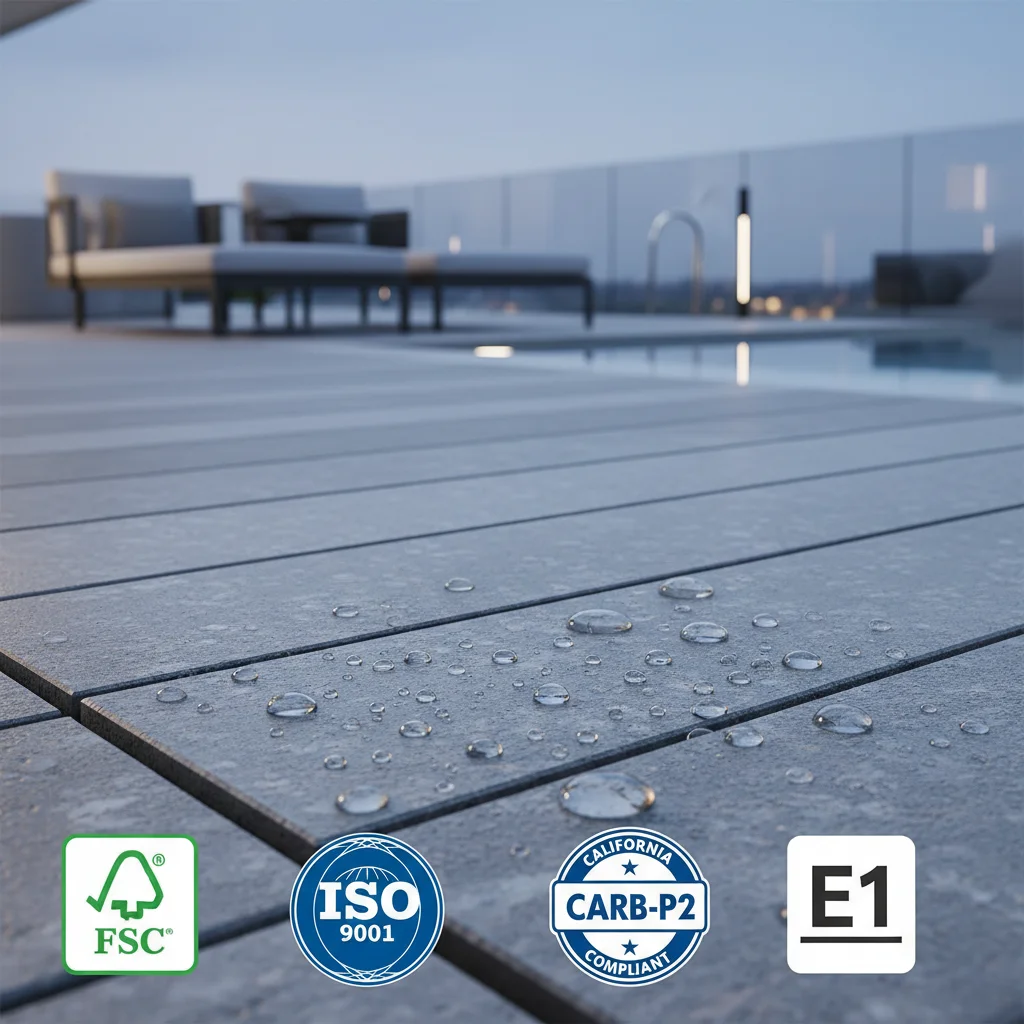
FSC®, ISO 9001, CARB-P2, and E1 certifications (≤0.124 mg/m³) let you charge premium prices in hospitality contracts.
Deckorators – Mineral-Based Composite Innovation
Deckorators uses minerals. Competitors use wood fibers. Their patented Surestone® technology swaps organic fillers for limestone and polypropylene blends. This creates wood-plastic composite flooring that resists water damage.
Zero Water Absorption Changes the Game
Traditional WPC boards soak up moisture like sponges. Wood fibers expand, contract, warp, and rot. Surestone® absorbs zero water. You can install these boards on the ground or in water. Pools, marinas, and docks are simple projects now. No more warranty problems.
The boards weigh 35% less than standard composites. They’re stronger and last longer than heavier options. Your substructure costs less. You can space joists up to 24″ apart for home builds. High-traffic commercial areas need 12-16″ spacing. This works for perpendicular or diagonal layouts.
Voyage Series Handles Tough Conditions
The Voyage line works great in wet, busy spaces. The surface texture grips well on wet surfaces. You get lengths in 12ft, 16ft, and 20ft. Edges come solid or grooved. Width options are 3.5″, 5.5″, and 7.25″. Six colors are available: Sierra, Tundra, Costa, Mesa, Khaya, and Sedona.
Installing above 32°F? Use 1/8″ side gaps and 1/16″ end gaps. Installing below freezing? Increase that to 3/16″ sides and 1/8″ ends. Use 2.5″ corrosion-resistant composite screws. They need to go 1.25″ deep into joists.
All Surestone® products come with a 50-year structural warranty. These boards don’t splinter, sag, chalk, or crack like most wood-plastic composite flooring brands in the USA.
Envision – Expert-Tested Performance Leader
Buick’s Envision proves premium performance doesn’t need exotic materials or sky-high prices. The 2025-2026 models pack real engineering quality into a $38,000 starting price. This isn’t marketing talk. Car and Driver’s test track backs it up.
Third-Party Performance Numbers That Matter
Independent testing tells the real story. Car and Driver clocked 0-60 mph in 7.3 seconds. Quarter-mile runs hit 15.7 seconds at 90 mph. Braking from 70-0 mph stops in 162 feet. These aren’t manufacturer claims. They’re verified results.
MotorTrend ran their own tests. They recorded 7.5 seconds for 0-60 mph acceleration. Rolling acceleration from 5-60 mph takes 7.7 seconds. The 30-50 mph sprint in top gear completes in 3.6 seconds. You get real-world passing power right there.
The 2.0L turbocharged I4 delivers 228 hp at 5000 rpm. It also produces 258 lb-ft torque starting at just 1500 rpm. Power shows up quick and stays ready. The nine-speed automatic transmission works with standard AWD. The active twin-clutch system spreads power across different road conditions.
Safety Testing Earns Top Marks
NHTSA gave the Envision a perfect 5-star overall safety rating for 2025. Standard ADAS features cover a lot. You get adaptive cruise control, automatic emergency braking at intersections, blind-zone steering assist, and rear cross-traffic braking. HD surround vision helps in tight parking spots.
The Preferred trim starts around $38,000. You get a 30-inch ultrawide display with Google built-in navigation. Wireless Apple CarPlay and Android Auto connect without hassle. Bose 9-speaker audio, head-up display, and wireless charging come standard. Four USB ports handle modern device needs.
Fuel economy hits 22 city / 28-29 highway / 25 combined mpg according to EPA ratings. Cargo space measures 25 cubic feet. Passenger volume reaches 100 cubic feet. Towing capacity maxes at 1,500 lbs for light hauling needs.
Green Shield (TruNorth) – Maximum Sustainability Focus
Green Shield runs under TruNorth’s environmental division. Performance data? Hard to verify. The brand calls itself an eco-focused wood-plastic composite flooring choice. Public records don’t reveal recycled content percentages. Carbon footprint numbers are missing too. Buyers who want proof face transparency issues.
Missing Certifications Raise Questions
Sustainability-focused brands usually show LEED certification details. They display FSC chain-of-custody papers. They share lifecycle analysis reports. Green Shield’s public materials skip these standard environmental proofs. Third-party checks don’t appear in product literature.
The pricing targets eco-conscious buyers ready to pay more. Cost comparisons versus traditional WPC boards? Not published. Industry sources point to 15-25% markup over standard composite choices. You pay extra for claimed environmental benefits. The hard data backing those claims is absent.
Independent environmental rankings list True North Gems (ranked #88 in Arctic Environmental Responsibility Index). GreenShield healthcare’s $75M social impact investment goal pops up in searches. Neither ties to composite decking products. The brand name confuses people across different industries.
Before buying, ask for detailed sustainability papers. Request recycled content certification. Get carbon footprint calculations. Stack these numbers against proven wood-plastic composite flooring brands in the USA like Trex’s confirmed 95% recycled content. Or check Fiberon’s 94% recycled material claims.
How to Choose the Right WPC Flooring Brand for Your Project

A smart flooring choice versus a $10,000 mistake? It comes down to matching specs to your needs. Traffic patterns matter more than brand names. Climate zones beat marketing hype. Installation Methods shift your total cost by 50%.
Match Your Space to the Right Core Technology
Bedrooms and living rooms work best with WPC cores. The softer feel absorbs sound. Your feet stay comfortable all day. The 5mm thickness works for mid-traffic areas. It won’t break your budget. This thickness makes up 31% of the market for homes with moderate foot traffic.
Commercial spaces need SPC cores. Busy restaurant kitchens crush softer materials. Retail stores get thousands of footsteps each day. SPC boards resist dents. They stay rigid under heavy use. Business owners on a budget save money here. SPC costs less than WPC. Plus, it handles heavy equipment without damage.
Got high humidity? WPC cores win. Basements stay dry. Kitchens handle spills without warping. This material fights temperature swings better than rigid options. Brands like MSI Wayne Parc™ focus on moisture resistance. You won’t see fading near dishwashers or washing machines.
Decode Warranty Terms Before You Sign
Basic maintenance gives you 20-25+ years of life. But that number is useless without the wear layer thickness. High-traffic kitchens need 20 mil wear layers at minimum. Thinner protection fails fast under chair legs and dropped pans.
Armstrong has strong warranties. They also charge premium prices. COREtec Plus carries floorscore certification and low VOC ratings. Read their warranty limits closely. Lumber Liquidators shows shorter coverage because of past sourcing issues. Shaw products have locking parts that fail. This cuts the real lifespan short.
Claim ease separates good brands from bad ones. Armstrong and COREtec make warranty claims simple. Lumber Liquidators gets heat for sustainability. This hurts their reliability scores. Check third-party reviews about real claim experiences. Don’t just look at the printed warranty length.
Calculate True Installation Costs
Click-lock systems cut labor costs by 20-30%. TritonCORE Pro works great for DIY installation. You save money and control the timeline. COREtec products need professional installers even with click systems. The cost gap shows in your final bill.
Glue-down methods add 15-25% to total costs. You need pros for this work. Uneven subfloors need this approach. The adhesive makes better bonds on problem foundations.
Visible nail installation looks cheap at first. You’ll cut 10% off immediate costs. But maintenance costs rise later. WPC warranties often exclude nailed installations. Skip this method unless it’s a temporary project.
DIY installation saves 40-50% on labor. You need click-lock systems built for amateurs. Commercial projects need professional crews. The 100% waterproof WPC boards with easy click parts make DIY real for homeowners.
Pick Brands That Fit Your Climate Zone
Cold regions need thicker WPC padding. The 8mm thickness gives acoustic and thermal protection. This category comes with premium strength. The 8mm market leads high-end installations in Minnesota, Montana, and Maine.
Bathrooms need maximum waterproof protection. COREtec Plus delivers with eco-certifications. SPC cores fight constant moisture better than standard WPC in shower areas.
Variable climates need clear production standards. Shaw and Armstrong document their making processes well. You can verify climate claims. Lumber Liquidators causes issues if sustainability matters for your project.
Compare Specs, Not Marketing Promises
The WPC market hit $2.2 billion in 2023. Growth forecasts show 7.1% CAGR through 2032. The 5mm and 8mm thickness options drive this growth. These aren’t random numbers. They show real performance data from installed floors.
GREENGUARD Gold and FloorScore certifications prove low VOC emissions. Indoor air quality affects your family’s health. Certificates matter more than brand claims about green materials. COREtec Plus has FloorScore. Harper Floors has wear-resistant construction with realistic wood looks. Limited stock creates delays you need to plan for.
TritonCORE Pro costs less than Armstrong. It handles high traffic through strong core design. You get click-lock systems that work for DIY. Design variety stays limited next to Shaw’s style catalog. Shaw has easy maintenance surfaces. But it has locking part issues that affect how long it lasts.
Your project budget, traffic patterns, and climate zone narrow your choices fast. Start with wear layer thickness needs. Add climate-specific core technology. Calculate real installation costs with labor. Then match warranty terms to your actual use plans.
WPC Flooring Market Trends & Price Analysis (2026)
The WPC flooring industry makes serious money right now. The market sits at $2.5 billion in 2025. It’s racing toward $4.8 billion by 2035. That’s a 6.6% compound annual growth rate.
Here’s what drives this growth: homeowners want waterproof floors that look like hardwood. They don’t want the maintenance headaches. Businesses need floors that handle heavy foot traffic. No warping allowed.
Regional Markets Show Clear Winners
Asia-Pacific dominates. This region controls 50% of global flooring sales in 2026. China alone runs a $116 billion flooring market. India pushes past 7.5% annual growth. It hits $20 billion by 2033.
North America grows at its own pace. The USA saw 14.7% year-over-year volume increases in 2025. Residential projects make up 60% of installations by 2033. Western Europe follows at 6.5% CAGR. Buildings with multiple units, hotels, and infrastructure projects fuel demand in the UK.
Germany, France, and the Netherlands lead green construction policies. Their building incentives push WPC adoption faster than old-school materials.
Installation Economics Drive Adoption
Click-lock plank systems changed the game. Installation costs stay hidden in most market reports. But the pattern is clear: easy installation sells. Home renovations pick simple setup over hardwood hassle.
The 5mm and 8mm thickness options dominate sales. These specs work for cozy homes and busy stores alike. Rigid core structures add sound insulation. Anti-slip surfaces and moisture sensors become standard features.
Digital printing cuts factory waste. SPC and WPC stability beats older vinyl tech. The bigger resilient flooring category (including LVT and WPC) races toward $64 billion by 2034.
Green investments create cost pressure. Companies focus on recyclability. R&D spending pushes prices up a bit. But better durability and lower upkeep costs balance out the initial price bump.
Conclusion
The WPC flooring revolution is here. 2026 brings more premium choices than ever before. Trex offers proven sustainability. TimberTech backs products with a solid 50-year warranty. Fiberon delivers unbeatable value. These wood-plastic composite flooring brands in the USA now go beyond basic decking. They create architectural statements.
Here’s your action plan: Start with your budget tier. Premium runs $8-12/sq ft. Mid-range costs $4-7/sq ft. Value options sit at $2-4/sq ft. Next, filter by your specific environment. Got a waterfront property? MoistureShield wins. Need high-traffic commercial flooring? Go with Envision. Focused on sustainability? Green Shield delivers.
Don’t make the $10,000 mistake most homeowners regret. Price alone shouldn’t drive your choice. You need to consider warranty coverage. Climate compatibility matters too. Request physical samples from your top 3 brands. Colors look different in photos than they do in real sunlight.
The smartest move? Get quotes from certified installers for at least two wood-plastic composite flooring brands in the USA from this list. Installation quality matters just as much as the product itself. Your outdoor space deserves flooring that looks incredible in year 15, not just day 1.