
Most people buying plywood do one thing when checking quality: they count the layers. More layers = better plywood. Simple, clean, done. Except — not quite.
That logic is like judging a sandwich by how many ingredients it has. You ignore whether those ingredients are any good. Or whether they even belong together.
The truth about plywood layers is messier — and more interesting — than the “more is better” shortcut. Ply count matters, sure. But so does core type, adhesive chemistry, grain orientation, and a handful of structural rules most buyers never think to ask about.
Stick around. You’ll walk away with a useful mental model for picking the right plywood — not just the thickest stack.
Plywood Layers Explained: Are More Plies Always Better?
Here’s what this article covers — and why each part matters.
Ply count is the obvious starting point. But the real story runs across four key variables:
How many plies — and what that means for stability, not just thickness
Grain orientation — every ply rotates 90°. That one rule gives plywood its strength in both directions
Glue lines — more plies means more adhesive layers. Those glue lines carry more structural load than most people expect
Wood species and core type — Baltic Birch, standard softwood, MDF, OSB. Same thickness. Very different performance
The article pulls in real load test numbers to back this up. No guesswork. You get exact failure points — pounds, kilograms, the moment a panel breaks down.
By the end, you’ll have a solid framework for judging plywood layers. It goes well past counting plies. It connects directly to how panels hold up under real conditions.
What Are Plywood Layers (Plies) and How Do They Work Together?
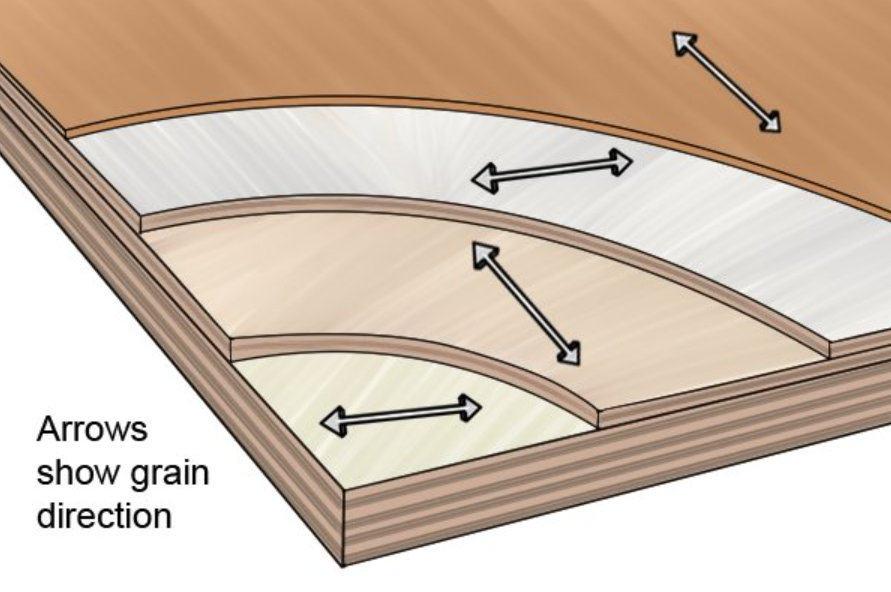
Here’s something most people never think about: every single ply in a sheet of plywood is rotated 90° from the one beneath it — a structural method explained in cross-laminated veneer construction principles recognized by APA – The Engineered Wood Association. Everyone. No exceptions. That one structural decision — repeated across every layer — is what makes plywood different from solid wood at a fundamental level.
Each ply is a thin wood veneer, usually 1–3mm thick. Stack them, rotate each one, press them together under heat and adhesive, and something interesting happens. The panel stops behaving like wood that wants to split, warp, and move with humidity. It starts behaving like an engineered material that fights back.
Three types of plies do three different jobs:
Face ply — The top layer. Highest-grade veneer. This is what you see, sand, and finish.
Back ply — The bottom outer layer. It supports stability. Often one grade lower than the face.
Core plies — Everything in the middle. These carry the structural load. More core plies means more backbone.
Notice that total ply count is always an odd number — 3, 5, 7, 9. That’s by design. Odd numbers let the panel mirror itself around a solid center ply. Stress stays balanced on both sides. Break that symmetry and the panel warps. Physics doesn’t bend on this.
Ply count follows thickness in a clear pattern:
| Nominal Thickness | Typical Plies | Typical Use |
|---|---|---|
| 1/4″ (6mm) | 3–5 | Lightweight paneling |
| 1/2″ (12mm) | 5–7 | Cabinets |
| 3/4″ (18mm) | 7–9 | Flooring, structural |
| 1″ (25mm) | 9–11 | Load-bearing applications |
One thing worth flagging: nominal thickness is not actual thickness. After sanding and pressing, that “3/4 inch” panel measures 23/32″ in real life. Cabinet-grade tolerances run ±1/64″. Utility-grade allows ±1/32″. Small numbers — until they’re not.
Load hits a panel and the plies handle it as a team. Outer face and back plies absorb surface tension and compression. Core plies move shear forces through those cross-grain bonds. The balanced stack cancels out expansion and contraction forces that would otherwise twist the panel. More plies, thinner each — like 9-ply Baltic birch — means tighter cooperation, cleaner edges, and fewer internal voids. A panel with fewer, thicker layers simply can’t match that.
The Structural Rules That Govern Ply Performance
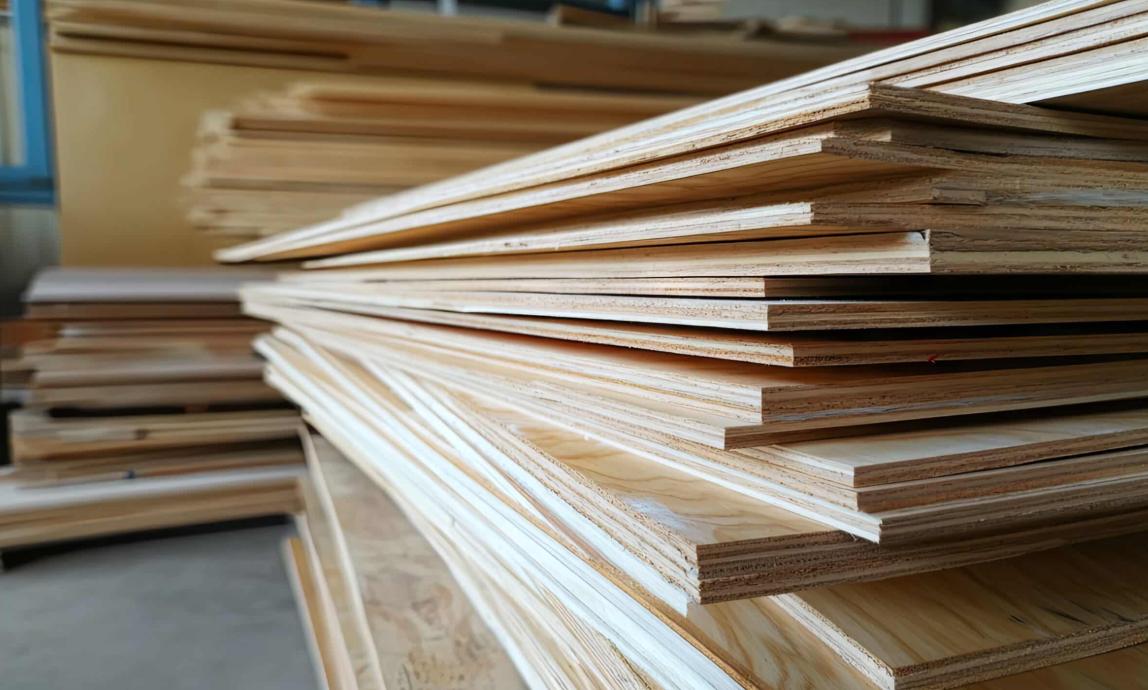
Four tests. That’s what certified structural plywood has to pass before it earns a span rating. Not a visual inspection. Not a tap test. Four specific, load-based evaluations: uniform load performance, panel bending, planar shear strength, and shear-through-thickness strength. Pass all four — you get a rating. Fail one — back to the drawing board. These load-based evaluations follow standardized testing frameworks such as the ASTM structural panel performance methods used in construction grading.
That’s worth sitting with for a second. Ply count is downstream of something more fundamental. The real performance question isn’t how many layers — it’s how do those layers behave under stress.
Here’s how the answer breaks down.
Stress doesn’t travel through plywood the way you’d expect. Load hits a panel. It doesn’t just push straight down and stop. It spreads outward through the glue lines in multiple directions. The cross-grain structure sends those forces along two axes at the same time. That’s the whole point. But the layers have to work together for that to happen. Any internal void, weak glue bond, or uneven veneer thickness creates a bottleneck. Stress builds up at that point. The panel fails at its weakest link — not its average one.
PS 1 — the governing standard for structural plywood panels defined by the U.S. Voluntary Product Standard PS 1 for Structural Plywood — sets hard limits on this:
- Linear expansion must stay at or below 0.50% after vacuum-pressure soak testing along both axes
- Along the primary strength axis, that tightens to ≤0.30%
- Squareness tolerance: ≤1.3 mm per meter on the longest edge
Those aren’t aesthetic specs. They show internal discipline — how well the ply stack holds its shape as moisture and load push against it.
The span rating table makes the stakes concrete:
| Thickness | Span Rating | Dry Concentrated Load | Wet Concentrated Load |
|---|---|---|---|
| 0.250″ | Subfloor-32 | 550 psf | 400 psf |
| 0.313″ | Single Floor-16 | 550 psf | 400 psf |
| 0.088″ | Single Floor-32 | 700 psf | 400 psf |
Notice something odd in that last row. A thinner panel — 0.088″ — carries a higher concentrated dry load than the thicker panels above it. That’s not a typo. Thickness and ply count are inputs into performance, not outputs. The span rating measures real-world load capacity. It comes from the full structural picture: species, adhesive, orientation, and manufacturing precision all working together.
More plies build the conditions for better performance. They don’t guarantee it.
Fewer Plies vs. More Plies: What Each Is Good For
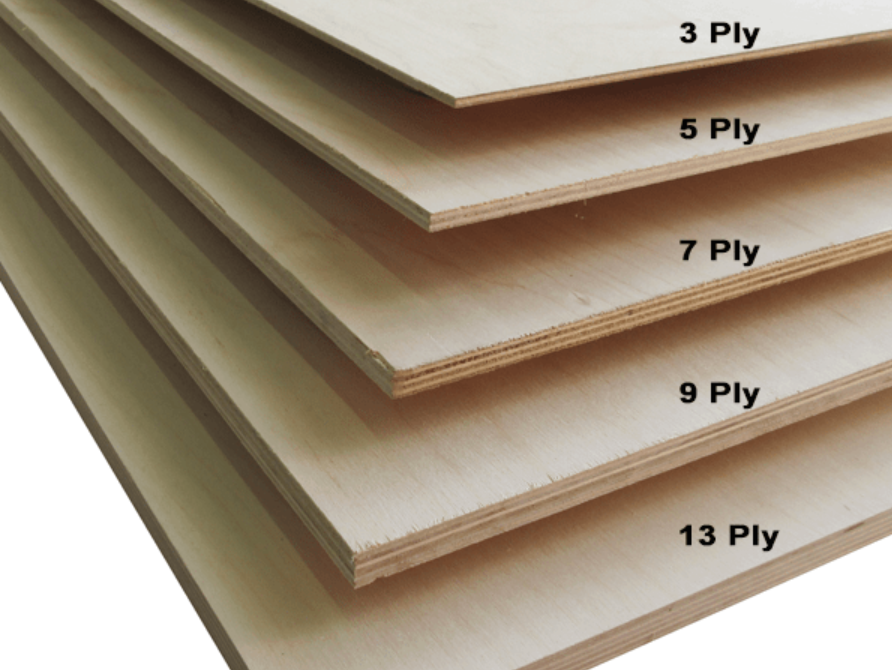
Ply count is a tool. Like most tools, the right one depends on what you’re building.
Fewer plies and more plies aren’t competing for a quality trophy. They solve different problems. The mistake is treating one as superior and using it everywhere. That’s how you end up with over-engineered shelving and under-supported subfloors in the same project.
Here’s how the trade-offs break down.
Fewer plies: where they win
Thin panels with fewer, thicker core plies are lighter. That matters more than it sounds. Less material means easier handling, faster installation, and less total load on supporting structures. For wall paneling, cabinet backs, and drawer bottoms, a 3-ply or 5-ply panel does the job well — no more, no less.
There’s also a flatness argument. Fewer plies means fewer glue lines. Fewer glue lines means fewer weak points where moisture or poor bonding creates a blister under the surface. In dry, stable environments, that simplicity is a real advantage.
More plies: where they earn their place
Put a panel under heavy floor loads, structural spans, or repeated impact — and more plies start pulling their weight. The cross-grain layers stack up. Shear forces spread across more bonding surfaces. The panel holds its shape better under stress.
This is where plywood layers count in a measurable way:
- Edge quality improves — more plies means cleaner cuts with fewer voids at the edge
- Screw-holding increases — denser layer stacking gives fasteners more material to grip
- Dimensional stability tightens — thinner veneers move less per layer, so total expansion and contraction stays controlled
The honest summary:
| Situation | Better Choice |
|---|---|
| Lightweight interior paneling | Fewer plies |
| Cabinet boxes, shelving | 5–7 ply |
| Structural subfloor, load-bearing | 7–9 ply |
| Heavy-duty, high-impact applications | 9+ ply |
Neither end is better across the board. The right panel is the one matched to its job — not the one with the highest ply count on the shelf.
How Core Type Changes the Equation (More Than Ply Count)
Here’s something that should unsettle you: two panels, identical ply counts, identical thickness, same species on the face. One holds up for decades. The other delaminates in three years. The difference isn’t the layers. It’s what’s inside them.
Ply count tells you how many times the manufacturer repeated the stacking process. Core type tells you what that process produced. Those are two different pieces of information — and most buyers track the wrong one.
The core isn’t just “the middle part.”
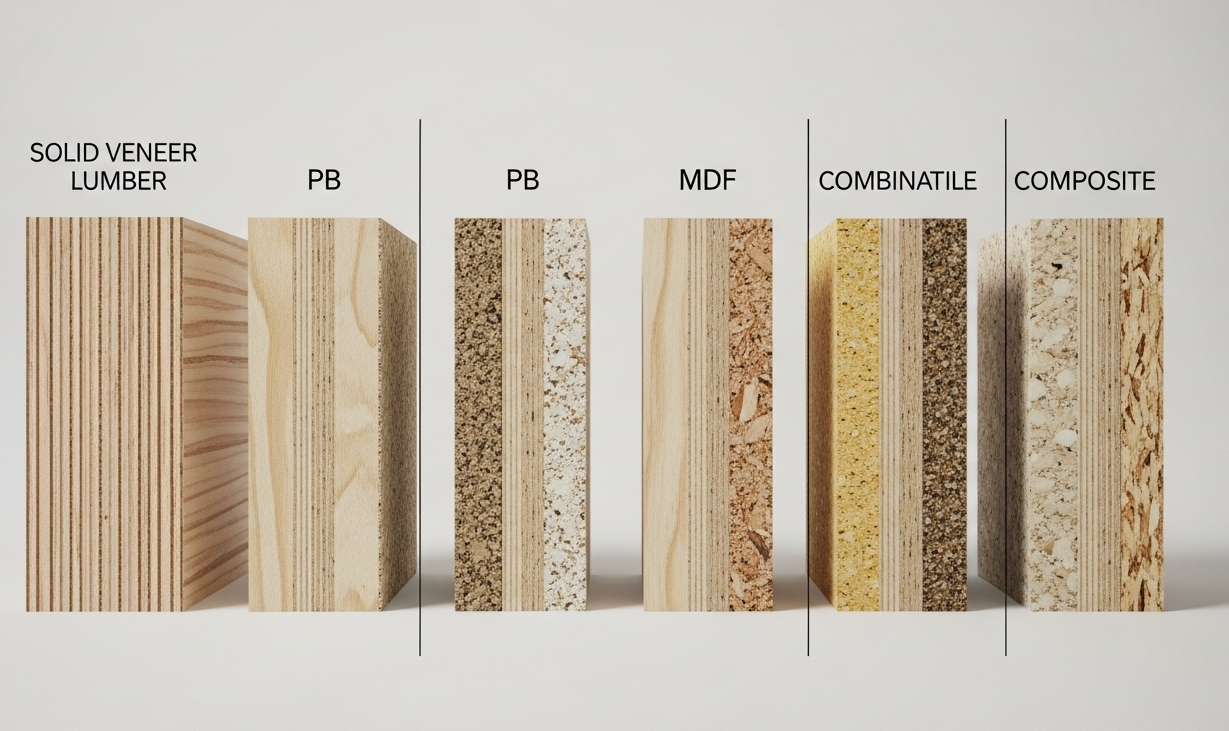
It’s the structural backbone of the entire panel. It comes in several distinct forms:
- Veneer core — Traditional cross-laminated wood plies all the way through, commonly used in structural plywood panels supplied for construction and furniture manufacturing.
- MDF core — Dense, heavy, and extremely flat, similar to density-controlled MDF panels used in cabinetry production.
- Lumber core — Solid wood strips placed between outer veneers. Excellent screw-holding, especially at edges. Heavy. Less stable in humidity swings.
- Combination core — MDF or HDF layers paired with veneer plies. Tries to balance flatness and structural performance. Often falls short on both ends.
What changes when the core changes:
| Core Type | Bending Strength | Screw Retention | Weight | Dimensional Stability |
|---|---|---|---|---|
| Veneer | High | High | Moderate | High |
| MDF | Low | Low (edges) | Heavy | Moderate |
| Lumber | Moderate | Highest | Heaviest | Lower |
| Combination | Moderate | Moderate | Heavy | Moderate |
A 9-ply panel with an MDF core doesn’t perform like a 9-ply veneer-core panel. It performs like what it is — a flat, rigid, edge-sensitive sheet that strips screws and sags under point loads.
This is where the “more plywood layers = better” shortcut breaks down hardest. You can count nine layers on a panel and still walk away with the wrong product for a structural job. The ply count is accurate. The conclusion you draw from it may not be.
Core type also changes how the panel responds to moisture. Veneer cores expand and contract in a cross-grain pattern — the same mechanism that gives plywood its dimensional stability. MDF cores absorb moisture evenly, swell up, and don’t recover. One wet season in an open environment, and the core shows its weakness straight through to the face.
The takeaway is simple: before you count the plies, ask what those plies are built around. The core does more structural work than any single layer above it.
The Role of Adhesives: The Binding Factor Buyers Overlook
Glue is boring. Nobody walks into a lumber yard and asks about glue.
That’s a problem.
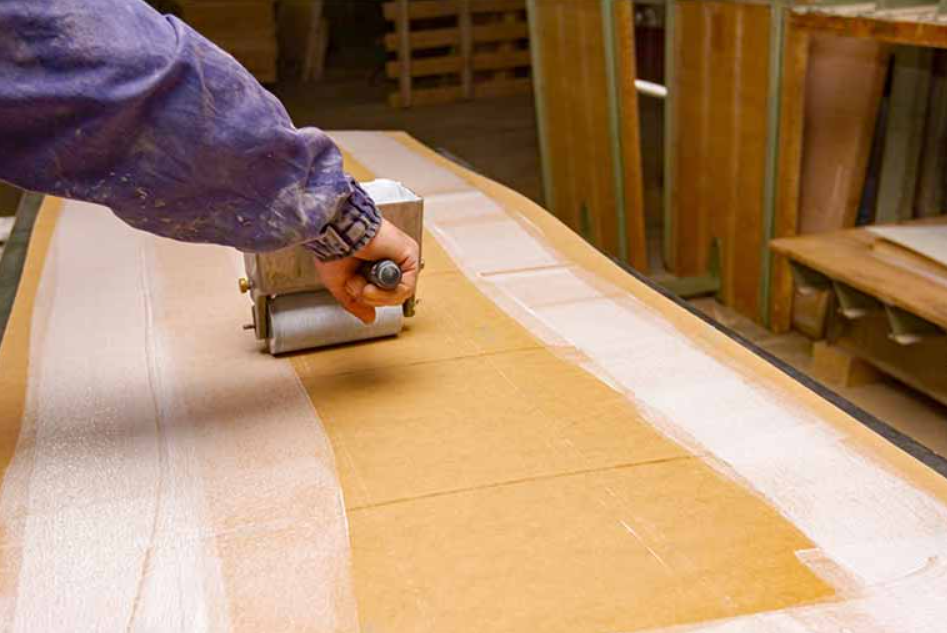
Here’s the thing about plywood layers: they’re only as good as what holds them together. A well-stacked, grain-oriented nine-ply panel is just a pile of veneers until the adhesive does its job. The adhesive works hard — buried in the compressed space between every single layer, out of sight the entire time.
Think about what those glue lines handle. Every load you put on a panel — foot traffic, shelving weight, subfloor stress — passes through the wood and through the adhesive bonds. The wood gets all the credit. The glue lines do half the structural work.
What adhesive type determines:
- Moisture resistance — Interior-grade urea-formaldehyde adhesive fails in wet environments. Exterior-grade phenol-formaldehyde holds up. Same ply count. A completely different survival rate outdoors.
- Delamination risk — Poor-quality adhesive causes plywood layers to separate under stress, heat, or humidity. The veneer count stops mattering the moment the bond breaks.
- Long-term panel integrity — A weak glue line is a slow-moving crack. It’s waiting for the right load conditions to give way.
The grade stamp on a plywood panel tells you the adhesive class — and whether it complies with US EPA TSCA Title VI formaldehyde emission requirements. — Exposure 1, Exterior, Interior. Most buyers skip right past it. That stamp tells you whether your panel survives real conditions or just looks good in the store.
Count the plies. Then check what’s holding them together.
Matching Ply Count to Application: A Practical Decision Guide
Pull up two receipts from the same lumber yard. One sheet of ¾-inch maple-faced plywood, sanded both sides — around $90. One sheet of ¾-inch CDX utility plywood — under $60. Same thickness. Same ply count range. Thirty dollars apart. That gap isn’t random markup. It tells you what job each panel was built to handle.
Ply count starts that conversation. It doesn’t end it.
Here’s a clear way to think about the numbers:
| Ply Count | Typical Thickness | Where It Belongs |
|---|---|---|
| 3-ply | ~6mm (¼”) | Decorative panels, cabinet backs |
| 5-ply | ~12mm (½”) | Furniture, cabinetry |
| 7-ply | ~15mm | Construction, medium structural loads |
| 9-ply | ~18mm (¾”) | Flooring, durable furniture |
| 13–19-ply | 15–25mm | Industrial flooring, heavy structural work |
Notice the pattern: two additional plies for every 3mm of added thickness. That’s not a suggestion. That’s how cross-laminated veneer stacking works in practice.
Where Specific Applications Draw the Line
Roofing punishes you fast for using too few plies. The minimum for standard asphalt shingles is 5/8 inch. Heavier materials — slate, clay tile — push that to ¾ inch. Snow country or high-wind zones need 19/32 or 23/32 inch panels. Wider rafter spans demand thicker panels. No exceptions. The old ½-inch CDX standard at 24-inch spacing handled lighter loads. Solar arrays, foot traffic, and heavy snowpack change that math fast.
Furniture and cabinetry care less about raw ply count. Surface grade and core consistency matter more. Take a Baltic Birch BB/BB panel — smooth, void-free, built with multiple plies. It earns its place in visible work not because it has the most layers. It earns it because every layer does its job well.
Utility and structural applications follow code. Not preference. Local building regulations set the minimum thickness and span ratings. That’s not red tape. It’s what keeps loads from failing.
The Mistakes That Cost People
Three decisions break plywood selection more than anything else:
- Buying on price alone. Cheaper panels cut corners on adhesive quality and manufacturing precision. That’s what makes ply count matter in the first place.
- Ignoring moisture exposure. Even brief construction exposure can ruin an interior-rated panel for good. You won’t see it coming until it’s too late.
- Miscounting load. Light-duty panels don’t warn you. They sag under snow, equipment, or foot traffic until they give out.
The takeaway: match ply count to the load, the span, the moisture environment, and the budget — in that order. Ply count is the input. Application survival is the output.
How to Evaluate Plywood Quality Beyond Just Counting the Layers
Ply count gives you one data point. Quality is about eight more.
The good news: most of these checks take under two minutes. Some need zero tools. Here’s what to look for.
Start at the edges. A cut edge is an instant X-ray of the panel. Run your eye across it. What you want: tight, even layers, no visible gaps, hardwood core material (Eucalyptus looks dense and consistent). What you don’t want: hollow pockets, wavy thickness, soft pale core wood like Poplar. That soft core compresses under load. It strips screws. It fails without warning.
Then press your thumbnail in. Sounds low-tech. Works anyway. High-density panels resist the dent. Poor-quality panels leave a mark you can measure. Your thumbnail tells you more than the label does.
Check for warping by setting the sheet flat. See any bow or twist? The adhesive or moisture control failed during manufacturing. That problem carries over once the panel is installed.
For anything load-bearing, verify the grade stamp:
– ISI:710 — Boiling Water Proof. Wet areas, exterior, marine use.
– ISI:303 — Moisture Resistant. Dry interior use.
Check the license number on the edge. Unstamped panels skip certification. That means no one tested the adhesive bond strength, shear resistance, or dimensional stability under humidity cycling.
The quick field checklist:
| Check | What to Do | Pass |
|---|---|---|
| Edge inspection | Look at cut edge | No voids, uniform layers |
| Density test | Press thumbnail | Minimal dent |
| Flatness | Lay sheet flat | No bow or twist |
| Smell test | Nose near surface | No sharp chemical odor |
| Grade stamp | Read panel edge | Valid ISI mark + license |
One last thing: moisture content matters before installation. The ideal range is 5–15%. Outside that range, the panel is already shifting — and it won’t stop once it’s in your floor.
Conclusion
Here’s the truth the plywood aisle won’t tell you: ply count is the nutrition label nobody reads. More layers sounds better — it feels logical, like more is always more. But the real performance story lives in symmetry, core construction, adhesive quality, and how well those elements serve your specific application.
So the next time someone tries to sell you a panel just because it has more plywood layers — that’s like judging a book by how many pages it has.
The smarter move? Start by defining your load requirements, moisture exposure, and finish expectations. Then match the spec to the job. That sequence alone puts you ahead of most buyers.
Sourcing panels for a serious project? Request a full technical sheet. The ply count will be on there. But now you’ll know which other numbers are the ones that matter.