
You stand in the building supply aisle, looking at stacks of OSB and plywood panels with the same price tags. Which one fits your project? Many people ask this question.
OSB vs. plywood—this choice goes beyond personal taste. It affects your project’s strength, how long it lasts, and your budget. These effects show up months or years later.
You might be sheathing a roof, laying subfloors, or building storage. Each material has clear benefits and real limits. Contractors and DIY builders need to know these before cutting the first panel.
This comparison skips the marketing hype and stories. You’ll get engineering facts, real performance data, and practical ways to decide. So you can pick the right material for your specific project with confidence.
OSB vs Plywood: Strength and Structural Performance
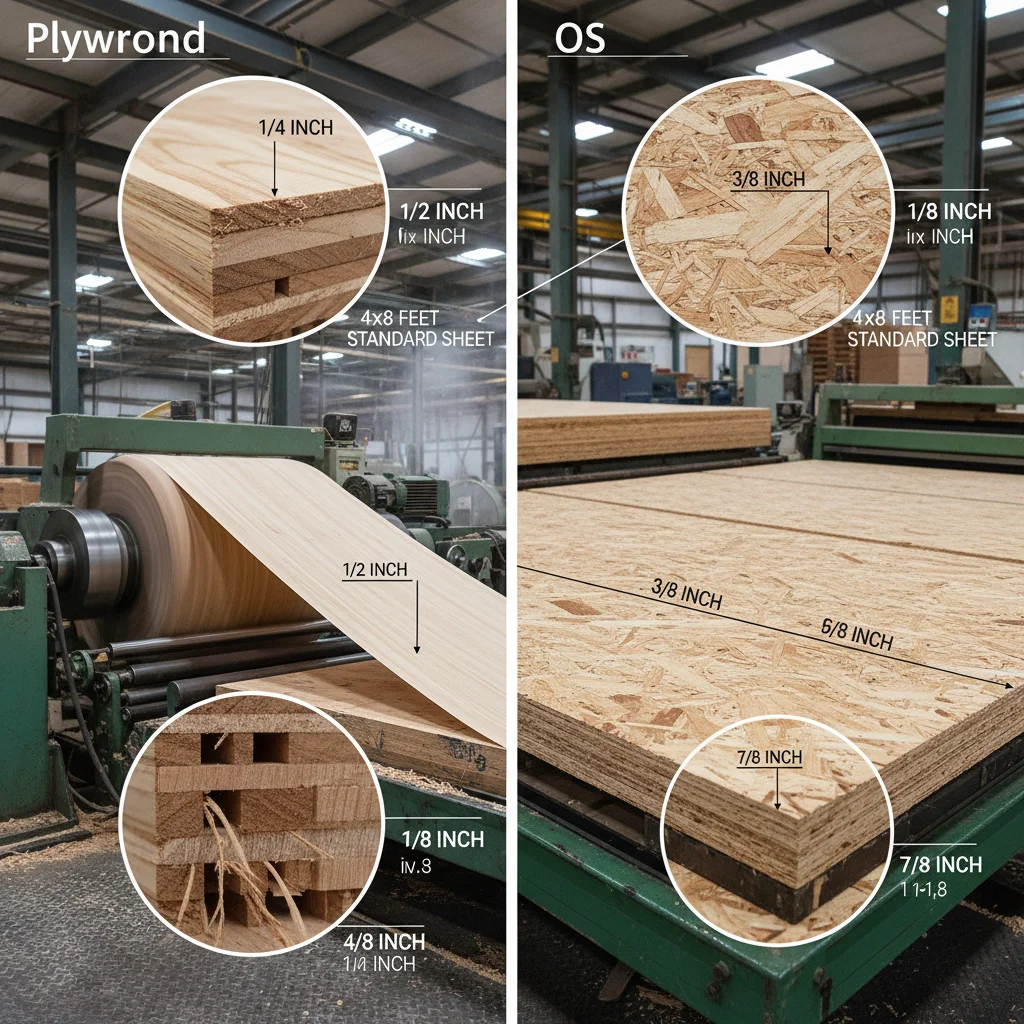
Numbers tell the real story about OSB vs plywood strength. Engineers tested both materials under EN standards. They used 11.1mm OSB/3 against 12mm marine plywood. The results split down the middle. Each material won in different areas.
Shear Strength: OSB Takes the Lead
OSB wins the shear strength battle along panel edges. Those compressed wood strands create a dense, uniform structure. This resists sliding forces really well. OSB becomes the top choice for load-bearing walls and roof sheathing. Wind and side forces hit these areas hard.
Stiffness and Flexibility: Plywood’s Domain
WISA-Spruce plywood measures 1.8 times stiffer than OSB/3 in elasticity tests. What does this mean? Plywood flexes less under the same load. You can use 18mm plywood where you’d need 22mm OSB for flooring. Plywood subfloors deliver about 10% more rigidity than OSB options. OSB flexes more. So you’ll need tighter joist spacing—16 inches instead of 24 inches. This prevents that annoying floor bounce.
Bending Strength Under Pressure
Test data shows OSB registers 32.7 ± 6.4 N/mm² in bending strength dry. Plywood starts higher. It keeps that edge throughout. After 24-hour water soaking, the gap grows wider. OSB’s elasticity and bending strength drop clearly. Plywood keeps more of its original strength. It bounces back to near-baseline performance after drying.
Long-Term Structural Stability
OSB swells more. It holds that deformation longer too. The moisture content after soaking reaches 36.9 ± 2.1% for OSB versus 41.8 ± 4.0% for plywood. But here’s the twist. Plywood recovers its shape better through wet-dry cycles. OSB carries higher internal stress from size changes. These changes never reverse completely.
Real-World Application Differences
Roofing in wet climates? Plywood resists damage better. OSB works fine in dry regions. Plus, it saves money upfront. Subfloors tell a similar story. Plywood grips fasteners more strongly. It creates a firmer walking surface. This matters for tile installations and high-traffic areas. OSB subfloors risk squeaks and edge swelling. You need proper installation techniques to avoid this.
Wall sheathing flips the script. OSB’s superior shear strength suits structural bracing well. Plywood counters with better impact resistance. It also tolerates moisture better at exposed edges during construction delays.
OSB vs Plywood: Moisture Resistance and Durability
Water exposure shows which panel performs better. A lab test at 85% humidity and 10°C proves this. An 18mm WISA-Spruce plywood panel expands about 1mm. The same-sized OSB/3 panel swells 3mm—three times more.
The Drying Game Changes Everything
Plywood soaks up water faster. But it also dries quicker. It snaps back to its original thickness. OSB takes longer to absorb moisture at first. Here’s the problem—it holds that water much longer. Compressed wood strands trap moisture deep inside. The panels stay swollen. The edges don’t recover.
Edge Swelling Creates Real Problems
OSB edges swell unevenly. The outer edges puff up more than the center. This creates permanent ridges. These ridges show through roof shingles as “ghost lines.” Factory edges have protective seals. Cut those panels on site? You lose that protection. Moisture rushes into exposed edges.
Installation becomes a nightmare here. Swollen OSB panels don’t fit together well. The material expands and contracts. This loosens fasteners. Plywood swells evenly across its surface. It recovers. Your fasteners stay tight.
Don’t use OSB under tile flooring. Uneven stress transfer cracks tiles. Plywood’s stable recovery keeps tiles intact.
Long-Term Performance in Wet Climates
Plywood dries out between rain events. Lower moisture content means slower decay. Western wood species in plywood resist decay moderately.
OSB holds moisture. This speeds up breakdown under chronic leaks. Aspen and poplar OSB varieties have zero natural decay resistance. Water-logged OSB becomes a biological time bomb.
Both materials share the same exposure class ratings (Exposure 1, 2, and Exterior). But real performance tells a different story. OSB can’t handle long moisture exposure as well.
Protection Strategies That Work
Treat all cut OSB edges in the field. Add waterproof membranes for key uses. Don’t install OSB in high-humidity, unvented spaces like bathrooms. Use proper barriers.
Construction delays matter. Rain and snow damage panels without protection. Use H-clips between roof panels. Add blocking between floor joists. Choose EN636 Class 3 plywood instead of standard OSB/3. It performs better in wet conditions.
OSB vs Plywood: Fastener Holding Power
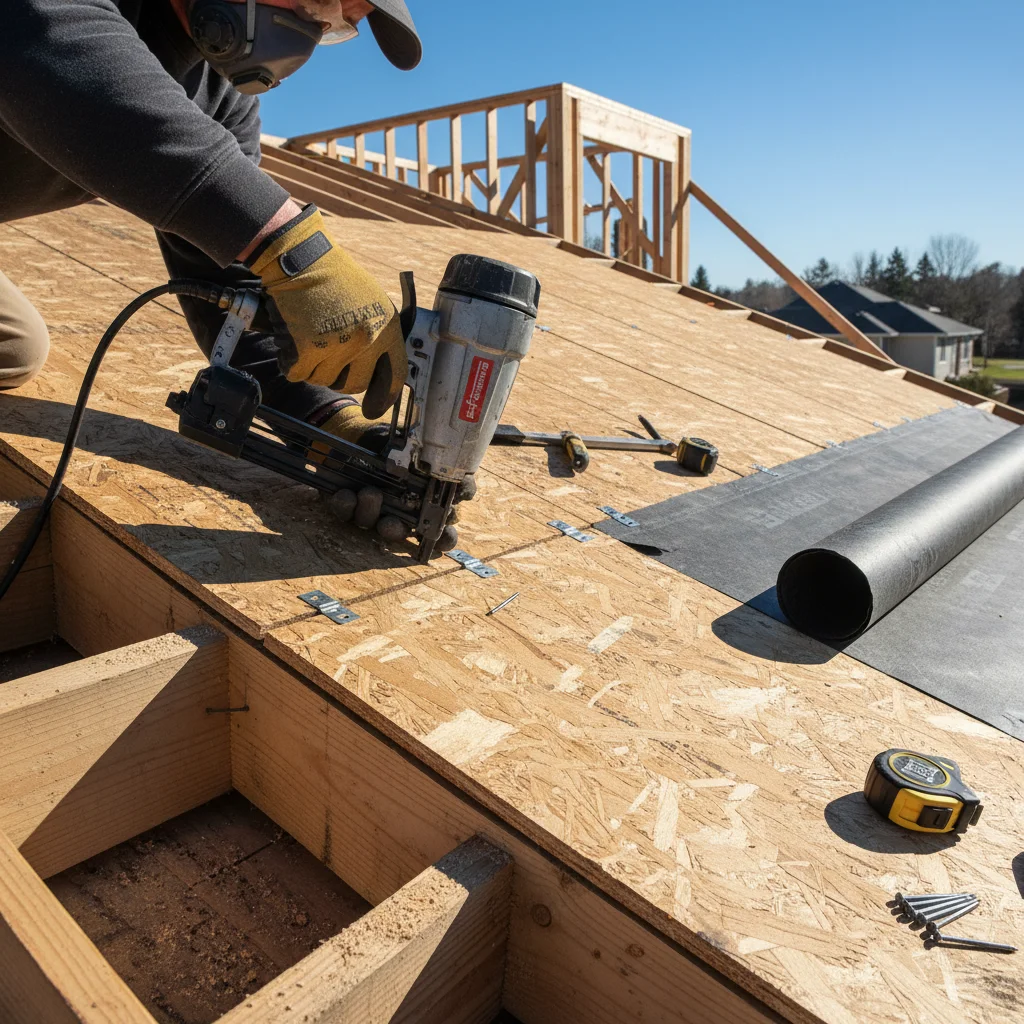
Nail withdrawal tests show surprising results. Engineers measure the force needed to pull fasteners out of panels. Plywood wins in most dry conditions. This happens despite OSB having higher specific gravity. Denser material doesn’t always grip better.
Withdrawal Strength by the Numbers
Plywood beats OSB for plain, screw, and ring shank nails in dry-dry testing. Both materials share the same recommended allowable values. Engineers use specific gravity 0.40 for plain and screw shank nails. Ring shank nails require 0.70. Wet conditions change the game. Use a 0.75 adjustment factor for moisture exposure.
Independent studies show mixed results. One University of Illinois test found OSB and waferboard matched or beat CD-grade plywood after 6-cycle aging. Another study found the same withdrawal strengths for both materials. OSB’s variable density profile causes these mixed results.
Head Pull-Through Performance
Panel thickness matters more than density here. Pull-through capacity increases as panels get thicker. Test data shows big differences:
-
0.594-inch OSB with 8d common nail: 722 lb capacity
-
0.728-inch plywood with 8d common nail: 360 lb capacity
OSB’s high-density face layers stop nail heads from breaking through. Plywood’s uniform structure can’t match this performance. Wet-to-dry ratios range from 0.68 for 9.5mm plywood to 0.91 for 12mm OSB.
Edge Fastening Reality
Plywood reduces edge splitting. Nails and screws hold better along panel edges. This matters during installation. OSB edges crumble more if fasteners go in too close. Thicker panels help—1/2-inch OSB shows 37-58% higher withdrawal resistance than 7/16-inch versions.
Moisture cycling affects fasteners in both materials. OSB swells 3mm at 85% humidity. Plywood expands just 1mm. The extra swelling pushes fasteners outward. They never regain full grip after drying.
OSB vs Plywood: Cost and Material Efficiency
Price tags show the first big difference between OSB and plywood. OSB runs 15–30% cheaper across most uses. A standard 4×8 sheet of construction-grade OSB cost around $6 in 2018. Plywood hit $10 for the same size. Recent markets show OSB at $10–$25 per sheet. Plywood climbed to $16–$24. Premium grades reach $144–$320 per sheet ($4.50–$10 per square foot).
The thickness gap makes the cost difference bigger. Half-inch plywood costs more than three times what you’d pay for 7/16″ OSB. Even 3/8″ plywood runs 2.5 times higher than 7/16″ OSB. October 2024 Canadian pricing shows 7/16″ OSB at C$460 per thousand square feet. Compare that to 3/8″ plywood at C$660. OSB comes in about 30% cheaper.
Material Efficiency Beyond Sticker Price
OSB panels stretch up to 16 feet long. Plywood maxes out at 8–10 feet. This size advantage cuts waste big time on long wall runs and roof spans. Fewer seams mean 20–30% less material loss during installation. You make fewer cuts. Less scrap ends up in the dumpster.
Whole-house sheathing projects show real savings. OSB totals $1,700–$4,400 depending on square footage. Plywood runs $2,800–$4,200 for similar coverage. Large structural jobs—roofs, floors, exterior walls—turn these savings into thousands of dollars. Volume pricing adds up fast.
Weight tells another story. Plywood’s lighter panels cut shipping costs per cubic foot. But OSB’s larger sheets mean fewer delivery trips. The heavier OSB needs more labor during installation. Check your handling costs against material savings for your project size.
OSB vs Plywood: Weight Considerations
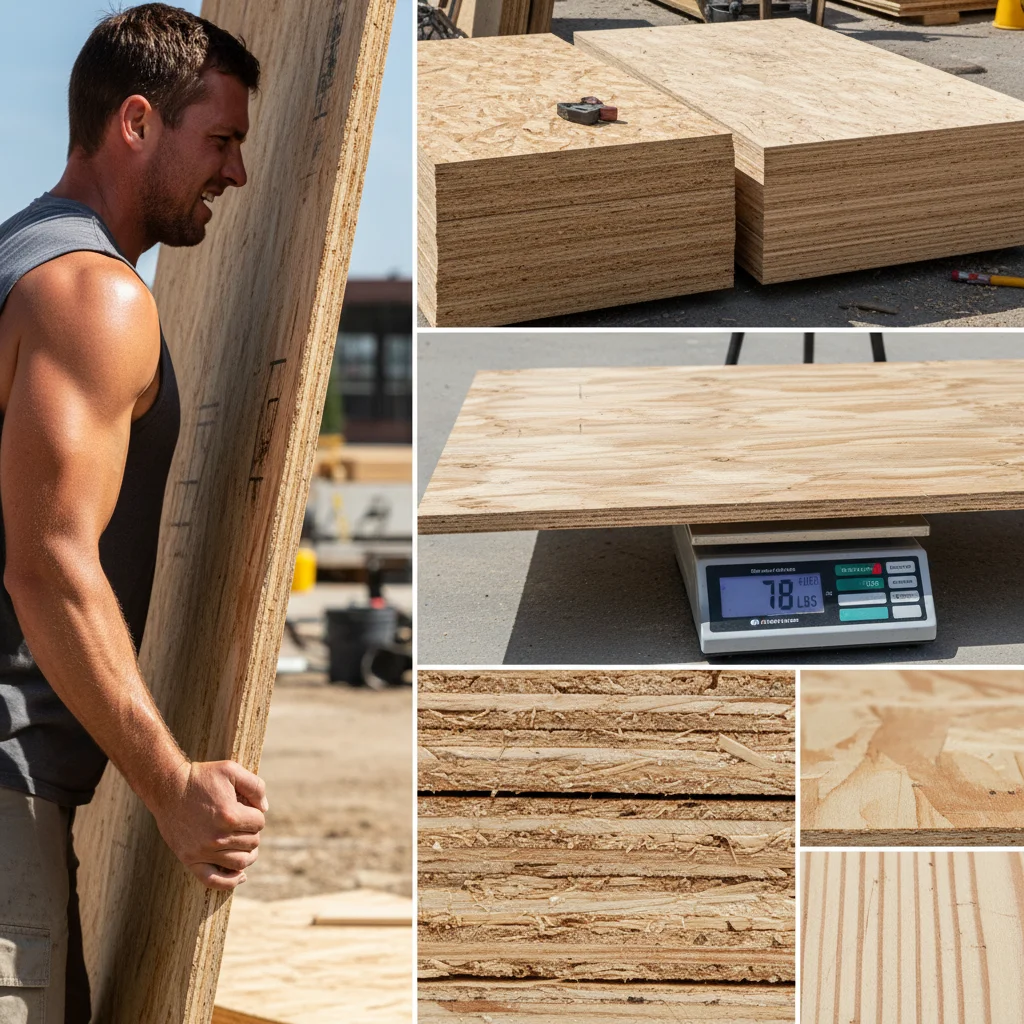
OSB weighs more than plywood. You’ll notice this the moment you lift your first sheet. A standard 23/32-inch OSB panel weighs about 78 pounds. The same-sized plywood sheet tips the scales at 67 pounds. That’s an 11-pound difference, or about 15-19% heavier for OSB.
The density numbers show why. Plywood sits at 34-36 pounds per cubic foot (specific gravity 0.57). OSB hits 38-42 pounds per cubic foot (specific gravity 0.62). Compressed wood strands pack tighter than plywood veneers.
Check out the weight across different thicknesses:
|
Thickness |
Plywood Weight |
OSB Weight |
Difference |
|---|---|---|---|
|
1/4″ |
22.1 lbs |
30.7 lbs |
+39% |
|
3/8″ |
35.8 lbs |
40.0 lbs |
+12% |
|
1/2″ |
45.4 lbs |
53.4 lbs |
+18% |
|
5/8″ |
50.0 lbs |
66.6 lbs |
+33% |
|
3/4″ |
60.8 lbs |
80.0 lbs |
+32% |
Thicker panels show a bigger weight gap. A 3/4-inch OSB sheet hits 80 pounds. Plywood stays at 61 pounds. Take this across a 1,000 square foot roof. OSB adds 10-15% more dead load to the structure.
Handling and Installation Reality
Overhead work takes the biggest hit from OSB’s extra weight. Roofers have a tough time lifting those 78-pound panels above their heads. Plywood’s 67 pounds feels easier to manage after hours of work. Multi-story projects show real fatigue differences.
Wall sheathing has similar issues. OSB’s bulk puts strain on crane loads and vertical lifts. Workers move slower. Plywood’s lighter build speeds up installation. Plus, better nail holding power cuts down on fastener adjustments.
Transport costs go up with OSB. That 16% weight increase per sheet piles up across truckloads. Delivery charges rise. Fuel costs increase. Plywood ships more easily despite costing more upfront.
OSB has one plus—consistent thickness. True 5/8-inch OSB measures just that. Plywood’s 19/32-inch version runs a bit thinner. But this precision doesn’t make up for the handling challenges on most job sites.
OSB vs Plywood: Environmental Sustainability
Forest health starts with the trees we cut. OSB makers use fast-growing, small trees—often wood that would go to waste. Plywood needs larger, mature trees that take decades to grow. This basic difference affects the whole sustainability picture.
Raw Material Efficiency
OSB saves 95% of each log. Those compressed wood strands use everything—tops, limbs, thinnings. Plywood peels veneers from prime logs. The rotary lathe needs straight, defect-free wood. Crooked or knotty sections get thrown away.
Fast-growth aspen and poplar regrow in 20-30 years. Compare that to 50-80 years for veneer-grade pine or fir. OSB production eases pressure on old-growth forests. But here’s the catch—mature trees store more CO2 during their longer lives.
Carbon Footprint Reality
NIST BEES lifecycle data shows plywood wins the emissions fight. Plywood manufacturing releases less CO2, SOx, NOx, and particulate pollution. The simpler process uses less energy. Plywood plants run cooler presses. Glue cures faster.
OSB production burns more fuel. Those massive multi-opening presses heat to 150°C. Dense strand compression needs higher pressure—1.38 MPa sustained. Energy costs climb.
Both industries cut emissions through smart fiber use. Modern plants capture 99% of VOCs using thermal oxidizers. But plywood’s lower baseline gives it the edge.
Indoor Air Quality Impact
Plywood’s veneer structure releases fewer volatile organic compounds. M1-rated WISA plywood meets Finland’s toughest emission standards. Public buildings choose M1 materials for health reasons.
OSB’s porous strand matrix traps more resin. Those phenol-Formaldehyde adhesives release gas longer. No OSB products carry M1 classification. Formaldehyde levels stay higher for months after you install it.
Certification & Transparency
WISA plywood provides Environmental Product Declarations (EPDs). These detail full lifecycle impacts. FSC certification tracks wood from forest to panel. OSB makers seldom publish similar data. Fast-growth sourcing helps forest management. But transparency falls behind plywood’s proven sustainability practices.
OSB vs Plywood: Application & Performance Comparison
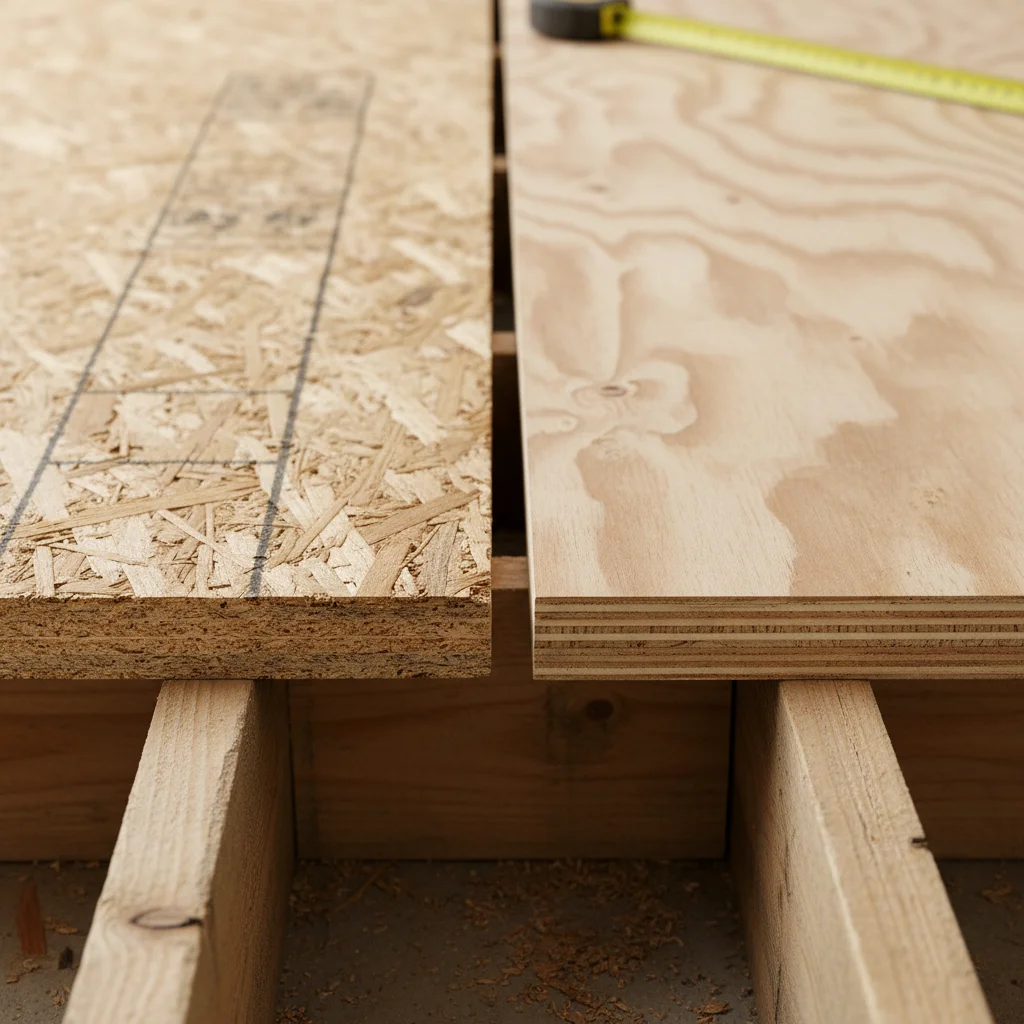
|
Category / Use Case |
OSB (Oriented Strand Board) |
Plywood |
|---|---|---|
|
Primary Positioning |
Cost-effective structural panel |
Precision, stability & finish quality |
|
Material Cost |
✅ 15–30% lower than plywood |
❌ Higher upfront cost |
|
Full-House Sheathing Cost |
USD 1,700–4,400 |
USD 2,800–4,200 |
|
Shear Strength |
✅ Excellent, load spreads evenly |
⚠️ Natural grain creates weak spots |
|
Strength Consistency |
✅ Uniform across entire panel |
⚠️ Knots and grain variation |
|
Maximum Panel Size |
✅ Up to 16 ft |
❌ Typically 8–10 ft |
|
Installation Speed |
✅ Faster, fewer joints |
⚠️ More seams |
|
Wall & Roof Sheathing |
✅ Preferred choice |
⚠️ Functional but higher cost |
|
I-Joist Web Material |
✅ Stable and consistent |
✅ Better moisture resistance |
|
Delamination Risk |
✅ No veneer separation |
❌ Can delaminate in humidity |
|
Subfloor (Budget Projects) |
✅ Suitable at ≥22 mm thickness |
✅ Higher stiffness |
|
Stiffness (Same Thickness) |
❌ ~10% lower |
✅ ~10% higher |
|
Floor Deflection Control |
⚠️ Acceptable in low-traffic areas |
✅ Reduces floor bounce |
|
Moisture Expansion (85% RH) |
❌ ~3 mm swelling |
✅ ~1 mm swelling |
|
Dimensional Recovery After Drying |
❌ Limited |
✅ Near original size |
|
Bathrooms & Kitchens |
❌ Not recommended |
✅ BWR / BWP grades |
|
Coastal & High-Humidity Areas |
❌ Risky |
✅ Marine plywood preferred |
|
Tile Underlayment |
❌ Not acceptable |
✅ Industry standard |
|
Premium Flooring Base |
⚠️ Inconsistent |
✅ Flat and stable |
|
Furniture & Cabinetry |
❌ Rough surface |
✅ Clean face & edges |
|
Visible Interior Panels |
❌ Not suitable |
✅ Architect-specified |
|
Machining & Edge Quality |
⚠️ Rough edges |
✅ Clean cuts |
|
Concrete Formwork |
❌ Limited reuse |
✅ 5–10 reuse cycles |
|
Fire-Rated Applications |
❌ Less effective |
✅ Better fire-retardant penetration |
|
Industrial & Transport Use |
⚠️ Limited durability |
✅ High impact strength |
|
Automotive Interiors |
❌ Rarely used |
✅ Widely used |
|
Urban Renovation Projects |
⚠️ Heavier handling |
✅ Lighter panels |
|
Weight Difference (Per Sheet) |
— |
✅ ~11 lb lighter |
|
Seismic & Wind Code Compliance |
⚠️ Limited |
✅ Easier compliance |
|
Long-Term Stability |
⚠️ Moderate |
✅ High |
|
Typical Regional Preference |
New large-scale construction |
Renovation & premium projects |
Decision Matrix: How to Choose the Right Panel for Your Project
Every project has unique needs. This framework takes the guesswork out of OSB vs. plywood. The matrix below turns scattered facts into one clear tool.
Building Your Decision Framework
Start with these six criteria. Assign 10 points total across them based on what matters most:
Moisture exposure (0-3 points): Rate your humidity and water contact risk. Coastal builds and bathrooms need maximum points here. Dry interior walls take minimum points.
Budget constraints (0-2 points): Add up material costs plus labor. OSB saves 15-30% upfront. But humid zones need extra sealing, which adds cost.
Structural requirements (0-2 points): Check your load-bearing needs. Wall sheathing works well with OSB’s shear strength. Floor joists need plywood’s stiffness. This prevents bounce.
Installation conditions (0-1 point): Think about weather exposure during construction. Open sites in rainy seasons need plywood’s moisture recovery.
Finish quality (0-1 point): Visible surfaces or paint-grade work? Plywood’s smooth face wins. Hidden structural use? OSB works fine.
Long-term performance (0-1 point): Think about your climate’s wet-dry cycles. Plywood holds its shape better through seasonal changes.
Scoring Your Options
Use this 1-5 scale for each criterion:
-
5 points = Excellent performance for your specific need
-
3 points = Adequate performance with minor trade-offs
-
1 point = Poor fit needing major fixes
Example calculation for a bathroom subfloor:
|
Criterion |
Weight |
OSB Score |
OSB Weighted |
Plywood Score |
Plywood Weighted |
|---|---|---|---|---|---|
|
Moisture exposure |
3 |
2 |
6 |
5 |
15 |
|
Budget |
1 |
5 |
5 |
3 |
3 |
|
Structural needs |
2 |
3 |
6 |
4 |
8 |
|
Installation |
2 |
2 |
4 |
4 |
8 |
|
Finish quality |
1 |
2 |
2 |
5 |
5 |
|
Long-term |
1 |
2 |
2 |
5 |
5 |
|
Total |
10 |
— |
25 |
— |
44 |
Plywood’s 44 total beats OSB’s 25 for this wet-area job. The moisture weighting drives the outcome.
Quick Decision Rules
Choose OSB:
– Budget cuts matter ($700+ savings on average homes)
– You’re sheathing walls or roofs in dry climates
– Installation happens in controlled, dry conditions
– Panels stay hidden behind finishes
– You need 16-foot lengths to reduce seams
Choose plywood:
– Moisture stays above 50% relative humidity most of the time
– You’re installing tile or premium flooring
– Visible surfaces need clean appearance
– Projects sit exposed during construction delays
– Fastener holding power affects safety
– You’re building in coastal or humid regions
Run your numbers through this matrix before ordering materials. The highest weighted score shows your best choice—not just the cheapest price tag.
Conclusion
OSB vs plywood – this choice doesn’t need to be complicated. Both materials work well for different needs. OSB gives you steady performance at a lower cost. Plywood handles moisture better and looks cleaner for visible work.
Which one wins? The one that fits your project. Subfloors, roof sheathing, and structural work where cost matters? OSB makes sense. Building furniture, cabinetry, or working in damp spaces? Plywood is worth the extra money.
Before you head to the store, think about these factors:
– Your local climate
– Will the material be exposed or covered?
– Your budget
– Your project timeline
Sometimes the “best” material is just the one you can get now that fits your schedule.
What’s next? Take these points to your local lumber yard. Talk with the pros there about your specific project. Make a choice that’ll work well for years ahead.