
You’ve seen those panels with wood strands running in specific directions. Maybe you’re building your first shed or choosing materials for a commercial job. Those panels are OSB—Oriented Strand Board. This material has changed how we build subfloors and roof decking.
Here’s the thing: not all OSB boards work the same way. Pick the wrong type and you’ll waste time and money. Worse, you might end up with structural problems.
This guide shows you what OSB board really is. You’ll learn how different grades compare. You’ll see where OSB beats plywood and where it falls short. Most important, you’ll know which OSB spec fits your project.
By the end, you’ll understand OSB better than most lumber yard staff. You’ll make smarter choices that save you money.
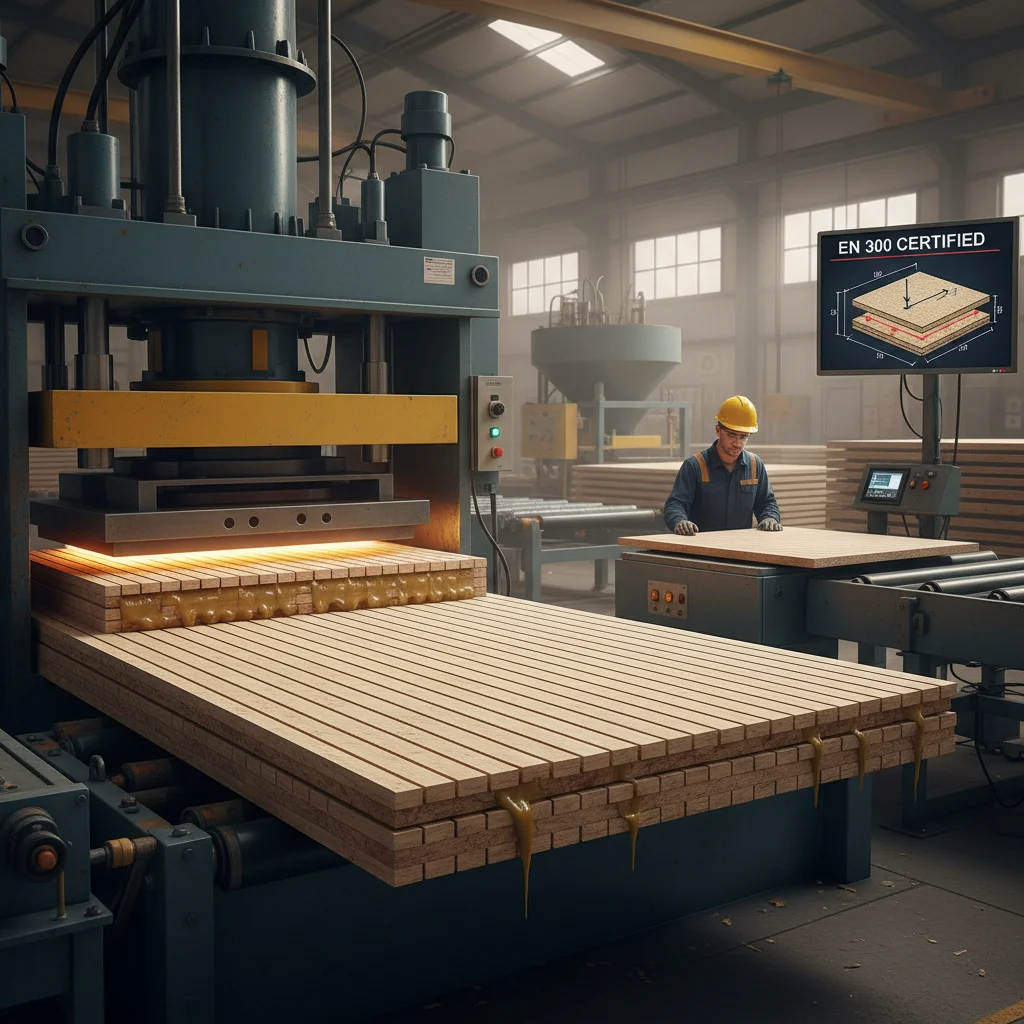
Types of OSB Boards and Their Specifications
The construction industry divides OSB into clear categories. These match real job needs. European standards define four grades: OSB1, OSB2, OSB3, and OSB4. Each grade gets stronger and resists moisture better.
OSB1 works for general interior jobs in dry spaces—think closet shelving or workshop projects. OSB2 carries loads in bone-dry conditions. OSB3 rules the construction market. It bears loads in humid spaces. Most wall sheathing and roof decking uses OSB3. OSB4 takes on heavy-duty jobs. High loads and moisture? This grade handles both.
North American standards work differently. The APA Rated Sheathing classification covers three uses: floors, walls, and roofs. Span ratings appear stamped right on the panel—12, 16, 20, 24, 32, 40, or 48 inches on center. These numbers show the maximum joist or stud spacing.
APA Rated Sturd-I-Floor changes floor systems completely. This single-layer panel puts subfloor and underlayment together. You skip a whole installation step. Span ratings run 16, 20, 24, 32, or 48 inches on center. The 48 oc rating handles 65 psf total load. That’s different from the standard 100 psf live load plus 10 psf dead load.
APA Rated Siding brings OSB to exterior walls. Span ratings sit at 16 or 24 inches on center. Structural I panels give you top bending stiffness. Extra strength matters for your project? Earthquake zones or high-wind areas need this grade.
Panel marks use simple codes. F means floor sheathing. R marks roof sheathing. W shows wall sheathing. A 1 after the letter means the panel stands alone as structure. A 2 means you need non-structural sheathing beneath it for support.
Common thicknesses range from 7/16 inch (perfect for studs at 24 inches o.c.) up to 1-1/8 inches for heavy-duty floors. Each thickness matches specific load ratings. Installation requirements appear stamped on every certified panel.
OSB Board Applications in Construction
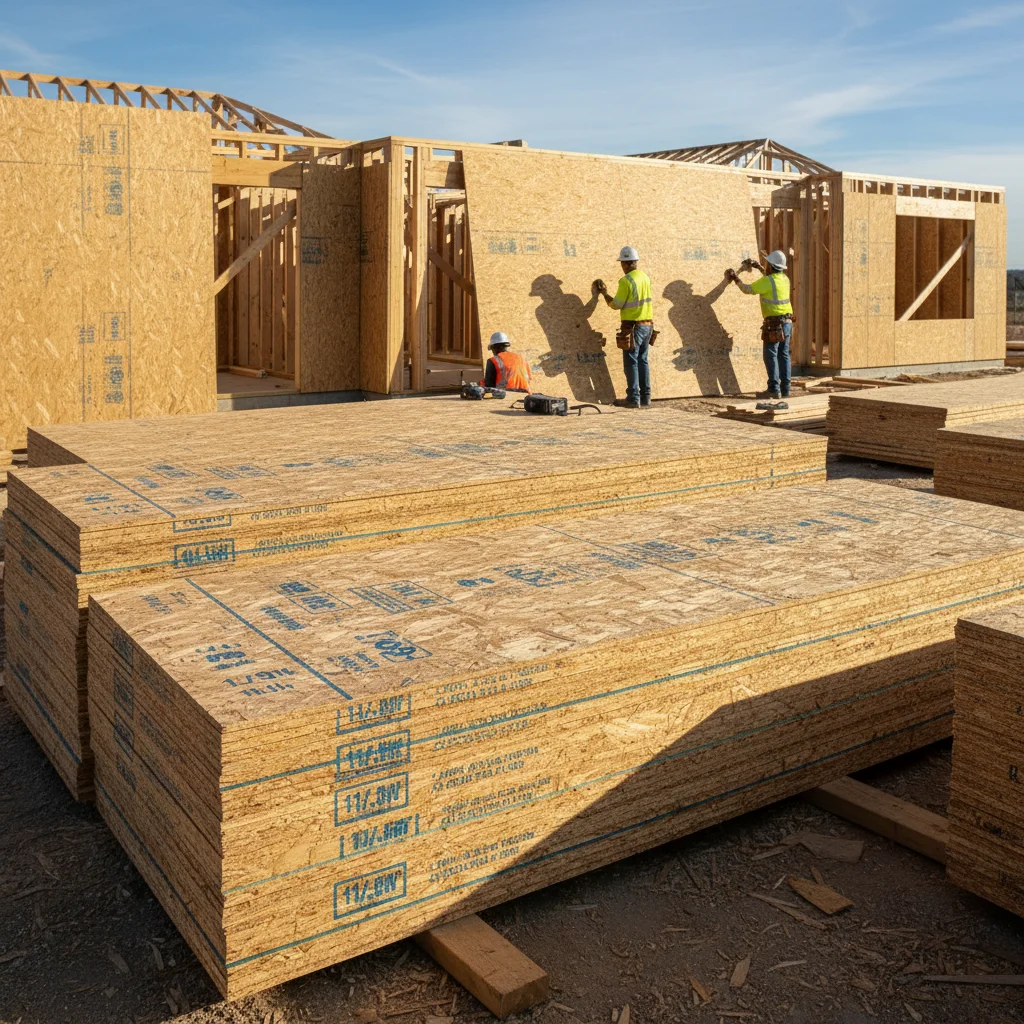
Builders consumed $9.8 billion worth of OSB in North America during 2024. That number jumps 7% each year through 2033. The global construction segment drives over 40% of total OSB demand. The market pushes from $35 billion in 2025 toward $50 billion by 2033. These numbers show OSB’s grip on modern construction methods.
Three applications dominate the field: floor systems, wall sheathing, and roof decking. Together they account for most OSB sales. Each application has specific installation steps. These steps determine how well the structure performs.
Floor Systems and Subfloor Installation
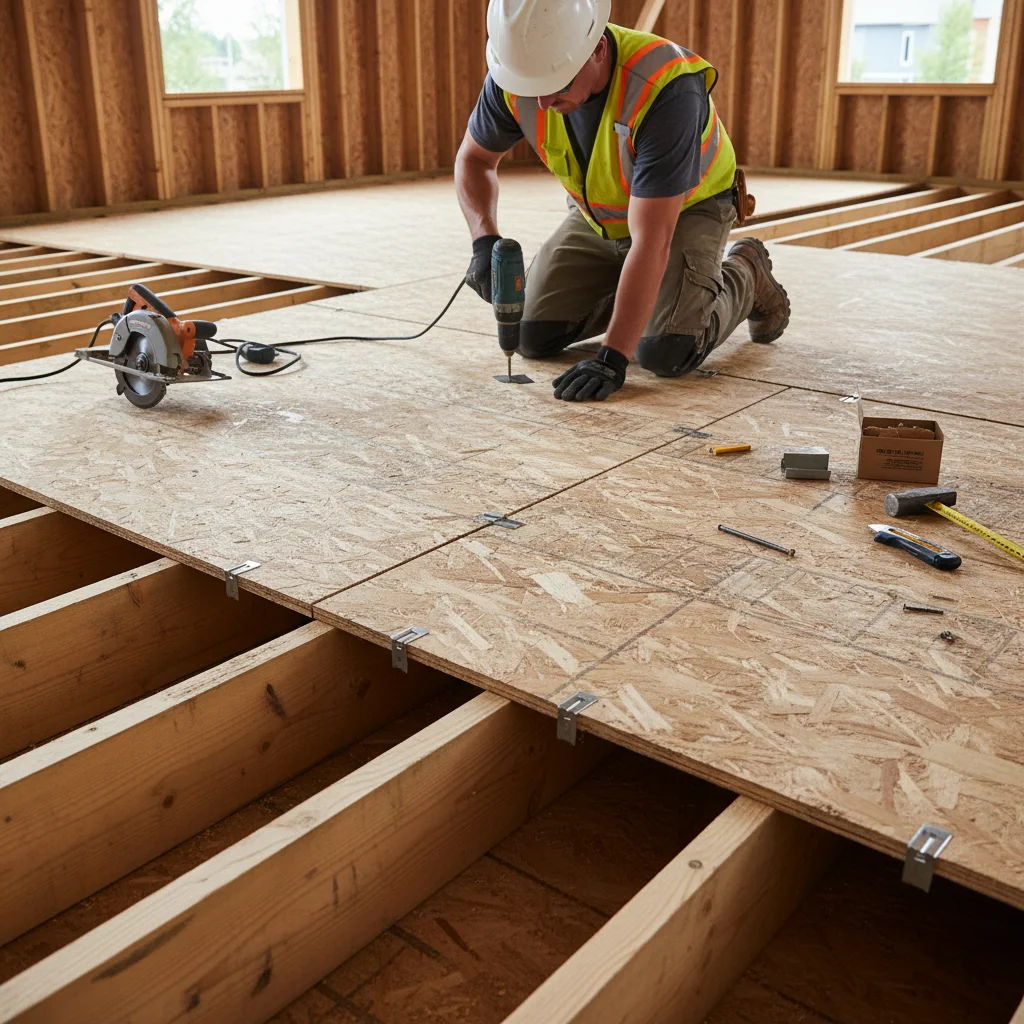
Single-layer flooring systems replaced old two-layer setups in most homes. OSB/3 handles the load-bearing demands without Extra underlayment beneath carpet or vinyl. Most jobs use 19/32-inch (15mm) panels for joists at 16 inches on center. Bump the spacing to 24 inches OC? Switch to 23/32-inch (18mm) thickness.
You need precision during installation. Position panels with the strength axis perpendicular to joists. Leave 1/8-inch gaps between panels to allow expansion. Edge support matters—you need 6 inches of solid bearing at every panel edge. Put construction adhesive along joists. Then fasten panels with 10d ring-shank nails or #8 screws every 6 inches at panel edges and 12 inches in the field.
Load performance follows APA standards. A 23/32-inch OSB/3 panel spans 19.2 inches under 40 psf live load. Maximum deflection stays at L/360. That’s the difference between a solid floor and one that feels bouncy. Most home floors support 100 psf live load across standard spans.
Wall and Roof Sheathing Systems
Wall sheathing puts panels perpendicular to studs. Frame spacing runs 16 or 24 inches on center. Nail spacing tightens at panel edges: 6 inches along perimeters, 12 inches in the field zone. Use 10d common nails or approved fasteners rated for your wind zone.
Roof decking follows similar patterns but carries different loads. 7/16-inch OSB/3 works for rafters at 24 inches OC in most home zones. Wind uplift resistance reaches 100 to 160 psf with proper nailing schedules. High-wind coastal areas? Step up to Structural I panels and tighter fastener spacing.
Exterior jobs need moisture management. Tape seems to create a continuous air barrier. This detail cuts energy loss. It also prevents condensation inside wall cavities. The OSB/3 grade resists moisture better than interior grades. But it’s not waterproof—cover it within normal exposure periods.
Engineered Structural Components
I-joists put OSB to work as structural webs. The webs measure 3/8 to 1/2 inch thick. Solid lumber flanges sandwich them. These assemblies span 30+ feet for floor systems. They weigh less than dimensional lumber. The OSB web resists shear forces. The flanges handle bending stresses.
Rim boards replace stacked dimensional lumber at floor edges. 1-1/4 to 1-1/2-inch thick OSB panels match I-joist depths. They transfer loads from walls to floor systems. Installation goes faster—one continuous panel instead of blocking between joists.
Structural insulated panels (SIPs) sandwich rigid foam between 7/16-inch OSB skins. R-values run 15 to 40 depending on core thickness. These panels form load-bearing walls and roofs. They cut traditional framing needs by 50%. A crew sets wall panels in hours, not days.
The economics favor OSB across all uses. Material costs run 20-30% below plywood for equal structural performance. OSB/3 panels average $40 to $60 per 4×8-foot sheet. Standard plywood sheathing costs $55 to $85 for similar grades.
Key Advantages of OSB Board
OSB board saves you money and time. Production costs run 15-30% lower than plywood. Strand-alignment software and precision resin dosing create that gap. These technologies cut waste and keep quality high. Louisiana-Pacific earned USD 267 million in OSB revenue during Q1-2025 even as prices dropped 11%. Builders shifted from plywood to OSB. The cost difference drives that switch.
Structural Performance That Eliminates Extra Work
Strength spreads evenly across every panel. Plywood has weak spots where knots break up grain patterns. OSB doesn’t have that issue. Shear strength and racking resistance take the place of diagonal bracing in wall assemblies. Your framing crew skips extra cuts and fasteners. This saves days off labor schedules.
Nail-holding capacity stays the same from edge to edge. No soft spots. No surprises during setup. This reliability backed the 7% rise in North American home housing starts in 2024. Builders trust OSB because callbacks drop. Squeaky floors disappear. Subfloor panels perform the same across every sheet.
Market Position Proves Real-World Value
OSB owns 69.45% of the structural panel market in 2025. That number climbs at 4.31% each year through 2031. The OSB/3 grade alone captures 46.85% market share. It’s the fastest-growing segment at 4.58% CAGR. Wall sheathing brings in the most revenue and volume. Shear strength and size stability explain why.
Size Stability Speeds Setup
Larger panels span greater distances. This helps meet wind-uplift codes in coastal areas. Tighter size tolerances mean prefab wall panels fit together faster on site. Even density from controlled pressing stops the warping and cupping that hits solid lumber. Your setup crew moves faster. Fewer adjustments. Fewer callbacks.
Better Moisture Resistance
Advanced resin systems boost moisture resistance beyond traditional plywood. Modern OSB fights edge swelling better than older types. It handles job-site exposure during normal construction schedules. Pest resistance beats plywood too. The manufacturing process leaves nothing for insects to eat.
Price Stability You Can Plan Around
Lumber markets swing over USD 100 per cubic meter on a regular basis. OSB prices handle those swings better than dimensional lumber. You lock in material costs up front. Budget certainty matters on projects that stretch six months or longer.
Production scale supports these benefits. RoyOMartin’s expansion built North America’s largest OSB mill. That capacity keeps housing projects moving. SWISS KRONO’s plant produces 720,000 cubic meters each year from 100% recycled wood. That scale brings cost efficiency down to you.
OSB vs Plywood: Detailed Comparison
Plywood dominated construction sites for decades. OSB changed that. Both materials now sit side-by-side in lumber yards. The choice isn’t as simple as picking the cheaper option.
Shear strength favors OSB. Through-thickness shear values run 2 times greater than plywood. This matters for shear walls that resist side forces. Edge shear strength gives OSB the edge here. Your walls handle wind and earthquake loads better with OSB.
Stiffness tells a different story. WISA-Spruce plywood rates 1.8 times stiffer than OSB/3 based on how much it bends under pressure. Yet OSB feels stiffer on the job site. Why? It stays consistent. OSB performs the same across every panel. Plywood varies. One sheet flexes more than another. That 7% stiffness gap doesn’t show up under your feet the way you’d expect.
Impact resistance and fastener grip favor plywood. Nails and screws hold firmer in plywood’s layered structure. OSB’s strand makeup creates weaker fastener hold. This gap matters for subfloors. Plywood gives you a more stable surface with less flex underfoot. Both materials perform the same in shear wall tests, though. Fastener hold controls the outcome in those cases.
Water changes everything. At 85% relative humidity, 18mm plywood expands about 1mm. The same conditions push OSB/3 to 3mm expansion. OSB swells more at panel edges. Worse, it doesn’t return to its original size after drying. Plywood dries faster. It holds its shape. Long-term tests show plywood coming apart in layers while OSB stays intact. But plywood handles moisture better. This makes it the safer pick where water exposure happens.
Texas Department of Insurance and multiple lumber makers recommend OSB for high-humidity areas. Testing and real-world use back that claim. Wet climates? Stick with plywood for lasting results.
Weight and thickness create handling differences. A 3/4-inch Sturd-I-Floor plywood sheet weighs 70 pounds. The OSB version hits 80 pounds. For flooring, 18mm plywood gets the job done. You need minimum 22mm OSB for the same strength. Thinner plywood panels mean lighter structures. They’re easier to install too.
Price drives most decisions. OSB runs 15-30% cheaper than plywood in current markets. A 2,500 sq ft house saves $700 using OSB sheathing instead of plywood. But remember 2021? OSB prices jumped 510% since January 2020. Some products hit 650-662% increases. Plywood climbed half that rate. OSB’s price swings add risk to long-term project budgets.
Installation Methods match up. Same H-clips. Same blocking. Same single-layer system tips. The difference shows up in how they perform, not how you install them.
Where OSB Doesn’t Work
OSB board has limits. The strand structure gives it strength but makes it vulnerable to water.
Edge Swelling Won’t Fix Itself
Edge swelling is OSB’s main weakness. Water hits an exposed edge. The strands swell up. They stay that way after drying. Factories coat the edges to prevent this. But each cut you make on site exposes raw wood. That fresh edge absorbs moisture fast.
Leave OSB in the rain before sealing those cuts? You get permanent thickness changes. The panel won’t sit flat. Attics without vents and crawlspaces with bad airflow do the same damage over months. High humidity works on those edges. The board swells. It never goes back.
Seal cut edges right away. Use edge sealer or construction adhesive. Don’t put it off. Rain won’t wait for you.
Surface Problems and Tile Issues
The rough texture makes OSB a poor choice under tile. The National Tile Contractors Association says OSB is “not acceptable” for ceramic tile. Here’s the problem: OSB handles stress in a different way than smooth surfaces. Moisture reaches the board under tile. It swells. This movement cracks the grout. Tiles pop loose. Failure is guaranteed.
The rough surface limits what you can do for finishing. Paint doesn’t work on OSB like it does on plywood. The texture bleeds through. You need primer and sanding first. Results still look worse than plywood.
Building Codes and Regional Bans
Dade County, Florida banned OSB for roof decking. Hurricane tests found problems with nail-holding in extreme winds. The ban remains despite APA research showing OSB meets code requirements. Coastal areas with high winds take the same approach. Check your local codes before using OSB for roofs in hurricane zones.
The National Roofing Contractors Association warns about size changes in roof uses. OSB roof decking gets far more complaints than other applications. Shingle warranties cover OSB and plywood equally. But complaints keep piling up.
How to Store and Handle OSB
OSB needs more care than plywood in storage. Stack it off the ground. Cover the whole pile—not just the top. Water between panels causes edge swelling before installation.
Check quality before buying. Look for these red flags:
– Edge coating with gaps or damage
– Panels that feel softer than others
– Past moisture damage—check for corner swelling
Products like AdvanTech cost more but resist moisture better. The extra cost pays off in humid areas or long projects. Standard OSB/3 works in dry conditions with good protection. Wet job sites need better materials.
Never use OSB for ground contact. The board has fungicides like zinc borate and oxine copper. These slow down decay. They don’t prevent it. Fungi grow on OSB in the right conditions. Ground contact gives them those conditions.
Fire creates another risk. Burning OSB puts out Formaldehyde at 280 times NIOSH safe limits. Fire training centers document this in practice burns. Real house fires show lower levels that still pose danger. Firefighters and residents face real health threats.
Picking the Right Material
Use OSB for protected walls and floors in normal conditions. Go with plywood for tile work, damp spaces, and spots where you can’t seal cuts right away. The 15-30% you save with OSB vanishes after you handle callbacks and fix moisture damage.
How to Choose the Right OSB Board for Your Project
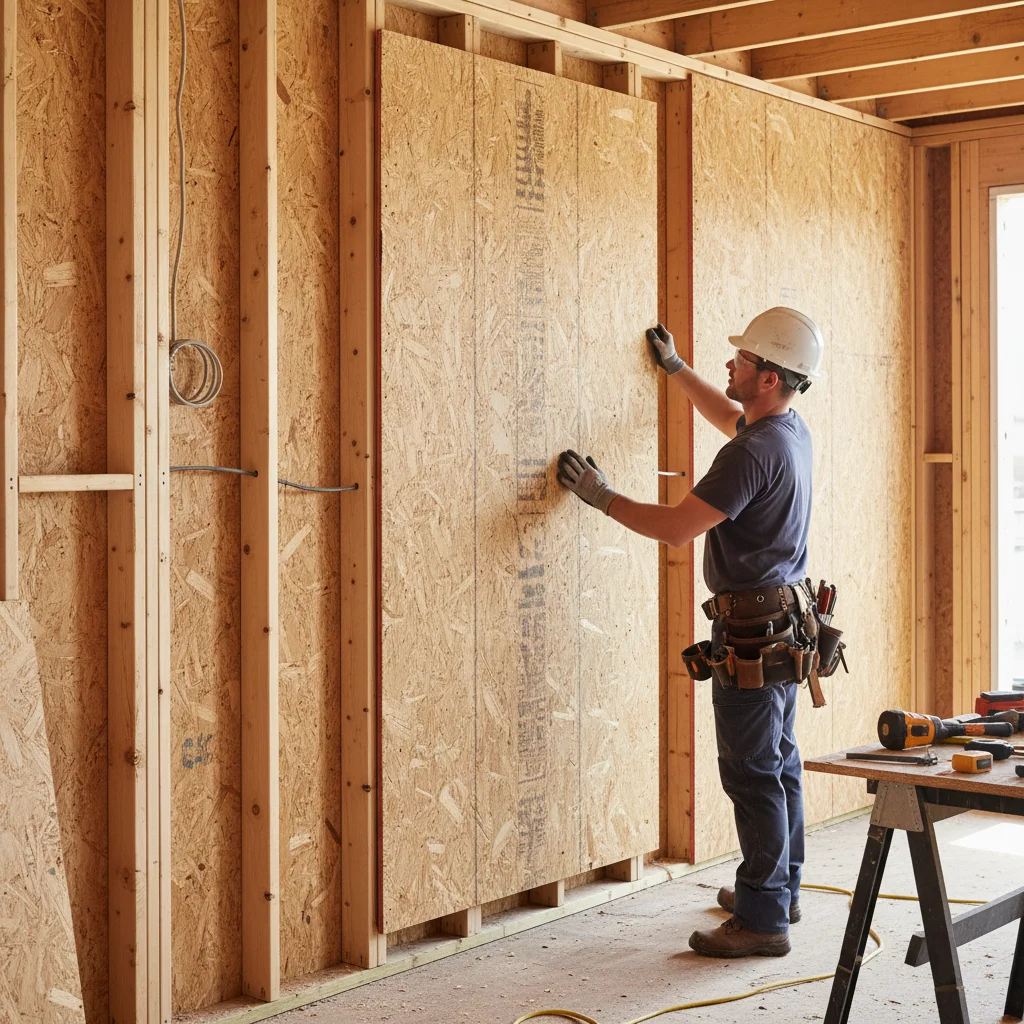
Match your board to what you’re building. Three factors narrow your choices: where you install it, what load it carries, and how much water it sees.
Location sets your baseline grade. Indoor shelving with zero moisture? OSB1 works fine for display boxes or light furniture. You’ll save money on non-structural work. Bedframes, sofas, or storage cabinets that carry real weight? Step up to OSB2. It handles loads in dry spaces. Skip OSB1 for anything that bears weight. You’ll create problems later.
Most construction jobs need OSB3. This grade owns the structural market for good reason. It handles occasional moisture. It carries full loads. Roof decking, wall sheathing, and floors in normal conditions—OSB3 covers them all. The 18mm T&G panels lock together for subfloors. The tongue-and-groove edges stop movement between panels.
Heavy-duty jobs demand OSB4. Industrial flooring takes constant foot traffic and equipment loads. Exterior walls face rain and humidity year-round. The phenolic glue in OSB4 resists water like marine plywood. You pay more—about 30-40% over OSB3—but callbacks disappear.
Thickness Locks In Performance
Thin panels sag. Thick panels cost extra. Here’s where each thickness works:
-
6-9mm: Lightweight backing, non-structural panels (OSB1/OSB2)
-
9-15mm: Interior load-bearing walls, light furniture frames (OSB2/OSB3)
-
15-18mm+: Floors, roofs, structural walls (OSB3/OSB4 required)
Floor systems need 18mm minimum for joists at 400mm centers. Roof decking? 15mm OSB3 spans 600mm between rafters without sagging. Wall sheathing runs thinner. 9-11mm panels give you racking resistance at 400-600mm stud spacing.
Standard sheets measure 1220x2440mm (the metric 4’×8′). Larger 1250x2500mm panels cover more area with fewer seams. Need custom sizes? Mills cut panels up to 8’×24′ for commercial jobs.
Application Matching Saves Time
|
Your Project |
Pick This Grade |
Thickness Range |
Why It Works |
|---|---|---|---|
|
Indoor floors (dry) |
OSB2 |
18mm T&G |
Load-bearing, stable, cheaper than OSB3 |
|
Subfloors (normal homes) |
OSB3 |
15-18mm T&G |
Moisture-resistant, structural certified |
|
Wall sheathing |
OSB2 (dry) / OSB3 (coastal) |
9-15mm |
Shear strength, humidity protection |
|
Roof decking |
OSB3 / OSB4 (wet climates) |
15-18mm |
Water-resistant, no sag under snow loads |
Look for T&G edges on any floor panel 15mm or thicker. The interlocking edges stop squeaks and movement. Square-edge panels need blocking between every joist. That’s extra labor you don’t need.
Glue Type Controls Moisture Limits
Three adhesive systems define how boards handle water:
-
MR glue (moisture-resistant): OSB1, fails in wet conditions
-
Melamine resin: OSB2/OSB3, handles humidity but not continuous water
-
Phenolic resin: OSB4, marine-grade waterproofing for exterior use
The glue matters more than the grade number. OSB3 with melamine resin resists occasional rain during construction. OSB4 with phenolic resin handles year-round exterior exposure. Check the panel stamp. It lists both grade and adhesive type.
Certifications Cut Through Marketing
APA certification proves structural performance. The stamp shows span ratings, grade, and exposure class. European panels carry EN 300:2006 compliance marks. Building inspectors require these. They’re not optional.
Density numbers reveal quality. Standard OSB runs 650-720kg/m³. Higher density means better fastener hold and load resistance. OSB4 hits 700-720kg/m³. You feel the difference lifting it.
Budget Strategy Without Compromise
Sterling 11mm OSB3 costs £12-15 per sheet in bulk packs of 50. That same budget gets you 8-10 sheets of equivalent plywood. The math favors OSB for large projects. Sheathing a 2,500 sq ft house? You save £500-700 using OSB3 instead of plywood.
Don’t cheap out on grade to save £3 per sheet. Using OSB2 where you need OSB3 costs you more in callbacks. Water damage repairs run £200+ per affected area. Structural failures? Those hit £1,000+ factoring in labor.
DIY projects under 20 sheets? Price differences shrink. Pick the right grade first. Compare suppliers after. Buy OSB1 for craft projects. Grab OSB2 for indoor furniture builds. Stick with OSB3 for anything structural or exposed to weather.
Bulk suppliers stock 18mm OSB3 in 50-sheet packs for floors and roofs. That’s your sweet spot for cost-per-performance on big jobs. Need just 5-10 sheets? Local yards work fine. The convenience saves you time.
Conclusion
OSB board has become a construction powerhouse—and for good reason. This engineered wood product gives you consistent strength, moisture resistance, and cost savings. Traditional materials can’t compete on these fronts. You might be framing a new home, fixing up a garage, or comparing OSB to plywood. Knowing the different types and where each works best helps you make the right call.
Here’s what you need to know: OSB/1 works great for interior projects with little moisture. OSB/3 handles weather during construction. OSB/4? That’s your pick for tough, wet conditions that need industrial-grade strength.
The smart approach? Match your OSB board grade to what you’re building. Think about your local climate. Don’t cut corners on installation. Do this right, and your structure stays solid for decades.
Ready to start building? Measure twice. Order the right grade once. Build something that lasts. That’s the OSB advantage in action.