
Choosing between natural veneer MDF and engineered veneer isn’t just a materials decision — it’s a business decision. The wrong choice hits your project margins, client satisfaction, and long-term credibility as a buyer.
Get it wrong, and two things can happen. You overpay for premium grain aesthetics your application doesn’t need. Or you cut costs in ways that show up as warping, inconsistency, or unhappy clients six months later.
Most buyers make this call with incomplete information. This guide fixes that.
By the end, you’ll have a clear, side-by-side picture of how sliced natural veneer and reconstituted veneer differ — across:
Manufacturing logic
Visual performance
Durability
Pricing
Real-world application fit
Every purchase decision you make from here will be grounded in solid knowledge, not guesswork.
What Buyers Should Know
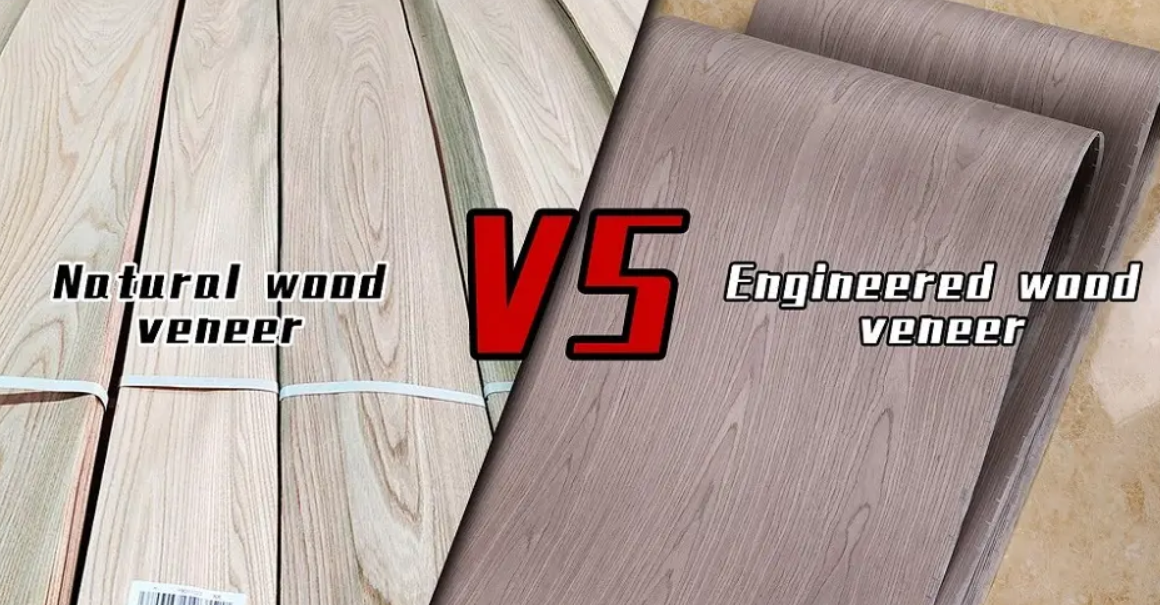
Smart buyers do one thing before committing to a material: they know what they’re comparing. This guide gives you that clarity.
Two distinct products. One clear breakdown:
Sliced natural veneer — cut in sequence from real logs, bundled in 24–32 sheets. Each piece carries its own knots, grain shifts, and color variations. No two sheets look alike.
Reconstituted veneer (engineered veneer) — made from real wood, but transformed through dyeing, recomposing, and precision manufacturing. The result: uniform, defect-free sheets every time.
Both work on an MDF core veneer board. Both count as decorative wood panels. But each one serves a different set of project needs.
The difference runs deep — across manufacturing process, visual performance, durability, cost, and where each material fits best. That’s what this guide covers.
No filler. No bias. Just the decision framework you need.
What Is Natural Veneer MDF? (And Why Buyers Pay a Premium)
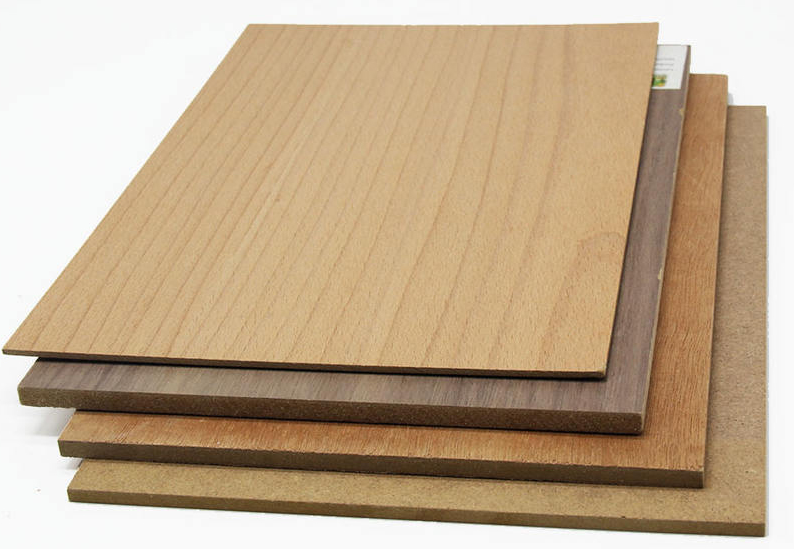
Real wood. Engineered stability. One product that delivers both.
Natural veneer MDF is what the name suggests — a thin slice of real hardwood (typically 0.5–1mm veneer thickness used in architectural wood panels). That core is medium-density fiberboard — an engineered wood panel made from compressed wood fibers bonded with resin and wax, widely used in furniture and Decorative Panel manufacturing. The surface is the star — oak, walnut, maple, cherry, hickory, rustic alder — cut from real logs using rotary, flat-slice, or half-round methods.
The MDF core is what makes this product a smart buy.
Why MDF Beats Solid Wood as a Core
Solid wood moves. It expands, contracts, and warps with humidity — which is why engineered panels like structural plywood and MDF composite boards used in furniture manufacturing are widely adopted instead.
| Core Property | MDF | Natural Wood |
|---|---|---|
| Water absorption | ~10% weight | ~40% weight |
| Warping risk | Low | Moderate–High |
| Cost vs. solid wood | 30–50% lower | Baseline |
| Surface for veneer adhesion | Very smooth | Variable |
MDF has consistent density and a flat, even surface. That makes it the go-to base for veneer panel production. Want large decorative wood panels with matched grain patterns? You can’t do that at scale with solid wood. With an MDF core veneer board, it’s standard production.
The Premium Is About What You See
Buyers pay more for natural veneer MDF because the veneer surface finish can’t be replicated. Each sheet has its own grain movement, color gradient, natural knots, and figure. No two panels look the same. That’s not a flaw — that’s the core value for luxury furniture and high-end cabinetry.
Brands like BoConcept, Roche Bobois, and Baier choose sliced natural veneer for a clear reason. It delivers seamless, symmetrical finishes with real wood character. No synthetic material comes close.
Three reasons the premium holds:
Authenticity at scale — you get real wood grain consistency across large surfaces. No cost blowout. No instability from solid timber.
Durability where it counts — the veneer layer holds up against surface wear. The MDF core takes care of structural stress.
Sustainable sourcing — thin slices get far more usable surface area out of every log than milling solid planks ever could.
The result? A mid-to-high price position that still sits 30–50% below solid wood — and outperforms it on stability, scalability, and consistency across large panel applications.
What Is Engineered Veneer (Reconstituted Veneer)? Core Manufacturing Logic
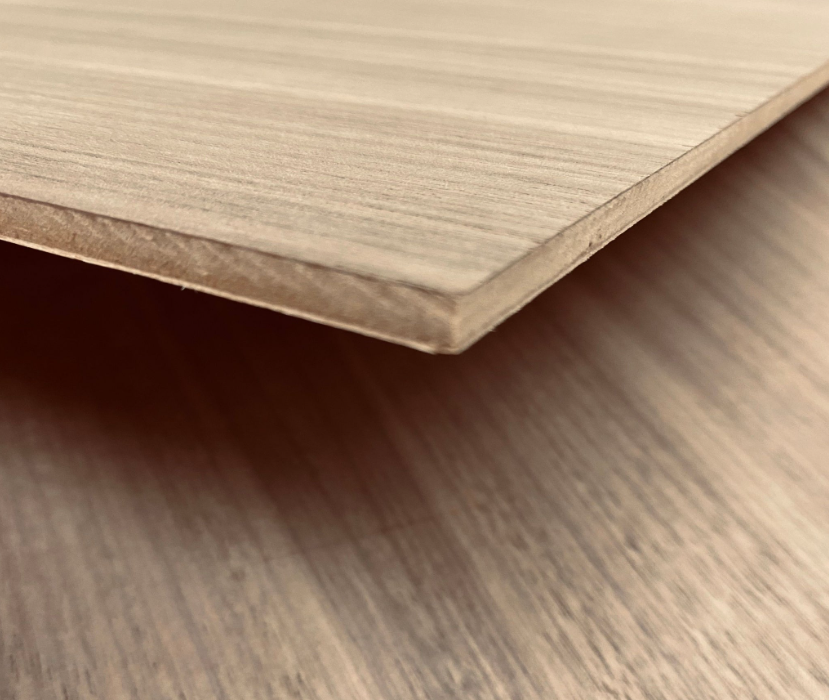
Here’s something most buyers don’t realize: engineered veneer is still real wood.
Not plastic. Not melamine paper. Not a laminate imitation. It starts as actual wood fiber — low-grade logs, fast-growing plantation species, veneer offcuts headed for the scrap pile. That raw material gets rebuilt into something more consistent than nature ever produces on its own.
That rebuilding process is the whole point.
How the Manufacturing Process Works
The steps are clear and follow a set order:
Source low-grade logs or veneer waste — materials that can’t yield full usable natural sheets
Rotary-peel into ~3mm green veneers — raw slices, rough and unfinished
Dye for color control — this is where exotic species get replicated at a fraction of the cost
Dry at ~200°C in industrial veneer dryers
Clip into strands and reorganize — each layer gets realigned to control grain direction
Bond with PF/UF resin (5–10% by weight) and press into solid blocks under heat and pressure
Re-slice blocks into finished veneers at 0.5–1mm thickness — consistent, defect-free, every time
That last step is what separates reconstituted veneer from everything else. You’re not slicing a tree. You’re slicing a precision-engineered block built to hit a specific, repeatable result.
Why This Matters for Bulk Buyers
Natural veneer carries 20–50% batch variability in grain and color. Engineered veneer brings that down to near zero.
The process cuts out knots, cracks, and inconsistencies before a single sheet is made. Ultrasonic grading sorts the material first — low-grade fibers go to core layers, higher-grade material goes to face layers. You end up with 100% defect-free sheets and grain patterns that repeat every time.
For large commercial fit-outs and standardized production runs, that consistency cuts material waste by 30–50%. The market reflects this — engineered veneer is projected to drive 56.1% segment growth between 2030 and 2035. Commercial and office projects are pushing that growth, where matching across panels matters far more than one-of-a-kind character.
So there’s a supply benefit too. Reconstituted veneer runs on plantation species and manufacturing offcuts. That cuts dependency on scarce hardwoods by 50–70%. For high-volume production, it’s one of the strongest cases for a sustainable wood veneer choice.
Appearance Comparison: Natural Grain Character vs Engineered Uniformity
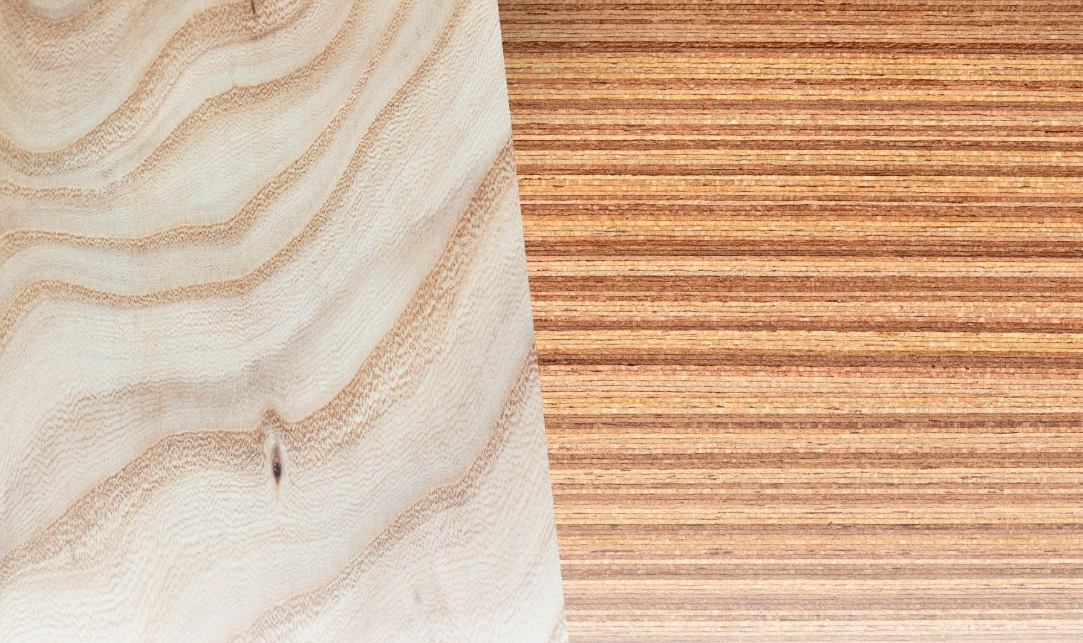
The grain on your panel tells a story. Your project either needs a one-of-a-kind look — or a consistent, repeatable finish across every surface.
Sliced natural veneer is nature’s own work. Walnut carries deep brownish hues with rich contrasts. Oak shows soft, asymmetrical grain lines that shift across each sheet in small, uneven ways. Every batch brings light-dark tone shifts, rotational grain patterns, and natural imperfections. No two sheets look the same. That unpredictability isn’t a defect — for high-end custom furniture, it’s the whole selling point. Distinct identity. Real character. A surface that signals craftsmanship before anyone touches it.
Reconstituted veneer works on a different logic. 90–95% wood fibers — dyed, compressed, and reassembled with precision — produce sheets with 100% consistent tone, grain, and texture, batch after batch. Rare species like teak or zebrawood? You get cross-sheet uniformity that nature can never guarantee.
Here’s where buyers make the critical mistake. They look at both materials one sheet at a time — single sheets, controlled lighting, showroom conditions. That’s not how panels perform in real projects.
Large-area splicing is where natural veneer shows its limits. Grain asymmetry and batch color variation create visual splitting — a broken, patchy look across cabinet door series or wardrobe runs. Engineered veneer removes that problem at the root. You get seamless uniformity at scale, every time.
How to Evaluate Samples Before You Commit
Don’t approve any veneer order based on a single sheet. Use this protocol:
For natural veneer batches:
– Lay 5–10 sheets side-by-side under natural light
– Measure color delta (ΔE >2–5 units signals instability across the batch)
– Check grain alignment at edges — misalignment >1mm creates splicing problems
– Assess whether flaws are spread out or clustered in one area
For engineered veneer:
– Align 3+ sheets and verify grain repeat precision (<0.5mm deviation)
– Test color match at 1 meter distance — visible seams mean inconsistent production
– Compare surface texture against your target species under 5000K lighting
| Property | Natural Veneer | Engineered Veneer |
|---|---|---|
| Sheet Uniformity | Variable per batch | 100% consistent |
| Aesthetic Range | Species-limited; unique character | Broadest range; exact repeatable appearance |
| Best Application | Individuality-driven, one-off pieces | Cabinets, wardrobes, large-area splicing |
Your project demands visual unity across multiple panels? Engineered veneer wins on appearance — not despite being manufactured, but because of it. Your project sells on uniqueness? Natural veneer’s grain character is the feature your clients are paying for.
Durability & Stability: Which Holds Up Better Across Applications?
Here’s what most suppliers won’t tell you: durability and stability are not the same thing. Mixing them up is one of the most expensive mistakes a buyer can make.
Durability is about surface survival. Scratches, stains, fading, daily wear. Stability is about structural integrity. Warping, buckling, dimensional shifts from humidity and temperature swings.
Both matter. But they don’t matter the same way for every application.
Natural Veneer MDF vs Engineered Veneer Comparison
| Factor | Natural Veneer MDF | Engineered Veneer Panels |
|---|---|---|
| Core Structure | MDF core with natural wood veneer surface | Reconstituted veneer sheets bonded with resin and layered structure |
| Dimensional Stability | Good stability in controlled indoor environments | Very high stability due to cross-layer construction |
| Moisture Resistance | Moderate — MDF absorbs ~10% water; requires sealing | Better resistance to humidity fluctuations |
| Surface Durability | Natural wood surface; durable when properly sealed | Highly consistent surface durability |
| Reaction to Temperature / Humidity | Can expand or warp in high-moisture environments | Designed to resist expansion and contraction |
| Grain Appearance | Authentic natural wood grain | Uniform, engineered grain pattern |
| Consistency Between Panels | Natural variation between sheets | Highly consistent color and pattern |
| Best Application Scenarios | Furniture, cabinetry, decorative wall panels | Large commercial interiors, hotel fit-outs, retail environments |
| Risk Factors | Performance drops in humid areas | Less natural grain authenticity |
Natural Veneer MDF: Where It Wins (and Where It Doesn’t)
The MDF core is the real performance driver here. MDF takes in about 10% of its weight in water — solid wood takes in 40%. That’s a big difference. Lower water absorption means far less warping risk in moderate climate conditions.
For interior furniture, cabinetry, and decorative wall panels and wood-based interior materials used in modern flooring and interior finishing systems. in climate-controlled spaces, MDF core veneer board gives you excellent dimensional stability. The veneer surface holds up well against normal wear — as long as it’s sealed and finished correctly.
The weak point? Moisture-heavy environments. Bathrooms, outdoor-adjacent spaces, high-humidity commercial kitchens. Push natural veneer MDF into those conditions without the right treatment, and stability breaks down fast.
Engineered Veneer: Built for Consistency Under Pressure
Reconstituted veneer has a built-in structural edge. The resin-bonded, cross-layered construction fights expansion and contraction better than raw natural sheets. Grain direction is controlled. Internal stress is removed at the manufacturing stage.
For large commercial fit-outs — hotel corridors, office interiors, retail spaces with changing foot traffic — reconstituted veneer panels hold tighter tolerances across temperature and humidity shifts. You get more consistent performance across a wider range of conditions.
The Bottom Line for Buyers
Neither material beats the other across every situation. The application environment decides which failure mode matters most.
Controlled interior spaces where looks are the priority? Natural veneer MDF is a solid, dependable choice. High-traffic, humidity-variable, or large-scale commercial projects? Engineered veneer’s stability edge is clear — and worth the trade-off on natural grain character.
Price Comparison: True Cost Analysis Beyond the Per-Sheet Price
The per-sheet price tells you almost nothing useful.
Buyers who focus on sticker price end up spending more — not less — by the time a project ships. Here’s the real picture.
Natural veneer MDF runs $15–$45 per sheet for premium hardwoods like oak and walnut. Engineered veneer lands at $5–$15 per sheet. On the surface, that’s a 2–3x gap. In reality, the gap is more complex — and depending on your order volume, it could be much wider.
Why Natural Veneer Costs More Before You Buy a Single Sheet
Three cost drivers push natural veneer pricing up before production starts:
Raw material scarcity — rare hardwood logs carry a 40–60% premium baked in at the source
Cutting yield loss — natural logs produce just 30–50% usable veneer; the rest is waste
Manual grading labor — hand-selection and quality screening accounts for 20–30% of total cost
That waste doesn’t disappear. It gets passed to you.
The Number That Counts: Total Cost of Ownership
Run a 1,000-sheet bulk order through the real math:
| Cost Factor | Natural Veneer MDF | Engineered Veneer Panels |
|---|---|---|
| Average Sheet Price | $25 / sheet | $10 / sheet |
| Order Quantity | 1,000 sheets | 1,000 sheets |
| Base Material Cost | $25,000 | $10,000 |
| Production Waste Rate | ~20% | ~7% |
| Waste Cost Impact | $5,000 | $700 |
| Splicing & Handling Labor | $3,000 | $1,000 |
| Total Cost of Ownership (TCO) | $33,000 | $11,700 |
| Cost Difference | colspan=2 → Engineered veneer saves ≈ $21,300 (≈64%) |
That’s a 182% cost gap — on identical sheet counts. Engineered veneer delivers 30–50% better TCO on orders above 500 sheets, every time.
Which Price Point Fits Your Project
Pay the natural veneer premium for:
– Small luxury surfaces under 50 sheets. Visual authenticity drives a measurable 25% resale uplift on high-end retail fixtures
– Clients paying for perceived craftsmanship, not just coverage
Go with engineered veneer for:
– Orders above 200 sheets — you save 40–60% on TCO with zero performance trade-off
– Commercial runs that need consistent output and zero waste variance
The decision isn’t natural vs. engineered. It’s matching your cost structure to your project reality.
When Buyers Choose Natural Veneer vs Engineered Veneer
Material selection breaks down at the project-matching stage — not the specification stage.
You can know grain consistency and Formaldehyde ratings inside out and still pick the wrong product. Here’s the framework that stops that mistake.
Where Natural Veneer MDF Belongs
Three conditions justify the premium: high visibility, small area, serious budget.
Premium custom furniture — luxury desktops and cabinet door displays under 2m² per unit, with budgets above $500/unit. Clients pay for grain character. Give them that.
Boutique hotel accent walls and reception panels — spaces between 5–20m². A 20–30% material cost premium gets you a finish no engineered product can match.
High-end retail fixtures and display props — small-batch runs under 100 units. Visible surfaces carry the brand’s full aesthetic weight here.
Where Engineered Veneer Takes Over
Scale changes the math. Push your project into large areas, uniform finishes, and tight delivery windows — reconstituted veneer becomes the clear rational choice.
Wardrobe and cabinet series above 1,000 units spanning 50–200m² per project
Chain store rollouts across 10+ outlets with sub-8-week delivery requirements
Export furniture components where bulk consistency drives 20–50% cost savings
The Mismatches That Kill Projects
Don’t run natural veneer in high-humidity environments. Bathroom cabinetry above 60% RH carries a 15–25% warping risk. Large splices over 4m² create visible color shifts pushing 10–20 Delta E units.
Don’t run engineered veneer on ultra-luxury projects. Clients paying for uniqueness reject standardized grain at a 30–40% rate. That’s not a preference — it’s a procurement failure.
The three-step match: assess visibility and area first → check humidity and scale risk → confirm the budget supports the grain story your client expects.
Key Decision Criteria: A Practical Buyer’s Checklist
Five dimensions separate a smart veneer purchase from a costly mistake. Score each one before you commit.
| Decision Dimension | Priority (1–10) | What to Measure |
|---|---|---|
| Appearance Priority | 9/10 | Cross-batch color consistency (ΔE <1.0); bookmatching capability for natural veneer |
| Budget Cap | 8/10 | Total cost of ownership — not just per-sheet price |
| Project Scale | 7/10 | Sheet count and total area; >200 sheets shifts the math toward engineered |
| Environmental Compliance | 8/10 | E0/ENF certification documents; FSC or PEFC for natural veneer |
| Delivery Timeline | 9/10 | Tight windows under 8 weeks? Engineered veneer’s standard production cycle handles that better |
Before you place any order, run this checklist:
Demand cross-batch test reports — lab data showing ΔE <1.0 across 3+ sampled batches
Run a small-batch prototype first — 10–20% of your full order volume; target 95% acceptance rate before scaling up
Seal your sample — your supplier must match the approved sample with <1mm edge variance, no exceptions
Verify storage compliance — panels stored at 18–22°C, 45–55% RH; go beyond 10% RH and you face a 25% warp risk
Specify edge banding adhesion — require PUR hot-melt with >2N/mm adhesion; weak banding leads directly to 15–20% delamination failure
This checklist isn’t bureaucracy. It’s the line between a project that ships clean and one that comes back as a warranty claim.
FAQ: What Buyers Ask Most Before Purchasing
Buyers ask the same questions — project after project. Here are the answers that move decisions forward.
Q: Can engineered veneer pass as natural veneer in a finished project?
Up close, a trained eye catches the difference. From normal viewing distance on cabinet doors or wall panels? Most clients can’t tell. The grain character is different — not inferior.
Q: Which veneer substrate option works better for humid environments?
Engineered veneer wins here. Its resin-bonded construction resists moisture-driven expansion better than natural sliced veneer on MDF. The structure stays tight. For bathrooms or high-humidity commercial spaces, that stability gap is real and measurable.
Q: Does reconstituted veneer meet formaldehyde compliance standards? It can — but your supplier needs to document it. Request ENF or E0 certification before you approve any orders. No paperwork, no approval. It’s that simple.
Q: Is MDF core veneer board suitable for heavy-use commercial furniture?
Yes — with the right finish and edge treatment. The MDF core holds its shape well under daily stress. The surface veneer handles normal wear without breaking down. Together, they hold up in demanding environments.
Q: What’s the minimum order where engineered veneer makes financial sense?
Above 200 sheets, the cost advantage becomes clear. You’re looking at 40–60% lower total cost compared to comparable natural veneer panels. Below that threshold, the savings are smaller but still worth reviewing based on your project scope.
Conclusion
Natural veneer MDF or engineered veneer — neither is better overall. The real question is: which one fits your specific project?
Here’s what the data shows:
- Grain authenticity matters? Sliced natural veneer gives you that premium, one-of-a-kind look. No two sheets are the same.
- Need consistency across a large order? Reconstituted veneer wins. It delivers wood grain consistency, production scalability, and cost predictability — all in one material.
Some buyers get this decision wrong. They focus on price alone. They skip the details — finishing complexity, grain matching labor, long-term stability. That’s where costly mistakes happen.
Don’t be that buyer.
Sourcing decorative wood panels for a high-volume project or a detailed interior spec? Your supplier partnership is just as important as the material you pick. The right partner helps you avoid mismatches before they hit the production floor.
Talk to our veneer specialists today. You’ll get a sample pack, a side-by-side technical comparison, and a quote built around your actual project needs — not a generic price list.