
Choosing between click SPC flooring system and glue-down LVT shouldn’t feel like a guessing game — but for many procurement teams, that’s what it becomes when deadlines pile up and supplier catalogs all start to look the same.
These two systems share the same surface. Below that, though, they follow different engineering logic, carry different installation costs, and deliver different long-term results.
Pick the right one, and your floor holds up for a decade without a single complaint. Pick the wrong one, and you’re dealing with edge lifting in a hotel corridor — or hollow spots under a retail checkout counter — just six months after handover.
This guide gives B2B buyers a clear framework to make that call. Whether you’re a contractor, designer, facility manager, or distributor, you’ll find a structured way to match the right system to each project — no spec-sheet guesswork needed.
Six decision areas separate these two systems. Each one ties to real project outcomes — cost overruns, installation timelines, long-term performance complaints, or none of those problems.
This guide covers them in order:
Technical specifications — wear layer thickness (0.3–0.55 mm), commercial-grade SPC rigid core panels, and dimensional stability under heat and rolling loads
Installation conditions — subfloor prep requirements, labor complexity, and downtime exposure
Commercial scenario matching — retail, hospitality, healthcare, office renovation, and high-traffic wet areas
Acoustic and comfort performance — impact noise reduction (ΔLw 18–22 dB for SPC with foam backing), underfoot feel, and bonded vs. floating behavior
Total cost of ownership — material vs. labor trade-offs, adhesive costs, and long-term maintenance demands
B2B selection framework — a structured decision model for procurement teams handling multiple project types at once
Each section is built around the specs and site conditions that cause real failures — not surface-level comparisons. By the end, you’ll know which system fits which project before the first tile gets ordered.
Quick Decision Summary Table:
| Property | Click SPC | Glue-Down LVT |
|---|---|---|
| Core Material | Stone powder + PVC composite | Flexible vinyl |
| Typical Thickness | 4mm–8mm (with underlay) | 2mm–3mm |
| Installation Method | Tongue-and-groove floating | Adhesive-bonded to subfloor |
| Subfloor Prep | Minimal | Extensive — flat, dry, defect-free |
| Dimensional Stability | High — resists temperature/humidity shift | High — adhesive acts as moisture barrier |
| Underfoot Feel | Firm, rigid | Softer, warmer |
| Waterproofing | Waterproof core by design | Moisture-resistant with proper adhesive application |
Click SPC vs Glue-Down LVT: What Sets Click SPC and Glue-Down LVT Apart
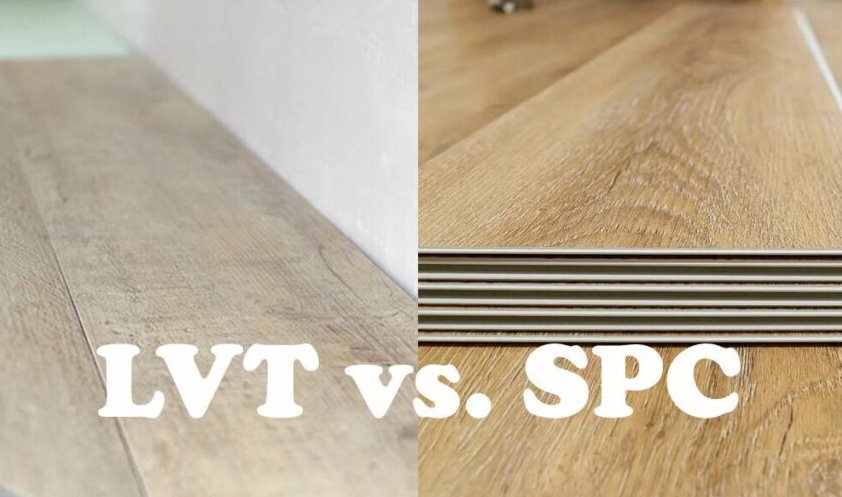
The difference starts in the core — and that’s where most procurement teams stop looking.
Click SPC uses a compressed mix of stone powder and PVC polymer. That rigid core gives it strong dimensional stability across shifting temperatures and humidity. This matters in spaces where HVAC systems run hard or moisture levels change with the seasons.
Glue-Down LVT is 100% flexible vinyl, bonded to the subfloor with adhesive. The profile is thinner — 2mm to 3mm — but once it’s down, it stays put. No floating movement. No micro-shift under rolling loads.
One key point for spec-driven buyers: wear layer thickness is the same across both systems at equivalent grades. The core construction doesn’t affect surface lifespan. That’s set by the wear layer spec alone — 0.3mm for moderate commercial use, or 0.55mm for high-traffic flooring environments.
On cost, glue-down LVT runs $4.20–$4.60 per unit (184×1220mm). Click SPC comes in at around $6.10 per unit (150×1220mm). SPC costs more upfront — but that gap shrinks once you account for subfloor prep and underlayment savings. Glue-down projects carry their own prep costs that don’t disappear.
Both systems do a solid job replicating wood, stone, and tile looks. SPC’s rigid core does produce sharper emboss definition. In hospitality and retail settings, that surface realism can push perceived value higher — so it’s worth factoring into your spec decision.
Click SPC vs Glue-Down LVT: Installation Comparison
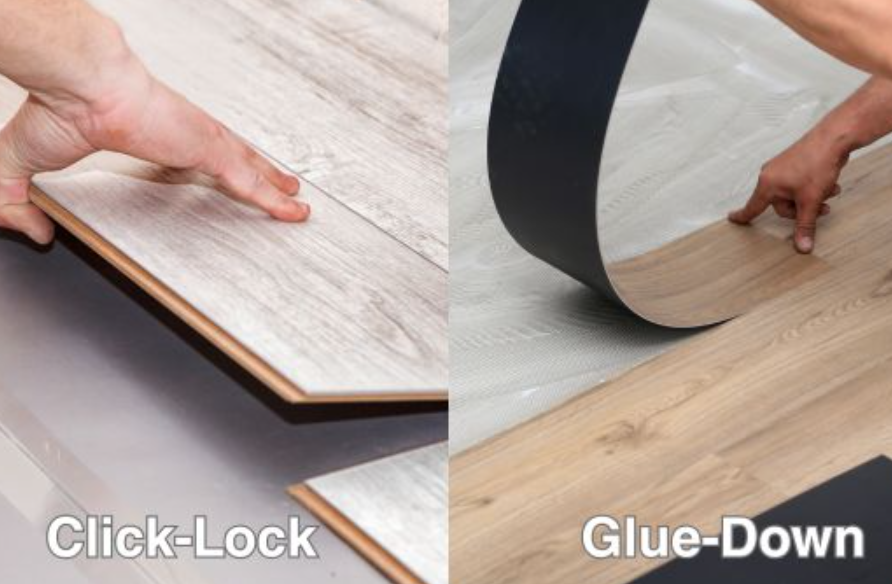
Labor is where the real cost gap opens up — and most buyers don’t see it until the invoice lands.
The material price difference between click SPC and glue-down LVT looks manageable on a spreadsheet. Then installation begins. The two systems pull in opposite directions on your project timeline, crew requirements, and contingency budget.
Click SPC: Speed Is the Product
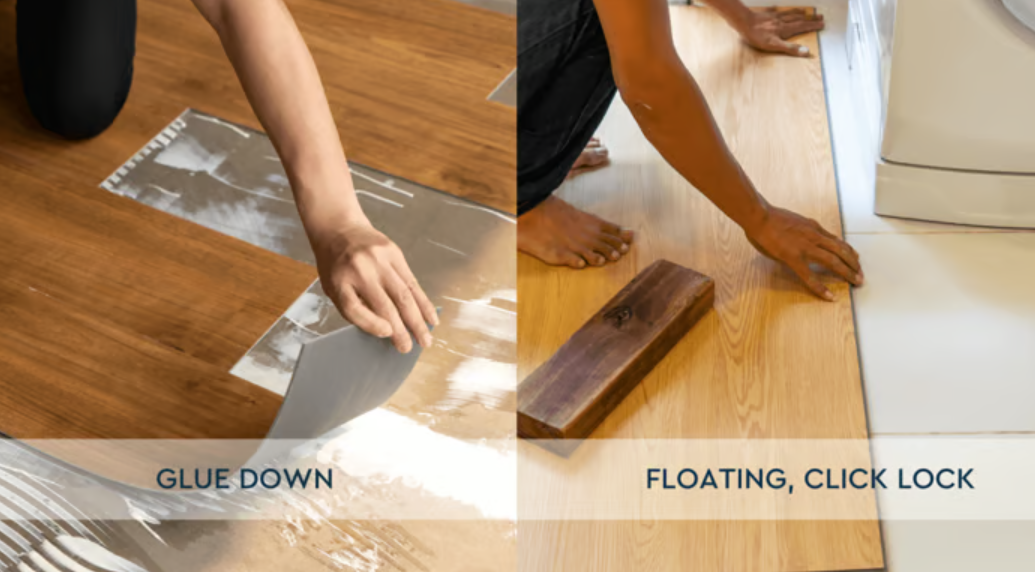
Click SPC installs as a floating rigid core flooring installation. Tongue-and-groove locking. No adhesive, no curing window, no waiting.
A trained two-person crew can cover 400–600 sq ft per day on a clean subfloor. For office renovations on tight tenant schedules, that pace matters. Spaces get handed back faster. Furniture moves back in sooner. The clock stops running on your delay liability.
Subfloor prep is light by comparison. You need minor leveling to stay within the 3mm over 1.8m flatness tolerance most manufacturers specify. That alone cuts a meaningful chunk off pre-installation labor.
There’s also a re-entry advantage. No adhesive means the floor is walkable as soon as installation finishes. For phased commercial fit-outs or occupied healthcare facilities, that’s not a convenience — it’s a scheduling requirement.
Glue-Down LVT: Precision Takes Time
Glue-down installation runs on a different clock.
Before a single tile goes down, the subfloor must be flat, dry, and compatible with the adhesive system. Moisture vapor emissions must test below 5 lbs per 1,000 sq ft per 24 hours in most commercial adhesive specs. Any deviation means grinding, patching, or waiting — none of which are free.
Adhesive open time runs 20–40 minutes depending on product and site conditions. Installers work in controlled sections. Full cure before heavy rolling loads can take 24–72 hours.
That curing window carries a direct cost: extended site occupation, delayed handover, and in high-traffic commercial projects, real revenue impact for the end client.
Where glue-down earns that time back is in long-term stability. Bonded floors don’t shift under pallet jacks, wheeled carts, or heavy foot traffic. For large-format retail floors over 10,000 sq ft, that dimensional lock-in eliminates the edge-lifting callbacks that hit poorly specified floating installations.
The Labor Cost Equation
| Factor | Click SPC | Glue-Down LVT |
|---|---|---|
| Subfloor Prep Time | Low | High |
| Installation Speed | Fast (400–600 sq ft/day) | Moderate |
| Adhesive/Materials Cost | None | $0.80–$1.40/sq ft added |
| Cure/Downtime Required | None | 24–72 hours |
| Rework Risk | Low | Moderate (subfloor sensitivity) |
For B2B buyers across multiple project types, the decision isn’t which system installs faster on paper. It’s which system fits your site conditions, schedule constraints, and the long-term performance contract you’re already committed to.
Click SPC wins on speed and flexibility. Glue-down LVT wins on sites with ideal subfloors where the floor must stay fixed for years under serious commercial load. Know which problem you’re solving before the crew shows up.
Click SPC vs Glue-Down LVT: Subfloor Requirements
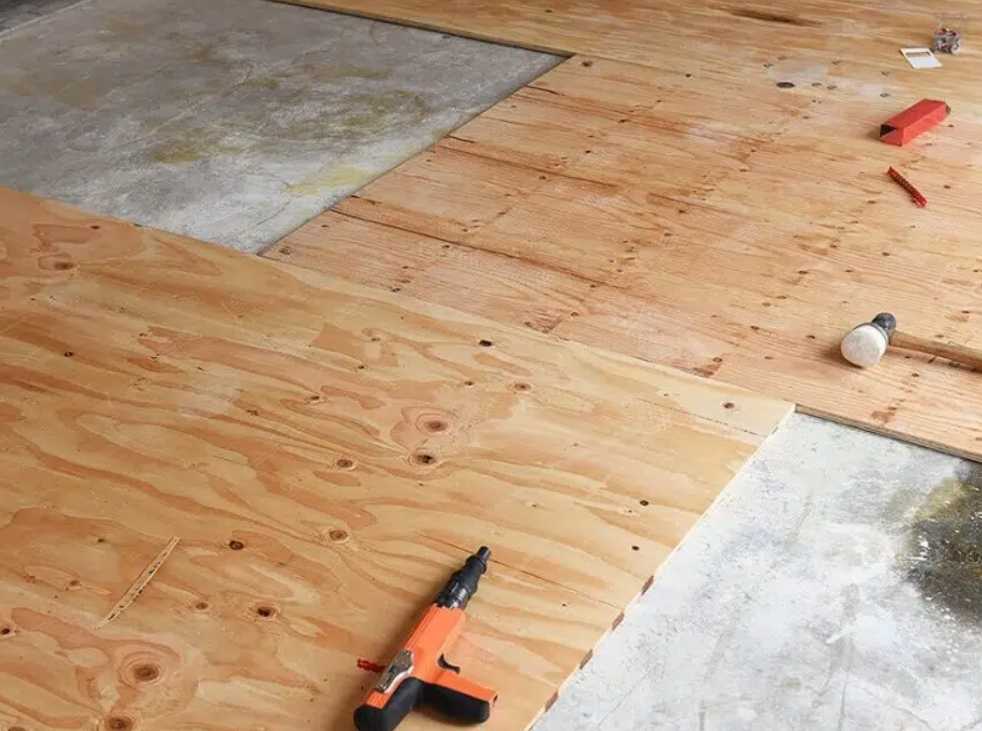
The subfloor doesn’t lie. Every shortcut taken at this stage shows up later — in a bubble, a crack, a tile that rocks when you step on it.
The slab or substrate beneath your feet decides more of the outcome than any product spec sheet. Know what it demands before you commit to either system.
What the Numbers Actually Demand
Glue-down LVT is unforgiving on flatness. The industry standard is clear: no more than 1/8″ variation over 10 feet. That’s not a suggestion. It’s the point where adhesive bonds start failing and tile edges begin to show every low spot in the slab below.
On a rough concrete pour, most commercial projects need a cementitious self-leveling underlayment (SLU) to hit that tolerance. A well-applied SLU reaches compressive strengths above 4,000 psi. It also passes the ASTM C627 Robinson Test at Extra Heavy Duty rating. That means it holds up under the rolling load punishment that retail and healthcare floors take every day.
Moisture is the other hard stop. Substrate moisture must read at or below 5 lbs per 1,000 sq ft per day (ASTM F-1869) or 80% RH (ASTM F-2170) before any SLU or primer goes down. Push past those thresholds and adhesive failure isn’t a risk — it’s a schedule.
Click SPC tolerates more. Its floating installation handles minor subfloor variation better than a bonded system. Flatness still matters — the 3mm over 1.8m tolerance holds — but reaching it almost never requires the full SLU process that glue-down projects need.
The Site Readiness Verdict
| Condition | Click SPC | Glue-Down LVT |
|---|---|---|
| Subfloor Flatness Required | 3mm / 1.8m | 1/8″ / 10 ft |
| Moisture Limit | Moderate tolerance | ≤5 lbs/1,000 sq ft/day |
| SLU Needed | Rarely | In most cases |
| Cure Wait After SLU | — | 12–14 hours (resilient flooring) |
Got aging concrete, uneven moisture readings, or a tight prep window? Click SPC cuts your risk. Glue-down LVT rewards sites that are already close to perfect — and penalizes every one that isn’t.
Which Is Better for Commercial Projects?
The floor doesn’t know what business runs above it. But the business does — and that knowledge should drive every spec decision before a single panel gets ordered.
Venue type changes everything. The same click SPC that works without issue in a corporate office renovation becomes a liability in a supermarket aisle under daily pallet jack traffic. Glue-down LVT that holds strong in a hospital corridor is overkill — and over-budget — in a boutique hotel room with light foot traffic and one refurbishment cycle per decade.
Here’s how each system holds up across the commercial environments where procurement teams most often get the call wrong.
Office & Corporate Fit-Outs
Click SPC is the clear choice here. Renovation timelines are tight. Tenant schedules don’t flex. Subfloor conditions in existing commercial buildings are rarely ideal. Floating installation lets crews move fast. There’s no adhesive curing window eating into handover dates. The rigid core vinyl plank flooring also handles the temperature swings that climate-controlled offices produce between occupied and unoccupied hours.
Retail — Small Format vs. Large Floor Plate
This is where the split matters most.
Small-format retail (under 3,000 sq ft): Click SPC works well. Installation is fast. You can refresh the floor between lease cycles without adhesive removal costs. The emboss definition on quality SPC also reads well under retail lighting.
Large-format retail (10,000 sq ft and above): Glue-down LVT earns its installation cost back. Bonded floors stop the micro-movement that builds up across wide floating installations under constant rolling loads — trolleys, restocking carts, high-traffic checkout zones. Edge lifting and joint separation are the callbacks that damage contractor reputations on big retail projects. Adhesive bonding cuts that risk at the source.
Hospitality — Hotels and Food & Beverage Spaces
Hotels break down by zone.
Guest rooms and corridors: Click SPC. Phased refurbishment is standard in hospitality — floors get replaced wing by wing, floor by floor, while the property stays open. Floating installation makes that work. No adhesive means no cure downtime pulling a revenue-generating room out of rotation.
High-volume F&B spaces and lobbies: Glue-down LVT. These are large, open floor plates with non-stop rolling service traffic. Stability under load matters more than installation speed in these areas. You recover the luxury vinyl tile installation cost through lower long-term maintenance and zero edge-lifting callbacks.
Healthcare
Glue-down LVT dominates. Full stop.
Healthcare floors deal with a mix of demands no floating system handles as well:
- Heavy equipment rolling loads — beds, IV poles, crash carts
- Infection control protocols that require seamless, grout-free surfaces
- Regulatory environments where floor performance gets documented and audited
The waterproof click flooring argument doesn’t hold here. Healthcare buyers don’t prioritize waterproofing. They prioritize dimensional stability and cleanability under industrial disinfectant regimens.
The adhesive bond also cuts out the hollow sound transmission that floating floors produce. That matters in patient rooms and clinical corridors — noise has a direct impact on care outcomes.
Venue-Type Decision Summary
| Venue Type | Recommended System | Primary Reason |
|---|---|---|
| Corporate office renovation | Click SPC | Speed, minimal subfloor prep |
| Small-format retail | Click SPC | Lease-cycle flexibility |
| Large-format retail (10,000+ sq ft) | Glue-down LVT | Stability under rolling loads |
| Hotel guest rooms / corridors | Click SPC | Phased refurbishment capability |
| Hotel lobbies / F&B | Glue-down LVT | Large floor plate stability |
| Healthcare facilities | Glue-down LVT | Load performance, infection control |
Match the system to the real operating conditions of the space — not the material price on the purchase order. That’s where high traffic commercial flooring decisions either protect a project or slowly unravel it.
Commercial Flooring Total Cost Analysis Comparison
The per-square-foot price on a purchase order is the start of the cost conversation — not the end.
Procurement teams that stop at material cost miss the full picture. A floor’s true cost over a 10-year period looks very different from its sticker price. Add installation labor, subfloor preparation, adhesive materials, maintenance cycles, and replacement logistics — and both click SPC and glue-down LVT tell a different story.
Here’s how to break down the real numbers.
The Four Cost Layers That Matter
Layer 1: Material + Installation
Click SPC starts at a higher unit cost — around $6.10 per unit versus $4.20–$4.60 for glue-down LVT. That gap closes fast. Glue-down projects add $0.80–$1.40 per sq ft in adhesive costs alone. On top of that, most commercial slabs need subfloor preparation before bonding can even begin.
Layer 2: Subfloor Preparation
This is where glue-down TCO starts to grow. Self-leveling underlayment, moisture mitigation, and primer all add material costs and crew-hours. On a 10,000 sq ft commercial floor, that prep phase can eat up a large share of the total installed cost. In many cases, it exceeds the adhesive spend on its own.
Layer 3: Downtime and Project Delay
A 24–72 hour adhesive cure window is more than an inconvenience. In occupied retail or hospitality spaces, a delayed handover means lost revenue for your client — plain and simple. Click SPC removes that wait. The floor is walkable the moment the last plank locks in. No cure time. No delays.
Layer 4: Long-Term Maintenance and Replacement
Replacing glue-down LVT is a messy job. Damaged tiles need adhesive removal — a labor-heavy process that disturbs the surrounding area. Click SPC is different. You can swap out one section without touching the rest of the floor. Over a full refurbishment cycle, that flexibility saves real money.
The TCO Verdict
Short-cycle commercial environments — office fit-outs, boutique retail, hotel guest rooms — tend to favor click SPC. Installation is faster, subfloor prep costs less, and replacing damaged sections is straightforward. The total cost adds up lower over time.
High-load, large-footprint spaces — warehouse-adjacent retail, healthcare facilities, hospitality lobbies — are a different case. Glue-down LVT holds up better under heavy traffic. Fewer callbacks and less maintenance over the long run can justify the higher upfront installed cost.
The floor that costs less to buy is not always the floor that costs less to own.
Maintenance, Repair & Replacement Logistics in Active Commercial Spaces
A damaged floor tile in a busy retail corridor isn’t just an aesthetic problem. It’s a liability, a scheduling conflict, and a test of how well you specified the system in the first place.
Each system handles wear, damage, and partial replacement differently. That difference separates a smart spec decision from one you’ll regret mid-lease.
Click SPC: Section Replacement Without Disruption
Floating installation works in your favor. A cracked or gouged SPC plank lifts out without touching the surrounding floor. No adhesive removal. No chemical stripping. A trained installer can swap a damaged section in hours, not days.
In occupied commercial spaces — a hotel wing, a phased office fit-out, a healthcare corridor that can’t close — that speed has real value. Maintenance crews work around the operation. The space stays live.
Glue-Down LVT: Stable, But Costly to Repair
Replacing a bonded tile is a different job. The adhesive that keeps glue-down LVT solid under rolling loads and heavy commercial traffic is the same thing that makes pulling a single tile a labor-heavy task. Surrounding tiles take on risk during extraction. You also need to scrape off adhesive residue before a new tile can bond to the subfloor.
For large, high-traffic floors where replacement is rare and long-term wear layer durability is the priority, that’s an acceptable trade-off. For spaces with frequent partial refurbishment cycles, the repair logistics add up fast.
The Practical Summary
| Factor | Click SPC | Glue-Down LVT |
|---|---|---|
| Partial Repair Ease | High — lift and replace | Low — adhesive removal required |
| Space Disruption | Minimal | Moderate to significant |
| Repair Turnaround | Hours | Days |
| Risk to Adjacent Tiles | None | Moderate |
Specify click SPC where fast maintenance matters — phased environments, shorter lease cycles, spaces that can’t afford downtime. Specify glue-down LVT where the floor needs to hold for a decade without a single panel coming up, and replacement is the exception, not the plan.
The B2B Decision Framework: A Procurement Checklist
Most flooring projects don’t fail because the wrong product was chosen. They fail because the right questions were never asked at the right time.
B2B flooring decisions don’t sit with one person. On commercial projects, procurement teams bring in six or more stakeholders — operations, facilities, finance, and legal all have a say. The CFO signs off in most organizations. Legal can stall or block a purchase outright. That’s how these decisions move in the real world.
Go through this checklist before the vendor conversation starts:
Project Conditions
– What is the subfloor condition — flatness, moisture readings, existing surface?
– What is the installation timeline? Can the space handle any downtime?
– Is this a phased fit-out or a single-stage handover?
Performance Requirements
– What load will the floor face — foot traffic, rolling equipment, or both?
– What is the expected refurbishment cycle — 3 years or 10?
– Do any regulations apply (healthcare, food service) that affect floor specification?
Commercial Considerations
– What is the total installed cost — material, labor, subfloor prep, and downtime combined?
– Who takes accountability if the floor fails within the warranty period?
– Does the vendor provide documented technical support for specification decisions?
Run both systems against this list. The right answer becomes clear before anyone starts debating price.
Conclusion
| Comparison Dimension | Click SPC | Glue-Down LVT | Notes |
|---|---|---|---|
| Core Material | Stone powder + PVC composite | Flexible vinyl | SPC rigid core offers dimensional stability; LVT relies on adhesive bond |
| Typical Thickness | 4–8 mm (with underlay) | 2–3 mm | SPC is thicker, floating installation; LVT thinner, glued |
| Installation Method | Tongue-and-groove floating | Adhesive-bonded | SPC requires no glue; LVT requires adhesive |
| Subfloor Requirements | Minor leveling (3mm/1.8m) | Highly flat & dry (1/8″ over 10ft) | LVT is strict; SPC tolerates minor unevenness |
| Dimensional Stability | High | High (adhesive provides extra lock) | SPC resists temperature/humidity changes; LVT stays fixed |
| Underfoot Feel / Comfort | Firm | Softer, warmer | SPC is rigid; LVT feels cushioned |
| Waterproofing | Core is waterproof | Moisture-resistant with proper adhesive | SPC core waterproof, but subfloor moisture still matters |
| Wear Layer Thickness | 0.3–0.55 mm | 0.3–0.55 mm | Surface durability similar |
| Installation Speed | Fast (400–600 sq ft/day per 2-person crew) | Moderate, adhesive curing 24–72h | SPC quick to install; LVT requires cure time |
| Subfloor Prep Cost | Low | High (SLU, self-leveling, moisture mitigation) | LVT prep adds significant labor/material cost |
| Partial Repair Difficulty | Easy, single plank replacement | Hard, adhesive removal needed | SPC allows quick localized repair |
| Disruption to Space | Minimal | Moderate to significant | SPC ready to walk on immediately; LVT requires cure |
| Total Cost of Ownership (TCO) | Lower (short-cycle projects) | Can be lower (high-load, large-area projects) | Depends on site conditions, load, maintenance |
| Commercial Application | Office renovations, small retail, hotel guest rooms | Large retail, hotel lobbies/F&B, high-load healthcare | Match system to operational reality, not purchase price |
| Material Price (per unit) | $6.10 (150×1220mm) | $4.20–$4.60 (184×1220mm) | SPC higher unit cost, but installation cost savings offset |
| Adhesive / Additional Material Cost | None | $0.80–$1.40/sq ft | LVT requires adhesive |
| Re-Entry / Walkable Time | Immediate | 24–72 hours | SPC can be used immediately after installation |
| Load Performance | Moderate commercial loads | Heavy commercial traffic | LVT suited for rolling loads and continuous traffic |
| Maintenance / Replacement Cycle | Flexible for short-cycle refurbishment | Long-cycle durability | SPC easy for phased replacement; LVT more durable but repair intensive |
| Acoustic Performance | ΔLw 18–22 dB (with foam underlay) | Fixed | LVT bonded reduces hollow sound; SPC floating has slight echo |
| Healthcare / Medical | Non-critical areas only | Preferred | LVT meets heavy equipment, disinfectant, and regulatory needs |
The choice between click SPC and glue-down LVT isn’t about which one is better. It’s about which one fits your project, your subfloor, and your five-year maintenance reality.
Speed, flexibility, and fast retrofit work? Rigid core vinyl plank in a floating format is the right call. Running a high-traffic commercial space where dimensional stability and long-term bond strength are must-haves? Glue-down is built for that.
Procurement teams that get this right don’t guess. They work from a clear framework — grounded in actual site conditions, verified total cost of ownership data, and supplier accountability.
A per-square-foot price tag should not drive a six-figure flooring decision.
Talk to a commercial flooring specialist. Request commercial SPC or LVT samples with full technical spec sheets. Then pressure-test your shortlist against the specific demands of your venue — before the subfloor is set and the timeline is locked.
The right floor doesn’t just perform. It disappears — and lets your space do the talking.
Frequently Asked Questions: Click SPC vs Glue-Down LVT
1. Is click SPC better than glue-down LVT for commercial projects?
It depends on the project conditions.
Click SPC performs better in renovation environments where installation speed, minimal subfloor preparation, and quick occupancy are priorities. It is often preferred in office fit-outs, hotel guest rooms, and small-format retail.
Glue-down LVT is typically stronger in large, high-traffic commercial spaces where long-term dimensional stability under rolling loads is critical — such as healthcare facilities, supermarkets, and hospitality lobbies.
The “better” option is the one that matches your site conditions and operational demands.
2. Does glue-down LVT last longer than click SPC?
Not necessarily.
Surface lifespan is determined primarily by the wear layer thickness (0.3 mm, 0.5 mm, or 0.55 mm), not by the installation method.
However, glue-down LVT may maintain joint stability better in very large open areas under constant rolling loads. Click SPC offers comparable durability when installed on a properly prepared subfloor and used within recommended load limits.
3. Which system is more cost-effective in the long term?
Click SPC often has lower total cost of ownership in short-cycle commercial environments because:
-
Installation is faster
-
Subfloor preparation requirements are lighter
-
There is no adhesive cost
-
Partial replacement is easier
Glue-down LVT may become more cost-effective in heavy-load commercial settings where long-term bonded stability reduces the risk of edge lifting or movement-related repairs.
Total cost should always include installation labor, downtime exposure, and future replacement logistics — not just material price.
4. Is click SPC suitable for healthcare or hospital flooring?
Glue-down LVT is generally preferred in healthcare facilities.
Healthcare environments require high dimensional stability, seamless performance under heavy equipment loads, and strong bonding to reduce movement and sound transmission. Adhesive-bonded commercial vinyl installation typically meet these operational requirements more consistently.
Click SPC can be used in certain non-critical healthcare areas, but specification should be reviewed against regulatory and facility standards.
5. Which system handles subfloor imperfections better?
Click SPC is more forgiving.
Because it floats over the substrate, it can tolerate minor variations within manufacturer flatness tolerances (typically 3 mm over 1.8 meters).
Glue-down LVT requires a very flat and dry subfloor. Most commercial projects require self-leveling underlayment before adhesive installation to meet the 1/8 inch over 10 feet standard.
6. Is click SPC truly waterproof?
The rigid core of click SPC is waterproof by design. However, waterproof does not mean moisture-proof at the subfloor level.
Excessive moisture vapor emission from concrete slabs can still cause issues in floating installations if not addressed properly.
Glue-down LVT relies on adhesive systems that often include moisture-resistant properties, but subfloor moisture testing is required in both systems before installation.
7. Can damaged sections be replaced easily?
Click SPC allows easier partial replacement because planks can be unlocked and swapped without removing adhesive.
Glue-down LVT replacement requires scraping off adhesive residue and may affect adjacent tiles, increasing labor time and disruption in active commercial environments.
8. Which option is better for large retail floors?
For large-format retail spaces (10,000+ sq ft), glue-down LVT is often recommended due to its bonded stability under heavy rolling loads and constant foot traffic.
For smaller retail spaces or short lease cycles, click SPC may offer better installation flexibility and lower renovation downtime.